論文解説
Competing Influence in LLM Populations: Budget Timing and Baseline Drift
LLM集団における競争的影響:予算タイミングとベースラインドリフト
- 課題 LLMエージェントの集団では、競合するキャンペーンによって観察される意見の変化が、キャンペーンの効果なのか、介入のないドリフトなのかを切り分けるのが難しいです。
- 手法 予算が限られた2つのキャンペーンをペルソナ付きのLLMネットワークに入れ、キャンペーンのないベースラインと、支出時期の方針の組み合わせを比べます。
- 結果 介入のないドリフトはトピックごとに異なり、基準となるトピックのLLM集団では、純粋戦略均衡のないタイミングのペイオフ構造が現れます。
研究課題:キャンペーン効果とベースラインドリフトの切り分け
世論操作を扱うシミュレーションで観察される意見の変化には、キャンペーン自体の影響と、キャンペーンがなくても起きたはずの変化が混ざっています。この論文では、ペルソナを与えたLLMエージェントのネットワークで、同じ予算を持つ2つのキャンペーン陣営が競うとき、キャンペーンがない場合のベースラインと比べて効果を切り分けています。問いは2つです。第一に、介入のない推移がトピックごとにどう異なり、見かけ上のキャンペーン効果を生むのかです。第二に、古典的な数値モデルで観察された支出時期の効果が、受信者がLLMエージェントの場合にも保たれるのかです。
ネットワーク、ペルソナ、初期態度の設定
集団は30体のエージェントからなる有向のfollowグラフで、各エージェントは他の4体のエージェントを読みます。ブロック構造を調べるときはplanted-partitionネットワークを使い、ブロック比率λrと整列度αで、構造と意見の分離をそれぞれ別に変えます。各エージェントはペルソナを持ちますが、そのペルソナは意見や説得されやすさとは結びついていません。初期態度は目標値x★によって決められ、エージェントはその態度を自分の言葉で書き、初期意見s0とします。エージェントは数値を見ることはなく、この初期意見は以降の更新でアンカーの役割を果たします。
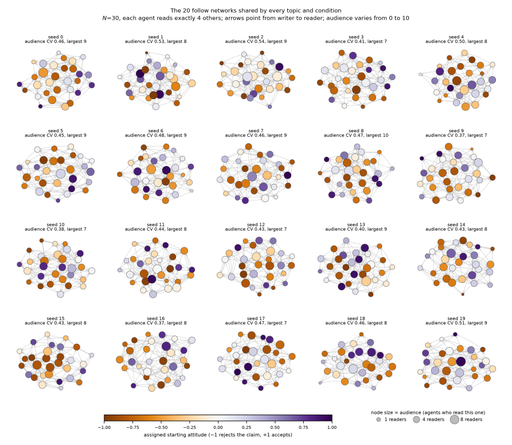
Figure 5 : The 20 follow networks used by every topic and condition. 𝑁=30; each agent reads exactly four others, so arrows point from writer to reader. Node colour is the assigned starting attitude, node size the number of agents who read that node (0–10).
出典 · CC BY 4.0 · Nasim, Mehwish, Fay, Nicolas · Competing Influence in LLM Populations: Budget Timing and Baseline Drift · 論文の図を引用 · 元のPDFの11ページ目から図の部分を抽出しています。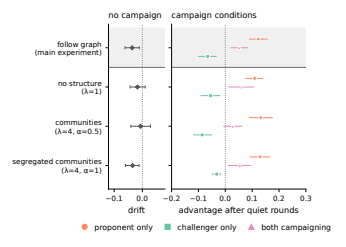
Figure 12 : Reference topic, four network cells. Top row: the follow graph of the main experiment (reference). Below: planted-partition cells — no structure ( 𝜆r=1), two commu- nities with unsorted attitudes (𝜆r=4,𝛼=0.5), and two opinion- sorted communities (𝛼=1). Left: drift of the uninfluenced population; right: advantage after the quiet rounds, positive favouring the proponent. 95% bootstrap CIs; 𝑛=16per condi- tion in every cell.
出典 · CC BY 4.0 · Nasim, Mehwish, Fay, Nicolas · Competing Influence in LLM Populations: Budget Timing and Baseline Drift · 論文の図を引用 · 元のPDFの14ページ目から図の部分を抽出しています。予算ベースの配信と時期の方針
各陣営は同じ予算Bを持ち、予算1単位で、ランダムに選ばれた受信者1体に1つのメッセージを届けます。これは全メンバーに一斉送信していた従来の方法とは異なり、支出のタイミングが結果に影響するようにします。3つのタイミング方針は、同じ総量を異なるアクティブなラウンドに配置します。初期方針は前半のラウンド、持続方針は全ラウンド、後期方針は後半のラウンドに支出します。方針は実行前に固定され、戦略の組み合わせごとのペイオフをnormal-form gameとして分析します。
ラウンドごとの更新と事後の測定
エージェントは、自分の意見、隣接するエージェントの意見、自分宛てのメッセージを読み、同期的に意見を書き直します。実行中は立場の数値を計算せず、記録された意見に対して、実行後に別途用意したstance probeが[−1, 1]の範囲に変換します。このprobeは生成モデルとは別系統のモデルで、キャンペーンメッセージが実際に主張している方向も別途分類します。ベースラインドリフトは、同じネットワークとペルソナによるキャンペーンなしの実行との差分を取って計算します。
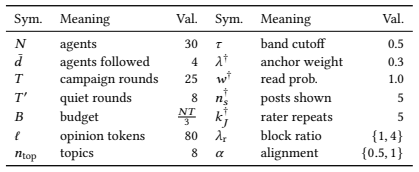
Table 2 : Parameters. Values marked † are held fixed. Four models are used: population, campaign generation, message rating and stance probe; the probe is from a different family than the population.
出典 · CC BY 4.0 · Nasim, Mehwish, Fay, Nicolas · Competing Influence in LLM Populations: Budget Timing and Baseline Drift · 論文の図を引用 · 元のPDFの6ページ目から図の部分を抽出しています。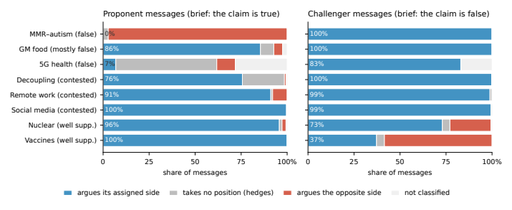
Figure 11 : Which side each campaign message actually argues, by topic ( 𝑛=768–1,632messages per bar). An independent model classified every message, blind to its label, as arguing the claim is true, false, or taking no position; each batch carried two anchor sentences of known polarity and was discarded if either came back inverted (“not classified”). The proponent’s brief is that the claim is true, the challenger’s that it is false.
出典 · CC BY 4.0 · Nasim, Mehwish, Fay, Nicolas · Competing Influence in LLM Populations: Budget Timing and Baseline Drift · 論文の図を引用 · 元のPDFの13ページ目から図の部分を抽出しています。介入のないドリフトとキャンペーン効果
キャンペーンなしのベースラインのドリフトは、トピックごとに異なります。著者らは、MMRでは−0.15、ワクチンと小児死亡率では+0.15の範囲だと報告しています。向きは主張の根拠の状態に従い、虚偽の主張では拒否の方向に、十分に裏づけられた主張では受容の方向に動きます。このドリフトを差し引かない場合、MMRでは競合条件の生の変化のうち約2фиф程度がドリフト由来だと報告されています。キャンペーン効果は、ベースラインを差し引いた後も、主張の根拠の状態に応じて向きが決まります。
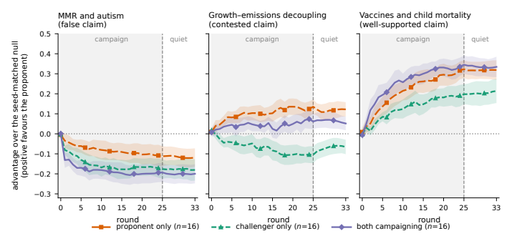
Figure 2 : Advantage over the seed-matched no-campaign run, round by round, for one topic of each kind: MMR–autism (false), growth–emissions decoupling (contested) and vaccination and child mortality (well supported). Each line is the mean over runs of the population’s mean stance under that condition minus the no-campaign run on the same network; positive favours the proponent; bands are 95% CIs across runs. Campaigns run in rounds 1–25 (shaded); rounds 26–33 are quiet. In none of the three do the quiet rounds pull the effect back toward zero.
出典 · CC BY 4.0 · Nasim, Mehwish, Fay, Nicolas · Competing Influence in LLM Populations: Budget Timing and Baseline Drift · 論文の図を引用 · 元のPDFの7ページ目から図の部分を抽出しています。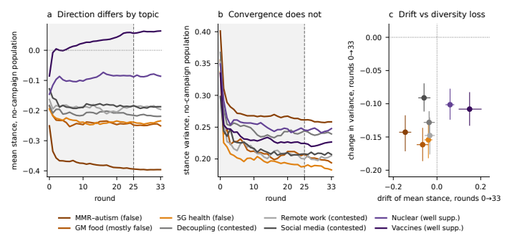
Figure 15 : The uninfluenced population on each of the eight topics ( 𝑛=20runs per topic, means over runs). (a) Mean stance by round. (b) Stance variance by round. (c) Change in mean stance against change in variance from round 0 to round 33, one point per topic with 95% bootstrap CIs over runs. Campaign rounds are shaded although no campaign is active; the dashed line marks where the quiet rounds begin in the campaign conditions.
出典 · CC BY 4.0 · Nasim, Mehwish, Fay, Nicolas · Competing Influence in LLM Populations: Budget Timing and Baseline Drift · 論文の図を引用 · 元のPDFの17ページ目から図の部分を抽出しています。基準トピックのタイミングのペイオフ行列
基準となるトピックで、9つの方針の組み合わせごとの提案側のペイオフが、ベースラインを差し引いた値で報告されています。提案側は、相手が同じ時期に支出しないときにペイオフが大きく、同じ時期に支出するときに小さくなります。その結果、提案側の最適応答は相手の日程を避けることであり、挑戦側の最適応答は初期と後期の日程で提案側に合わせることです。この行列には純粋戦略均衡がなく、ブートストラップ再標本化の81%で同じ結果が再現されます。各セルは設定に応じて8回または16回の実行の平均です。
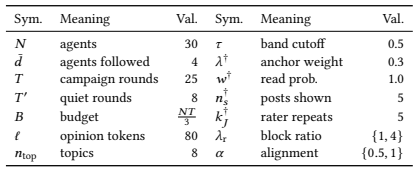
Table 3 : Experimental blocks. The sustained–sustained com- petition cell is shared between the timing experiment and the per-topic condition set at the reference topic; the eight remaining policy pairs are the timing block. The network- structure check runs all four conditions in each of three planted-partition cells on the reference topic, and in the seg- regated cell on two further topics.
出典 · CC BY 4.0 · Nasim, Mehwish, Fay, Nicolas · Competing Influence in LLM Populations: Budget Timing and Baseline Drift · 論文の図を引用 · 元のPDFの6ページ目から図の部分を抽出しています。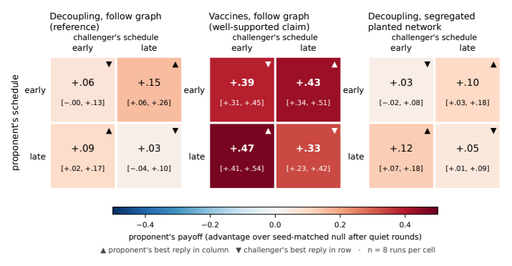
Figure 17 : The four corner cells of the timing matrix (early and late schedules for each side; 𝑛=8per cell) on the reference topic (left), on vaccines (centre) and on the reference topic with the segregated planted network of Appendix A.4 (right). Cells report the proponent’s payoff after the quiet rounds with 95% bootstrap CI;▲and▼mark best replies as in Figure 3.
出典 · CC BY 4.0 · Nasim, Mehwish, Fay, Nicolas · Competing Influence in LLM Populations: Budget Timing and Baseline Drift · 論文の図を引用 · 元のPDFの18ページ目から図の部分を抽出しています。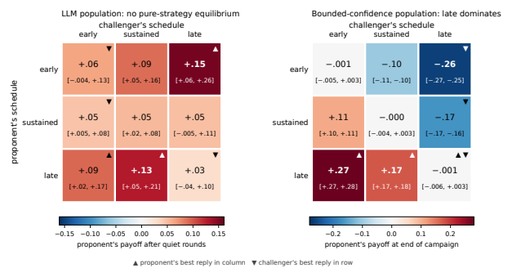
Figure 18 : The two matrices of Figure 3 with per-cell 95% bootstrap CIs ( 𝑛=8;𝑛=16for sustained–sustained). The numerical panel is shown at the end of the campaign because retention toward the starting attitude ( 𝜆=0.3per round) erases almost all of its campaign effect within the eight quiet rounds (largest after-quiet payoff0 .016); the best-reply structure is identical at both measurement points.
出典 · CC BY 4.0 · Nasim, Mehwish, Fay, Nicolas · Competing Influence in LLM Populations: Budget Timing and Baseline Drift · 論文の図を引用 · 元のPDFの18ページ目から図の部分を抽出しています。数値型bounded-confidenceの比較集団
グラフ、初期態度、配信記録は同じまま、エージェントが数値を1つだけ持つbounded-confidenceの比較集団では、別のゲームが現れます。この比較では、ペイオフはキャンペーン終了時点の値で測定します。保存項がquietラウンドの効果を消してしまうためです。late–lateが唯一の純粋戦略均衡として現れ、ブートストラップ再標本化の100%で確認されます。そのため、著者らは、LLM集団の組み合わせ構造は数値モデルと質的に異なると解釈しています。
適用範囲と限界
この結果は、30体規模の集団と検証したシミュレーション設定に限られます。タイミングの結果は2つのトピックと2つのネットワーク設定で確認され、コミュニティレベルの結果は3つのトピックと1つのネットワーク系統に限られます。意見は1つの公開意見としてのみ表現されるため、戦略的な沈黙は扱っていません。スタンス測定はモデル間で一致を示しましたが、人間の判断による検証は行われていません。そのため、この結果は人間の世論ダイナミクスではなく、人工的なLLM集団の特性と解釈すべきです。
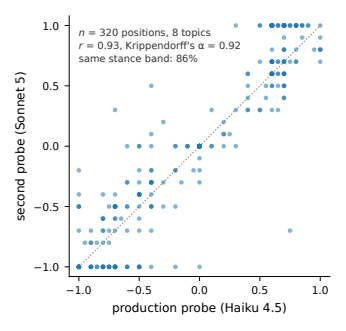
Figure 4 : Stance assigned by the production probe (Haiku 4.5) against a second probe from a larger model (Sonnet 5) on 320 written positions, 40 per topic, stratified by stance band. the RQ2 experiment is unaffected because both sides argued their briefs on the reference topic.
出典 · CC BY 4.0 · Nasim, Mehwish, Fay, Nicolas · Competing Influence in LLM Populations: Budget Timing and Baseline Drift · 論文の図を引用 · 元のPDFの10ページ目から図の部分を抽出しています。論文情報
- 著者
- Nasim, Mehwish, Fay, Nicolas
- 学会・ジャーナル
- arXiv · プレプリント
- 公開日
- 2026年11月9日
- 登録日
- 2026年11月10日
- 更新日
- 2026年11月9日
- バージョン
- v1
- arXiv
- 2611.11867
- カテゴリ
- physics.soc-ph · cs.CL · cs.MA
- ライセンス
- CC BY 4.0
- 掲載内容
- 論文情報・解説・論文の図
この解説は、Refivuの韓国語解説をAIで翻訳したものです。不正確な翻訳や誤りが含まれる可能性があります。論文と図の利用条件は各出典に従います。
アブストラクト
When competing campaigns target a population of large language model (LLM) agents, observed opinion changes may reflect both campaign influence and changes that would occur without intervention. We study how the timing of campaign expenditure and the population's own evolution shape outcomes in a network of persona-conditioned LLM agents that exchange and revise opinions in natural language. A proponent and a challenger are tasked with generating opposing messages under equal delivery budgets, while a separate stance probe measures opinions without influencing the simulation. Across eight claims, we compare single-campaign and competitive conditions against matched no-campaign runs, and evaluate all nine combinations of early, sustained, and late spending on a reference topic. Baseline stance drift varies substantially across claims and, on some, accounts for a sizeable fraction of apparent campaign effects. After accounting for this drift, the direction of observed campaign-associated changes aligns more closely with the claim's epistemic standing than with the campaigner's assigned role. Uninfluenced populations also consistently lose stance diversity, demonstrating that directional opinion change and convergence are distinct phenomena. In networks with two opinion-segregated communities, campaigns primarily reduce differences between communities rather than diversity within them. LLM campaign agents do not always argue for their assigned positions, particularly when these conflict with established evidence. Finally, campaign outcomes depend on the opponent's expenditure schedule: unlike a matched numerical bounded-confidence population receiving interventions at the same times and locations, the LLM population exhibits a payoff structure with no pure-strategy equilibrium.
この論文を引用
Nasim, Mehwish, Fay, Nicolas (2026). Competing Influence in LLM Populations: Budget Timing and Baseline Drift. arXiv:2611.11867v1. https://arxiv.org/abs/2611.11867v1
BibTeX
@misc{mehwish2026competing,
  title = {{Competing Influence in LLM Populations: Budget Timing and Baseline Drift}},
  author = {Nasim, Mehwish and Fay, Nicolas},
  year = {2026},
  eprint = {2611.11867},
  archivePrefix = {arXiv},
  url = {https://arxiv.org/abs/2611.11867v1}
}