論文解説
ScreenProof: Where Is This Screen Wrong? Finding UI Faults Without a Reference
ScreenProof:参照なしのUI欠陥検出
- 課題 目標の設計や参照画像なしに、スマートフォンのスクリーンショットだけからUI欠陥をバウンディングボックスで見つけ、きれいなページでの誤検出を抑える批評器を作れるかが問題です。
- 手法 データエンジンは、HTMLページのコードに欠陥を1つ注入して正確なラベルを作り、Qwen3.5-9BにLoRAを適用したProofJudgeをSFTで学習させます。閾値によって、確信度の低いバウンディングボックスを取り除きます。
- 結果 ただし、局所スタイルとテキストレイアウトの欠陥では、API判定器より少なく検出しました。
目標なしのUI欠陥検出の難しさ
スマートフォンの画面は、参照画像や仕様がなくても誤りが生じることがあります。テキストが画面外にあふれる、文字同士が触れ合う、周囲と異なる角丸や質感を持つ要素が1つだけある、といった場合がこれに当たります。生成されたページをデザイナーが確認する前にふるい分けるには、欠陥のないページでは沈黙し、欠陥のある要素だけをバウンディングボックスで示す批評器が必要です。論文では、この目標設計を必要としない一貫性ベースの判定を、ScreenProofベンチマークとして定義しています。入力はスクリーンショット1枚のみで、出力はcleanまたはfaultyの判定、欠陥のバウンディングボックス、要素の種類、欠陥の系列、理由です。
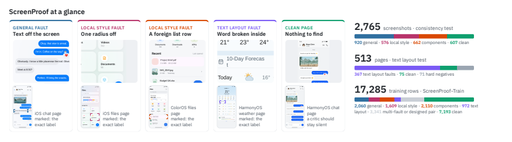
Figure 2 . ScreenProof at a glance. Left: one test example per fault family, each from another page: the faulty area enlarged on top, and the whole screen below with the data engine’s exact label as corner marks; a clean page has nothing to find, and a critic should stay silent on it. Right: the two test sets and the released training set, split by fault family in the same colours (Secs. 3 and 4). Every fault is made in page code, so its box is exact.
出典 · CC BY 4.0 · Huiming Sun, Yue Li, Kangning Yang, Ruineng Li, Jie Cai, Lan Fu, Yunwan Fu, Jinlong Li, Jinglin Shen · ScreenProof: Where Is This Screen Wrong? Finding UI Faults Without a Reference · 論文の図を引用 · 元のPDFの3ページ目から図の部分を抽出しています。論文は欠陥を3つの系列に分けています。一般欠陥は、どのデザインでも誤りになるものです。局所スタイルの欠陥は、ある要素が同じページの同種の要素と異なる場合です。テキストレイアウトの欠陥は、字間、行の高さ、改行といった組版のルールを崩したものです。フロンティア判定器は、きれいな実際のスクリーンショットの18–62%、生成されたきれいなページの18–82%を欠陥として表示したと報告されています。
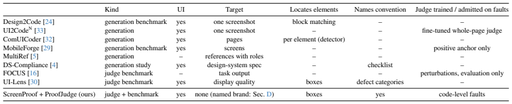
Table 2 . Fault taxonomy. The main task gives no target; a finding is general, local style or text layout (brand faults, which need a named target: Sec. D).Engine fault: how the data engine makes it (Sec. 4).
出典 · CC BY 4.0 · Huiming Sun, Yue Li, Kangning Yang, Ruineng Li, Jie Cai, Lan Fu, Yunwan Fu, Jinlong Li, Jinglin Shen · ScreenProof: Where Is This Screen Wrong? Finding UI Faults Without a Reference · 論文の図を引用 · 元のPDFの4ページ目から図の部分を抽出しています。データエンジンと欠陥の注入
データエンジンは、HTMLページに対して変更を1つだけ加え、DOMから変更された要素のレンダリング後のバウンディングボックスを読み取って、正確なラベルを作ります。判定器はスクリーンショットしか見ませんが、学習ラベルはコードレベルの変更から得られるため、バウンディングボックスは正確です。ベースとなるページは8つのスマートフォンデザイン言語から生成され、クリーンなページは2人の審査者が仕様に合っていると確認したものだけを使います。
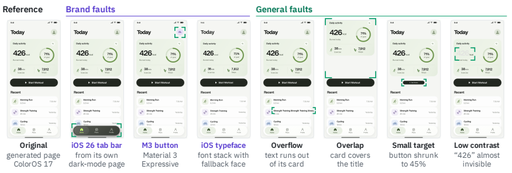
Figure 4 . Faults made by the data engine on one base page (a generated ColorOS 17 page); each copy changes one thing in the page code and carries an exact label (amber corner marks). A component can be transplanted, with all its styles, from a page of another design system (the iOS 26 tab bar keeps the dark glass of its own dark-mode page); general faults are wrong in any design.
出典 · CC BY 4.0 · Huiming Sun, Yue Li, Kangning Yang, Ruineng Li, Jie Cai, Lan Fu, Yunwan Fu, Jinlong Li, Jinglin Shen · ScreenProof: Where Is This Screen Wrong? Finding UI Faults Without a Reference · 論文の図を引用 · 元のPDFの6ページ目から図の部分を抽出しています。局所スタイルの欠陥では、同じ種類の要素がページに2つ以上あるとき、1つの角丸、質感、強調色、またはアイコンを変更します。たとえば、あるボタンの角丸を28ピクセルから9ピクセルに変え、残りのカードは28ピクセルのままにします。この場合はページ自体が基準になるため、ブランドの知識がなくても判定できます。隣接する要素がすべて同様に変わる場合はハードネガティブとして残し、ページ内の差だけを欠陥とみなすようにします。テキストレイアウトの欠陥では、1つのテキスト要素のCSSを変更し、レイアウト後のテキストボックスをラベルとして使います。
ProofJudgeの学習と信頼度閾値
ProofJudgeはQwen3.5-9Bを基盤としており、視覚エンコーダと基本の重みは固定したまま、言語モデルのすべての線形層にLoRAを適用して学習します。学習はScreenProof-TrainのラベルJSONを用いた教師ありファインチューニング(SFT)で行い、1ページあたり1つから4つまでの欠陥を含めます。プロンプトには目標ブランドはなく、ページ自体のスタイルを崩している要素が何かを尋ねます。
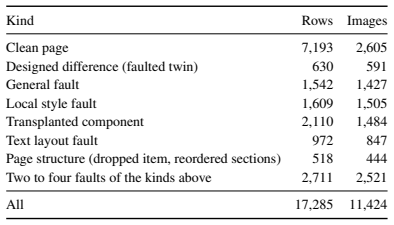
Table 3 . ScreenProof-Train: training rows and images by kind. A row is an image with its labels; an image can appear in several rows.
出典 · CC BY 4.0 · Huiming Sun, Yue Li, Kangning Yang, Ruineng Li, Jie Cai, Lan Fu, Yunwan Fu, Jinlong Li, Jinglin Shen · ScreenProof: Where Is This Screen Wrong? Finding UI Faults Without a Reference · 論文の図を引用 · 元のPDFの4ページ目から図の部分を抽出しています。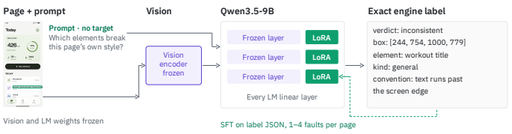
Figure 3 . Overview of ProofJudge. A data-engine page and prompt pass through Qwen3.5-9B with its vision encoder and weights frozen; one LoRA on every linear layer of the language model is trained by SFT on the label JSON across pages with one to four faults each. The prompt gives no target and asks which elements break the page’s own style. The label is exact: the engine made the title overflow, a general fault under any design.
出典 · CC BY 4.0 · Huiming Sun, Yue Li, Kangning Yang, Ruineng Li, Jie Cai, Lan Fu, Yunwan Fu, Jinlong Li, Jinglin Shen · ScreenProof: Where Is This Screen Wrong? Finding UI Faults Without a Reference · 論文の図を引用 · 元のPDFの5ページ目から図の部分を抽出しています。推論時には、判定器がcleanである確率も合わせて出力します。この確率が閾値より低い結果だけを欠陥として残し、閾値は検証セットで決め、テストでは固定します。論文では、同じデータでシードだけを変えた2つの実行で、検証F1に最大0.04の差が出ることがあるため、2つのシードのアダプタを平均する方法も使ったと報告しています。この閾値により、モデルは確信度の低いバウンディングボックスを捨てて誤検出を減らします。
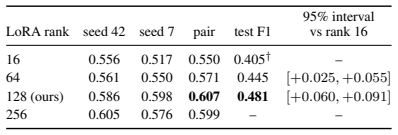
Table 6 . Capacity and seeds (v7f data, two epochs, each run at its final step 2,570; LoRA α = 2 × rank). Validation: F1 with each model’s own cut on the validation split. Pair: the average of the two seeds’ adapters. Test: the 2,765-page consistency test with the validation cut. Rank 64 was tested and rank 256 validated once on the training machine; their raw answers are not released. †The rank-16 model tested is one run, step 2,500, checkpoint and cut chosen on validation (the paper’s model before this one).
出典 · CC BY 4.0 · Huiming Sun, Yue Li, Kangning Yang, Ruineng Li, Jie Cai, Lan Fu, Yunwan Fu, Jinlong Li, Jinglin Shen · ScreenProof: Where Is This Screen Wrong? Finding UI Faults Without a Reference · 論文の図を引用 · 元のPDFの8ページ目から図の部分を抽出しています。一貫性テストの結果と解釈
一貫性テストでは2,765枚のスクリーンショットを使い、そのうち607枚がきれいなページです。同じ実験で、ProofJudgeはきれいな実際のスクリーンショットの2%と、生成されたきれいなページの9%しか欠陥として表示しませんでした。この2つの値は、Argonの18%と18%それぞれより低く、15%のゲートを通過する唯一の欠陥検出判定器です。
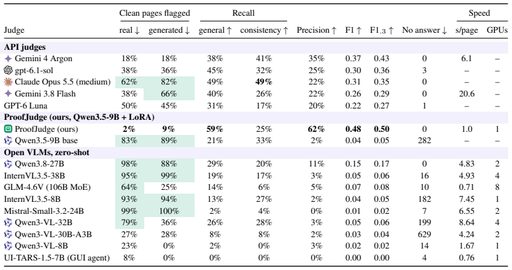
Table 4 . Consistency test (2,765 screenshots, 607 of them clean: 120 real and 487 generated; no target; same prompt; local models greedy without thinking, API judges at default reasoning). Consistency recall: swapped components and local style faults. The gate: at most 15% of real and of generated clean pages flagged; only ProofJudge with the cut passes it among fault-finding judges. No answer: unparsable, scored as finding nothing. Cut: a finding is kept only when the verdict’s probability of a clean page is below a threshold chosen on validation. Seconds per page: ProofJudge (rank-16 adapter) on one A100-80GB, open VLMs on A100-40GB, Gemini via API. Tinted: over half of the clean pages flagged.
出典 · CC BY 4.0 · Huiming Sun, Yue Li, Kangning Yang, Ruineng Li, Jie Cai, Lan Fu, Yunwan Fu, Jinlong Li, Jinglin Shen · ScreenProof: Where Is This Screen Wrong? Finding UI Faults Without a Reference · 論文の図を引用 · 元のPDFの6ページ目から図の部分を抽出しています。ただし、この結果には条件があります。閾値を取り除くとF1は0.46になりますが、きれいなページの誤検出が大きく増えます。局所スタイルの欠陥では、Argonが41%を見つけたのに対し、ProofJudgeは25%でした。テキストレイアウトの欠陥でもAPI判定器より少なく見つけています。したがって、ProofJudgeの利点は全体のF1と誤検出の抑制にあり、すべての欠陥の種類で優位に立っているわけではありません。
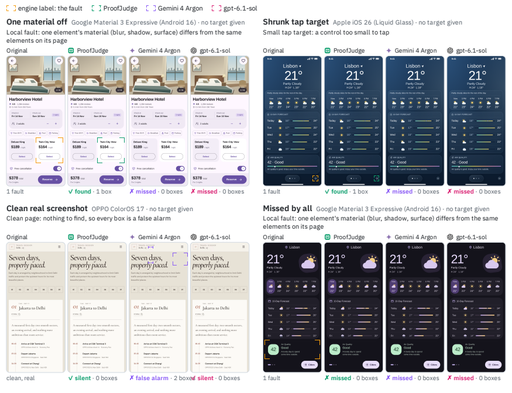
Figure 5 . Where ProofJudge succeeds and fails on the consistency test (no target given): four hand-picked cases, three of its strengths and one fault every judge misses; Tab. 4 gives the overall picture, where ProofJudge has the highest F1 but Gemini 4 Argon finds more local style faults. Under each title, one line names the fault; each example shows the original screenshot with the engine’s exact label (amber corner marks), then ProofJudge and two API judges with only their own boxes. ProofJudge alone finds the room card whose surface differs from its sibling’s and a control shrunk below tap size (IoU ≥ 0.5), whereas the API judges’ boxes, if any, lie elsewhere; on a clean real screenshot it stays silent where Gemini 4 Argon boxes a timeline and an empty area. No judge finds the air-quality card that has lost the surface its sibling cards keep. Twenty cases chosen by a fixed rule, including failures, are in Sec. R.
出典 · CC BY 4.0 · Huiming Sun, Yue Li, Kangning Yang, Ruineng Li, Jie Cai, Lan Fu, Yunwan Fu, Jinlong Li, Jinglin Shen · ScreenProof: Where Is This Screen Wrong? Finding UI Faults Without a Reference · 論文の図を引用 · 元のPDFの7ページ目から図の部分を抽出しています。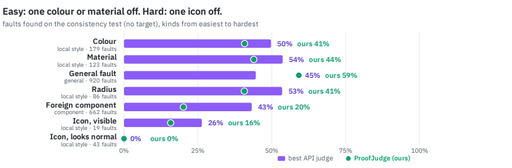
Figure 6 . What is easy and what is hard (consistency test, 2,765 screenshots, no target). Each row is one kind of fault, ordered by the mean share the four API judges find, easiest first; the bar is the share the best of them finds (Gemini 4 Argon, gpt-6.1-sol, Gemini 3.8 Flash, GPT-6 Luna), the dot the share ProofJudge finds. One element with another colour, material or corner radius is found by the best API judge about half the time; a foreign icon is hard for every judge, and none of the four nor ProofJudge finds an icon that looks normal on its page (Claude Opus 5.5, which flags most clean pages, finds 3 of 43; Tab. S6). ProofJudge finds the most general faults (59%). Every judge’s numbers are in Tab. S6, the split of icon faults in Sec. I.
出典 · CC BY 4.0 · Huiming Sun, Yue Li, Kangning Yang, Ruineng Li, Jie Cai, Lan Fu, Yunwan Fu, Jinlong Li, Jinglin Shen · ScreenProof: Where Is This Screen Wrong? Finding UI Faults Without a Reference · 論文の図を引用 · 元のPDFの8ページ目から図の部分を抽出しています。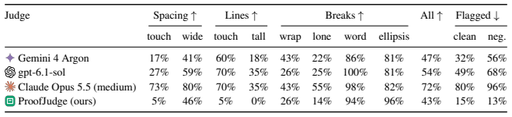
Table 5 . Text layout test (held-out page requirements, no target, IoU ≥0.5 ): recall per rule, and pages flagged among 75 clean pages and 71 hard negatives (every sibling changed alike). 367 faults: characters touch 66, letter spacing unlike siblings 46, lines touch 20, line height unlike siblings 17, short label wraps 23, lone last word or character 73, word broken inside 50, needless ellipsis 72. Spacing: characters touch, letter spacing wider than the siblings’; Lines: lines touch, line height larger than the siblings’; Breaks: a short label wraps, a lone last word or character, a word broken inside, a needless ellipsis; Flagged: clean pages and hard negatives flagged. The base pages are English, so the Chinese line-start punctuation rule has no test item; “–”: not run.
出典 · CC BY 4.0 · Huiming Sun, Yue Li, Kangning Yang, Ruineng Li, Jie Cai, Lan Fu, Yunwan Fu, Jinlong Li, Jinglin Shen · ScreenProof: Where Is This Screen Wrong? Finding UI Faults Without a Reference · 論文の図を引用 · 元のPDFの8ページ目から図の部分を抽出しています。外部ベンチマークと実際の欠陥への転移
外部ベンチマークであるOwlEyeでは、実際のAndroidのスクリーンショット600枚を使い、そのうち半分に表示の問題が含まれています。すべての画面を欠陥とみなすと、F1は0.67になります。ProofJudgeはF1 0.72を記録し、正常なスクリーンショットの25%を表示しました。一方、Gemini 4 Argonは、F1 0.86とさらに高い値でした。この評価は、一貫性プロンプトを変えずに実施されました。

Table 7 . External benchmark (consistency prompt unchanged). OwlEye: 600 Android screenshots, half with display issues; flag- ging all scores F1 0.67. Full table: Tab. S5.
出典 · CC BY 4.0 · Huiming Sun, Yue Li, Kangning Yang, Ruineng Li, Jie Cai, Lan Fu, Yunwan Fu, Jinlong Li, Jinglin Shen · ScreenProof: Where Is This Screen Wrong? Finding UI Faults Without a Reference · 論文の図を引用 · 元のPDFの9ページ目から図の部分を抽出しています。論文では、エンジンが作った欠陥での順位が、実際の画面での順位とどの程度一致するかも分析しています。21個の判定器と変種を対象としたスピアマン相関は、F1で比べると0.58、きれいな画面に付けたフラグの割合で比べると0.91と報告されています。これは相関であり、エンジンの欠陥が実際の欠陥を完全に代表することを証明するものではありません。
コストと1次フィルタとしての利用
A100-80GBを1台使うと、ProofJudgeは1ページあたり約1.0秒かかります。GPUの時間あたりの料金を2ドルと仮定すると、1,000ページあたり約0.04ドルです。同じ仮定で、Gemini 4 Argonは6.1秒と4.42ドルと報告されています。このコストは1ページ処理の推定であり、APIの価格やGPUの仮定によって変わります。
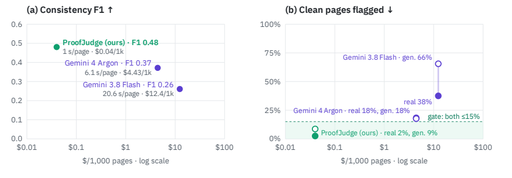
Figure 8 . Cost against accuracy, the same cost scale in both panels.(a)F1 on the consistency test (2,765 pages, no target given), with time per page and cost per 1,000 pages.(b)Clean pages flagged: real screenshots (filled) and generated pages (open); a checkpoint is usable only below the dashed line on both. ProofJudge is the cheapest by two orders of magnitude and flags the fewest clean pages, real and generated. ProofJudge’s time was measured on v6, with the same base model and a smaller adapter (rank 16). ProofJudge’s cost assumes $2 per A100-hour; the API costs are list prices on 2026-10-25.
出典 · CC BY 4.0 · Huiming Sun, Yue Li, Kangning Yang, Ruineng Li, Jie Cai, Lan Fu, Yunwan Fu, Jinlong Li, Jinglin Shen · ScreenProof: Where Is This Screen Wrong? Finding UI Faults Without a Reference · 論文の図を引用 · 元のPDFの10ページ目から図の部分を抽出しています。論文では、ProofJudgeをAPI判定器の前段の1次フィルタとして使う構成も検討しています。ProofJudgeが表示した42%のページだけをgpt-6.1-solに見せると、バウンディングボックスのF1は0.30から0.32に変わり、きれいな実際のスクリーンショットの誤検出は38%から1%に減ります。その代わりに再現率は37%から28%に下がります。この結果はそのフィルタリング構成によるものであり、すべてのAPI判定器に同じ利点があるという意味ではありません。
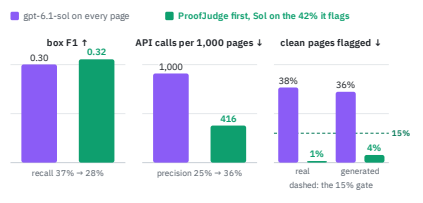
Figure 9 . ProofJudge as a cheap first check (consistency test, no target). gpt-6.1-sol runs either on every page or only on the 42% of pages ProofJudge flags: box F1 0.30 to 0.32, precision 25% to 36%, recall 37% to 28%, and clean pages flagged 38% to 1% (real) and 36% to 4% (generated; dashed line: the 15% gate). Sol reports no token counts, so the saving is shown in API calls; the same gate with Gemini 4 Argon is in the text.
出典 · CC BY 4.0 · Huiming Sun, Yue Li, Kangning Yang, Ruineng Li, Jie Cai, Lan Fu, Yunwan Fu, Jinlong Li, Jinglin Shen · ScreenProof: Where Is This Screen Wrong? Finding UI Faults Without a Reference · 論文の図を引用 · 元のPDFの10ページ目から図の部分を抽出しています。制約と残された課題
論文が扱うのは単一のスマートフォン画面だけで、操作や動きは扱っていません。きれいなラベルは、2人の審査者が仕様に合っていると確認した、生成された基本ページに依存しています。また、判定結果はモデルベースの審査者を通じて測定されました。以前のProofJudgeの変種の多くは1回だけ学習されており、モデル容量の実験と最終モデルだけが2つのシードを使いました。
さらに、テキストレイアウトのテストは英語のページだけを使っています。修正実験では、判定器の出力のあとに、修正器がページのコードを読むという条件があります。スクリーンショットだけが与えられる設定や、インストール済みのアプリでの修正効果は確認していません。論文は、設計者を交えた研究を今後の課題として残しています。
論文情報
- 著者
- Huiming Sun, Yue Li, Kangning Yang, Ruineng Li, Jie Cai, Lan Fu, Yunwan Fu, Jinlong Li, Jinglin Shen
- 学会・ジャーナル
- arXiv · プレプリント
- 公開日
- 2026年11月6日
- 登録日
- 2026年11月10日
- 更新日
- 2026年11月6日
- バージョン
- v1
- arXiv
- 2611.10234
- カテゴリ
- cs.AI · cs.SE
- ライセンス
- CC BY 4.0
- 掲載内容
- 論文情報・解説・論文の図
この解説は、Refivuの韓国語解説をAIで翻訳したものです。不正確な翻訳や誤りが含まれる可能性があります。論文と図の利用条件は各出典に従います。
アブストラクト
A phone screen can be wrong in ways that need no reference: a label that runs off the screen, letters that touch, a line that breaks one character before its end, one button with sharp corners among round ones. We ask whether a model can box every such fault on a screenshot, given no target design and no reference image. Such a critic could serve as a cheap first pass over generated pages before a designer reviews them, but only if it stays silent on clean pages. ScreenProof poses this target-free critique over three families of faults: general faults, local style faults (one element breaks the style its page sets) and text layout faults (letter spacing, line height, line breaks). A data engine makes each fault in page code and records the changed element's box, and hard negatives change every sibling alike. No frontier judge is reliable: frontier models flag 18-62% of clean real screenshots and 18-82% of clean generated pages, find 47-72% of text layout faults, and rarely find a foreign icon (5-19%). Our small critic ProofJudge (Qwen3.5-9B with LoRA), trained on code-made pages with one to four faults each and keeping a finding only when it is confident, reaches F1 0.48, the highest of all judges (Gemini 4 Argon 0.37; open models at most 0.15; 0.46 even without the confidence cut), and is the only fault-finding judge within 15% false alarms on clean pages (2% real, 9% generated), the property such a first pass needs, at about a hundredth of Argon's cost. It finds the most general faults (59%) but fewer local style faults than Argon (25% against 41%) and fewer text layout faults than the API judges (43%; Gemini 4 Argon 47%). Against a named brand the task is harder still: models know a design language about as well as its public documentation states it.
この論文を引用
Huiming Sun, Yue Li, Kangning Yang, Ruineng Li, Jie Cai, Lan Fu, Yunwan Fu, Jinlong Li, Jinglin Shen (2026). ScreenProof: Where Is This Screen Wrong? Finding UI Faults Without a Reference. arXiv:2611.10234v1. https://arxiv.org/abs/2611.10234v1
BibTeX
@misc{sun2026screenproof,
  title = {{ScreenProof: Where Is This Screen Wrong? Finding UI Faults Without a Reference}},
  author = {Huiming Sun and Yue Li and Kangning Yang and Ruineng Li and Jie Cai and Lan Fu and Yunwan Fu and Jinlong Li and Jinglin Shen},
  year = {2026},
  eprint = {2611.10234},
  archivePrefix = {arXiv},
  url = {https://arxiv.org/abs/2611.10234v1}
}