論文解説
Gendered Misclassification from Surname-Based Race Imputation
姓に基づく人種推定が生む性別による誤分類
- 課題 米国の自己申告人種データを用いて、姓に基づく人種推定に見られる女性へのバイアスを測定します。あわせて、配偶者の姓がグループ別の推定でバイアスを生むかどうかを検討します。
- 手法 既婚女性の配偶者の姓を、結婚前の姓の復元、配偶者の姓の除外、重みの低減などで補正し、BIFSGとBIRDiEの結果を比較します。
- 結果 アジア系とヒスパニック系の女性は分類精度が低いです。配偶者の姓を除外するとアジア系の性別格差によるバイアスは減りますが、黒人の投票率の差は悪化します。
姓に基づく人種推定の問題
政治学では、有権者ファイルにある姓と居住地域から個人の人種を推定するBISG系の手法が広く使われています。この手法は、姓が人種集団の所属を示すという仮定に基づいていますが、既婚女性が配偶者の姓を名乗ると、この仮定が崩れます。論文では、米国では大多数の既婚女性が夫の姓を名乗ると説明されており、アジア系とヒスパニック系の女性は他の人種の配偶者と結婚する割合が高いと報告されています。そのため、配偶者の姓を使った女性は、自分の人種と異なる人種に誤って分類される可能性があります。
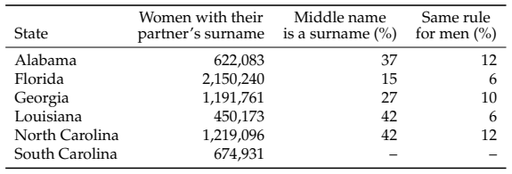
Table 1 : Women who share their partner’s surname.
出典 · CC BY 4.0 · Noah Dasanaike · Gendered Misclassification from Surname-Based Race Imputation · 論文の図を引用 · 元のPDFの5ページ目から図の部分を抽出しています。問題なのは、この誤分類がランダムなノイズにとどまらない点です。配偶者の人種に合わせて誤分類された女性は、同じ人種の他の女性と政治的志向が異なることがあるため、誤差が集団推定の中で打ち消し合わず、バイアスとして残ります。この論文では、このバイアスを米国6州の自己申告人種データで測定し、補正手法を比較しています。
バイアスの式と補正版
論文は、BIRDiEのような手法が求める独立性の仮定を基準に問題を整理しています。結果変数は、人種、地理、観測された共変量が与えられたとき姓と独立でなければなりませんが、配偶者の姓は配偶者の人種という第3の要因を通じてこの仮定に違反します。論文では、女性集団の推定値のバイアスを、既婚姓の割合、他の人種の姓を持つ女性が自分の人種に割り当てられる確率の差、そして結果の差の積として表す式(1)を提示しています。ただし論文のテキストでは式の細かい記号が完全には保たれていないため、ここでは3つの要因の積という構造だけを扱います。
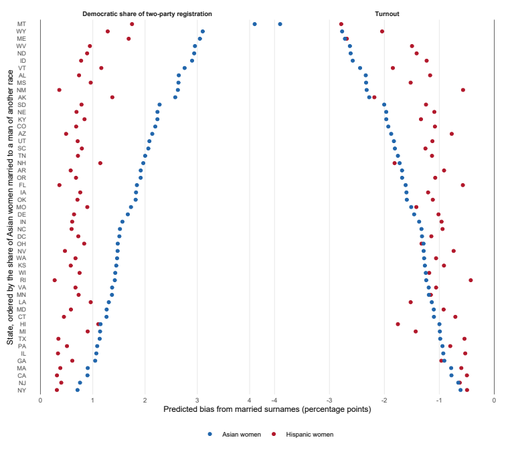
Figure 5 : Predicted bias in the weighted estimates for Asian and Hispanic women by state. Predic- tions use expression (1) and the American Community Survey of 2022.
出典 · CC BY 4.0 · Noah Dasanaike · Gendered Misclassification from Surname-Based Race Imputation · 論文の図を引用 · 元のPDFの12ページ目から図の部分を抽出しています。補正は3つ示されています。1つ目は、ミドルネームが姓に見える場合に、結婚前の姓に戻す方法です。2つ目は、結婚前の姓を復元できない配偶者と姓を共有する女性の姓を除外し、名前と地域から確率を計算する方法です。3つ目は、配偶者の姓に低い重みを与える方法です。論文では5つの姓のバージョンを構成しており、最後のバージョンでは、配偶者と姓が同じ女性や、ハイフンで姓をつないだ女性の姓をすべて除外します。男性の確率は、すべてのバージョンで同じです。
精度と独立性違反の検証
最初の検証では、BIFSGが自己申告の人種をどれだけ正しく当てられるかを比較しています。アジア系女性は55.2%が正しく分類され、アジア系男性の64.8%より低い結果です。ヒスパニック女性は79.0%で、ヒスパニック男性の85.8%を下回ります。白人では女性と男性の差は小さく、黒人では女性の方がむしろ高くなっています。ヒスパニック女性の性別による差は、最も若い有権者では小さく、結婚適齢期で大きくなります。論文は、これが姓の変更で一部説明できることを示す初期の根拠として提示しています。
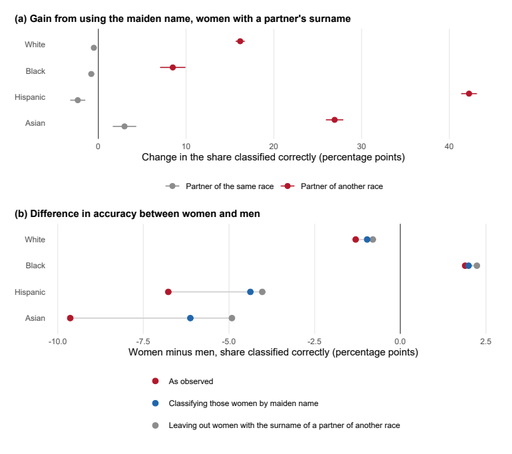
Figure 1 : BIFSG accuracy and married surnames. Panel (a) contains women who share their partner’s surname and have a surname as their middle name. Horizontal lines are 95% intervals. Supplementary Table S10 gives the numbers for panel (b).
出典 · CC BY 4.0 · Noah Dasanaike · Gendered Misclassification from Surname-Based Race Imputation · 論文の図を引用 · 元のPDFの8ページ目から図の部分を抽出しています。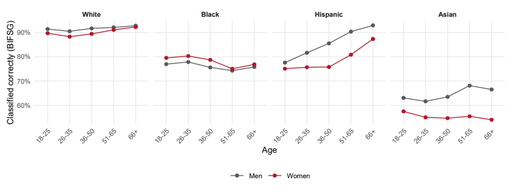
Figure 2 : BIFSG accuracy by age and sex, using current surnames.
出典 · CC BY 4.0 · Noah Dasanaike · Gendered Misclassification from Surname-Based Race Imputation · 論文の図を引用 · 元のPDFの9ページ目から図の部分を抽出しています。2つ目の検証では、配偶者の姓を持つ女性のうち、配偶者が別の人種である集団で、ミドルネームから復元した結婚前の姓に切り替えたとき、精度がどれだけ上がるかを示しています。ノースカロライナ州の登録履歴データでも、同じ方向の結果が報告されています。
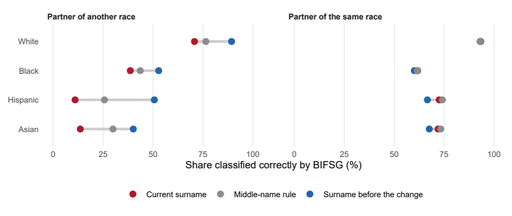
Figure 3 : BIFSG accuracy for women in North Carolina whose surname changed between 2005 and 2026. Panels give the race of the man who shares her current surname.
出典 · CC BY 4.0 · Noah Dasanaike · Gendered Misclassification from Surname-Based Race Imputation · 論文の図を引用 · 元のPDFの10ページ目から図の部分を抽出しています。BIRDiEのバイアスと補正の効果
女性が配偶者の姓を名乗った場合、政党支持も配偶者の人種と関連します。論文では、アジア系女性のうち白人の配偶者を持つ女性は民主党登録の割合が35.4%で、アジア系の配偶者を持つ女性の51.9%より低いと報告されています。したがって、誤分類された女性は結果変数と相関しています。
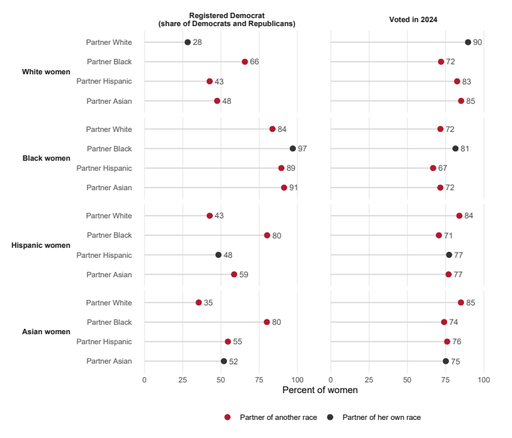
Figure 4 : Partisanship and turnout of women in inferred couples, by the race of the woman and of her partner. Combinations with fewer than 1,000 women are omitted.
出典 · CC BY 4.0 · Noah Dasanaike · Gendered Misclassification from Surname-Based Race Imputation · 論文の図を引用 · 元のPDFの11ページ目から図の部分を抽出しています。論文では、式(1)はBIRDiEのバイアスを過小推定しており、保守的な推定だと説明されています。
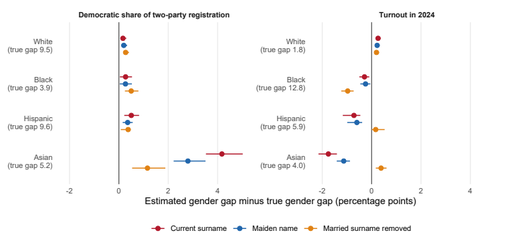
Figure 6 : Error in the BIRDiE estimate of the gender gap (women minus men) within each race. Horizontal lines are 95% intervals from resampling counties.
出典 · CC BY 4.0 · Noah Dasanaike · Gendered Misclassification from Surname-Based Race Imputation · 論文の図を引用 · 元のPDFの13ページ目から図の部分を抽出しています。適用範囲と限界
この結果は、米国6州のデータと、識別できた夫婦という条件で得られたものです。論文では、同性カップルにも同じ種類のバイアスが生じうるが、直接は識別できなかったと述べられています。ミドルネームの規則は、州ごとに結婚前の姓の記録方法が異なるため、復元できる範囲が限られます。レバノンの分析は同じ原理の別の形を示しています。既婚女性が自分の姓を維持する一方で夫の居住地登録に従うため、地理の事前情報が誤分類を生みます。
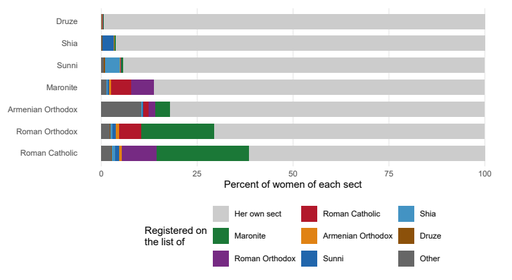
Figure 8 : Lebanese women of each sect by the sect of the list on which they are registered, 2018.
出典 · CC BY 4.0 · Noah Dasanaike · Gendered Misclassification from Surname-Based Race Imputation · 論文の図を引用 · 元のPDFの16ページ目から図の部分を抽出しています。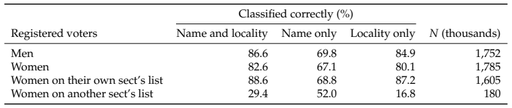
Table 2 : Share classified correctly in the Lebanese voter registry, by sex and by whether women are registered on their own sect’s list.
出典 · CC BY 4.0 · Noah Dasanaike · Gendered Misclassification from Surname-Based Race Imputation · 論文の図を引用 · 元のPDFの17ページ目から図の部分を抽出しています。論文情報
- 著者
- Noah Dasanaike
- 学会・ジャーナル
- arXiv · プレプリント
- 公開日
- 2026年11月7日
- 登録日
- 2026年11月10日
- 更新日
- 2026年11月7日
- バージョン
- v1
- arXiv
- 2611.10931
- カテゴリ
- cs.CL · stat.AP
- ライセンス
- CC BY 4.0
- 掲載内容
- 論文情報・解説・論文の図
この解説は、Refivuの韓国語解説をAIで翻訳したものです。不正確な翻訳や誤りが含まれる可能性があります。論文と図の利用条件は各出典に従います。
アブストラクト
Researchers increasingly estimate political behavior based on race and gender from voter files, where race is imputed from surnames and geography. This only works where surnames suggest group membership, an assumption violated where surnames follow norms around marriage. Imputation is therefore biased against women who adopt their husband's surname, especially those who racially inter-marry, an outcome itself endogenous to partisanship. Using six US states recording self-reported race, I show that imputation is less accurate for Asian and Hispanic women, particularly those sharing the surname of a partner of another race, who differ politically from other women of their race. This violates assumptions behind downstream inference approaches, which nearly double the gender gap in partisanship among Asian voters. I derive an expression showing the bias is largest where a group is small. Using maiden rather than marriage-adopted surnames in North Carolina raises accuracy up to fourfold for women married across racial lines. Recovering maiden surnames, or omitting the married surname, removes much of the bias. In a national replication of a study of gender gaps in turnout, the correction more than triples the gap among Asian voters. In Lebanon, where wives register in their husband's locality, the error enters through geography.
この論文を引用
Noah Dasanaike (2026). Gendered Misclassification from Surname-Based Race Imputation. arXiv:2611.10931v1. https://arxiv.org/abs/2611.10931v1
BibTeX
@misc{dasanaike2026gendered,
  title = {{Gendered Misclassification from Surname-Based Race Imputation}},
  author = {Noah Dasanaike},
  year = {2026},
  eprint = {2611.10931},
  archivePrefix = {arXiv},
  url = {https://arxiv.org/abs/2611.10931v1}
}