論文解説
Consumer-Time Validity in Stateful AI Runtimes: Verifying Recovered State and Deferred Authority
LLM実行基盤で取り消しや承認が古くなっていないか読む側で確かめる
- 課題 取り消しや巻き戻し、承認は一箇所で記録されても、後で使う側は、その後に対象が変わったかを確かめていません。そのため、古い状態を読んだり、古い承認で上書きしたりします。
- 手法 消費者ごとの回復契約は、読む側が求める除外・保持・完了を同時に確かめます。判定はリクエスト自身の証拠で行い、GPUを使わないオフライン検証器で確かめます。
- 結果 vLLMの割り当て単位の修復は、誘発した7つの障害条件をすべて満たしました。上流の修正は2つしか満たしませんでした。
記録は正しいのに、使う側で壊れる理由
LLMの推論基盤やエージェント基盤では、1つの会話の実行状態が、トランスクリプト、KVキャッシュ、テナント間で共有されるプレフィックス索引、GPUのブロック表、位置カウンタ、承認待ちのキューに分かれて置かれます。取り消しや巻き戻し、承認が起きたとき、決定を受け取った場所では正しく記録されていても、索引や非同期の読み込み、GPUの位置、後で状態を参照するツールは、その決定を見直さないことがあります。そのため、取り消しが一部の表現にしか届かず、後続の処理が古い状態を読んだり、古い承認で実行したりします。
論文は、ALPHAとBETAが外部KVストアから読んだ共有のプレフィックスを例に、この問題を示します。ALPHAの読み込みは途中で中断され、コネクタは失敗を報告しましたが、プレフィックス索引は書かれていないブロックを含めてすべて登録したままでした。そのためBETAのリクエストは、ヒットとして扱われた書かれていない位置を使うことになります。ヒット数やテストの出力は、この状態を見逃します。ヒット数は索引の項目を証明するだけで、その背後のバイト列は証明しないからです。
承認の例でも構図は同じです。セッション1が版κのファイルへの書き込みを承認待ちにし、セッション2が承認を得て版κ+1をコミットしても、セッション1の承認は取り消されません。ディスパッチャは主体、パス、操作、権限の版を確認するだけで、すべて有効と判定するため、古い書き込みが新しい版を上書きしてしまいます。承認は発行時点では正しかったものの、今のファイルに対して有効かどうかは再確認されていません。
論文はこの二つを、消費時有効性(consumer-time validity)という一つの性質の二つの形として扱います。状態有効性は、キャッシュや派生状態を読んでよいかを、取り消し、巻き戻し、ブロック再割り当ての後に問います。権限の鮮度は、取り消されていない権限をまだ実行してよいかを、対象が変わった後に問います。局所的な修復では足りません。索引項目の削除、位置の巻き戻し、キャッシュの破棄は、それぞれ一つの条件しか満たさず、回復には無効な状態の除外、有効な状態の保持、依存タスクの完了が必要だからです。
消費時の契約と許容される証拠
論文の方法の核は、消費者ごとに成り立つべき条件を契約として書き、その条件を消費するリクエスト自身の証拠で判定することです。状態の契約では、キャッシュ済みプレフィックスを読んでよいのは、生成側がその範囲を書き終えた場合に限られます。遅れて届いた報告は現在の割り当てを指す必要があり、続きの処理は一貫した位置から再開しなければなりません。権限の契約では、取り消されていない承認でも、対象の版が承認時の版と一致する場合にだけ書き込みを実行します。
状態の契約は、Equation 4で表されます。プレフィックスのトークン列が一致するという条件を\(Q_{:r}=C_{:r}\)、続きの位置が一致するという条件を\(\mathrm{SeamOK}(e,r)\)、書き込みが完了した範囲を\([0,r)\subseteq V(x)\)と書き、3つを同時に求めます。トークン列の一致だけでは、書き込みが終わったことも位置が正しいことも保証されません。SeamOKは、接続点でホスト側の位置πhとデバイス側の位置πdが一致するかを見る条件です。論文はこの式を、評価した3条件だけを表すものとしており、実行の正しさを十分に保証する式とは書いていません。
証拠には、admissible witnessという基準を設けます。出力の一致(Tier 0)とヒット数(Tier 1)は状態の述語には使わず、スケジューラのメタデータ(Tier-2a)と永続化された成果物(Tier-3)を採用します。注意機構が実際に読んだKVのバイト列(Tier-2b)も許容されますが、これは別のオンライン監査で集めます。出力の一致を使えない理由は、BF16のバッチ処理だけで障害のない実行が30トークン目から分岐する一方、注意機構が読んだKVダイジェストは一致したことにあります。判定の基準を誤ると結論も変わります。16回の実行のうち6回が破損、10回が正常で、後続のプローブPの状態述語をPが残した成果物と照合すると、6回の破損をすべて見つけ、正常な10回では警告を出しませんでした。
修復は、状態が消費される境界に置きます。vLLMでは、未書き込みのハッシュを割り当て単位で退避し、デバイス側の位置を巻き戻します。ディスパッチャでは、承認の版が現在の版と一致する場合だけ実行します。ただし、修復は有効な状態まで捨ててはいけません。全消去は除外を満たしても保持を満たさず、有効な履歴まで失うからです。検証器は修復の結果を読むだけで、執行はしません。修復の中身はターゲットの各ランタイムに置かれます。
GPUを使わないオフライン検証器
検証器は、凍結されたスケジューラのトレースと、ハーネスの注釈を除いた永続化成果物を読みます。GPUのテンソルは使わず、必要な証拠が欠けた場合は合格にしません。42のGPU行列のセルのうち39が完走し、3つのブロック再利用セルはallocation-identityの義務に失敗した後、cuBLASの実行失敗で早期に終わりました。この42セルの判定について、検証器は参照判定と42/42で一致しました。第二のH20ホストでも同じ結果でした。
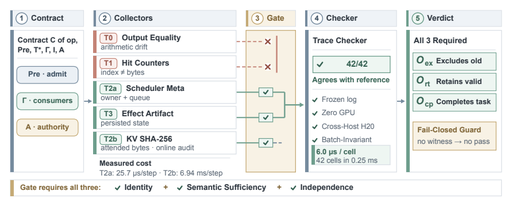
Figure 3 : The verifier evaluates consumer-bound recovery predicates using admissible recorded evidence; enforcement remains in the target runtimes.Contracts determine which predicates must be decided. An admissibility gate rejects Tier 0 (output equality) and Tier 1 (hit counters) for state predicates and admits Tier-2a scheduler metadata and persisted Tier-3 artifacts. These two feed the offline trace verifier, which reads frozen traces, uses no GPU tensors, and takes 6.0µ s per cell. Tier-2b attended-KV digests are admissible evidence but are collected by a separate online audit (Section 5.2), not by the offline verifier. Repairs are separate code in each target system. The three obligations in the verdict panel, Oex, Ort, and Ocp, apply to state-recovery contracts. Authority-freshness predicates are Equations 5 and 6.
出典 · CC BY 4.0 · Guijia Zhang, Huihao Jing, Bing Li, Shing-Chi Cheung, Harry Yang, Ziqi Zhang · Consumer-Time Validity in Stateful AI Runtimes: Verifying Recovered State and Deferred Authority · 論文の図を引用 · 元のPDFの13ページ目から図の部分を抽出しています。義務単位では、210の義務枠から196が適用可能、162が比較可能になり、そのうち159/162で一致しました。残りの3件の不一致は、いずれも保守的な判定です。参照判定が早期中断後のタイムスタンプ順序の確認を保留しましたが、生ログでは、ロード98、中断106、再割り当て124、報告消費127の順に起きていました。偽の警告は3/149、偽の証拠は0/13でした。ただし、この一致はトレース述語への適合性です。計測器が正しいこと、デバイス状態がメタデータと一致することは示しません。
Tier-2bのバイト監査は1層で0.42 ms/step、28層すべてで6.94 ms/stepです。
vLLMで誤ったテナントの呼び出しが生成される経路
障害のない対照では、BETAはキャッシュ済みの511トークンを再利用し、自分のテナントを指す呼び出しを10/10の回で生成しました。この呼び出しは、スキーマに一致し、読み出して記録されるだけで、バックエンドは実行していません。
ALPHAの読み込みをトークン128で中断すると、BETAの要求は256トークンのヒットとなり、そのうち128トークンは書かれていませんでした。その結果、BETAは認証済みのセッションのまま、ALPHAを指すスキーマ有効な呼び出しを10/10の回で生成しました。正しい対象の呼び出しも、パーサによる拒否も起きませんでした。

Table 7 : Stale-state admission yields schema-valid tool calls naming the wrong tenant in 10/10 native-fault runs, and the repair restores 10/10 correct-target calls.Ten runs per arm on one pinned harness (identical SHA-256 on both hosts), model, and prompt schedule, recompute policy, fault at token 128. The native-fault arm ran on one H20 host and the repaired arm on a second; the no-fault baseline gave 10/10 correct-target calls on each. Adm. counts prompt tokens admitted from cache without computation. Calls are generated and re-read from disk; no backend executes them.
出典 · CC BY 4.0 · Guijia Zhang, Huihao Jing, Bing Li, Shing-Chi Cheung, Harry Yang, Ziqi Zhang · Consumer-Time Validity in Stateful AI Runtimes: Verifying Recovered State and Deferred Authority · 論文の図を引用 · 元のPDFの19ページ目から図の部分を抽出しています。256トークンのヒットは三つの区間に分かれます。0から127は、ALPHAの読み込みで書かれた部分で、テナントのラベル一覧を含みます。128から255は書かれていない残りで、ハッシュは索引に残っています。256以降はBETA自身の本文です。接続点では、ホストは128トークンの計算済みを数えるのに対し、デバイスのステージングバッファは288を指していて、位置は160ずれます。生成されたラベルは書かれた一覧の最初のラベルと整合しますが、論文はスペーサ対照を行っていないため、どの区間に由来するかは断定していません。
修復では、許可を検証済みの128トークンに制限し、正しい対象の呼び出しを10/10の回で取り戻しました。2x2の要因実験では、退避だけでは継続が壊れたままで、デバイスの巻き戻しだけでは未書き込みの状態が許可されたままでした。両方を組み合わせたときだけ、2つの条件が満たされました。つまり、試した経路では、2つの修復はどちらも欠かせないということです。
上流のPR 61769は、直接の中断経路を塞ぐものの、先取りされた所有者や再利用されたブロックを狙う報告は塞ぎません。割り当て単位の修復は、固定されたスケジューラの事例行列で7つの障害述語をすべて満たし、PR 61769は2/7にとどまりました。
単一セッションとディスパッチャでの同じ欠落
ChatGLM2では、枝の削除で、表示される履歴とhistoryのリストは更新されますが、past_key_valuesは残ります。9つの低温度条件で、削除された枝と同じフォワードパスのテンソル・ダイジェストが9/9の回で一致しました。
キャッシュを消去すると古いテンソルは消えますが、同時に保持されるべき履歴も失われます。図4の比較で、ネイティブ削除は除外を6/6で満たさず、全消去は除外を6/6で満たす一方で保持と完了を0/6にしました。保持されたプレフィックスから再構築した場合は、3条件すべてを6/6で満たしました。除外だけでは回復にならないという論文の命題は、この比較と整合します。
Google ADK 2.13.0は、巻き戻し後のアクティブイベントを絞り込んだビューを保ちますが、長期記憶のエクスポータは生の全イベントログを読みます。9つの分岐履歴のうちネイティブのエクスポータは3/9でのみ契約を満たし、残りの6履歴では巻き戻された発話を出力しました。巻き戻しのエポックで絞り込む、上流のコミット3640e7d0c74bを適用する、再構成したアクティブイベントから出力する、のいずれでも9/9になりました。
DSHの承認ランタイムでは、セッション1が版κで読んだファイルへの書き込みを承認待ちにし、セッション2が版κ+1をコミットしました。承認はallowed-onceで解放され、ディスパッチャは主体、パス、操作、権限の版を確認しましたが、κは読みませんでした。その結果、1/1の許可された実行で、新しい版が上書きされました。このライブ実行は到達性の確認で、出現頻度を示すものではありません。
4種類の到着パターンで各1,000件、4,000回の対話では、未束縛のディスパッチャは1,502回の巻き戻しを起こし、版束縛はそれをすべて防ぎ、誤拒否はありませんでした。つまり、判定は原子的な検査と書き込みの区間の中で行う必要があります。承認後の時間差ではなく、書き込み直前の版が問題になるからです。

Table 8 : Revision binding blocks 160/160 conflicting overwrites and applies all 140/140 valid grants.Three hundred deterministic boundary instances, with identical grant tuples for both dispatchers. Stale counts silent overwrites of a newer revisionκ+1.
出典 · CC BY 4.0 · Guijia Zhang, Huihao Jing, Bing Li, Shing-Chi Cheung, Harry Yang, Ziqi Zhang · Consumer-Time Validity in Stateful AI Runtimes: Verifying Recovered State and Deferred Authority · 論文の図を引用 · 元のPDFの20ページ目から図の部分を抽出しています。限界
本論文の結果は、固定された実装での到達性と因果構造を示すもので、出現頻度を示すものではありません。提供モデルは、Qwen3-1.7B-Base、Phi-3.5-mini-instruct、ChatGLM2-6BのFP16の小型の密なデコーダに限られ、大規模、混合専門家、FP8やINT8の構成は試していません。
オフライン検証器の42/42は、同じ記録トレースを読む参照判定との適合性で、独立した正解の検証ではありません。Tier-2bのダイジェストは100回の実行の資料では収集されていません。ライブのDSH承認の証拠は1件の許可された実行で、残りは制御されたモデル実験です。
完全な非同期読み込みに対する有効性と、再利用前に未完了の読み手が消えることの検証は行っていません。影響を受けるメンテナへの報告は提出時点で完了しておらず、成果物は計画中で、まだ公開されていません。
論文情報
- 著者
- Guijia Zhang, Huihao Jing, Bing Li, Shing-Chi Cheung, Harry Yang, Ziqi Zhang
- 学会・ジャーナル
- arXiv · プレプリント
- 公開日
- 2026年11月21日
- 登録日
- 2026年11月24日
- 更新日
- 2026年11月21日
- バージョン
- v1
- arXiv
- 2611.29004
- カテゴリ
- cs.CR · cs.AI · cs.SE
- ライセンス
- CC BY 4.0
- 掲載内容
- 論文情報・解説・論文の図
この解説は、Refivuの韓国語解説をAIで翻訳したものです。不正確な翻訳や誤りが含まれる可能性があります。論文と図の利用条件は各出典に従います。
アブストラクト
Stateful LLM serving engines and agent runtimes reuse execution state and deferred permissions across components and sessions. A cancellation, rollback, or approval is recorded by one component and relied on by another, and recording it does not make the later use valid: a downstream consumer may read state or dispatch an action whose identity, production status, allocation, or target revision has since changed. We call the missing check consumer-time validity and separate two forms. State validity governs what a consumer reads. On vLLM with LMCache, an interrupted KV load leaves unwritten blocks indexed, and a host-only counter rewind desynchronizes the GPU position, so a second tenant generates a schema-valid tool call naming the wrong tenant in 10/10 native-fault runs; the call is recorded and not executed. Authority freshness governs what a consumer executes: on a multi-session approval runtime, an unrevoked deferred grant overwrote a newer revision in one admitted live execution. Output equality cannot test state validity: a fault-free run diverges at token 30 through BF16 batching alone while attended-KV digests match. We therefore specify consumer-bound recovery contracts that, for state recovery, jointly require exclusion, retention, and task completion, and an admissible-witness standard realized as a GPU-free offline trace verifier over scheduler metadata and persisted tool artifacts. On recorded traces the verifier agrees with the reference verdicts in 42/42 frozen GPU-matrix scenarios. An allocation-aware repair satisfies 7/7 triggered vLLM fault predicates on a pinned scheduler-case matrix, where upstream PR 61769 satisfies 2/7, and revision-bound dispatch blocks all 160 deterministic conflicting overwrites in a separate dispatcher cohort. Recovery must be checked where state and authority are consumed, with evidence bound to the consuming request.
論文の図

Table 2 : State validity and authority freshness differ in what the consumer must check.Both instances ask the consumer to re-establish at use what an upstream record asserted at issue.
出典 · CC BY 4.0 · Guijia Zhang, Huihao Jing, Bing Li, Shing-Chi Cheung, Harry Yang, Ziqi Zhang · Consumer-Time Validity in Stateful AI Runtimes: Verifying Recovered State and Deferred Authority · 論文の図を引用 · 元のPDFの7ページ目から図の部分を抽出しています。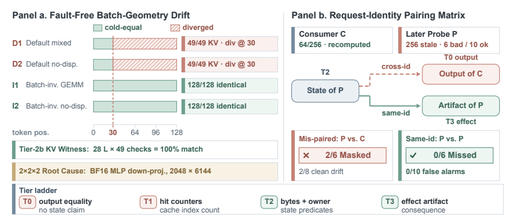
Figure 2 : Output equality fails as a recovery check in two ways.Panel a: in four fault-free 128-token runs with no transport abort, the two default-arithmetic mixed-batch runs keep identical attended KV digests over 49 forward checks and 28 layers, yet diverge from the cold reference at token 30. Batch-invariant GEMM controls match at all 128 positions. Panel b: pairing consumer C’s output with probe P’s corrupted state masks 2/6 corruptions. Pairing P’s state with P’s own persisted artifact detects 6/6 with 0/10 false alarms.
出典 · CC BY 4.0 · Guijia Zhang, Huihao Jing, Bing Li, Shing-Chi Cheung, Harry Yang, Ziqi Zhang · Consumer-Time Validity in Stateful AI Runtimes: Verifying Recovered State and Deferred Authority · 論文の図を引用 · 元のPDFの11ページ目から図の部分を抽出しています。
Table 4 : Boundary-specific repairs enforce the consumer’s postcondition.The identity column gives the value the consumer verifies, from Section 3.2.
出典 · CC BY 4.0 · Guijia Zhang, Huihao Jing, Bing Li, Shing-Chi Cheung, Harry Yang, Ziqi Zhang · Consumer-Time Validity in Stateful AI Runtimes: Verifying Recovered State and Deferred Authority · 論文の図を引用 · 元のPDFの14ページ目から図の部分を抽出しています。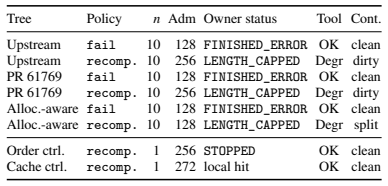
Table 6 : The failure policy determines cross-tenant reachability, and a complete repair needs allocation-aware evictionE with device position rewind D.One pinned vLLM and LMCache stack, tenants sharing a 256-token prefix; Adm is prefix tokens admitted without computation. Panel A end-to-end cohort (Art: probe artifact matches the cold reference; Cons: consumer output matches the cold reference token for token; Eff: recorded stale-state effect; the three are distinct measurements and are not pooled). Panel B: trees crossed withfailandrecompute. Panel C: the 2×2 factorial ofEandD.
出典 · CC BY 4.0 · Guijia Zhang, Huihao Jing, Bing Li, Shing-Chi Cheung, Harry Yang, Ziqi Zhang · Consumer-Time Validity in Stateful AI Runtimes: Verifying Recovered State and Deferred Authority · 論文の図を引用 · 元のPDFの17ページ目から図の部分を抽出しています。
Table 10 : The stale-output guard arms all 6/6 fault cases, and removing its single line delivers and commits the stale token.Stale counts discarded stale tokens; Armed records live request-object guard state, with✓armed and×unarmed.
出典 · CC BY 4.0 · Guijia Zhang, Huihao Jing, Bing Li, Shing-Chi Cheung, Harry Yang, Ziqi Zhang · Consumer-Time Validity in Stateful AI Runtimes: Verifying Recovered State and Deferred Authority · 論文の図を引用 · 元のPDFの27ページ目から図の部分を抽出しています。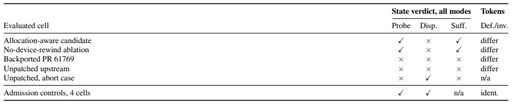
Table 11 : Batch-invariant mode substitution preserves100%of Tier-2 state verdicts while generated tokens vary across modes.Each frozen cell is re-run with VLLM_BATCH_INVARIANT=1 and with default kernels.Probe,Disp., andSuff.are Tier-2 state witnesses.
出典 · CC BY 4.0 · Guijia Zhang, Huihao Jing, Bing Li, Shing-Chi Cheung, Harry Yang, Ziqi Zhang · Consumer-Time Validity in Stateful AI Runtimes: Verifying Recovered State and Deferred Authority · 論文の図を引用 · 元のPDFの27ページ目から図の部分を抽出しています。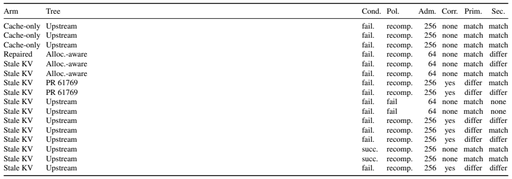
Table 12 : The per-run pairing ledger across all 16 packaged executions separates 6 corrupted runs from 10 clean runs. Prim. pairs probe state with the probe’s own persisted artifact; Sec. cross-pairs the original consumer output against the same cold reference.
出典 · CC BY 4.0 · Guijia Zhang, Huihao Jing, Bing Li, Shing-Chi Cheung, Harry Yang, Ziqi Zhang · Consumer-Time Validity in Stateful AI Runtimes: Verifying Recovered State and Deferred Authority · 論文の図を引用 · 元のPDFの28ページ目から図の部分を抽出しています。
Table 14 : The standalone checker and blind cross-vendor parsers reproduce every endpoint verdict on the 42-cell matrix, with a 0/13 false-witness rate and 3/149 conservative false alarms.Top: agreement against reference verdicts, where FW denotes false-witness probability over invalid obligations and FA the conservative false-alarm rate over n comparable items. Bottom: the formal obligation sets derived from raw event streams.
出典 · CC BY 4.0 · Guijia Zhang, Huihao Jing, Bing Li, Shing-Chi Cheung, Harry Yang, Ziqi Zhang · Consumer-Time Validity in Stateful AI Runtimes: Verifying Recovered State and Deferred Authority · 論文の図を引用 · 元のPDFの29ページ目から図の部分を抽出しています。
Table 17 : Upstream PR 61769 closes running-owner invalidation and leaves PREEMPTED owners unresolved, so allocation- aware eviction with preempted settlement is the remedy that satisfies the owner obligation.Hit / Exp. compares prefix tokens admitted to a later request against the 48 valid tokens preceding the failed block; Owner reports whether the preempted owner reaches terminal settlement.
出典 · CC BY 4.0 · Guijia Zhang, Huihao Jing, Bing Li, Shing-Chi Cheung, Harry Yang, Ziqi Zhang · Consumer-Time Validity in Stateful AI Runtimes: Verifying Recovered State and Deferred Authority · 論文の図を引用 · 元のPDFの31ページ目から図の部分を抽出しています。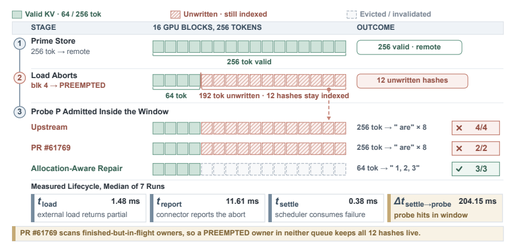
Figure 5 : A failed external load leaves twelve unwritten block hashes indexed for later requests, and allocation-aware eviction plus device rewind together stop the contamination.Consumer C aborts across blocks 4 through 15 and enters PREEMPTED, so 12 unwritten suffix hashes stay live in the prefix index; probe P is then admitted all 256 stale tokens on unpatched upstream and backported PR 61769, while allocation-aware repair restricts admission to the 64 valid tokens. Medians across 7 runs record the partial external load at 1.48 ms, the connector abort report at 11.61 ms, scheduler settlement at 0.38 ms, and the interval from failure consumption to probe output at 204.15 ms, labeled ∆tsettle→probe, over which the owner stays unretired and the stale hashes stay indexed.
出典 · CC BY 4.0 · Guijia Zhang, Huihao Jing, Bing Li, Shing-Chi Cheung, Harry Yang, Ziqi Zhang · Consumer-Time Validity in Stateful AI Runtimes: Verifying Recovered State and Deferred Authority · 論文の図を引用 · 元のPDFの31ページ目から図の部分を抽出しています。この論文を引用
Guijia Zhang, Huihao Jing, Bing Li, Shing-Chi Cheung, Harry Yang, Ziqi Zhang (2026). Consumer-Time Validity in Stateful AI Runtimes: Verifying Recovered State and Deferred Authority. arXiv:2611.29004v1. https://arxiv.org/abs/2611.29004v1
BibTeX
@misc{zhang2026consumer,
  title = {{Consumer-Time Validity in Stateful AI Runtimes: Verifying Recovered State and Deferred Authority}},
  author = {Guijia Zhang and Huihao Jing and Bing Li and Shing-Chi Cheung and Harry Yang and Ziqi Zhang},
  year = {2026},
  eprint = {2611.29004},
  archivePrefix = {arXiv},
  url = {https://arxiv.org/abs/2611.29004v1}
}