論文解説
CS-Pi: Constraint-Satisfying Flow Policy Sampling
CS-Pi:制約を満たすフローポリシーサンプリング
- 課題 配備時に与えられる安全制約を満たしつつ、方策が学習した妥当な行動を捨てないサンプリングが必要です。
- 手法 CS-Piは、方策のdrawを安全集合に投影してアンカーを作り、投影残差に応じて再ノイズを加えたあと、修正していない方策を再び実行する反復サンプラーです。
配備時の制約と方策分布の保持の衝突
フローマッチング方策は、学習デモになかった安全制約に、配備時に遭遇することがあります。新しい制約ごとに再学習するのは現実的ではないため、制約は推論時に課されるべきです。このとき、制約を課す過程で方策が学習した行動分布を捨ててはいけません。論文では、方策がほとんどサンプルしない行動が障害物を避けたとしても、タスクに失敗しうると述べ、安全性と妥当らしさの両方が必要だとしています。既存のgradient guidanceは、ノイズのある状態で、きれいな行動のproxyに対してコストの勾配を適用します。そのため、方策が二つのモードの間で不確実なとき、proxyが障害物を貫く平均になることがあります。この論文は、この限界に取り組むサンプラーを提案しています。
投影と再ノイズを繰り返すCS-Pi
CS-Piは、方策から行動のdrawを一つ得たあと、そのdrawを安全集合Cに投影してアンカーを作ります。投影残差δは、現在のdrawと投影との距離です。論文では、再ノイズの時点をn=k/(k+δ)と定め、σ=δ/kで対応づけると述べています。アンカーをn時点まで再ノイズしたあと、修正していない方策をその時点から再び積分し、次のdrawを得ます。δが許容誤差τ以下になると、そのdrawを返します。kが小さいと再ノイズが強くなり、rejectionに近づきます。kが大きいと投影に近づきます。連続コストの場合は、投影の代わりに近接演算子がアンカーを与え、ハード制約と連続コストは同じdrawに順番に適用されます。
一方、Proposition 1は、正確な事後再デノイズの仮定のもとで、一回の反復についての条件付き分布を示しています。これは反復の収束の証明や定常分布を意味するものではありません。
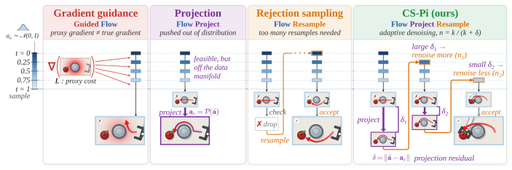
Figure 2 :Sampling a safe action from a flow-matching policy. Gradient guidancesteers each denoising step with a cost gradient evaluated at a proxy and can still violate the constraint.Projec- tionmoves the draw to the safe set, yielding an action the policy would rarely sample.Rejection samplingredraws from pure noise until a draw is safe.CS-Piprojects the draw, renoises the pro- jection to timen=k/(k+δ)set by the projection residualδ(largerδrenoises more), and re-runs the policy until a draw is safe and plausible.
出典 · CC BY 4.0 · Soumojit Bhattacharya, Oliver Kroemer, Shubham Tulsiani · CS-Pi: Constraint-Satisfying Flow Policy Sampling · 論文の図を引用 · 元のPDFの3ページ目から図の部分を抽出しています。反復の限界と終了投影
CS-Piは、K_max回の反復のあとも、許容誤差内のdrawを保証しません。論文では、その場合は最後のdrawの安全性の問題と、終了投影の妥当らしさの低さのどちらかを選ぶ必要があると述べています。終了投影を使うと、実行される行動はC内に入りますが、論文では、その行動は方策のもとで起こりにくい可能性があると説明しています。また、CS-Piは投影と近接演算子を正確に計算できるという仮定を必要とします。ハードウェアでは、シーン推定の誤差によってCが不正確になることがあります。
2Dと棚タスクの比較結果
論文では、CS-Piとprojectionは同じL-BFGSの近接ステップを共有しているため、差は反復ループから生じると解釈しています。この結果は、当該のシミュレーションタスクと設定で得られたものです。
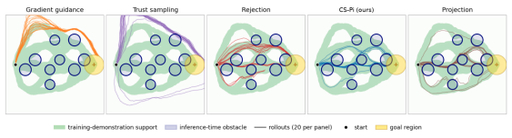
Figure 3 :2D AVOIDANCEtrajectory distributions, one scenario per method.20rollouts overlaid on the demonstration support (shaded); the obstacles are outlined. Gradient guidance and Trust Sampling visibly leave the support to reach the goal or cut through the obstacle; rejection stays on-support but only a few draws survive;CS-Pikeeps every trajectory in-distribution while routing around the obstacle. The other five scenarios are in App. D.
出典 · CC BY 4.0 · Soumojit Bhattacharya, Oliver Kroemer, Shubham Tulsiani · CS-Pi: Constraint-Satisfying Flow Policy Sampling · 論文の図を引用 · 元のPDFの7ページ目から図の部分を抽出しています。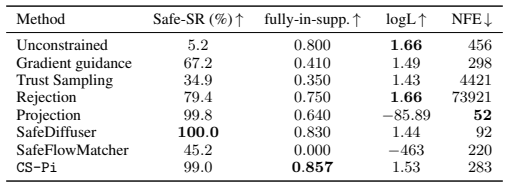
Table 1 :2D AVOIDANCE, macro over six scenarios(200rollouts per cell; best hyperparameter per method).Safe-SR: rollouts reaching the goal collision-free.fully-in-supp.: fraction of rollouts whoseeverywaypoint lies inside the demonstration support.logL: mean log-likelihood underπ θ.
出典 · CC BY 4.0 · Soumojit Bhattacharya, Oliver Kroemer, Shubham Tulsiani · CS-Pi: Constraint-Satisfying Flow Policy Sampling · 論文の図を引用 · 元のPDFの7ページ目から図の部分を抽出しています。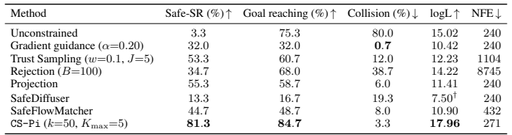
Table 2 :Shelf pick-and-place,5scenarios,150tasks (30/scenario).Safe-SR: collision-free roll- outs that pick and place the cube.logL: mean log-likelihood underπ θ (nats/dim; the unconstrained policy scores15.02). NFE: flow-model calls per trajectory. †Median: a few diverged SafeDiffuser chunks make its mean uninformative.
出典 · CC BY 4.0 · Soumojit Bhattacharya, Oliver Kroemer, Shubham Tulsiani · CS-Pi: Constraint-Satisfying Flow Policy Sampling · 論文の図を引用 · 元のPDFの8ページ目から図の部分を抽出しています。実機Franka配備の結果
実際のFranka FR3実験では、π0.5方策をzero-shotで使い、りんごを拾って青い皿に置くタスクで行われました。障害物のバウンディングボックスはZED 2 RGB-Dパイプラインから得て、レイアウトごとに10回の試行を比べました。論文では、この実験は標本数が少ないと述べているため、この結果は二つのレイアウトでの小規模な試行から得られたものです。
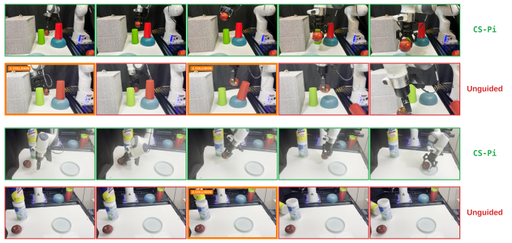
Figure 4 :Hardware rollouts; frames run left-to-right within each strip.Green-bordered strips areCS-Pi, which enforces the deployment-time obstacle constraint and completes the pick-and- place; red-bordered strips are the sameπ 0.5 policy run unconstrained.Layout 1(first two):CS-Pi grasps the apple and places it, while the unconstrained policy clips the cup and loses the grasp. Layout 2(last two):CS-Pireaches down and lifts the apple cleanly, while the unconstrained policy collides with the obstacle.
出典 · CC BY 4.0 · Soumojit Bhattacharya, Oliver Kroemer, Shubham Tulsiani · CS-Pi: Constraint-Satisfying Flow Policy Sampling · 論文の図を引用 · 元のPDFの9ページ目から図の部分を抽出しています。遮断モード診断と適用範囲
遮断モード診断は、二つのモードのガウス混合方策で左のモードを遮断し、補正によってサンプルが別のモードへ移れるかを確認します。この実験では、CS-Piは遮断されたdrawの85.9%を生存モードへ移し、正確なrejectionの92.5%と比べられています。投影、SafeDiffuser、SafeFlowMatcher(既定値)は、生存モードへ移ることができませんでした。この診断は、安全性が同じでも、サンプルがどのモードへ移動するかを区別するために設計されたものです。

Table 21 :Blocked-mode diagnostic, blocked subset(241draws).∆ logp: change in exact log- likelihood relative to the unconstrained policy. Every method returns a safe action on all draws.
出典 · CC BY 4.0 · Soumojit Bhattacharya, Oliver Kroemer, Shubham Tulsiani · CS-Pi: Constraint-Satisfying Flow Policy Sampling · 論文の図を引用 · 元のPDFの24ページ目から図の部分を抽出しています。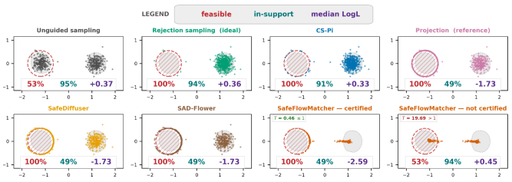
Figure 12 :Blocked-mode diagnostic, left mode blocked.Rejection andCS-Pimove blocked draws to the surviving mode; the other methods stay safe but land in low-likelihood regions of the policy.
出典 · CC BY 4.0 · Soumojit Bhattacharya, Oliver Kroemer, Shubham Tulsiani · CS-Pi: Constraint-Satisfying Flow Policy Sampling · 論文の図を引用 · 元のPDFの25ページ目から図の部分を抽出しています。論文情報
- 著者
- Soumojit Bhattacharya, Oliver Kroemer, Shubham Tulsiani
- 学会・ジャーナル
- arXiv · プレプリント
- 公開日
- 2026年11月5日
- 登録日
- 2026年11月9日
- 更新日
- 2026年11月5日
- バージョン
- v1
- arXiv
- 2611.08654
- カテゴリ
- cs.RO
- ライセンス
- CC BY 4.0
- 掲載内容
- 論文情報・解説・論文の図
この解説は、Refivuの韓国語解説をAIで翻訳したものです。不正確な翻訳や誤りが含まれる可能性があります。論文と図の利用条件は各出典に従います。
アブストラクト
A flow-matching policy deployed in the field must often satisfy a constraint that was absent from its demonstrations, such as avoiding an obstacle it has never seen. Retraining for every new constraint is impractical, so the constraint must be enforced at inference time. Enforcing it must not discard what the policy learned: an action the policy would rarely sample may avoid the obstacle yet fail the task. We therefore want actions that are both safe, satisfying the constraint, and plausible, remaining likely under the policy. Gradient guidance, the most common approach, steers noisy states, so it must evaluate its cost on the policy's running estimate of the clean action; when the policy is uncertain between passing left or right of an obstacle, this estimate is their average and can pass straight through it. We instead build on rejection and projection. Rejection redraws actions until one is safe: every output is plausible, but the wait is intractable when safe actions are rare. Projection moves an action to the nearest safe one: it is efficient, but the result need not be plausible. Our key insight is that flow-matching sampling lets us combine the two, keeping projection's efficiency and rejection's plausibility. CS-Pi, our draw-project-renoise sampler, projects each draw to the nearest safe action, adds noise back scaled to how far the projection moved it, and re-runs the unmodified policy until a draw is safe. Replacing only the projection step extends CS-Pi to continuous costs. Across a 2D diagnostic, a 7-DoF shelf pick-and-place, an orientation preference, and a zero-shot Franka deployment, CS-Pi reaches 81% safe success on the shelf and 55% on hardware, against 55% and 40% for projection, while staying plausible.
この論文を引用
Soumojit Bhattacharya, Oliver Kroemer, Shubham Tulsiani (2026). CS-Pi: Constraint-Satisfying Flow Policy Sampling. arXiv:2611.08654v1. https://arxiv.org/abs/2611.08654v1
BibTeX
@misc{bhattacharya2026constraint,
  title = {{CS-Pi: Constraint-Satisfying Flow Policy Sampling}},
  author = {Soumojit Bhattacharya and Oliver Kroemer and Shubham Tulsiani},
  year = {2026},
  eprint = {2611.08654},
  archivePrefix = {arXiv},
  url = {https://arxiv.org/abs/2611.08654v1}
}