論文解説
Direct Regression and Geometric Recovery for Event-based Spacecraft Pose Estimation
イベントベース宇宙機姿勢推定のための直接回帰と幾何学的復元
- 課題 合成イベントデータで学習した宇宙機姿勢推定モデルは、実際のイベント記録では性能が下がります。直接回帰と幾何ベースのモジュール型方式は、translationとorientationの誤差を異なる形で持ちます。
- 手法 直接回帰のシステムは、グローバルvoxelと適応型クロップを枝ごとに処理します。モジュール型のシステムは、HRNetW32のキーポイント、EPnPとRANSAC、ドメイン適応、EKFによる平滑化を用います。
- 結果 直接回帰はorientation誤差を22.7%減らし、複合スコアを13.4%下げます。モジュール型システムは相対translation誤差を78.7%減らします。
合成学習モデルの実イベントデータへの汎化の問題
宇宙機の姿勢推定では、イベントカメラは高い時間分解能と広いダイナミックレンジを提供します。一方で、合成イベントストリームで学習したモデルは、実センサーのノイズ、背景活動、コントラストの変化に弱いです。この論文は、実イベント記録に移したときに2つの設計がどの誤差をどれだけ残すかを比較します。直接回帰方式は、グローバルvoxelと適応型クロップからtranslationとrotationを同時に予測します。モジュール型方式は、2Dキーポイントと既知の3D座標をEPnPとRANSACで結び、poseを復元します。2つのシステムはSPARK 2026隠しテスト・プロトコルで評価され、評価範囲は実イベントsplitに限られます。
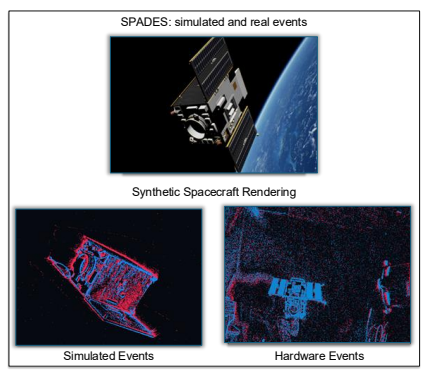
Figure 2 . The synthetic-to-real setting of the SPADES benchmark, showing a synthetic spacecraft rendering, simulated events, and events recorded with physical hardware. The synthetic rendering on the top is reproduced from SPADES [28].
出典 · CC BY 4.0 · Pruthvi Nandan Janga, Kashyap Hegde Kota, Bharatesh Chakravarthi · Direct Regression and Geometric Recovery for Event-based Spacecraft Pose Estimation · 論文の図を引用 · 元のPDFの3ページ目から図の部分を抽出しています。直接回帰システムの入力構成と学習目的
translation分岐は、ImageNetで事前学習したEfficientNet-V2-SでX_gを処理し、その1280次元の特徴に、イベント分布の幅から計算したscale hintを結合して、MLPでtranslationを回帰します。rotation分岐は、ConvNeXt-TinyでX_cを処理して生のquaternionを出力し、それを単位長に正規化します。学習目的は、ESAの複合スコアに基づくL_pose = E_T + λ_R E_Rで、λ_Rは合成検証splitで{1.0, 1.5, 2.0, 3.0}のうち2.0が選ばれました。このλ_Rの選択は、この直接回帰モデルの設定であり、モジュール型システムには適用されません。
さらに、物理ベースの拡張12種類と、ドメインアンカー正則化項L_anchorが学習に使われます。この正則化は、クリーンなビューと破損したビューの特徴を近づけますが、実ドメイン全体に対する不変性を実証するものではありません。
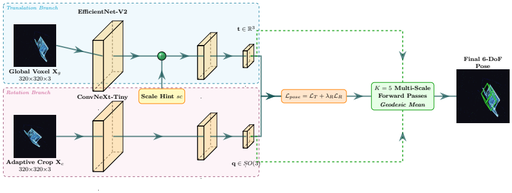
Figure 1 . Direct regression system - separate branches process a global voxel for translation, an adaptive crop for rotation, and event-spread feature provides an additional apparent-scale cue.
出典 · CC BY 4.0 · Pruthvi Nandan Janga, Kashyap Hegde Kota, Bharatesh Chakravarthi · Direct Regression and Geometric Recovery for Event-based Spacecraft Pose Estimation · 論文の図を引用 · 元のPDFの2ページ目から図の部分を抽出しています。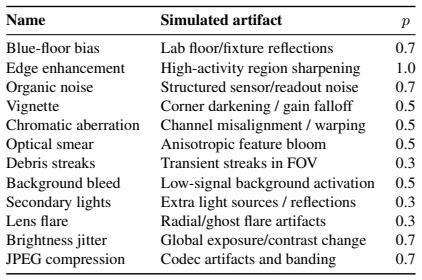
Table 2 . Physics-grounded augmentation suite applied toX g and Xc during training.
出典 · CC BY 4.0 · Pruthvi Nandan Janga, Kashyap Hegde Kota, Bharatesh Chakravarthi · Direct Regression and Geometric Recovery for Event-based Spacecraft Pose Estimation · 論文の図を引用 · 元のPDFの5ページ目から図の部分を抽出しています。モジュール型キーポイントシステムの適応とpose復元
モジュール型システムは、20個の時間binからなるvoxel gridをHRNetW32に入力し、11個の宇宙機キーポイントのヒートマップと信頼度を予測します。このバックボーンは合成SPADESデータでファインチューニングされます。CycleGANは、対応のない対象の観測を使って、合成voxelフレームを対象の見た目に近づけるように変換します。test-time BN適応は、対象入力から正規化統計量を更新します。DANNは、gradient reversalのドメイン分類器で合成特徴と対象特徴を揃えます。そのため、このシステムは実際のposeのラベルは使いませんが、対象ドメインの観測にはアクセスします。
poseは、信頼度重み付きEPnPとRANSACを、CycleGAN+TT-BN分岐とDANN分岐にそれぞれ適用して得ます。最終的なposeでは、orientationはCycleGAN+TT-BNソルバーの値を、translationはDANNソルバーの値を使います。その後、pose系列をforward-backward EKFでオフラインで洗練します。
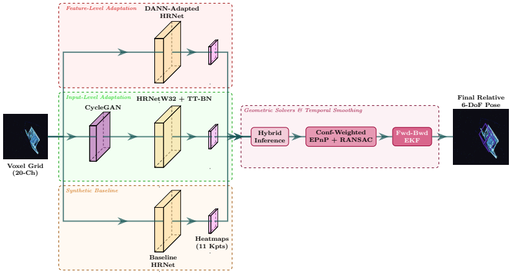
Figure 3 . Modular keypoint-tracking architecture. CycleGAN+TT-BN and DANN provide the two adapted keypoint branches used by the deployed hybrid, the unadapted HRNet is shown as a reference configuration. Confidence-weighted EPnP with RANSAC is solved separately for each adapted branch before component selection and EKF smoothing.
出典 · CC BY 4.0 · Pruthvi Nandan Janga, Kashyap Hegde Kota, Bharatesh Chakravarthi · Direct Regression and Geometric Recovery for Event-based Spacecraft Pose Estimation · 論文の図を引用 · 元のPDFの6ページ目から図の部分を抽出しています。公式集計結果に見られる構成要素ごとの逆転
公式の隠しテスト結果では、直接回帰の提出物はorientation誤差を1.1767 radから0.9101 radに減らし、22.7%の削減でした。同じ比較で、モジュール型の提出物は相対translation誤差を0.1335から0.0285に減らし、78.7%の削減でした。複合スコアは、直接回帰の提出物の1.2052から13.4%低い1.0436です。この13.4%は、orientation誤差の削減率22.7%とは異なる割合です。複合スコアは2つの単位を足した値なので、回転誤差が順位を主に決めます。つまり集計スコアでは直接回帰が優位に見えますが、translationではモジュール型システムが大きく上回ります。
この結果は全フレームに対する公式の集計であり、信頼区間や軌道ごとの分散は報告されていません。
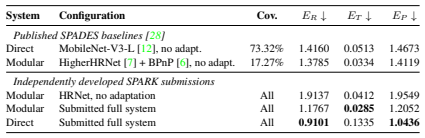
Table 3 . SPADES real-data results in common units: relative trans- lation as a fraction and orientation in radians. Coverage is the per- centage of frames scored. Bold marks the lower error among the two SPARK submissions.
出典 · CC BY 4.0 · Pruthvi Nandan Janga, Kashyap Hegde Kota, Bharatesh Chakravarthi · Direct Regression and Geometric Recovery for Event-based Spacecraft Pose Estimation · 論文の図を引用 · 元のPDFの7ページ目から図の部分を抽出しています。アーカイブされた直接回帰構成の複合スコアの推移
アーカイブされた直接回帰構成の複合スコアは、適応なしでは1.7299でした。ドメインアンカーを加えると1.4664に、照明・ノイズ拡張を使うと1.2879に、空間・アーティファクト拡張を使うと1.2293に下がります。アンカーと拡張の組み合わせ全体を使った構成は1.0436です。これらの構成は互いに包含関係にないため、各変種の個別効果を切り分けられません。また、中間構成は複合スコアのみ記録されているため、構成要素ごとの分解は限られます。モジュール型のCycleGAN+DANN中間構成のスコア1.3347と、最終的なモジュール型スコア1.2052の差0.1295は、ハイブリッド選択やEKF平滑化など複数の変更が同時に反映された値です。
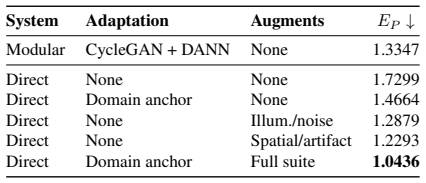
Table 4 . Official composite scores for archived challenge configu- rations. Each row records a submitted system configuration.
出典 · CC BY 4.0 · Pruthvi Nandan Janga, Kashyap Hegde Kota, Bharatesh Chakravarthi · Direct Regression and Geometric Recovery for Event-based Spacecraft Pose Estimation · 論文の図を引用 · 元のPDFの7ページ目から図の部分を抽出しています。ベースライン比較と検証範囲の限界
公開SPADESベースラインのうち、直接的なMobileNet-V3-L構成は73.32%のcoverage、モジュール型のHigherHRNet構成は17.27%のcoverageと報告されています。この値は、確信度の高いposeのみを残した選択的サンプルに対する結果なので、提出システムのAll coverageとは直接比較できません。論文では、2つのシステムの差は、表現、バックボーン、適応、時間処理までまとめた全体パイプラインの差だと述べられています。したがって、translation–orientationの逆転を、直接回帰かキーポイント復元のどちらか1つの設計選択に因果的に帰属させることはしていません。
定性的なケーススタディでは、背景活動でモジュール型のキーポイント対応が失敗する例が示されていますが、その頻度や全体集計の差の原因は測定されていません。
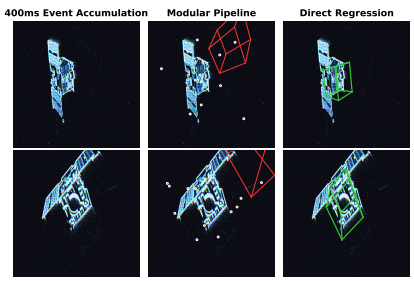
Figure 4 . Two representative frames from a challenging real SPADES sequence. Red markers denote modular HRNet key- points, the red wireframe is the resulting modular EPnP pose projection, and the green wireframe is the direct-regression pose projection. Background activity produces inconsistent correspon- dences and a failed modular pose, while direct regression remains aligned with the spacecraft.
出典 · CC BY 4.0 · Pruthvi Nandan Janga, Kashyap Hegde Kota, Bharatesh Chakravarthi · Direct Regression and Geometric Recovery for Event-based Spacecraft Pose Estimation · 論文の図を引用 · 元のPDFの8ページ目から図の部分を抽出しています。ハイブリッド設計は検証済みの手法ではなく仮説
論文は、直接的なorientation推定と幾何制約によるtranslation復元を組み合わせたハイブリッド設計を提案しています。ただし、これを検証済みの手法としては扱わず、今後の評価のための仮説として位置づけています。著者らは、2つの設計の相補的な誤差分布がこの組み合わせを示唆すると解釈しています。この解釈は、本論文で実装または測定した結果ではありません。公開された集計スコアと定性的な事例だけでは、構成要素ごとの寄与は切り分けていません。
論文情報
- 著者
- Pruthvi Nandan Janga, Kashyap Hegde Kota, Bharatesh Chakravarthi
- 学会・ジャーナル
- arXiv · プレプリント
- 公開日
- 2026年11月6日
- 登録日
- 2026年11月9日
- 更新日
- 2026年11月6日
- バージョン
- v1
- arXiv
- 2611.09717
- カテゴリ
- cs.CV
- ライセンス
- CC BY 4.0
- 掲載内容
- 論文情報・解説・論文の図
この解説は、Refivuの韓国語解説をAIで翻訳したものです。不正確な翻訳や誤りが含まれる可能性があります。論文と図の利用条件は各出典に従います。
アブストラクト
Event cameras offer high temporal resolution and dynamic range for uncooperative spacecraft pose estimation, but models trained on synthetic event streams must generalize to the noise, background activity, and contrast variation of physical sensors. We present a comparative systems study of two independently developed approaches to synthetic-to-real, event-based 6-DoF spacecraft pose estimation. The first is a modular pipeline that combines learned keypoint detection and unlabeled target-domain adaptation with geometry-based pose recovery and temporal smoothing. The second directly regresses translation and rotation from global and cropped event representations using an apparent-scale cue, physics-motivated synthetic corruptions, and feature-consistency regularization. We evaluate both systems under the same SPARK 2026 hidden-test protocol on the real-event split of SPADES, with predictions for all test frames. The results reveal a component-wise reversal concealed by the aggregate challenge score: direct regression reduces orientation error by 22.7% (1.1767 to 0.9101 rad) and obtains a 13.4% lower composite score, whereas the modular pipeline reduces relative translation error by 78.7% (0.1335 to 0.0285). Archived configurations and a qualitative failure case identify plausible explanations for these complementary error profiles, without isolating their causes. These findings motivate a testable hybrid design that combines direct orientation estimation with geometry-constrained translation recovery.
この論文を引用
Pruthvi Nandan Janga, Kashyap Hegde Kota, Bharatesh Chakravarthi (2026). Direct Regression and Geometric Recovery for Event-based Spacecraft Pose Estimation. arXiv:2611.09717v1. https://arxiv.org/abs/2611.09717v1
BibTeX
@misc{janga2026direct,
  title = {{Direct Regression and Geometric Recovery for Event-based Spacecraft Pose Estimation}},
  author = {Pruthvi Nandan Janga and Kashyap Hegde Kota and Bharatesh Chakravarthi},
  year = {2026},
  eprint = {2611.09717},
  archivePrefix = {arXiv},
  url = {https://arxiv.org/abs/2611.09717v1}
}