論文解説
Learning a calibrated decision head from logged bandit feedback
ログに残るバンディットフィードバックによる較正済み決定ヘッドの学習
- 課題 デプロイ後のログには選ばれた行動の結果しか残らないため、デコーダヘッドを較正するのは難しいです。
- 手法 選ばれた行動の確率に適切スコアを適用し、pathwise勾配で学習するCAPSを提案します。
デプロイ後のログだけで得られるフィードバックの限界
デプロイ後のデコーダヘッドは、多くの場合、選んだ行動が正しかったかどうかだけを記録します。この論文は、ログに残るバンディットフィードバックだけでヘッドを適応させながら、確率をうまく較正する方法を問うています。よくある方法として、正解と確認された相互作用だけを選んでファインチューニングする方法がありますが、著者らは、この方法は不正解の事例を捨てるため、モデルが過信するようになると見ています。本文では、この問題の設定と、それに対する代替案を順に説明します。
CAPS: 選ばれた行動の確率への適切スコアの適用
CAPSは、ロギングポリシーが選んだ行動aの確率p_theta(a|x)に厳密な適切二値スコアSを適用し、その値を最小化する手法です。目的関数はL(theta)=E_x E_{a~q} S(p_theta(a|x), r(x,a))で、基本のスコアはBrierであり、代替としてlogスコアを使います。ロギング確率qによる重み付けは行わず、pathwise勾配で学習します。方策には、適合したヘッドのargmaxを使います。チェックポイントは、最後の0.1N件の相互作用に対する対数尤度に基づいて50段階の格子から選び、金ラベルは読み込みません。
Brierとlogスコアを分離された報酬として使う場合の失敗
同じスコアを、サンプルされた行動確率に対する分離されたREINFORCE報酬として使うと、誤った行動の報酬が正しい行動以上になります。論文のCorollary 1では、K個の選択肢と正解gを置き、報酬としてR(a)=1−(r_a−p_a)^2またはlogスコアを用いると、R(w)≥R(g)が成り立つと整理しています。さらに、K=2ではすべての報酬が等しくなり、勾配が0になるとしています。また、正解ロジットに関する期待勾配は0以下です。著者らは、これは分離された報酬がpathwise項を捨てる一般的な規則の特殊な場合だと説明しています。
完全ラベル環境でのバンディットarmの比較
完全ラベルの実験では、REINFORCEの報酬rとr−p、CAPS-Brier、CAPS-logの4つのarmを、同じ温度条件で比較しました。4つの未知ラベルスキームで平均unseen-schema ECEを測ると、4つのarmのいずれも、交差エントロピーに温度を1つ加えたSFTに勝てませんでした。最良のarmは、ベースラインと平均ECEで同程度でした。報酬rによる結果の崩壊は確認されましたが、この比較では優位性は見られませんでした。
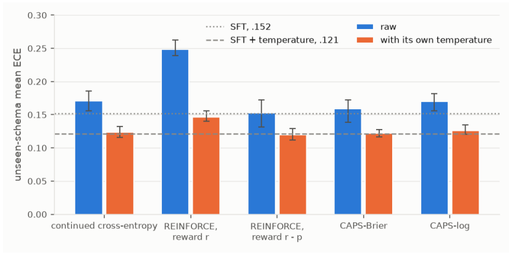
Figure 2 : Unseen-schema mean ECE per full-label arm, 0.6B: the mean of three seeds with their range, raw and with the arm’s own temperature. That temperature is fitted on the in-domain validation split, and the references are SFT and SFT plus one temperature. Provenance: Table C.1, F2.
出典 · CC BY 4.0 · Ye Yuan · Learning a calibrated decision head from logged bandit feedback · 論文の図を引用 · 元のPDFの9ページ目から図の部分を抽出しています。Banking77ログでのCAPSの性能
Banking77のテスト分割で、Nが500、2000、5000の場合について、CAPS-Brierとpositive-only SFTを比較しました。positive-only SFTは学習シードが1つだけだったため、シード平均の差は、基準としたシード1つに対する値です。ログ確率の重みを使うIPS変種は、効果を示しませんでした。
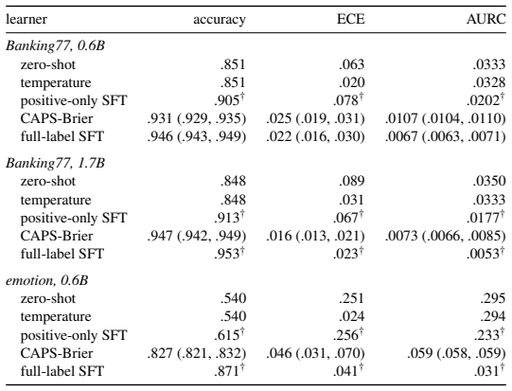
Table 1 : Summary atN5000. Three-seed mean(range)where threeseedsexist, otherwiseseed 0(†). Intervalsand paireddifferences are in Appendix A; every interval there is a record bootstrap with no training-seed variance.
出典 · CC BY 4.0 · Ye Yuan · Learning a calibrated decision head from logged bandit feedback · 論文の図を引用 · 元のPDFの10ページ目から図の部分を抽出しています。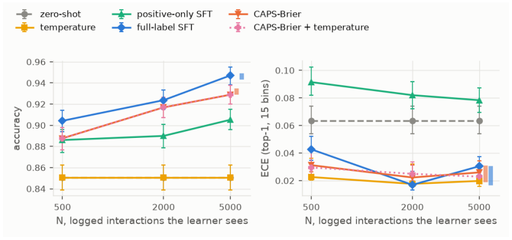
Figure 3 : Accuracy and ECE against N on the Banking77 test split, 0.6B. Every learner is shown at seed 0 with 95 percent record-bootstrap intervals, and CAPS-Brier also with a temperature fitted on its own training interactions. At N 5000 the range over three training seeds is shown for CAPS-Brier and full-label SFT. Provenance: Table C.1, F3.
出典 · CC BY 4.0 · Ye Yuan · Learning a calibrated decision head from logged bandit feedback · 論文の図を引用 · 元のPDFの11ページ目から図の部分を抽出しています。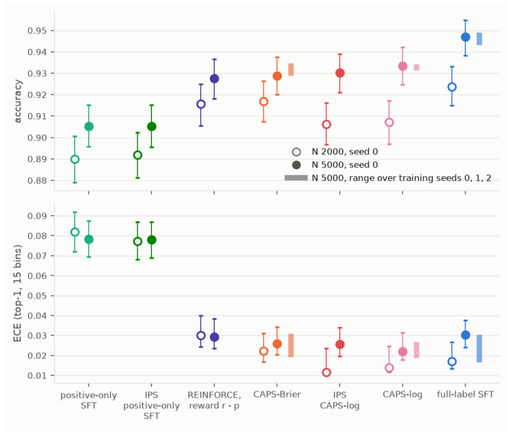
Figure 7 : Off-policy baselines on the Banking77 log, 0.6B: accuracy (top) and ECE (bottom) on the Banking77 test split, 3080 records. Open circles are N 2000 and filled circles N 5000, both seed 0, and their thin whiskers are 95 percent record-bootstrap intervals. The thick bars are the range over training seeds 0, 1 and 2 at N 5000 for the three arms with three seeds, CAPS-Brier, CAPS-log and full-label SFT. Provenance: Table C.1, F7.
出典 · CC BY 4.0 · Ye Yuan · Learning a calibrated decision head from logged bandit feedback · 論文の図を引用 · 元のPDFの26ページ目から図の部分を抽出しています。反転したフィードバックと較正
結果を既知の割合fで対称に反転させた実験では、CAPSの確率は平均的にチャネル比率に従いました。最後まで学習させると、CAPSは単一のノイズdrawを暗記しますが、ログスコアに基づく早期停止では、3つの実行すべてで崩壊前のチェックポイントが選ばれました。ノイズスイープは、割合ごとに1シードです。
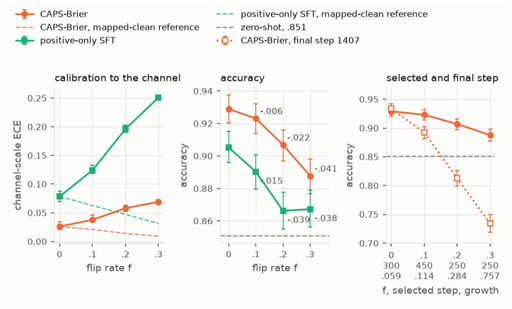
Figure 4 : Noise-rate sweep on the Banking77 log, 0.6B, N 5000, seed 0, one seed per rate with nested draws. Circles are CAPS-Brier and squares positive-only SFT, and every whisker is a 95 percent record-bootstrap interval. Left: channel-scale ECE, the stored top-1 probability scored against the channel’s outcome rate𝑓+(1−2𝑓)×correct ; at f 0 it is the ordinary ECE. The dashed coloured lines are each learner’s mapped-clean reference, its clean run’s top-1 probability mapped through𝑓+(1−2𝑓)𝑝 and scored the same way. Centre: accuracy, each noisy point labelled with its paired accuracy loss from the clean run, whose interval is in Table A.4.1; the dashed grey line is zero-shot accuracy, .851. Right: CAPS-Brier’s accuracy at the selected step (filled circles, solid line) and at the final step 1407 (open squares, dotted line), with zero-shot dashed. Each tick gives the selected step and the criterion growth. The best achievable value of the selection criterion(7)is−𝐻(𝑓) for flipped outcomes, with𝐻 the binary entropy in nats, and 0 for clean ones. Its deterioration is that value minus the criterion, and criterion growth is the deterioration at the final step minus at the selected step. Provenance: Table C.1, F4.
出典 · CC BY 4.0 · Ye Yuan · Learning a calibrated decision head from logged bandit feedback · 論文の図を引用 · 元のPDFの12ページ目から図の部分を抽出しています。シミュレーションによるフィードバックと比較範囲の限界
フィードバックは金ラベルからシミュレーションされ、対称な反転のみを扱ったため、実際の遅延やバイアスは確認していません。反事実リスク最小化の方策学習器と二重頑健推定器は実行していません。学習予算の範囲内では、positive-only SFTはより多くのpassesを受け取り、CAPSは収束前に停止しました。ラベル監査は2つの言語モデルが行い、人によるレビューはありませんでした。
論文情報
- 著者
- Ye Yuan
- 学会・ジャーナル
- arXiv · プレプリント
- 公開日
- 2026年11月11日
- 登録日
- 2026年11月13日
- 更新日
- 2026年11月11日
- バージョン
- v1
- arXiv
- 2611.15572
- カテゴリ
- cs.LG · cs.CL
- ライセンス
- CC BY 4.0
- 掲載内容
- 論文情報・解説・論文の図
この解説は、Refivuの韓国語解説をAIで翻訳したものです。不正確な翻訳や誤りが含まれる可能性があります。論文と図の利用条件は各出典に従います。
アブストラクト
A decision head reads a state and a list of options and returns a probability per option in one forward pass. Once deployed, it usually observes only whether the option it chose was right: logged bandit feedback. We adapt such a head, LoRA on Qwen3-0.6B-Base and 1.7B-Base, from that feedback and report three results. First, the Brier or log score of the sampled action's own probability is not a usable REINFORCE reward: every wrong action earns at least gold's reward, with a mean baseline the lowest-probability wrong action gets the largest advantage, and at two options the signal is zero; in one run it cut accuracy on ordered-scale questions from .636 to .111. Scoring the probability as a loss by the pathwise gradient avoids the collapse, as do the REINFORCE rewards r and r minus p. Second, with full labels, none of four tested bandit arms beat cross-entropy plus one temperature on mean expected calibration error (ECE) over four unseen label schemas. Third, from logged feedback alone, Chosen-Action Proper Scoring (CAPS), the direct method with a proper score on the chosen action's probability, beats fine-tuning on confirmed answers only, which discards negatives: on Banking77 by 2.6 accuracy points, .053 lower ECE and lower selective risk (three seeds against one baseline seed), and by 21.7 points on one seed on emotion data with an often-wrong logger. At N 5000, CAPS stays 1.5 points below full-label training at 0.6B and .6 points at 1.7B against one full-label seed, and propensity weights add nothing on this log. Under feedback flipped at a known rate, one seed per rate, CAPS's confidence tracks the noisy channel on average, backward correction recovers most of the clean calibration, and early stopping on held-out logged outcomes prevented memorising noisy draws in all three runs. Code, adapters, logs and per-record results are public.
この論文を引用
Ye Yuan (2026). Learning a calibrated decision head from logged bandit feedback. arXiv:2611.15572v1. https://arxiv.org/abs/2611.15572v1
BibTeX
@misc{yuan2026learning,
  title = {{Learning a calibrated decision head from logged bandit feedback}},
  author = {Ye Yuan},
  year = {2026},
  eprint = {2611.15572},
  archivePrefix = {arXiv},
  url = {https://arxiv.org/abs/2611.15572v1}
}