論文解説
Causally Constrained and Uncertainty-Aware Cardiopulmonary Risk Prediction
因果的制約と不確実性を考慮した心肺リスク予測
- 課題 胸部CTと臨床記録から心血管リスクを予測する際、既存の計算式はCT所見を使わず、機械学習は小規模コホートで交絡によって歪んだ方向を学習しやすいです。
- 手法 発表された疫学効果を、結果を見る前に重みの制約へ変換します。そのうえで制約の中で重みを当てはめ、閉じた形で欠測入力の不確実性を伝播させます。
胸部CTリスク予測の問題
胸部低線量CTは肺がん検診で標準的に使われており、同じ画像に肺、心臓、血管の表現型が含まれています。しかし既存の臨床リスク計算式は、疾患ごとに固定係数を使い、CT所見を除外することが多いです。一方で、制約のない機械学習は小規模な病院コホートで過学習しやすく、治療や疾患によって歪んだリスクの方向を学習してしまうことがあります。さらに外来記録では直近の検査や過去のCTが欠けていることが多く、単一の値で埋めると個人リスクの不確実性が見えなくなります。この論文は、この3つの問題を同時に扱います。
Causal Envelopeと二段階構造
CE-Agentは二段階の構造です。Stage Iでは、結果ラベルを見る前に有向非巡回グラフを使って事後の事象と複合指標を除外し、発表された相対リスクとオッズ比を、予測変数ごとの範囲、点の値、方向、または自由推定に変換します。この制約の集合がCausal Envelopeです。Stage IIでは、この制約の中で切片と標準化されたログオッズの重みを当てはめます。展開時には、閉じた形の不確実性伝播によって欠測入力が生じるリスクの分散を患者ごとに計算し、90%予測区間を出力します。
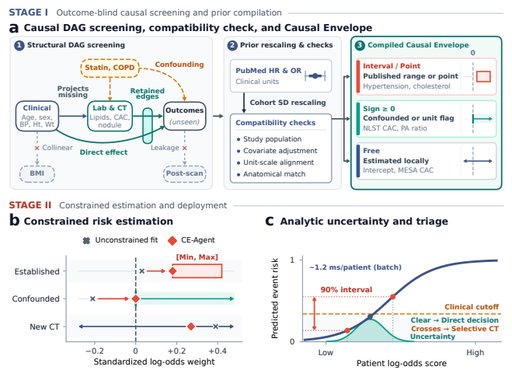
Fig. 1 Overview of the Causal Envelope Agent (CE-Agent). a, Stage I, before any outcome is seen: a directed acyclic graph (DAG) screen removes composite indices and post-scan information; published hazard and odds ratios (HR, OR) per standard deviation (SD) assign each predictor a range, point value, direction, or free estimation.b, Stage II fits weights within these constraints, zeroes those contradicting the published direction, and estimates new CT phenotypes locally.c, Closed-form uncertainty propagation returns a risk, its 90% interval, and a triage decision. BP, blood pressure; Ht, height; Wt, weight; BMI, body mass index; CAC, coronary artery calcification; COPD, chronic obstructive pulmonary disease; PA, pulmonary artery.
出典 · CC BY 4.0 · Yuxiang Lai, Jiashuo Zhang, Liang Zhao, Xiaofeng Yang · Causally Constrained and Uncertainty-Aware Cardiopulmonary Risk Prediction · 論文の図を引用 · 元のPDFの4ページ目から図の部分を抽出しています。制約集合と目的関数
Causal Envelopeは、切片と重みベクトルの集合Ω_CEとして定義されます。区間制約のある予測変数は、発表された区間をデータのスケールに変換した[ℓ_j, u_j]の中になければなりません。点固定の予測変数は発表された点の値と等しく、符号制約のある予測変数は記録された方向δ_jと同じ符号を持たなければなりません。推定では、経験的ロジスティック負の対数尤度に、区間の外側を罰する二乗ヒンジ項と点固定項を加えたものを最小化します。符号制約のもとでKKT条件を見ると、経験的勾配が記録された因果の符号と逆向きを指す予測変数の重みは0に固定されます。交絡によって方向が反転したPA直径比がこの場合に当たると報告されています。
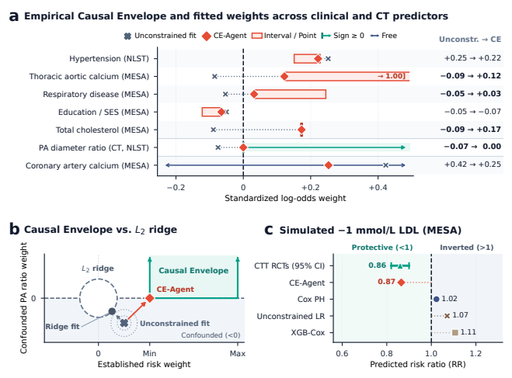
Fig. 2 The Causal Envelope: constraints, geometry , and simulated interventions. a, Standardized log-odds weights by constraint type, from unconstrained fits (Unconstr.) and CE-Agent (CE).b, Schematic: ridge ( L2) shrinkage pulls an established risk factor and the confounded pulmonary artery (PA) diameter ratio toward zero; the Causal Envelope holds the first in range and zeroes the second.c, Risk ratios (RR) for MESA cardiovascular mortality under a simulated 1 mmol/L reduction in low-density lipoprotein (LDL) cholesterol, against Cholesterol Treatment Trialists’ (CTT) randomized controlled trials (RCTs; 95% confidence interval, CI) [ 39]. SES, socioeconomic status; Cox PH, Cox proportional hazards; LR, logistic regression; XGB-Cox, Cox-boosted trees.
出典 · CC BY 4.0 · Yuxiang Lai, Jiashuo Zhang, Liang Zhao, Xiaofeng Yang · Causally Constrained and Uncertainty-Aware Cardiopulmonary Risk Prediction · 論文の図を引用 · 元のPDFの5ページ目から図の部分を抽出しています。NLST心血管死亡予測の検証
同じアウトカムについて、33の病院を統合したモデルと比べると、CE-AgentはFramingham、PCE、PREVENTより高い結果となり、制約のない生存モデルや機械学習モデルと同程度でした。単一病院での学習では、264の病院-ベースラインの組のうち、すべての外部比較でCE-Agentが勝ちました。この数値は、NLSTで血圧、脂質、腎機能が測定されていないため、計算式に標準的な未治療の参照値を入れた条件で得られたものです。
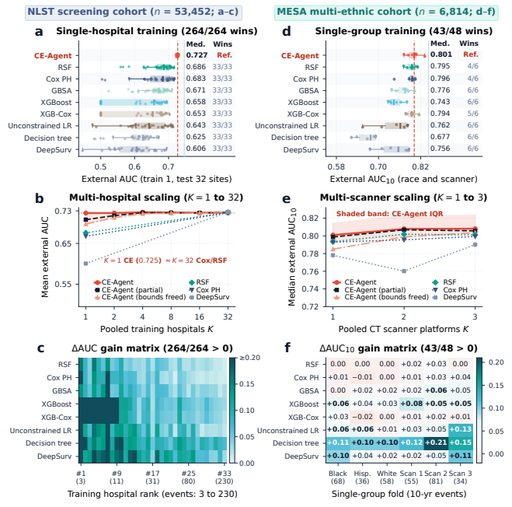
Fig. 4 Generalization across environments and scaling with pooled centers. a,d, External AUC of models trained at one NLST hospital (a) or one of six MESA racial/ethnic or scanner groups with ≥ 20 training events (d); wins, training environments favoring CE-Agent.b,e, External discrimination after pooling NLST hospitals (b) and MESA scanner platforms (e; band, interquartile range, IQR). Partial, some published ranges retained; bounds freed, range-constrained predictors unconstrained.c,f, External AUC gain of CE-Agent over each baseline by NLST hospital (c) and MESA group (f). RSF, random survival forest; GBSA, gradient-boosted survival analysis; XGBoost, gradient- boosted trees; DeepSurv, neural-network survival model; Med., median; Ref., reference; Hisp., Hispanic.
出典 · CC BY 4.0 · Yuxiang Lai, Jiashuo Zhang, Liang Zhao, Xiaofeng Yang · Causally Constrained and Uncertainty-Aware Cardiopulmonary Risk Prediction · 論文の図を引用 · 元のPDFの7ページ目から図の部分を抽出しています。MESA多民族一次予防の検証
MESA検証では、血圧、空腹時脂質、腎機能が直接測定されました。MESAの22個の予測変数を用いたCE-Agentは、10年AUCで0.807を記録し、制約のないモデルの0.789を上回りました。ただし、Coxモデルや臨床計算式とはほぼ同程度です。この結果はMESAのテストコホート内での比較であり、他の集団への一般化は検証されていません。
肺がん予測と適用範囲
同じフレームワークをNLSTの肺がん予測にそのまま適用すると、6年AUCcrは0.708で、再校正したPLCOm2012の0.704と比較されました。予測変数を方向のみに絞ったsign-only変種も、AUCcr 0.710を記録しました。ただし、この結果はNLSTテストセットでの肺がん予測に限られ、他の検診集団で同じ性能が得られるかは確認していません。
限界と残された課題
著者らは、主要な結果が2つの米国コホートに基づいており、他の集団への一般化はまだ検証されていないと述べています。制約は、発表された疫学的根拠の方向と範囲が現在のコホートの測定と整合しているという仮定の上に置かれています。付録の一部のアブレーション実験は、単一の設定と限られたブートストラップ反復で測定されたため、他の病院や集団で同じ大きさの改善が得られることは保証されません。また、実際の臨床転帰の改善は前向き研究で確認する必要があります。
論文情報
- 著者
- Yuxiang Lai, Jiashuo Zhang, Liang Zhao, Xiaofeng Yang
- 学会・ジャーナル
- arXiv · プレプリント
- 公開日
- 2026年11月13日
- 登録日
- 2026年11月16日
- 更新日
- 2026年11月13日
- バージョン
- v1
- arXiv
- 2611.17819
- カテゴリ
- cs.AI
- ライセンス
- CC BY 4.0
- 掲載内容
- 論文情報・解説・論文の図
この解説は、Refivuの韓国語解説をAIで翻訳したものです。不正確な翻訳や誤りが含まれる可能性があります。論文と図の利用条件は各出典に従います。
アブストラクト
Routine chest computed tomography (CT) captures pulmonary, cardiac, and vascular phenotypes that jointly stratify lung cancer and cardiovascular disease, the two leading causes of death in lung-screening populations. Yet clinical risk calculators evaluate each disease in isolation and omit CT findings, whereas unconstrained machine learning overfits small hospital cohorts, learns treatment- and illness-confounded risk directions, and conceals uncertainty when patient records are incomplete. Here we present the Causal Envelope Agent (CE-Agent), a two-stage framework that compiles peer-reviewed epidemiological evidence into explicit constraints on risk-factor weights before any outcome is seen, while estimating local baseline risk and newly added CT phenotypes from cohort data. At deployment, closed-form uncertainty propagation accounts for missing clinical or CT inputs within milliseconds per patient, running over two orders of magnitude faster than Monte Carlo sampling and returning calibrated risk intervals that direct chart review and selective imaging to borderline patients. Across 53,452 lung-screening participants from 33 US hospitals and 6,814 multi-ethnic adults, CE-Agent outperforms cardiovascular calculators in lung screening, exceeds the Pooled Cohort Equations on hard atherosclerotic events while correcting their 1.7-fold risk overestimation, and generalizes from a single hospital or CT scanner to external sites while lowering required sample sizes up to fivefold. Applied unchanged to lung cancer, CE-Agent matches established screening models with accurate calibration even when restricted to risk-factor directions alone, and pairing both predictions improves joint cardiopulmonary triage from a single screening visit.
この論文を引用
Yuxiang Lai, Jiashuo Zhang, Liang Zhao, Xiaofeng Yang (2026). Causally Constrained and Uncertainty-Aware Cardiopulmonary Risk Prediction. arXiv:2611.17819v1. https://arxiv.org/abs/2611.17819v1
BibTeX
@misc{lai2026causally,
  title = {{Causally Constrained and Uncertainty-Aware Cardiopulmonary Risk Prediction}},
  author = {Yuxiang Lai and Jiashuo Zhang and Liang Zhao and Xiaofeng Yang},
  year = {2026},
  eprint = {2611.17819},
  archivePrefix = {arXiv},
  url = {https://arxiv.org/abs/2611.17819v1}
}