論文解説
Goodhart in the Planner: Sampling-Based Control Exploits Rewards Learned from Human Preferences
計画器の中のGoodhart:人間の選好から学習した報酬を悪用するサンプリングベース制御
- 課題 学習した選好報酬の点数器を、サンプリングベースの計画やbest-of-N選択に使うと、実際の収益が下がるかどうかを測定します。
- 手法 MPPIは、複製ポリシーの周りの行動列を学習点数で重み付けして平均し、χ2規則は誤差の広がりを基準に探索の強さを決めます。
- 結果 HalfCheetahやHopperなどでは、探索を強くすると実際の収益が下がります。人間ラベルのdrawer-openでは、探索の設定によって引き出しが開かなかったと報告されています。
学習された報酬を最適化するときの問題
ロボットは、人の選好から学習した報酬モデルを基準に行動を選ぶ場面が増えています。モデル予測制御(MPC)やbest-of-N選択では、多くの候補をサンプリングし、学習した点数が高い候補を選ぶため、点数器の誤差が実際のタスクの収益をどの程度減らすのかが中心の問いです。言語モデルの整合性の研究では、学習した報酬を過度に最適化すると、その報酬が測ろうとしていた品質が下がることが知られています。この論文は、ロボットの計画器でも同じ現象が見られるか、見られるとすればどのような条件で起きるのかを測定しています。計画器は毎ステップ最適化し直され、ラベル数は数百から数千ペア程度である点で、言語モデルの設定とは異なります。
MPPI計画器と点数器の構成
MPPIは現在の状態からN個の行動列をロールアウトし、学習した収益推定値に従って加重平均を計算し、最初の行動を実行します。提案行動は、複製ポリシーの計画U周辺にノイズを加えて作られ、これがRLHFの基準ポリシーの役割を果たします。標準のMPPIでは、重みをexp(Ĵ/λ)に比例させ、これはKL正則化目的の解にあたります。χ2規則はmax(0, Ĵ−c)の形の重みを使い、Tsallis発散に基づくMPPIから取り入れた手法です。点数器は、選好ペアに対するBradley–Terry尤度で学習した2層MLPです。評価には実際のMuJoCo動力学を使い、失敗が点数器に由来するのかを切り分けます。
誤差の広がりとχ2正則化の保証範囲
理論の節では、計画分布pが提案分布qからどれだけ動いたかをs(p)=√χ2(p∥q)で測り、点数器の誤差の広がりσeとの積で、実際の利得と学習点数上の利得の差を抑えます。論文のLemma 1は、|∆(p)−∆̂(p)| ≤ σe s(p)を示しています。ここで∆は実際の利得、∆̂は学習した点数基準の利得です。Theorem 2は、σが点数器自体の広がりσq(Ĵ)以上であれば、どの計画分布も利得を保証できないと述べています。それより小さい場合には、χ2 MPPIが最悪ケースの保証W_σ(p)を最大化すると述べています。この結果は、σeが既知であるという条件と、最悪ケース保証の範囲内でのみ成り立ちます。
Locomotionにおける探索の強さと実際の収益
HalfCheetahとHopperで、クラウドソースのラベルで学習した点数器を使うと、MPPIの温度λを3から0.01に下げるほど実際の収益が下がります。論文の報告では、HalfCheetahの実際の収益はλ=3で480、λ=0.01で262に下がり、一様平均は233、複製ポリシーを直接実行した値は412です。完璧な点数器では、同じタスクで867から1,010へむしろ向上します。Hopperでも探索の強度が上がると収益は減りますが、完璧な点数器でも損失が出るため、一部は計画器自体のコストです。
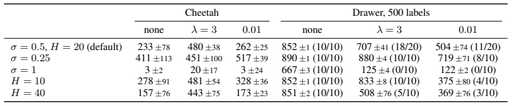
Table 2 .Planner settings. True return of uniform averaging (no search) and of standard MPPI with the learned scorer at λ= 3 and 0.01, for proposal noise σ and horizon H; mean ± standard error over 10 runs (default row: all runs of the main experiments); successes in parentheses.
出典 · CC BY 4.0 · Soovadeep Bakshi, Apurba Bose · Goodhart in the Planner: Sampling-Based Control Exploits Rewards Learned from Human Preferences · 論文の図を引用 · 元のPDFの13ページ目から図の部分を抽出しています。操作タスクと人間ラベルの違い
Meta-World drawer-openで500個のラベルを使うと、実際の収益は707から504に下がり、引き出しは20回中9回しか開きません。著者がブラインドでラベル付けした人間ラベル300ペアでは、最も弱い探索が複製ポリシーとほぼ同程度ですが、λが0.1以下だと20回すべてで引き出しが開きません。この結果は、ブラインドラベルを用いた特定のタスクとラベル条件での観察であり、すべての人間ラベルに対する一般的な結論には広がりません。plate-slideでは、合成ラベルは探索の強さに応じて収益を下げましたが、人間ラベルでは悪化の程度が小さくなりました。
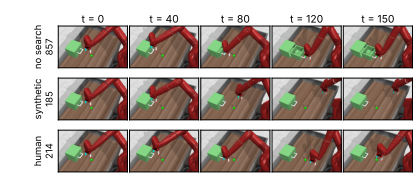
Figure 2 .One drawer start under three planners (true returns). Uniform averaging opens the drawer. Standard MPPI (λ= 0.01 ) on the 500-label scorer lifts the hand into a part of the workspace the data never visited; on the human-label scorer (λ= 0.1 ) it pulls in front of the handle without touching it.
出典 · CC BY 4.0 · Soovadeep Bakshi, Apurba Bose · Goodhart in the Planner: Sampling-Based Control Exploits Rewards Learned from Human Preferences · 論文の図を引用 · 元のPDFの5ページ目から図の部分を抽出しています。補正規則と人間ラベル補正の限界
ただし、この規則は、探索が役立つ場面でも保守的に動きます。人の比較で補正しても、その人が点数器に学習させたバイアスは見つけられず、別の評価者やタイ補正がその害を減らします。ある一人の著者のラベルで学習した点数器は、その著者の比較では高く評価されましたが、実際の収益とは負の相関を示しました。
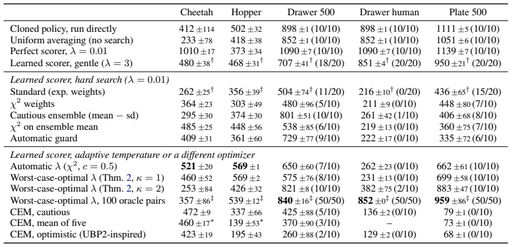
Table 1 .True return at hard search, mean ± standard error over 10 runs per cell († 20, ∗ 5); successes over runs in parentheses on the arm. ‡ Mean ± standard deviation across five independent 100-pair calibration sets ranked by true return (an oracle), drawn on start states the evaluation never uses, each calibrating its own controller (Table 6). Bold: best learned-scorer method per column (the calibrated temperature on the arm, the automatic one on the walkers).
出典 · CC BY 4.0 · Soovadeep Bakshi, Apurba Bose · Goodhart in the Planner: Sampling-Based Control Exploits Rewards Learned from Human Preferences · 論文の図を引用 · 元のPDFの8ページ目から図の部分を抽出しています。検証器を使ったbest-of-N実験
best-of-N実験では、状態ベースの検証器を合成ペア500個または2,000個で学習させ、N個のノイズ行動のうち1つを選ぶ手法を検証します。500ペアでは、N=4がdrawerで1つのノイズ行動とおおむね同程度ですが、N=16以上では両方の値が下がり、N=1,024では1つのノイズ行動よりはっきり低くなります。2,000ペアでは、すべてのNで選択が1つのノイズ行動より優れていたと論文では報告されています。したがって、この結果は検証器の学習ペア数に依存するという条件付きです。
範囲と残された限界
実験はシミュレーション上で行われ、点数器は状態入力の小さなMLPです。人間ラベルは二人の著者から得られ、ほとんどのセルは10回実行です。計画段階では実際のシミュレータを使って報酬の問題を切り分けますが、動力学モデルの誤差は含まれていません。補正ペアの大部分は実際の収益やシミュレーション上のラベラーから得たもので、実ロボットへの配備で得られるオラクルではありません。そのため、補正規則の結果は、この課題と設定で確認された範囲と解釈すべきです。
論文情報
- 著者
- Soovadeep Bakshi, Apurba Bose
- 学会・ジャーナル
- arXiv · プレプリント
- 公開日
- 2026年11月6日
- 登録日
- 2026年11月9日
- 更新日
- 2026年11月6日
- バージョン
- v1
- arXiv
- 2611.09670
- カテゴリ
- cs.RO · cs.AI · cs.LG
- ライセンス
- CC BY 4.0
- 掲載内容
- 論文情報・解説・論文の図
この解説は、Refivuの韓国語解説をAIで翻訳したものです。不正確な翻訳や誤りが含まれる可能性があります。論文と図の利用条件は各出典に従います。
アブストラクト
Robots increasingly choose actions by searching against a reward model learned from human preferences, in model-predictive control or best-of-$N$ selection; we measure what this does to the true objective. On HalfCheetah and Hopper with crowd-sourced labels, and on Meta-World drawer-open and plate-slide with synthetic labels and blind labels from the two authors, harder MPPI search cuts true return by up to 76%: with human labels the drawer opens in 0 of 20 runs against 10 of 10 for the cloned policy the planner starts from, while held-out label accuracy stays at 0.75-0.97. On plate-slide human labels are exploited less than synthetic ones, and on window-open search helps. True return roughly follows how far the planner's weights move from its proposals ($\sqrt{\mathrm{KL}}$) for both weighting rules we test, and best-of-$N$ with a verifier from synthetic labels falls below a single noisy action. We prove that $χ^2$-regularized MPPI at a temperature set by the scorer's error spread on the proposals is worst-case optimal, that no positive gain can be certified once that spread exceeds the scorer's own, and that an episode's return splits exactly into per-step terms, of which the guarantee covers the selection terms. Calibrated from 100 proposal pairs ranked by true return (an oracle) on start states the evaluation never uses, this rule is the safest fix we test: with each of five independent sets it succeeds in every arm run and keeps on average 86-94% of the cloned policy's return on plate-slide and drawer-open, though it is cautious where search helps. Calibration from a person's comparisons cannot detect a bias the scorer learned from that person; correcting for the pairs people cannot tell apart, or a second person, limits the damage.
この論文を引用
Soovadeep Bakshi, Apurba Bose (2026). Goodhart in the Planner: Sampling-Based Control Exploits Rewards Learned from Human Preferences. arXiv:2611.09670v1. https://arxiv.org/abs/2611.09670v1
BibTeX
@misc{bakshi2026goodhart,
  title = {{Goodhart in the Planner: Sampling-Based Control Exploits Rewards Learned from Human Preferences}},
  author = {Soovadeep Bakshi and Apurba Bose},
  year = {2026},
  eprint = {2611.09670},
  archivePrefix = {arXiv},
  url = {https://arxiv.org/abs/2611.09670v1}
}