論文解説
What Entropy-Based View Selection Cannot See: An Audit of Test-Time Adaptation for Vision-Language Models
エントロピーベースのview選択が見落とすもの:Vision-Languageモデルにおけるテスト時適応の検証
- 課題 テスト時適応で、view選択の点数が実際にどの情報を使っているかは、十分に検証されていません。
- 手法 論文では、パイプラインの段階ごとに寄与を分解し、エントロピー点数の情報量をAUCで測定しています。
既存のview選択点数への疑問
CLIPのようなvision-languageモデルは、学習していないカテゴリも分類できますが、テスト画像のスタイルや出所が学習データと異なると精度が下がります。これを抑えるため、TPT、ZERO、ADTEといったtest-time adaptation手法は、画像ごとにランダムなcropとflipで64個のviewを作り、そのうち予測エントロピーが低いviewだけを選んで平均予測に使います。ただ、view選択の点数が実際に何を見ているのかは、十分に検証されていません。この論文では、パイプラインの残りの段階を固定したまま、点数そのものを検証しています。
エントロピー点数の実際の役割の分解
論文では、augment、score、select、aggregate、gradient stepの各段階を、残り2段階を固定したまま個別に測定しています。同じviewとキャッシュされた埋め込み、readoutを使い、差分をその段階の効果として帰属させました。エントロピーが入力とするのは、モデルがviewごとに出力する予測分布です。論文では、reducible errorにおいてこの点数が正解viewをどの程度よく選び分けられるかを、AUCで測定したと述べられています。このAUC測定では、平均予測で誤りの集合を選んだあとに生じるバイアスを防ぐため、viewを半分ずつに分ける統制設計を用いています。
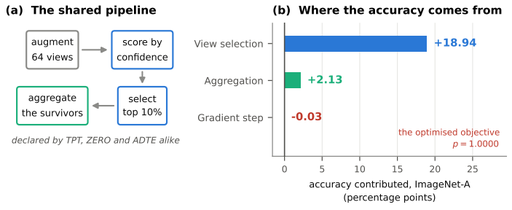
Figure 1 :The pipeline, and which of its stages produces the accuracy. (a)The augment, score, select, aggregate recipe TPT, ZERO and ADTE each declare.(b)Each stage measured with the other two held fixed, on ImageNet-A, inpercentage points: the absolute gap between two accura- cies, so40%to59%is19of them. Selection produces almost all of the gain; the gradient step is indistinguishable from no update under a paired McNemar test [McNemar, 1947]. Concurrent work agrees by different means [Huang et al., 2026]; we claim the decomposition and its mechanism, not the direction.
出典 · CC BY 4.0 · Sivasuthan Sukumar, Uthayasanker Thayasivam · What Entropy-Based View Selection Cannot See: An Audit of Test-Time Adaptation for Vision-Language Models · 論文の図を引用 · 元のPDFの2ページ目から図の部分を抽出しています。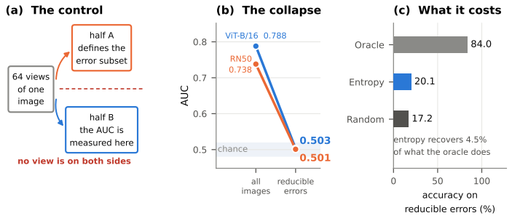
Figure 2 :The entropy score separates useful views from useless ones only where a better choice cannot help. (a)The control: reducible errors are defined on one random half of an image’s views and the score evaluated on the disjoint half, so restricting the population cannot contaminate the measurement.(b)Area under the ROC curve (AUC, Sec. 3), where1.0orders correct views perfectly above incorrect ones and0.5carries no information; on reducible errors it falls to chance on both encoders.(c)The consequence in accuracy on those images.
出典 · CC BY 4.0 · Sivasuthan Sukumar, Uthayasanker Thayasivam · What Entropy-Based View Selection Cannot See: An Audit of Test-Time Adaptation for Vision-Language Models · 論文の図を引用 · 元のPDFの3ページ目から図の部分を抽出しています。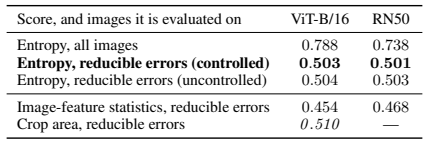
Table 2 :The entropy score is at chance exactly where a better choice would help.Mean AUC over six datasets per encoder, where0.5means the score orders correct and incorrect views no better than chance. Orientation matters: a value below0.5is anti-predictive, and reversing the image- feature row gives0.546and0.532. That row tests statistics computed from the cached embeddings rather than the output distribution, and the crop-area row a quantity that is not a function of the model at all.
出典 · CC BY 4.0 · Sivasuthan Sukumar, Uthayasanker Thayasivam · What Entropy-Based View Selection Cannot See: An Audit of Test-Time Adaptation for Vision-Language Models · 論文の図を引用 · 元のPDFの13ページ目から図の部分を抽出しています。情報の限界とcrop面積の信号
論文は、点数が出力分布の順序統計量だけを見るため、どのクラスを好むかを表現できないと分析しています。その代わりの手段として、augmentationがすでにサンプリングしたcrop面積をラベルなしで記録し、view順位に結合しました。これは5-foldのcross-fittingで2つのパラメータを選んだ結果ですが、ベースラインのエントロピーはチューニングしていません。

Table 1 :Selection rules on the15-dataset benchmark, CLIP ViT-B/16, with identical views, cache and readout so thatonlythe selection rule differs. The baseline is never tuned; our parameters are cross-fitted. ∗ marksp <0.05under paired McNemar [McNemar, 1947]. Crop geometry is positive on14of15datasets and its largest gains are those the label-free measurement flags in advance (Fig. 3).
出典 · CC BY 4.0 · Sivasuthan Sukumar, Uthayasanker Thayasivam · What Entropy-Based View Selection Cannot See: An Audit of Test-Time Adaptation for Vision-Language Models · 論文の図を引用 · 元のPDFの7ページ目から図の部分を抽出しています。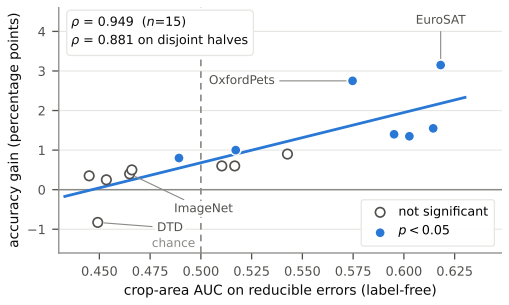
Figure 3 :The gain is predictable before the method is run.One point per dataset; the horizontal axis is how well a view’scrop areaseparates correct from incorrect views on reducible errors, an AUC computed with no method in the loop. Datasets left of the chance line gain nothing, as a real signal rather than a tuning artefact should. Per-dataset gains are in Tab. 1.
出典 · CC BY 4.0 · Sivasuthan Sukumar, Uthayasanker Thayasivam · What Entropy-Based View Selection Cannot See: An Audit of Test-Time Adaptation for Vision-Language Models · 論文の図を引用 · 元のPDFの8ページ目から図の部分を抽出しています。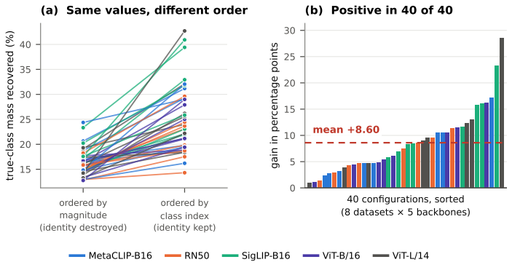
Figure 4 :What the model’s response cannot see.Both arms use the same regressor, the same training rows, and feature sets of identical dimension holding the identical value multiset; only the ordering differs.(a)Every configuration improves when class identity is preserved.(b)The gap, sorted: positive in40/40, mean8.60percentage points. The capacity ladder had saturated in all40, so under-fitting does not explain it. Per-configuration numbers in Tab. 5.
出典 · CC BY 4.0 · Sivasuthan Sukumar, Uthayasanker Thayasivam · What Entropy-Based View Selection Cannot See: An Audit of Test-Time Adaptation for Vision-Language Models · 論文の図を引用 · 元のPDFの15ページ目から図の部分を抽出しています。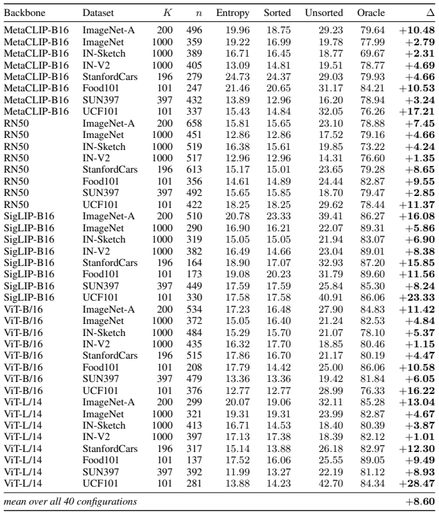
Table 5 :Keeping class identity is worth8.60percentage points, positive in40/40.“Sorted” and “Unsorted” are the two matched feature sets; “Oracle” ranks by the true-class mass directly. Share of the oracle gap:8.4%for the best class-symmetric fit,21.7%for the class-asymmetric one.
出典 · CC BY 4.0 · Sivasuthan Sukumar, Uthayasanker Thayasivam · What Entropy-Based View Selection Cannot See: An Audit of Test-Time Adaptation for Vision-Language Models · 論文の図を引用 · 元のPDFの16ページ目から図の部分を抽出しています。残された課題
論文では、crop面積の信号は、より強いscoring関数と組み合わせたとき追加の利得が大きくなかったと報告されています。2つの信号は加算的だと事前登録していましたが、実際の利得は予測より小さいものでした。また、crop面積が精度を上げる仕組みは提示できておらず、提案ルールは2つのパラメータをcross-fitするため、チューニングが不要な手法だとは主張していません。ZEROとADTEのコードは実行せず、設定の記述に基づいて適用範囲を論証しています。
論文情報
- 著者
- Sivasuthan Sukumar, Uthayasanker Thayasivam
- 学会・ジャーナル
- arXiv · プレプリント
- 公開日
- 2026年11月10日
- 登録日
- 2026年11月13日
- 更新日
- 2026年11月10日
- バージョン
- v1
- arXiv
- 2611.14686
- カテゴリ
- cs.CV · cs.AI
- ライセンス
- CC BY 4.0
- 掲載内容
- 論文情報・解説・論文の図
この解説は、Refivuの韓国語解説をAIで翻訳したものです。不正確な翻訳や誤りが含まれる可能性があります。論文と図の利用条件は各出典に従います。
アブストラクト
Vision-language models such as CLIP can classify images into categories they were never explicitly trained to recognize, but accuracy degrades when test images differ in style or source from their training data. A common remedy generates randomly cropped and flipped copies of each test image, called views, and combines their predictions. Since some views miss the object, methods must identify which views to trust. The dominant approach uses prediction entropy to measure confidence and retains the most certain views. Other methods use signals such as embedding typicality. Despite repeated refinements of these scoring functions, the information they rely on, the model's own response to each view, remains largely unexamined. We investigate this choice while holding other pipeline stages fixed. First, we show that view selection, rather than the gradient update, accounts for almost all accuracy gains. We then examine whether entropy identifies useful views when predictions are wrong, despite at least one view predicting the correct class. In these cases, entropy ranks correct views above incorrect ones no better than chance, recovering only about one-twentieth of the accuracy recovered by an oracle over the same views. This finding holds across two image encoders and under a control ruling out an obvious statistical artifact. An exact analysis explains this limitation: entropy measures confidence but not which class a view favors. We identify an unused signal already available in the augmentation pipeline: the fraction of the original image retained by each crop. Ranking views by this quantity improves accuracy on 14 of 15 benchmark datasets over entropy and on 11 of 15 over the strongest scoring function tested. A pre-method measurement also predicts which datasets benefit.
この論文を引用
Sivasuthan Sukumar, Uthayasanker Thayasivam (2026). What Entropy-Based View Selection Cannot See: An Audit of Test-Time Adaptation for Vision-Language Models. arXiv:2611.14686v1. https://arxiv.org/abs/2611.14686v1
BibTeX
@misc{sukumar2026what,
  title = {{What Entropy-Based View Selection Cannot See: An Audit of Test-Time Adaptation for Vision-Language Models}},
  author = {Sivasuthan Sukumar and Uthayasanker Thayasivam},
  year = {2026},
  eprint = {2611.14686},
  archivePrefix = {arXiv},
  url = {https://arxiv.org/abs/2611.14686v1}
}