論文解説
DR Pixel: Page-Native Deep Research with Vision-Language Models
DR PIXEL: 論文のページ画像だけを使って文献を探し答えを導くエージェント
- 課題 従来のDRエージェントは、論文をOCRでテキストに変えてから検索していました。そのため表や図の見た目が失われ、変換の誤りも後の検索と推論に残ります。
- 手法 DR PIXELは、論文のページ画像をそのまま検索と推論に使います。テキストに戻さないので、図表や数式の見た目が最後まで残ります。
- 結果 DRPIXELBENCHで、学習後のQwen3.6-27Bの精度が40.1から52.1に向上し、GPT-5.4をわずかに上回りました。
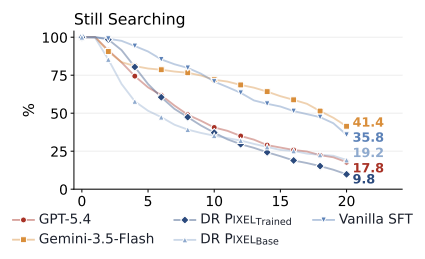
Figure 8 : Share of questions that issue at least k searches on DRPIXELBENCH. The harness stops a trajectory at 20 calls, so the right-hand endpoint of each curve is that model’s exhaustion rate. DR PIXEL Trained is the lowest curve from the twelfth search on and the only model that ends below 10%. Vanilla SFT and Gemini-3.5-Flash share a shape: both stay above 75% for the first eight searches and then run out of budget rather than deciding to stop.
出典 · CC BY 4.0 · Tiansheng Hu, Yichuan Wang, James V. Talwar, Nicholas Tomlin, Chen Zhao, Sewon Min · DR Pixel: Page-Native Deep Research with Vision-Language Models · 論文の図を引用 · 元のPDFの24ページ目から図の部分を抽出しています。OCRに頼るDRの限界
DRエージェントは、複数回の検索と推論を繰り返して複雑な情報探索に答えるエージェントです。DRが法律、金融、科学といった専門文書の領域へ広がるにつれ、根拠は本文だけでなく表、図、グラフ、数式にも含まれるようになりました。それでも従来は、PDFを線形化してテキストに変換し、検索と推論をテキスト空間の中で行うのが一般的でした。この方式には2つの問題があります。
1つ目は、線形化によって図や表の視覚構造が失われ、そこにある情報を取り出しにくくなることです。2つ目は、抽出やOCRの誤りが後段の検索と推論に伝わることです。つまり、解析の段階で一度捨てられた情報は、後段の検索や推論では取り戻せません。
そこで著者らは、ページを画像のまま検索と推論に使えば、この問題を避けられるかを問いました。既存の研究には、画像検索ツールを追加してテキスト検索と使い分ける方式もあります。しかし、この方式ではテキストと視覚の内容を別々の空間として扱うため、同じページ上の図と、それを説明する本文の関係が保たれません。この対応の切れ目が、本研究でページを1単位として扱う動機になりました。
評価の面でも、既存のDRベンチマークはテキスト中心か、1回の検索で再現率が高くなるものが多く、この設定を測るには足りません。そこで著者らは、複数回の検索と図表の読解を同時に求める評価セットDRPIXELBENCHを作りました。
ページ画像を検索と推論の単位にする仕組み
DR PIXELは、論文をページごとに画像へ変換し、検索の対象も推論の入力もそのページ画像にするエージェントです。テキストに戻す段階を挟まないため、図表や数式の見た目は最後まで証拠として残ります。ページは検索の単位であると同時に、エージェントが読むモデル入力でもあります。推論を担うのは、画像を直接読めるVLMであるエージェントπです。
オフラインでは、各論文をページ単位で描画し、D は固定長ベクトルに変換されたページ画像の集まりになります。各ページ画像は、Qwen3-VL-Embedding-8Bのような VLM ベースの埋め込みモデルで固定長ベクトルに符号化されます。この索引には1,062,153枚のページ画像が入ります。推論時には、検索関数fがテキストのクエリatを同じ埋め込み空間に写し、上位k件のページ画像を返します。返すページ数はk=3で、他の設定とトークン予算がほぼ揃うように選ばれています。
全体の流れはReActループで、各ターンtにエージェントが思考τtと行動atを生成します。行動は検索クエリか最終回答のいずれかで、最終回答が出た時点で軌跡は終了します。検索結果は履歴Ht-1に加えられ、最終回答まで文脈に残ります。検索は最大T=20回で、これは全モデル共通の上限です。
テキストと画像を別々の検索ツールとして扱う拡張では、文と図の対応関係が保たれません。DR PIXELは、同じページ内に文と図を残したまま検索できる点で異なります。その意味で、差は検索の単位そのものにあります。
OCRベース手法との比較:学習なしでもページ検索は有利か
OCRベース手法との比較では、テキストのみのOCRベース、テキストと図を併用するOCRベース、DR PIXELの3つの設定を、GPT-5.4、Gemini-3.5-Flash、Qwen3.6-27Bの3モデルで比べました。精度は、DR PIXELがどのモデルでも両方のOCRベース設定を上回りました。テキストと図の設定と比べると、GPT-5.4で5.6ポイント、Gemini-3.5-Flashで5.1ポイント、Qwen3.6-27Bで5.2ポイント高くなりました。論文は、学習なしでもページ画像を直接扱うことで、OCRベースの手法より精度が5.1から8.4ポイント改善すると要約しています。
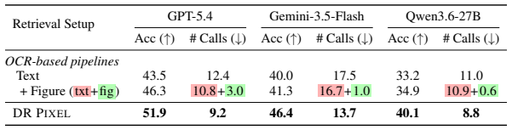
Table 2 : DR PIXELversus OCR-based retrieval pipelines, all with no training. OCR-based pipelines retrieve OCR text chunks (Text), optionally with a separate search on the figure corpus (+ Figure). DR PIXELretrieves and reads whole pages as images.Accis answer accuracy.# Callsis the number of tool calls per question, split into text and figure calls in the text-and-figure setting.
出典 · CC BY 4.0 · Tiansheng Hu, Yichuan Wang, James V. Talwar, Nicholas Tomlin, Chen Zhao, Sewon Min · DR Pixel: Page-Native Deep Research with Vision-Language Models · 論文の図を引用 · 元のPDFの5ページ目から図の部分を抽出しています。図の検索ツールを足しても効果は小さく、エージェントは指示に図の検索が書かれていても、それをあまり使いませんでした。検索回数を見ると、GPT-5.4ではテキストと図の併用設定が10.8回のテキスト検索と3.0回の図の検索を行うのに対し、DR PIXELは9.2回で済みました。Gemini-3.5-Flashでは、テキストのみの設定の17.5回に対してDR PIXELは13.7回、Qwen3.6-27Bでは11.0回に対して8.8回でした。このように、DR PIXELは検索回数を20%から30%減らしました。精度と検索回数の両方で改善しているため、OCRを挟まずにページを直接扱う方が、効率の面でも有利だと言えます。
一方、Qwen3.6-27Bは、DR PIXELでも精度が40.1にとどまり、GPT-5.4の51.9には届きませんでした。Qwen3.6-27Bの検索回数はGPT-5.4とほぼ同じですが、精度は11.8ポイント低くなっています。内訳では、Qwen3.6-27Bは正解ページを取得する割合がGPT-5.4より9.4ポイント低く、クエリの5.3%が以前のクエリと重複していました。さらに、取得したページを読む力にも差があり、正解ページが直近の検索で得られた場合は5.1ポイント、以前の検索で得られた場合は12.3ポイント遅れました。
この差が、学習の対象をオープンウェイトのモデルにした理由です。次節では、学習前のモデルをDR PIXEL Base、学習後のモデルをDR PIXEL Trainedと呼び、その効果を比べます。
反実仮想クレジット再重み付けの計算
教師軌跡には、正解につながる検索と、重複したり失敗したりした検索が混ざっています。標準のSFTはこれらを区別せず模倣するため、無駄な検索まで増えてしまいます。そこで本研究は、ステップごとに寄与を測り、その寄与で学習の重みを変える方法を用いました。
寄与は、ステップを取り除いたとき正解の対数尤度がどれだけ下がるかで測ります。対数尤度は凍結した基底モデルπ0で計算し、\(\ell(H)=\log\pi_0(y^\star \mid H)\)と書きます。ここでy⋆は正解、Hは i 回の検索後までの履歴です。
推論ステップτiは、HTから取り除いたときの減少で測ります。式では\(c_{\tau_i}=\ell(H_T)-\ell(H_T\setminus\tau_i)\)です。検索ステップaiは、検索結果を加えたことで増えた分を見ます。式では\(c_{a_i}=\ell(H_i)-\ell(H_{i-1})\)です。
生の寄与は値の幅が定まらないため、正の寄与だけを順位で重みに変えます。寄与が0以下のステップの重みは0になり、正のものは\(w_{u_i}=2\cdot\mathrm{rank}(c_{u_i})\)で重みを得ます。rankはk/nで、kは同じ種類で残ったn個のステップのうち寄与の小さい順の番号です。2倍するのは、正の重みの平均が1付近になり、標準のSFTと同じ規模になるようにするためです。
推論ステップは直後の検索クエリを生むため、推論と検索の重みを連動させます。検索行動がマスクされた推論ステップや、尤度の増分が中央値より低い推論ステップはマスクされます。負の寄与で重みが0になった推論のうち、マスクされなかったものには中央値の正の重み \(\bar w\) を与えます。
最終損失は、重み付きのトークン単位の負の対数尤度です。\[\mathcal{L}(\theta)=-\sum_{i=1}^{T-1}\Big[\tilde w_{\tau_i}\sum_{t\in\tau_i}\log\pi_\theta(x_t\mid x_{<t})+w_{a_i}\sum_{t\in a_i}\log\pi_\theta(x_t\mid x_{<t})\Big]-\lambda\sum_{t\in a_T}\log\pi_\theta(x_t\mid x_{<t})\]最終回答のトークンには定数の重みλを掛け、λは1.5に設定されています。
図3の例では、無関係なページだけを返した1回目の検索は寄与が負になり、重みは0です。正解の論文を返した2回目や、正解ページを返した3回目は正の重みを持ちます。
学習後のDR PIXEL Trainedの結果
学習後のDR PIXEL Trainedは、DRPIXELBENCHで精度が40.1から52.1に向上し、GPT-5.4の51.9をわずかに上回りました。Qwen3.6-27Bに対する学習による向上は12.0ポイント、相対では30%に当たり、この数値は学習が閉じた差の大きさを示しています。この結果は3回の実行の平均です。
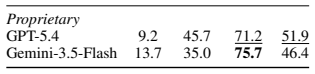
Table 4 : Results on DRPIXELBENCH.Tool/qis searches per question.PgHitis the percentage of questions that retrieves the gold page, andAcc |Pg is accuracy restricted to those questions. Results are averaged over three runs. DR PIXEL Trained matches GPT-5.4 in accuracy, retrieving the gold pages more often while using fewer searches.
出典 · CC BY 4.0 · Tiansheng Hu, Yichuan Wang, James V. Talwar, Nicholas Tomlin, Chen Zhao, Sewon Min · DR Pixel: Page-Native Deep Research with Vision-Language Models · 論文の図を引用 · 元のPDFの8ページ目から図の部分を抽出しています。著者らは、DR PIXEL Trainedの利得が主に検索にあると分析しました。DR PIXEL Trainedは正解ページを取得する割合(PgHit)で52.0を記録し、GPT-5.4の45.7を6.3ポイント上回りました。著者らは、後段の学習によって検索クエリが視覚検索用の埋め込み空間に合いやすくなり、検索に有効なクエリを生成できるようになったと考えています。
比較対象のバニラSFTは、同じ教師軌跡をすべてのトークンに同じ重みで学習したモデルです。つまり、反実仮想クレジット再重み付けの効果は、取得率の向上よりも、不要な検索を抑える点に現れています。20回の検索予算を使い切った質問の割合は、バニラSFTの35.8%に対し、DR PIXEL Trainedは9.8%でした。精度でも、DR PIXEL Trainedは52.1で、バニラSFTの49.0を上回りました。
予算を使い切る割合は、GPT-5.4が17.8%、学習前の基底モデルが19.2%で、DR PIXEL Trainedはそれより低い値でした。この学習後の結果は、DRPIXELBENCHでの精度と検索効率の両方を改善しました。
外部ベンチマークとViDoRe-V3での汎化
外部ベンチマークでは、DR PIXEL Trainedは学習前のDR PIXEL Baseと比べて、IRPAPERS、M3SciQA、AirQAのすべてで精度が向上しました。その向上幅は9.6から14.4ポイントでした。検索量は、IRPAPERSとAirQAでは減り、M3SciQAでは増えました。M3SciQAでは、学習前のモデルの文書検索がGPT-5.4より15.0ポイント低く、3つの中で差が最も大きい場所です。この場所で検索を増やしたことから、DR PIXEL Trainedは検索の難しさに合わせて検索量を変えていると読めます。
ViDoRe-V3は金融や人事などの非科学文書を含み、学習領域の外での汎化を見るための設定です。ページ検索とテキスト検索のどちらでも、学習後は学習前より4.1ポイント改善しました。学習にはページ検索の教師軌跡だけを使ったため、テキスト検索でも改善したことは、学習した検索行動が検索の種類を超えて移ることを示唆します。両者の差が小さいのは、視覚的な内容を必要とする質問が1.7%しかないためです。
ページ検索を使うDR PIXEL Trainedの総合精度は70.8で、ページを直接与えたOracleの72.6とは1.8ポイントの差です。Oracleは、ViDoRe-V3が公表する上限値として表6に載っている値です。テキスト検索の設定でも、DR PIXEL Trainedは69.8で、学習前のDR PIXEL Baseの65.7より高くなりました。つまり、学習の効果はページ検索だけのものではありません。
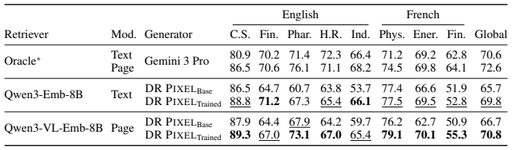
Table 6 : End-to-end accuracy on ViDoRe V3. Oracle∗ is ViDoRe V3’s published upper bound. DR PIXEL Trained improves over DR PIXEL Base with both page and text retrieval on documents outside its training domain, so the training generalizes well.
出典 · CC BY 4.0 · Tiansheng Hu, Yichuan Wang, James V. Talwar, Nicholas Tomlin, Chen Zhao, Sewon Min · DR Pixel: Page-Native Deep Research with Vision-Language Models · 論文の図を引用 · 元のPDFの9ページ目から図の部分を抽出しています。コーパス規模とページ解像度の影響
コーパス規模の影響は、論文数を20,000から99,000まで段階的に増やして調べられました。著者らは質問と正解文書を固定し、ページヒット率の推移を比べました。ページヒット率はどのモデルでも下がりますが、DR PIXEL Trainedの低下は8.0ポイントにとどまり、GPT-5.4の12.5ポイントより小さくなりました。その結果、検索精度の差は20,000論文で1.8ポイント、99,000論文で6.3ポイントに広がり、最終回答の精度向上にもつながりました。
ページ解像度は、視覚的な忠実度と推論コストの釣り合いを決めます。高解像度のページ画像は処理コストが大きいため、著者らは1ページの上限を1.05 megapixelsに抑え、ネイティブ解像度のおよそ50%としました。この設定では入力トークンが30%から48%減る一方、精度の低下は1.0から3.8ポイントにとどまりました。出力トークンは低解像度で少し増えますが、全トークンの25%未満であるため、節約効果は大きく残ります。低解像度でも、ページ検索はOCRベースのテキスト検索を2.7から7.4ポイント上回りました。図5のキャプションでは、トークンの削減を24%から45%、精度の低下を1から4ポイントとしており、本文の数値と範囲が異なります。
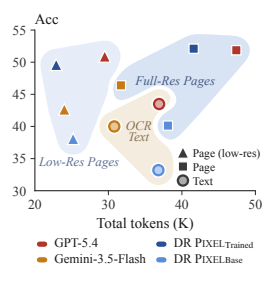
Figure 5 : Accuracy against total to- kens as page resolution varies. Lower- ing resolution cuts tokens by 24% to 45% for a 1 to 4 point drop, and page retrieval stays ahead of OCR text.
出典 · CC BY 4.0 · Tiansheng Hu, Yichuan Wang, James V. Talwar, Nicholas Tomlin, Chen Zhao, Sewon Min · DR Pixel: Page-Native Deep Research with Vision-Language Models · 論文の図を引用 · 元のPDFの9ページ目から図の部分を抽出しています。学習データの種類については、テキストの質問の軌跡と視覚の質問の軌跡で学習した場合を比べました。視覚の軌跡で学習したモデルはテキストの質問で1.4ポイント以内に収まり、テキストで学習したモデルは視覚の質問で6から11ポイント下がりました。
限界と未検証の点
学習に使われたのは、オープンウェイトのQwen3.6-27Bという一つのモデルだけです。著者らは、GPT-5.4が生成した約2,500件の教師軌跡を用いてLoRAで学習しました。そのため、他のモデルや他の教師モデルで同じ効果が出るかは、この論文の範囲では検証されていません。
学習データに含まれるのは視覚の質問だけで、テキストの質問の軌跡で学習した場合との比較も行われました。2,000件のテキスト軌跡で学習したモデルの精度は46.0、2,000件の視覚軌跡で学習したモデルの精度は50.2でした。視覚の軌跡で学習したほうが良い結果でしたが、この比較は一つの設定で行われたものに限られます。
ViDoRe-V3は、ページ検索の利点を外部の文書で測るための評価として用いられました。ただし、ViDoRe-V3のうち視覚的な内容を実際に必要とする質問は1.7%しかありません。そのため、ページ検索とテキスト検索の結果が近い値になり、ページ検索の効果をこの評価だけで測るには限りがあります。学習後はページ検索とテキスト検索の両方が4.1ポイント改善しましたが、これはこの外部評価での結果です。
評価では、GPT-5.4-miniが正誤を判定し、厳格なプロンプトのもとで独立した複数回の判定の多数決を取りました。教師軌跡を生成したGPT-5.4と判定に使ったGPT-5.4-miniは、いずれもOpenAIのモデルです。表5のキャプションには、質問あたりの検索回数の平均値は示されていません。本研究が示したのは、学習なしでページ検索がOCRベースの設定を上回り、学習でその差をさらに縮められるという範囲です。
論文情報
- 著者
- Tiansheng Hu, Yichuan Wang, James V. Talwar, Nicholas Tomlin, Chen Zhao, Sewon Min
- 学会・ジャーナル
- arXiv · プレプリント
- 公開日
- 2026年11月2日
- 登録日
- 2026年11月4日
- 更新日
- 2026年11月2日
- バージョン
- v1
- arXiv
- 2611.03097
- カテゴリ
- cs.CV · cs.CL · cs.IR
- ライセンス
- CC BY 4.0
- 掲載内容
- 論文情報・解説・論文の図
この解説は、Refivuの韓国語解説をAIで翻訳したものです。不正確な翻訳や誤りが含まれる可能性があります。論文と図の利用条件は各出典に従います。
アブストラクト
Complex documents such as scientific papers contain rich information in tables, figures, and equations; however, existing deep research (DR) agents typically reduce papers to OCR-extracted text. We instead ask whether vision-language models (VLMs) can enable page-native deep research: directly retrieving and reasoning over rendered document page images. We introduce DR Pixel, the first open-source end-to-end multimodal DR agent that uses rendered page images as its sole retrieval and reasoning unit, operating over a corpus of 1.06M pages. To evaluate this setting, we construct DRPixelBench, a benchmark on scientific papers requiring reasoning over text, figures, tables, and equations. Surprisingly, page-native DR already works well without training, outperforming OCR-based baselines across state-of-the-art models like GPT-5.4, Gemini-3.5-Flash, and Qwen3.6-27B, while requiring fewer tool calls. We next turn to DR training. A key challenge is that teacher trajectories for agentic supervised finetuning are noisy, mixing critical reasoning and action steps with redundant or failed attempts. To address this, we introduce counterfactual credit reweighting, a fine-grained credit assignment method that weights individual reasoning and action steps by their counterfactual contribution to the final answer. Our training improves retrieval recall by about 15 points and final accuracy by over 10 points on DRPixelBench, and likewise outperforms the untrained baseline on four existing benchmarks. On out-of-distribution ViDoRe-V3, DR Pixel comes within 1.8 points of an oracle that is given the gold pages directly. Our results suggest that the conventional OCR-then-retrieve pipeline is not only unnecessary but suboptimal: directly retrieving and reasoning over visual document pages makes complex DR both more effective and more efficient.
論文の図
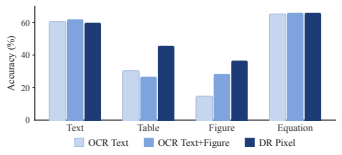
Figure 2 : GPT-5.4 accuracy by evidence source under the two OCR-based settings and DR PIXEL. DR PIXELconsistently outperforms OCR-based pipelines on questions that require tabular and figure evidence.
出典 · CC BY 4.0 · Tiansheng Hu, Yichuan Wang, James V. Talwar, Nicholas Tomlin, Chen Zhao, Sewon Min · DR Pixel: Page-Native Deep Research with Vision-Language Models · 論文の図を引用 · 元のPDFの6ページ目から図の部分を抽出しています。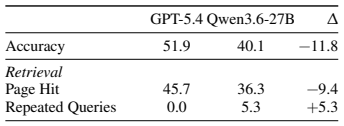
Table 3 : Decomposing gap between GPT-5.4 and Qwen3.6-27B. Qwen3.6-27B retrieves the gold page less often and uses it less well once found.
出典 · CC BY 4.0 · Tiansheng Hu, Yichuan Wang, James V. Talwar, Nicholas Tomlin, Chen Zhao, Sewon Min · DR Pixel: Page-Native Deep Research with Vision-Language Models · 論文の図を引用 · 元のPDFの6ページ目から図の部分を抽出しています。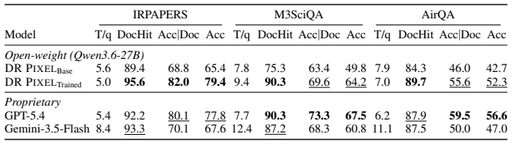
Table 5 : Results on external multimodal scientific-QA benchmarks.T/qis searches per question. DocHitis the percentage of questions for which the gold document is retrieved, andAcc |Docis accuracy restricted to those questions. DR PIXEL Trained improves over DR PIXEL Base on all three benchmarks and adapts search effort dynamically.
出典 · CC BY 4.0 · Tiansheng Hu, Yichuan Wang, James V. Talwar, Nicholas Tomlin, Chen Zhao, Sewon Min · DR Pixel: Page-Native Deep Research with Vision-Language Models · 論文の図を引用 · 元のPDFの8ページ目から図の部分を抽出しています。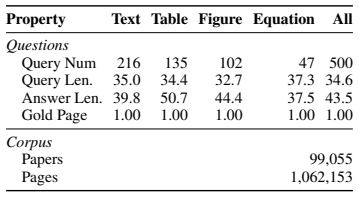
Table 8 : DRPIXELBENCHstatistics. Questions are grouped by the modality of the evidence they are grounded in, and lengths are in tokens. Every question is grounded to exactly one page.
出典 · CC BY 4.0 · Tiansheng Hu, Yichuan Wang, James V. Talwar, Nicholas Tomlin, Chen Zhao, Sewon Min · DR Pixel: Page-Native Deep Research with Vision-Language Models · 論文の図を引用 · 元のPDFの18ページ目から図の部分を抽出しています。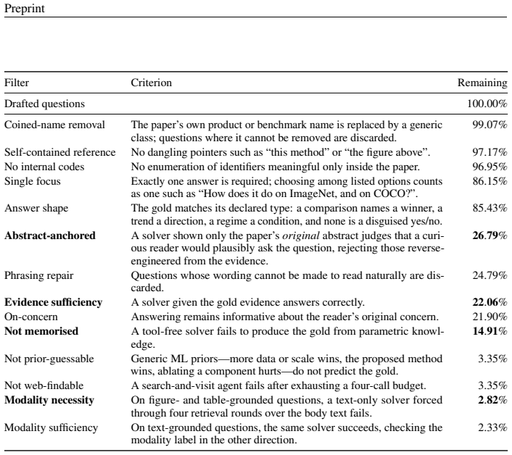
Table 9 : Filters applied to drafted questions, in the order they run.Remainingis the share of drafted questions still alive after each filter. The four filters described in section 3 are in bold.
出典 · CC BY 4.0 · Tiansheng Hu, Yichuan Wang, James V. Talwar, Nicholas Tomlin, Chen Zhao, Sewon Min · DR Pixel: Page-Native Deep Research with Vision-Language Models · 論文の図を引用 · 元のPDFの19ページ目から図の部分を抽出しています。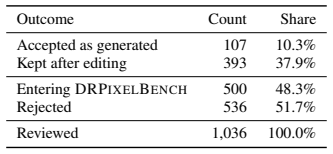
Table 11 : Human annotation of the DRPIXELBENCH. Of 1 ,036 generated questions reviewed, about one in ten survived untouched and over half were rejected.
出典 · CC BY 4.0 · Tiansheng Hu, Yichuan Wang, James V. Talwar, Nicholas Tomlin, Chen Zhao, Sewon Min · DR Pixel: Page-Native Deep Research with Vision-Language Models · 論文の図を引用 · 元のPDFの20ページ目から図の部分を抽出しています。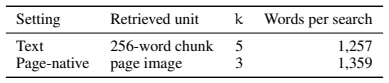
Table 13 : Text returned per search. Word counts are measured over 800 randomly sampled corpus documents including 22,149 chunks of text, 12,296 pages, with page text obtained by OCR. A chunk averages 251 words and a page 453.
出典 · CC BY 4.0 · Tiansheng Hu, Yichuan Wang, James V. Talwar, Nicholas Tomlin, Chen Zhao, Sewon Min · DR Pixel: Page-Native Deep Research with Vision-Language Models · 論文の図を引用 · 元のPDFの21ページ目から図の部分を抽出しています。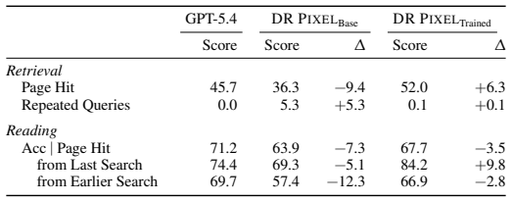
Table 14 : Decomposing the gap to GPT-5.4 on DRPIXELBENCH, with ∆ measured against GPT-5.4 in both blocks.Page hitis the share of questions whose gold page is retrieved, andrepeated queries the share of search calls that re-issue a query already sent in the same trajectory.Acc | page hitis accuracy given the gold page was retrieved, split by whether the page arrived from the last search or had to survive further searches. Training reverses the retrieval gap, and the reading deficit that remains is confined to pages carried from an earlier search.
出典 · CC BY 4.0 · Tiansheng Hu, Yichuan Wang, James V. Talwar, Nicholas Tomlin, Chen Zhao, Sewon Min · DR Pixel: Page-Native Deep Research with Vision-Language Models · 論文の図を引用 · 元のPDFの22ページ目から図の部分を抽出しています。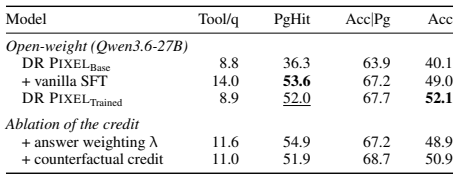
Table 15 : Results on DRPIXELBENCH.Tool/qis searches per question.PgHitis the percentage of questions for which the gold page is retrieved, andAcc |Pgis accuracy restricted to those questions. The lower block adds one component of the credit at a time on top of vanilla SFT baseline, and DR PIXEL Trained is the full method, which additionally corrects the reasoning and searching channels against each other. Each component removes searches while gradually benefit the final accuracy.
出典 · CC BY 4.0 · Tiansheng Hu, Yichuan Wang, James V. Talwar, Nicholas Tomlin, Chen Zhao, Sewon Min · DR Pixel: Page-Native Deep Research with Vision-Language Models · 論文の図を引用 · 元のPDFの22ページ目から図の部分を抽出しています。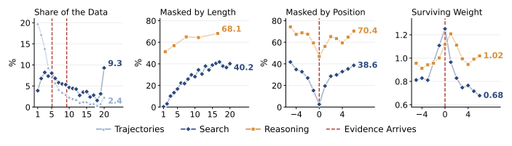
Figure 7 : What the credit masks in the 2,500 training trajectories.Share of the Data: trajectories and search steps by trajectory length; The dashed rules mark the average trajectory, which has 5.1 searches, and the same average weighted by how many steps each trajectory contributes, which is 9.3.Masked by Length: mask rate against trajectory length.Masked by PositionandSurviving Weight: the same two quantities against position relative to the search that first retrieves a page the final answer cites, marked by the dashed rule; that search is masked 2.5% of the time, the minimum of the panel.
出典 · CC BY 4.0 · Tiansheng Hu, Yichuan Wang, James V. Talwar, Nicholas Tomlin, Chen Zhao, Sewon Min · DR Pixel: Page-Native Deep Research with Vision-Language Models · 論文の図を引用 · 元のPDFの24ページ目から図の部分を抽出しています。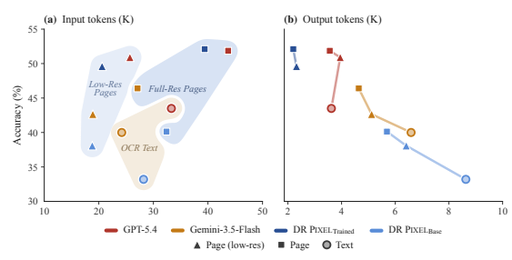
Figure 9 : Accuracy against (a) input and (b) output tokens as page resolution varies. Lowering resolution cuts input tokens by 30% to 48% for a 1 to 4 point drop, while staying 2.7 to 7.4 points more accurate than the OCR-based Text setting.
出典 · CC BY 4.0 · Tiansheng Hu, Yichuan Wang, James V. Talwar, Nicholas Tomlin, Chen Zhao, Sewon Min · DR Pixel: Page-Native Deep Research with Vision-Language Models · 論文の図を引用 · 元のPDFの25ページ目から図の部分を抽出しています。この論文を引用
Tiansheng Hu, Yichuan Wang, James V. Talwar, Nicholas Tomlin, Chen Zhao, Sewon Min (2026). DR Pixel: Page-Native Deep Research with Vision-Language Models. arXiv:2611.03097v1. https://arxiv.org/abs/2611.03097v1
BibTeX
@misc{hu2026pixel,
  title = {{DR Pixel: Page-Native Deep Research with Vision-Language Models}},
  author = {Tiansheng Hu and Yichuan Wang and James V. Talwar and Nicholas Tomlin and Chen Zhao and Sewon Min},
  year = {2026},
  eprint = {2611.03097},
  archivePrefix = {arXiv},
  url = {https://arxiv.org/abs/2611.03097v1}
}