論文解説
A Theory of Cross-Validation Variance
交差検証分散の理論
- 課題 交差検証の推定値の分散が、モデル、学習比率、分割設計によってどう決まるかを説明する一般理論が不足していました。
- 手法 各観測値の検証重みと学習重みで推定値を表し、分散を標本化分散と分割ノイズに分ける、正確な有限標本の恒等式を示します。
- 結果 K-foldは両方の重みが1/nの均衡設計で、1次分散はKに依存しません。ペアごとの指標では、通常のK-foldが分割ノイズを加え、leave-pair-outがそれを取り除きます。シミュレーションでは、予測した恒等式と測定した分散が一致したと報告されています。
交差検証分散を説明する理論の空白
交差検証は、データを学習セットと検証セットに繰り返し分けて、モデルの予測性能を推定する手続きです。この論文は、K-fold、反復K-fold、Monte Carlo分割、ブートストラップは分割の仕方だけが異なると見たうえで、モデル、学習比率、再標本化設計が一緒になって交差検証分散をどう決めるのかについて、一般理論が不足している点を問題としています。既存研究は個々の設計を別々に扱ってきました。各観測値が検証対象としての役割と学習データとしての役割を同時に担うことを、正確な有限標本の分解として示すことはできていませんでした。
役割重みと分散の恒等式
論文では、各観測値が検証重みv_iと学習重みw_iという2つの役割重みによって推定値に寄与すると説明しています。検証重みは、全体の検証評価のうちその観測値が占める割合です。学習重みは、学習セットの利用のうちその観測値が占める割合です。K-fold交差検証は、反復回数によらず両方の重みが1/nになる均衡設計です。一方、Monte Carloとブートストラップでは、観測値が検証される回数が確率的になるため、均衡が崩れます。分散の恒等式は、1次分散を標本化分散と2つの重みの2次形式で表し、ペアごとの指標でも同じ形が保たれると示しています。
不均衡ペナルティと設計の比較
重みが均等でない場合、1次分散に不均衡ペナルティが加わります。このペナルティは、2つの重みのずれを共分散行列で2次形式にした値として計算され、均衡設計では0になります。論文はK-foldにはこのペナルティがないと報告しています。Monte CarloとブートストラップについてはS回の分割に対しておよそ1/S程度のペナルティを持つと計算しています。したがって、同じ学習サイズでは標本化分散は同じで、設計間の差は分割ノイズに現れます。
ペアごとの指標とleave-pair-out
AUCのように、事例と対照のペアを比較する指標では、1回の評価が2つの観測値にまたがります。論文は、この場合も恒等式は拡張されると述べています。通常のK-foldは同じ分割に属するペアだけを評価するため、Kが大きくなるほど増える分割ノイズが加わると説明しています。すべての事例と対照のペアを1回ずつ評価するleave-pair-outと、ペアごとの交差検証は、この分割ノイズを取り除く設計として示されています。
シミュレーションによる検証と適用範囲
著者らは、帯域幅0.7で固定したNadaraya–Watson平滑化器を用いて、MSE、Brier score、AUCについて、nが250、500、1000の条件で検証しています。対象はK-fold(K=2、5、10)、leave-one-out、Monte Carlo交差検証(p=0.5、0.9、S=10)で、測定した分散を予測の恒等式と比べました。測定分散と予測値の比は、大部分の条件で1付近にあります。ペアの項を除くと、AUCの分割ノイズの予測が大きく外れるため、1次項だけではペアごとの指標の交差ペアの寄与を説明できないと報告しています。この検証は、特定の平滑化器と設定で得られた結果であり、他の学習器すべてについての証明ではありません。
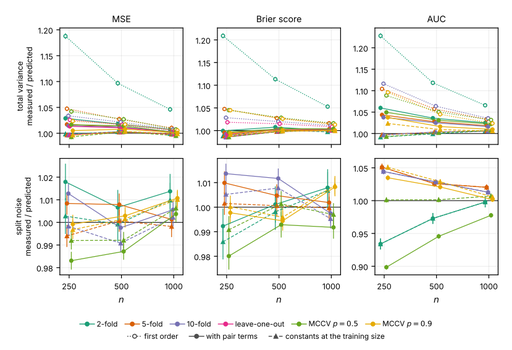
Figure 1 : Measured variance against the identity’s predictions, for three metrics, six designs, and three sample sizes. Error bars are one standard error. Top row: total variance over 10 5 datasets, as a ratio to the prediction at first order (hollow markers, dotted) and to the prediction with the limiting pair terms added (filled markers, solid). Bottom row: split noise over 6000 datasets with 30 redraws, as a ratio to the prediction with the pair terms. Triangles: ratio to the prediction with the constants at the training size, through order three for MSE and the Brier score and at first order for the AUC. Leave-one-out has no split noise.
出典 · CC BY 4.0 · Nathaniel S. O'Connell, Jaime L. Speiser · A Theory of Cross-Validation Variance · 論文の図を引用 · 元のPDFの24ページ目から図の部分を抽出しています。限界と残された課題
この分析は、分割数を固定すること、特定の仮定(A1など)、影響関数の条件を前提としています。ペアごとの指標では、ペア項の補正が必要で、これを除くと分割ノイズが過小推定されます。論文では、実際の学習器全般でこの条件が成り立つかは完全には保証されないとしています。高次の項を推定する実用的な推定器の開発は、今後の課題として残されています。
論文情報
- 著者
- Nathaniel S. O'Connell, Jaime L. Speiser
- 学会・ジャーナル
- arXiv · プレプリント
- 公開日
- 2026年11月10日
- 登録日
- 2026年11月12日
- 更新日
- 2026年11月10日
- バージョン
- v1
- arXiv
- 2611.14463
- カテゴリ
- stat.ML · cs.LG · math.ST
- ライセンス
- CC BY 4.0
- 掲載内容
- 論文情報・解説・論文の図
この解説は、Refivuの韓国語解説をAIで翻訳したものです。不正確な翻訳や誤りが含まれる可能性があります。論文と図の利用条件は各出典に従います。
アブストラクト
Cross-validation estimates predictive performance by repeatedly splitting the data into training and validation sets, fitting the model on the first and evaluating it on the second. Every observation influences the estimate in two roles, through its own evaluation when it is held out and through the models it helps fit when it trains. The random splits determine its weight in each role. From this representation, we prove an exact finite-sample identity for the variance of the cross-validated estimate. For a given splitting scheme with a common training set size, the variance is a function of these weights, with constants of the model, the metric, and the population. It covers metrics averaged over observations, such as mean squared error, and over case--control pairs, such as the AUC. The identity shows which schemes to use. The variance decomposes into sampling variance, which depends only on the training size, and variance due to the random fold splitting, which arises when the weights change from one draw of the splits to the next. K-fold cross-validation, whose weights are equal across observations by design, is therefore variance optimal at first order; Monte Carlo and bootstrap cross-validation are not. The first-order variance of K-fold does not depend on K, and under reasonable conditions on the model leave-one-out has the smallest variance of any K-fold scheme. For the AUC the same holds for leave-pair-out, which evaluates every case--control pair. Finally, we show the cross-validated estimate is asymptotically normal with the identity's full variance. Together, these results provide a general theoretical foundation for inference on cross-validated performance and establish principles for selecting variance-optimal cross-validation designs.
この論文を引用
Nathaniel S. O'Connell, Jaime L. Speiser (2026). A Theory of Cross-Validation Variance. arXiv:2611.14463v1. https://arxiv.org/abs/2611.14463v1
BibTeX
@misc{oconnell2026theory,
  title = {{A Theory of Cross-Validation Variance}},
  author = {Nathaniel S. O'Connell and Jaime L. Speiser},
  year = {2026},
  eprint = {2611.14463},
  archivePrefix = {arXiv},
  url = {https://arxiv.org/abs/2611.14463v1}
}