論文解説
Sada-ASR: A Production Multidialectal Arabic Speech Recognition System
Sada-ASR:運用環境向け多方言アラビア語音声認識システム
- 課題 アラビア語の方言音声は、MSA中心に作られた認識器で誤認識されやすいです。認識の誤りは、音声エージェント全体の最初の失敗になります。
- 手法 ウェブ上の弱いラベルと社内で注釈した音声を統合して、アテンションベースのエンコーダ-デコーダを学習しました。すべてのテストでは、plain greedy searchによりデコードしています。
- 結果 120時間の非公開テストセットでWER 11.69%を記録し、MAI-Transcribe-2の13.51%を下回りました。ただし、レバノン方言では及びませんでした。
方言音声が認識を難しくする理由
アラビア語の顧客対応電話の発信者は、現代標準アラビア語(MSA)ではなく、自分の地域の方言で話します。しかし音声認識器は、主にMSAで作られ、評価されてきました。方言音声は語彙、発音、形態がMSAと異なり、標準的なつづりもありません。そのため認識段階で聞き誤った内容は、後段の処理がどれだけ良くても取り戻せません。
この論文では、EchoNovaの音声エージェントに組み込まれるSada-ASRを対象にしています。湾岸、エジプト、レバントの方言とMSAを含む非公開テストセットで、外部の商用APIとオープンウェイトモデル十一個と比べます。評価の対象は音声認識器そのもので、エージェント全体やTTSは評価していません。
2系統の学習データ構築
方言音声の正解の書き起こしは不足しています。書き起こしには、その方言を理解する注釈者が必要で、方言には標準的なつづりもありません。ウェブ上の音声は見つけやすい一方で、ラベルが弱いです。Sada-ASRは、この2つの流れを1つの学習セットにまとめて学習しました。一方は社内の注釈プラットフォームで書き起こされた音声で、もう一方はウェブから集めた弱いラベルの音声です。
社内プラットフォームは3層で構成されます。100人を超える注釈者が音声を書き起こし、レビュー担当者が提出物を継続的に確認し、専門のライターとドメインの専門家が難しい事例を担当します。すべての注釈者のキューに同じ評価サンプルを入れて共通のベースラインを作り、重複サンプルを密かに混ぜて、注釈者間の一貫性を測定しました。統制サンプルは、データセットを作る前にすべて取り除きました。統合段階では、2つの流れの間の重複音声を取り除きます。さらに、汚染された記録、音声とラベルが合わない記録、音声アーティファクトをフィルタリングしたうえで、形式とメタデータを標準化しました。
エンコーダ-デコーダの学習とデコードの方法
Sada-ASRは、アテンションベースのエンコーダ-デコーダ構造で、書き起こしのテキストをトークン単位で生成します。学習目標は、書き起こしと終了トークンに対する次トークンの交差エントロピーです。ラベルスムージングとCTCの補助損失は使っていません。データ拡張も適用せず、音声は16 kHzモノラルにリサンプリングしただけです。
エポックごとに、クリップの半分は英語から抽出し、英語の音声は繰り返し、アラビア語は部分的に抽出します。アラビア語の中では、各変種の時間の割合に従ってクリップを抽出します。アラビア語のターゲットは発音区別符号なしで書き、数字は単語で書きます。チェックポイントは、1,482件の発話からなる検証用サブセットで、貪欲探索により計算したWERで選びました。このサブセットは、学習とすべてのテストセットから分けてあります。
デコードは、すべてのテストセットで同じ設定を使います。ビームサーチ、繰り返しペナルティ、n-gram制約は使わず、繰り返しループを防ぐガードと出力長の上限を設けています。30秒を超える音声は、2秒の重なりを持たせた30秒の窓に分けてデコードします。
非公開テストセットでの比較結果
非公開テストセットは、MSAと8つの方言からなる120時間規模です。クリップはすべて30秒以下で、すべてのシステムが同じ音声を受け取りました。WERとCERは、コーパス単位のマイクロ平均で計算しました。すべてのAPIはアラビア語に設定し、可能な場合は逐語転写と形式オプションを無効にしました。
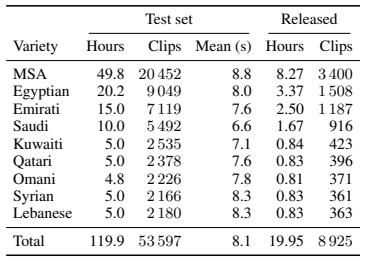
Table 1 : Composition of the private test set and of its released subset. Mean is the mean clip length; totals are computed before rounding.
出典 · CC BY 4.0 · Mahmoud Khaled, Mohammed Abd-Elnaser, Mahmoud Mohsen, Hazem Ahmed, Abdelrahman Hafez · Sada-ASR: A Production Multidialectal Arabic Speech Recognition System · 論文の図を引用 · 元のPDFの4ページ目から図の部分を抽出しています。全体のWERは、Sada-ASRが11.69%、Microsoft MAI-Transcribe-2が13.51%で、差は1.83ポイントでした(95% CI 1.72–1.93、録音単位のブートストラップ)。方言別に見ると、Sada-ASRは9つのうち7つで最も低い値でした。レバノン方言では、MAI-Transcribe-2に1.91ポイント及びませんでした。数字、数字の単語、ラテン文字を含まない統制クリップでは、全体の差は0.74ポイント(95% CI 0.65–0.83)に縮まりました。著者らは、MAI-Transcribe-2の数字表記の出力が全体の差の一部を生んでいると解釈しています。
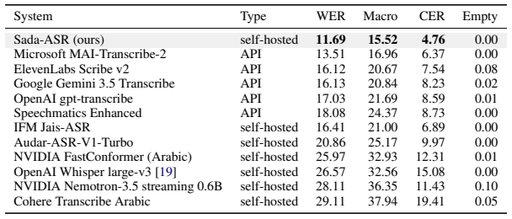
Table 2 : Private test set. WER and CER in %, corpus micro-averaged; Macro is the unweighted mean of the nine per-variety WERs in Table 3; Empty is the % of clips with an empty transcript.
出典 · CC BY 4.0 · Mahmoud Khaled, Mohammed Abd-Elnaser, Mahmoud Mohsen, Hazem Ahmed, Abdelrahman Hafez · Sada-ASR: A Production Multidialectal Arabic Speech Recognition System · 論文の図を引用 · 元のPDFの5ページ目から図の部分を抽出しています。
Table 3 : WER (%) by variety on the private test set. MAI-2: Microsoft MAI-Transcribe-2; Scribe v2: ElevenLabs Scribe v2; Gemini: Google Gemini 3.5 Transcribe; gpt-tr.: OpenAI gpt-transcribe; Speechm.: Speechmatics Enhanced; Jais: IFM Jais-ASR; FastConf.: NVIDIA FastConformer (Arabic); Nemotron: NVIDIA Nemotron-3.5 streaming 0.6B; Cohere: Cohere Transcribe Arabic. ∆ MAI-2: Sada-ASR’s margin over MAI-Transcribe-2 in points (positive = Sada-ASR lower), with a 95% CI from 2 000 bootstrap resamples of source recordings; †the only CI including zero. ∆ ctrl.: the same margin on clips with no digit, number word or Latin script in the reference or in either system’s output. Differences are computed before rounding. CER: Appendix A.1.
出典 · CC BY 4.0 · Mahmoud Khaled, Mohammed Abd-Elnaser, Mahmoud Mohsen, Hazem Ahmed, Abdelrahman Hafez · Sada-ASR: A Production Multidialectal Arabic Speech Recognition System · 論文の図を引用 · 元のPDFの6ページ目から図の部分を抽出しています。公開テストセットと発表値の比較
公開の6セットの平均WERは、Sada-ASRが17.17%で、Falcon-ASRの20.92%、Jais-ASRの22.85%、Audar-ASR-V1-Turboの23.17%より低い結果でした。ただしこの数値は、リーダーボードが2026年7月27日に改定した採点基準で計算した値です。比較対象の発表値の多くは、その改定の前に出ています。発表側が現在の採点基準を使ったと明示していないため、この比較は参考値です。
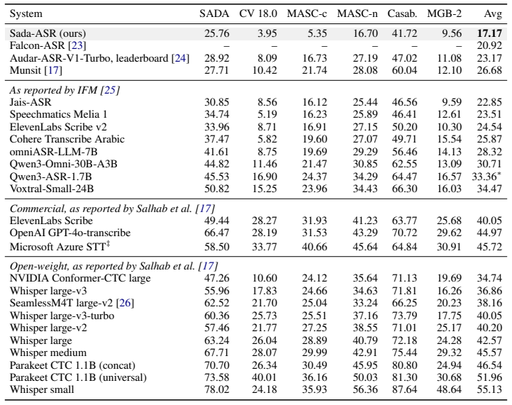
Table 4 : WER (%) on the six public test sets; Avg is their unweighted mean. Rows other than ours are published figures: Audar-ASR-V1-Turbo is the leaderboard’s best entry (10 October 2026), and Falcon-ASR reports only an average over the same six test lists. IFM measured Jais-ASR with the leaderboard’s evaluation script, without stating its version, measured Melia 1 and Scribe v2 itself, and lists the other five from the leaderboard. ElevenLabs Scribe, GPT-4o-transcribe and Azure STT in the Salhab rows are earlier models than those we measured. ‡Mean of Azure’s Saudi and Jordanian models. ∗As published by IFM; its six per-set values average 33.69. Our row uses the leaderboard’s current scoring, revised on 27 July 2026; most published rows predate that revision, so the comparison is indicative (CER: Appendix A.2).
出典 · CC BY 4.0 · Mahmoud Khaled, Mohammed Abd-Elnaser, Mahmoud Mohsen, Hazem Ahmed, Abdelrahman Hafez · Sada-ASR: A Production Multidialectal Arabic Speech Recognition System · 論文の図を引用 · 元のPDFの7ページ目から図の部分を抽出しています。レバノン方言で負ける理由
レバノン方言では、71件の元の録音のうち55件で、MAI-Transcribe-2より誤りが多くなりました。著者らは、原因として2つを挙げています。1つ目は、Sada-ASRがMSAと綴りを共有するレバノンの単語をMSAの形で書くことです。2つ目は、逐語性が低く、偽の開始、繰り返し語、短い単語を省く傾向があることです。語彙の置き換えを同じものとみなすと、差は0.51ポイントに縮まり、統計的に有意ではなくなります。
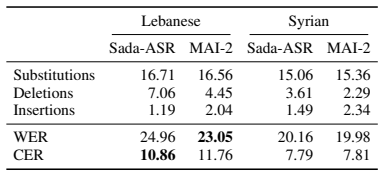
Table 5 : Levantine errors (%). Substitutions, deletions and insertions are shares of the reference words and sum to WER before rounding.
出典 · CC BY 4.0 · Mahmoud Khaled, Mohammed Abd-Elnaser, Mahmoud Mohsen, Hazem Ahmed, Abdelrahman Hafez · Sada-ASR: A Production Multidialectal Arabic Speech Recognition System · 論文の図を引用 · 元のPDFの6ページ目から図の部分を抽出しています。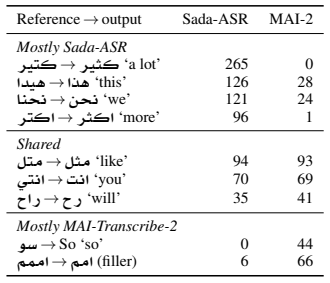
Table 6 : Frequent Lebanese substitutions and how often each system makes them.
出典 · CC BY 4.0 · Mahmoud Khaled, Mohammed Abd-Elnaser, Mahmoud Mohsen, Hazem Ahmed, Abdelrahman Hafez · Sada-ASR: A Production Multidialectal Arabic Speech Recognition System · 論文の図を引用 · 元のPDFの8ページ目から図の部分を抽出しています。残る制約
非公開テストセットは、MSAと8つの方言を扱い、マグレブ、イラク、スーダン、イエメンのアラビア語は含みません。公開セットとの比較は、採点基準と発表時期が異なるため参考値です。また、Sada-ASRのTTSやエージェント全体は評価していません。
論文情報
- 著者
- Mahmoud Khaled, Mohammed Abd-Elnaser, Mahmoud Mohsen, Hazem Ahmed, Abdelrahman Hafez
- 学会・ジャーナル
- arXiv · プレプリント
- 公開日
- 2026年11月14日
- 登録日
- 2026年11月17日
- 更新日
- 2026年11月14日
- バージョン
- v1
- arXiv
- 2611.19512
- カテゴリ
- cs.CL · cs.SD · eess.AS
- ライセンス
- CC BY 4.0
- 掲載内容
- 論文情報・解説・論文の図
この解説は、Refivuの韓国語解説をAIで翻訳したものです。不正確な翻訳や誤りが含まれる可能性があります。論文と図の利用条件は各出典に従います。
アブストラクト
Callers to Arabic customer-service lines speak their own dialect, while speech recognizers are built and evaluated mainly on Modern Standard Arabic (MSA). A recognizer that mishears the dialect breaks the call before anything else can help. We present Sada-ASR, the speech recognizer of EchoNova's production Arabic voice agent. On a 120-hour test set of MSA and eight dialects, it has the lowest word and character error rates of twelve systems, against eleven from Microsoft, ElevenLabs, Google, OpenAI, Speechmatics, IFM, Cohere, NVIDIA and Audar: 11.69% word error rate against 13.51% for the strongest, Microsoft's MAI-Transcribe-2 (a lead of 0.74 points on clips unaffected by that system's fixed number and script conventions), and 15.52% against 16.96% averaged over varieties. Its largest margins are on Omani (4.30 points), Egyptian (3.78) and Saudi (2.19) speech; it is level on Syrian and loses on Lebanese (24.96% against 23.05%), mostly because it writes Lebanese words in MSA forms and is less verbatim. On six public test sets its average word error rate under the leaderboard's current scoring is 17.17%, below every published figure we found, among them Falcon-ASR (20.92%), Jais-ASR (22.85%) and Audar-ASR-V1-Turbo (23.17%), though none of these states that it used that scoring, so the comparison is indicative. We describe the data pipeline and methodology behind Sada-ASR and release a 20-hour subset of the test set with our scoring code.
この論文を引用
Mahmoud Khaled, Mohammed Abd-Elnaser, Mahmoud Mohsen, Hazem Ahmed, Abdelrahman Hafez (2026). Sada-ASR: A Production Multidialectal Arabic Speech Recognition System. arXiv:2611.19512v1. https://arxiv.org/abs/2611.19512v1
BibTeX
@misc{khaled2026sada,
  title = {{Sada-ASR: A Production Multidialectal Arabic Speech Recognition System}},
  author = {Mahmoud Khaled and Mohammed Abd-Elnaser and Mahmoud Mohsen and Hazem Ahmed and Abdelrahman Hafez},
  year = {2026},
  eprint = {2611.19512},
  archivePrefix = {arXiv},
  url = {https://arxiv.org/abs/2611.19512v1}
}