論文解説
Controlling the Probability of Unknown Unknowns in Pre-Deployment Testing of AI Systems
AIシステムの展開前テストにおける未知の未知の発生確率の制御
- 課題 展開前テストで、まだ観測していない失敗モードが残る確率をいつ十分に小さいと判断するかは難しいです。
- 手法 Good-Turingのmissing mass推定を逐次設定に拡張し、ベッティング過程の混合によって、任意の停止時点でも有効な上限を作ります。
- 結果 SWE-Chatでは、提案上限が多重検定補正Good-Turing上限より狭く、時間同時カバレッジはt=3000まで0.973を記録しました。
未観測の失敗確率をいつ信頼して止めるか
AIエージェントの展開前テストでは、すでに観測した失敗モードは修正したり対策したりできますが、まだ現れていない未知の失敗(unknown unknowns)は扱いにくいです。テストを続けると時間と費用がかかり、止めると見つかっていない失敗が残ります。そのため、開発者が十分にテストしたかを判断する基準が必要です。本論文では、次の出力が以前に観測されていない失敗モードである確率であるmissing massを、データに応じて止めても有効な上限として推定する問題を扱います。
古典的なGood-Turing推定は、標本サイズを固定した場合のmissing massを推定します。著者らはこの問題を、観測と推定が交互に起こる逐次的な設定に拡張しました。ここでmissing massは時間とともに減少し、その上限は、データに依存する任意の停止時点でも成り立つ必要があります。
ベッティング過程を用いた信頼シーケンス
入力X_tは目標の展開分布Pから独立に抽出されます。システムの出力A_tに対して、failの関数で失敗かどうかを判定し、unseenの関数で過去の失敗履歴H_{t-1}と照らして新しい失敗モードかどうかを判定します。2つの指示子の積が1になる場合が、未観測の失敗事象です。unseenは、履歴が増えるほど値が小さくなる単調性と、すでに履歴にある出力に対して0になる条件を満たす必要があります。
Algorithm 1は、各λについて観測値でベッティング利得E^λ_{s:t}を累積し、開始時点の異なるベッティング過程を重み付きで混合してM_t(u)を作ります。U_t(α)は、M_t(u)が1/αより小さくなる最大のuとして定義されます。この上限が閾値εより小さくなると、テストを停止します。著者らは、失敗確率が下がると利得が大きくなる構造を使って停止を設計しました。混合では、λを[0,1]上で一様に置きますが、実際には有限のグリッドで近似します。
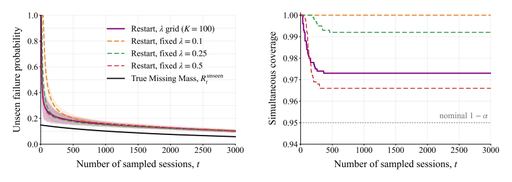
Figure 9 : Sensitivity to the choice of betting parameter λ. We compare the finite-grid mixture used in the main results with fixed choices λ ∈ { 0.1, 0.25, 0.5}. (a) Anytime-valid upper bounds on the unseen-failure probability together with the true missing mass. The grid mixture performs similarly to the fixed- λ alternatives across the evaluation horizon. (b) Empirical simultaneous coverage through time t. All choices remain above the nominal level 1 − α = 0.95 throughout the evaluation horizon.
出典 · CC BY 4.0 · Rachel Li, Chris Hays, Aaditya Ramdas, Manish Raghavan · Controlling the Probability of Unknown Unknowns in Pre-Deployment Testing of AI Systems · 論文の図を引用 · 元のPDFの50ページ目から図の部分を抽出しています。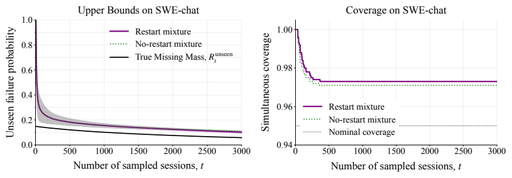
Figure 10 : Minimal benefit of restart-mixing on SWE-Chat. We compare the restart mixture (solid purple) with a non-restarted betting process (dotted green), using the same equally weighted grid of 100 lambda values and α = 0 .05. Left: mean upper confidence bounds across 1,000 paired trials, with shaded bands showing the empirical 2.5th97.5th percentiles; black denotes the true unseen-failure probability. Right: empirical simultaneous coverage, which is 0.973 with restarts and 0.971 without restarts through 3,000 draws, both above the nominal 0.95 level. Restarting yields modestly tighter bounds on this dataset.
出典 · CC BY 4.0 · Rachel Li, Chris Hays, Aaditya Ramdas, Manish Raghavan · Controlling the Probability of Unknown Unknowns in Pre-Deployment Testing of AI Systems · 論文の図を引用 · 元のPDFの50ページ目から図の部分を抽出しています。同時カバレッジと停止時間の保証
Theorem 3.2は、すべてのtについてR_tがU_t(α)以下になる確率が少なくとも1−αであると主張します。証明は、ベッティング過程が非負の上位マルチンゲールであることを示し、Ville不等式を適用する方法です。この証明は、R_tが時間とともに減少するという単調性に依存します。
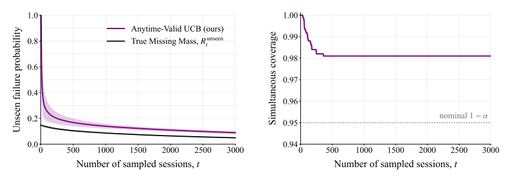
Figure 6 : Our method remains valid under an online embedding-based failure novelty rule , where a failure is considered unseen when its failure-mode description is insufficiently similar to all previously observed failures under the online embedding-based matching rule. (a) Anytime-valid upper bound on the unseen-failure probability, together with the true unseen-failure probability defined by the same online novelty rule. Solid line is the mean, shaded bands show 2.5th-97.5th percentiles across trials. (b) Empirical simul- taneous coverage through time t. Coverage remains above the nominal level 1 − α = 0 .95 throughout the evaluation horizon.
出典 · CC BY 4.0 · Rachel Li, Chris Hays, Aaditya Ramdas, Manish Raghavan · Controlling the Probability of Unknown Unknowns in Pre-Deployment Testing of AI Systems · 論文の図を引用 · 元のPDFの48ページ目から図の部分を抽出しています。Theorem 3.3は、Algorithm 1がほぼ確実に停止し、失敗確率がγを下回った時点T_γ以降の遅延が対数オーダーにとどまると述べています。下界は、特定の構成の分布条件のもとで停止遅延をこれ以上減らせないことを示すものです。この条件の外でも一般に最適であるとまでは広げていません。
SWE-Chatでの実験結果
SWE-Chatの5,001セッションでは、失敗かどうかを、元のスコアが70未満の候補を最新の判定モデルで再確認して決めました。固定の分類体系により538のカテゴリを作成しました。1,000回の試行では標本を復元抽出し、α=0.05に設定しました。
提案された上限は、多重検定補正のGood-Turing上限および固定時点のGood-Turing上限よりも狭くなりました。時間同時カバレッジはt=3000まで0.973で、公称水準0.95を上回りました。一方、Good-Turingベースラインは、この実験ではカバレッジが1でした。合成の最悪分布では、10,000回の試行でのカバレッジが0.9587で、公称水準を上回りました。
定義とコストに関する限界
著者らは、有効性と有用性がfailとunseenの定義に依存すると明らかにしています。失敗のコストは考慮していません。発生確率が極めて低いものの被害の大きい失敗は、サンプリングだけでは十分に扱えないと記しています。また、実験では公開データ、固定の分類体系、LLM判定器を用いたため、機微な非公開データや人手で作られた定義にそのまま当てはめて述べることはできません。
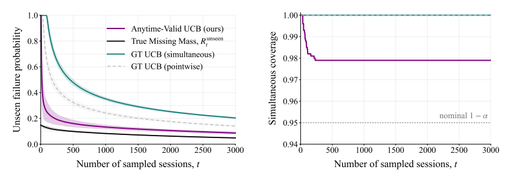
Figure 8 : Robustness to an alternative LLM-based fixed taxonomy. We repeat the main statistical evaluation using a second fixed taxonomy constructed by an LLM-based grouping procedure rather than the clustering-based taxonomy used in the main results. (a) Anytime-valid upper bound on the unseen-failure probability, together with the true missing mass and the simultaneous and pointwise Good-Turing UCBs. Solid lines show the mean, and shaded bands show the 2.5th-97.5th percentiles across trials. (b) Empirical simultaneous coverage through time t. Our method remains above the nominal level 1 − α = 0.95 throughout the evaluation horizon; both Good–Turing bounds achieve coverage of 1.
出典 · CC BY 4.0 · Rachel Li, Chris Hays, Aaditya Ramdas, Manish Raghavan · Controlling the Probability of Unknown Unknowns in Pre-Deployment Testing of AI Systems · 論文の図を引用 · 元のPDFの49ページ目から図の部分を抽出しています。論文情報
- 著者
- Rachel Li, Chris Hays, Aaditya Ramdas, Manish Raghavan
- 学会・ジャーナル
- arXiv · プレプリント
- 公開日
- 2026年11月11日
- 登録日
- 2026年11月13日
- 更新日
- 2026年11月11日
- バージョン
- v1
- arXiv
- 2611.15835
- カテゴリ
- cs.AI · cs.CY · math.ST
- ライセンス
- CC BY 4.0
- 掲載内容
- 論文情報・解説・論文の図
この解説は、Refivuの韓国語解説をAIで翻訳したものです。不正確な翻訳や誤りが含まれる可能性があります。論文と図の利用条件は各出典に従います。
アブストラクト
In pre-deployment testing of AI systems such as AI agents, a developer can often deal with known failure modes (e.g., leaking API keys, deleting important databases, or installing a malicious package) by implementing fixes or making contingency plans for when the same issue might occur again. What is more challenging are the unknown unknowns: the unseen failure modes that haven't surfaced during testing. The decision to stop testing and deploy therefore faces an inherent tradeoff: continue testing to observe more behaviors, at the cost of time and resources, or stop testing and deploy, at the risk of failure modes remaining undiscovered. How then does the developer decide when they have tested enough? To answer this, we develop an algorithm that certifies when the probability of observing an unseen failure mode is sufficiently small. The algorithm constructs an anytime-valid upper confidence sequence on this quantity, so the developer can repeatedly test a system, inspect the bound, and decide to stop when it falls below a chosen threshold without invalidating the statistical guarantee. Our problem can be interpreted as a sequential variant of the missing-mass estimation problem which gave rise to the classic Good-Turing estimator (Good, 1953). On SWE-Chat, a dataset of real-world coding agent traces (Baumann et al., 2026), we implement our procedure and show that it achieves tighter upper bounds than a simple multiple-testing corrected Good-Turing baseline, and even dominates a fixed-horizon (non-multiple-testing-corrected) Good-Turing upper confidence bound, which is not anytime valid. Additionally, to better match realistic evaluation pipelines, we extend our method to handle sampling from a different task distribution and imperfect automated failure labeling.
この論文を引用
Rachel Li, Chris Hays, Aaditya Ramdas, Manish Raghavan (2026). Controlling the Probability of Unknown Unknowns in Pre-Deployment Testing of AI Systems. arXiv:2611.15835v1. https://arxiv.org/abs/2611.15835v1
BibTeX
@misc{li2026controlling,
  title = {{Controlling the Probability of Unknown Unknowns in Pre-Deployment Testing of AI Systems}},
  author = {Rachel Li and Chris Hays and Aaditya Ramdas and Manish Raghavan},
  year = {2026},
  eprint = {2611.15835},
  archivePrefix = {arXiv},
  url = {https://arxiv.org/abs/2611.15835v1}
}