論文解説
Evidence-Aligned Benchmarking and Learning for Medical Video Language Models
医療映像言語モデルに映像を見て答えさせるよう評価と学習を両面から直す
- 課題 既存の医療映像ベンチマークでは、映像を見なくても高い点が出てしまいます。学習でもモデルが学習質問を丸暗記し、強化学習で学ぶ材料が尽きてしまいます。
- 手法 MedEvidUは、評価を映像なしの回答で監査して作り直し、指定フレームを隣と混ぜないQuery-slot inputsと、未知の質問を補うLQRで学習します。
- 結果 4Bモデルの接地IoUは30.4から44.4に高まり、教師あり学習の27Bモデルを上回りました。
映像を見なくても高得点が出る評価
医療映像言語モデルには、手術区間の範囲、器具の位置、現在のフェーズ、CVSの達成といった、映像の根拠に基づいて答えることが求められます。ところが、既存のベンチマークでは、映像を使わなくても高い点が出てしまうことがあります。たとえばMultiBypass140では、クリップが録画内のどこにあるかという位置情報だけで、手順を37%の質問で当てられました。これは最頻出の手順を当てる7%を大きく上回る値です。CVSの軌跡指標でも、定数の「never met」回答が66.4となり、学習済みのどのモデルよりも高くなりました。時間的テストの30%は参照が空のため、noneを返すだけで35.9を得られます。
同じ問題は学習でも起きます。SFT後のモデルは学習質問をほぼ覚えてしまい、強化学習では多くの回答が同じ報酬を得るため、勾配が生まれにくくなります。つまり、評価で近道が通ってしまうことと、学習信号が尽きることが重なり、映像を見て答えるモデルを育てにくくなっています。本研究はこの二つの問題を、評価の監査と学習の設計の両方から扱います。
映像が必要になるように作り直したMedVidBench-v2
MedVidBench-v2は、18の手術・臨床データセットから34タスクを集め、2,676録画を含みます。学習には77,261の質問があり、どのデータセットも録画単位で分割されています。監査では映像なしの回答を基準にして、プロンプトから録画内の位置を外し、認識質問には全ラベル語彙を並べます。軌跡はクラスごとの平均精度で採点し、イベントの有無と局在を別々に報告します。
Temporal F1は、時間IoUが0.5以上で予測区間と参照区間を1対1に対応させ、空の予測と空の参照を1とみなします。そこから分けられた指標のうち、Presenceはイベント再現率と空回答の正解率の平均で、Localization F1は参照にイベントがある質問だけのtemporal F1です。Blind windowsは、録画全体を注釈の位置を見ずに固定長の窓で切ったもので、窓内にイベントがあるかをモデルが先に判断する必要があります。このセットは8,292質問を含みます。さらに、HeiChole、MultiBypass140のStrasbourg、KUMC、PhaKIRの4つのOOD suiteを、学習に含まれない病院から用意しています。
Query-slot inputsで対象フレームのトークンを分ける
要点は、質問で名指しされたフレームのトークンを、隣のフレームと混ぜないようにすることです。Qwen2.5-VL、Qwen3-VL、GLM-4.1V/4.5Vなど多くの映像エンコーダは、連続する2フレームを1組にまとめて1セットのトークンに埋め込みます。そのため、ある時刻のボックスを求める質問は、対象フレームと隣のフレームを混ぜた表現から答えることになります。この混ざりは、PhaKIRのように16フレームを1秒おきに並べた場合に最も強くなります。
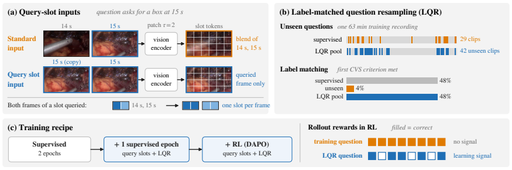
Figure 2 .Evidence-aligned learning.(a) Query-slot inputs fill the queried frame’s token slot with that frame; a slot with two queried frames is split. (b) LQR draws unseen questions from the training recordings and matches their label distribution. (c) Both enter the final supervised epoch and reinforcement learning.
出典 · CC BY 4.0 · Zhongpai Gao, Anwesa Choudhuri, Meng Zheng, Benjamin Planche, Terrence Chen, Ziyan Wu · Evidence-Aligned Benchmarking and Learning for Medical Video Language Models · 論文の図を引用 · 元のPDFの5ページ目から図の部分を抽出しています。Query-slot inputsでは、対象フレームを組の相方の位置に複製して置き換えるため、そのスロットはそのフレームだけを符号化し、静止画と同じ扱いになります。フレーム数、タイムスタンプ、プロンプト、トークン数は変わらず、使うのは質問に書かれた時刻だけで、答えは使いません。そのため学習、RL、推論のすべてに適用できます。両方のフレームが質問対象の場合は、スロットを2つに分けるため、接地質問の13%に1スロットずつ追加されます。適用するのは、フレーム名を含む接地、フレーム単位のCVS、シーングラフの質問で、動きを見る質問は従来のフレーム組を残します。
標準のピクセル予算のQS, 1×pxでは、接地が30.4から36.8に高まり、SFT baselineに対して6.4点の改善となりました。同じ画素数を2倍にしても、標準入力では接地が1.0しか上がらず、スロットを使うと2.1と7.3上がりました。著者らは、この差から、接地の伸びは画素数ではなく、質問したフレームをモデルに見せることから来ると解釈しています。対象フレームだけを入力したSFT baselineは、キュレーションされたテストで32.7、PhaKIRで54.2で、クリップ全体を入力したQS付きモデルの41.5と70.2を下回りました。
未使用の質問で学習信号を補う
LQRは、学習録画から未使用の質問と、新しい時刻で切り直したクリップを補い、新しい注釈を追加せずに学習データを増やす方法です。補う質問は、学習と同じ録画、タスク、ラベル語彙から来るため、同じ映像について別の問いを立てることになります。RLでは、正解と不正解がともに出る質問だけが勾配を生み、その割合は学習質問で14%、未知の質問で28%と、未知の質問の方が多くなります。
ただし未知の質問は回答の統計が学習データと異なり、たとえばEndoscapesでは最初のCVS基準が達成される割合が、未知フレームで4%、学習フレームで48%です。そこでLQRは、タスクごとの質問数と、CVSや時間的タスクでのクラス別の質問数を元の学習データに合わせ、未知の質問が足りないクラスだけ学習質問で補います。学習は3段階で、Qwen3.5-4Bの言語モデル部分を視覚エンコーダを凍結したまま2エポック微調整し、第3エポックをQuery-slot inputsとLQRの質問で学習します。SFT baselineは第3エポックを元の質問と入力で行い、学習量を3エポックに揃えます。
RLにはDAPOを使います。DAPOは、価値関数を学習せずに検証可能な報酬で方策を更新する手法です。報酬はベンチマークの指標そのものなので、映像なしで得られる近道の回答には報酬が与えられません。
同じエポックでBlind windowsのPresenceも81.2から82.7に高まり、新しい注釈を使わずに効果が見られました。
4Bモデルの接地と未知の病院での結果
比較の基準は、同じ3エポックの教師あり学習量を保つSFT baselineです。同じ4Bモデルは、27B SFT baselineの42.7を接地で上回り、差の区間は[0.4, 2.8]です。Blind windowsでは、Presenceが81.2から86.7に、Localization F1が49.6から57.7に高まりました。
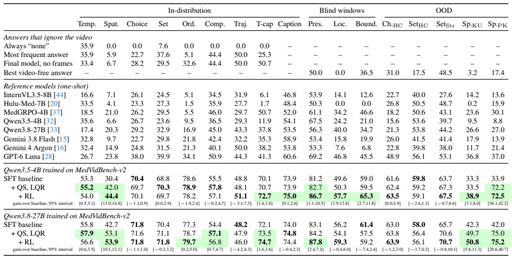
Table 3 .Main results(×100) on MedVidBench-v2 test (15,101 questions), blind windows (8,292; Tab. 5), and unseen hospitals (HC HeiChole, Str Strasbourg, KU KUMC, PK PhaKIR; Tab. 11). QS: query slots; LQR: question resampling. Bold: block best;green / red : significantly above / below the SFT baseline (no cell is red); brackets: better row 95% interval.
出典 · CC BY 4.0 · Zhongpai Gao, Anwesa Choudhuri, Meng Zheng, Benjamin Planche, Terrence Chen, Ziyan Wu · Evidence-Aligned Benchmarking and Learning for Medical Video Language Models · 論文の図を引用 · 元のPDFの7ページ目から図の部分を抽出しています。学習に含まれない病院のPhaKIRでは、4Bモデルの接地が33.9から72.5に高まりました。したがって、規模の大きいモデルが勝つ場面もあり、4Bモデルの結果は接地とBlind windowsのPresenceに限って読むのが妥当です。
RLを加えると、イベント再現率は78.7から87.9に高まりました。同時に空クリップの正解率は86.9から76.3に下がり、RLはイベントを報告しやすくなったと読めます。Query-slot inputsの効果は学習を伴わなくても一部出ます。推論時だけ使うと接地が3.3上がります。標準入力のままRLを加えたbaselineは、完全な構成より接地が11.3、PhaKIRで36.2低いままです。
限界
Query-slot inputsは、接地、フレーム単位のCVS、シーングラフの質問のように、質問がフレームを名指ししている場合にだけ適用しています。フレームを暗黙にする質問への拡張と、臨床レポートを伴う録画の利用は、今後の課題として残されています。CVSの軌跡指標では、どのモデルも定数回答の50を明確に上回っていません。本論文の分割は元データセットの公式分割と異なるため、公開されている数値とは直接比べられません。同じチェックポイントを2回評価するとファミリースコアは約1点動くため、それより小さい差は同点とみなしています。
論文情報
- 著者
- Zhongpai Gao, Anwesa Choudhuri, Meng Zheng, Benjamin Planche, Terrence Chen, Ziyan Wu
- 学会・ジャーナル
- arXiv · プレプリント
- 公開日
- 2026年11月25日
- 登録日
- 2026年11月26日
- 更新日
- 2026年11月25日
- バージョン
- v1
- arXiv
- 2611.34465
- カテゴリ
- cs.CV
- ライセンス
- CC BY 4.0
- 掲載内容
- 論文情報・解説・論文の図
この解説は、Refivuの韓国語解説をAIで翻訳したものです。不正確な翻訳や誤りが含まれる可能性があります。論文と図の利用条件は各出典に従います。
アブストラクト
A medical video language model should answer from the visual evidence its question asks about. We find three places where this breaks down and address each with an approach we call MedEvidU. First, benchmarks reward answers that ignore the video: on one dataset, the position of a clip within its recording predicts the surgical step in 37% of questions, and a constant answer beats every trained model on a standard safety-assessment metric. We build MedVidBench-v2, 34 tasks from 18 surgical and clinical video datasets, in which prompts and metrics are audited with answers given without video, and which tests unseen hospitals and windows cut blindly from whole recordings. Second, common video encoders merge consecutive frames into shared tokens, so a question about one frame is answered from a blend of two. Query-slot inputs give each queried frame its own tokens at almost no extra cost. Third, a fine-tuned model has memorized its training questions, which leaves little to learn from. Label-matched question resampling (LQR) adds unseen questions about the same recordings while keeping the answer distribution fixed, in a final supervised epoch and in reinforcement learning. Together, these raise the grounding IoU of a 4B model from 30.4 to 44.4, above a supervised 27B model, and instrument grounding at an unseen hospital from 33.9 to 72.5. On blindly cut windows, event-presence accuracy improves by 5.5 points and localization F1 by 8.1 points. Project page: https://gaozhongpai.github.io/MedEvidU/
論文の図
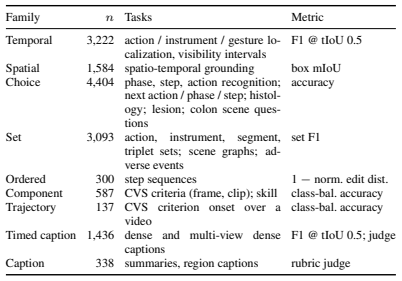
Table 2 .Task families of MedVidBench-v2.Scores average over datasets within a task and over tasks within a family;n: test ques- tions in the headline scope.
出典 · CC BY 4.0 · Zhongpai Gao, Anwesa Choudhuri, Meng Zheng, Benjamin Planche, Terrence Chen, Ziyan Wu · Evidence-Aligned Benchmarking and Learning for Medical Video Language Models · 論文の図を引用 · 元のPDFの3ページ目から図の部分を抽出しています。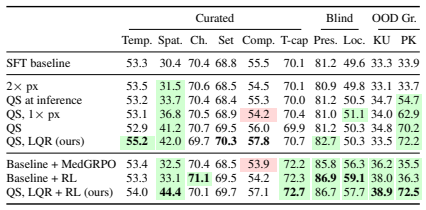
Table 4 .Contribution of each component(4B,×100). Mid- dle: third-epoch variants; bottom: RL (ours or MedGRPO’s [37]). QS: query slots; px: grounding pixels; KU, PK: KUMC, PhaKIR. Bold: best; green / red : significantly above / below baseline.
出典 · CC BY 4.0 · Zhongpai Gao, Anwesa Choudhuri, Meng Zheng, Benjamin Planche, Terrence Chen, Ziyan Wu · Evidence-Aligned Benchmarking and Learning for Medical Video Language Models · 論文の図を引用 · 元のPDFの8ページ目から図の部分を抽出しています。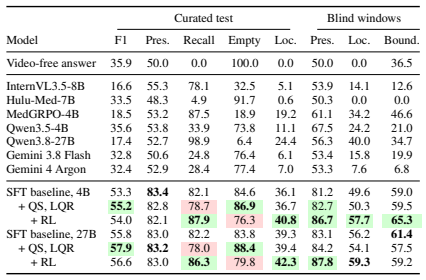
Table 5 .Temporal presence and localization(×100). F1: usual temporal F1; Pres.: mean of event recall and empty accuracy; Loc.: F1 on event clips; Bound.: windows with a boundary. Bold: block best; green / red : significantly above / below baseline.
出典 · CC BY 4.0 · Zhongpai Gao, Anwesa Choudhuri, Meng Zheng, Benjamin Planche, Terrence Chen, Ziyan Wu · Evidence-Aligned Benchmarking and Learning for Medical Video Language Models · 論文の図を引用 · 元のPDFの8ページ目から図の部分を抽出しています。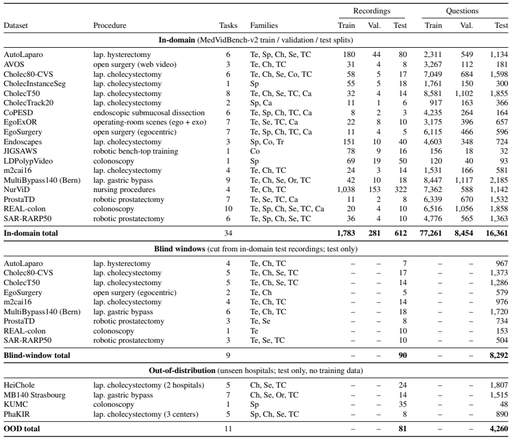
Table 7 .Dataset composition of MedVidBench-v2.The four Cholec* sources share one patient pool, and blind windows reuse test recordings; totals count unique recordings. Families: Te temporal, Sp spatial, Ch choice, Se set, Or ordered, Co component, Tr trajectory, TC timed caption, Ca caption.
出典 · CC BY 4.0 · Zhongpai Gao, Anwesa Choudhuri, Meng Zheng, Benjamin Planche, Terrence Chen, Ziyan Wu · Evidence-Aligned Benchmarking and Learning for Medical Video Language Models · 論文の図を引用 · 元のPDFの12ページ目から図の部分を抽出しています。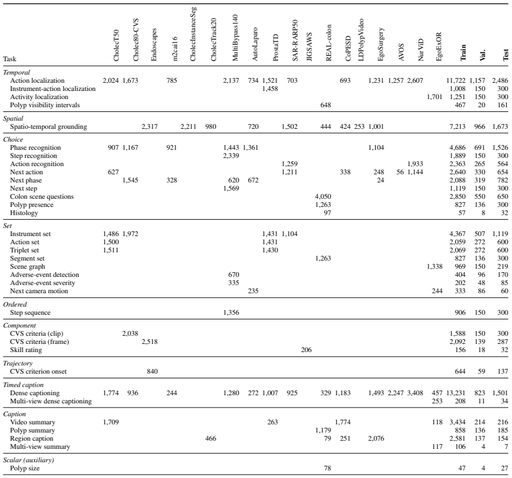
Table 8 .Questions per task and source dataset(in-domain splits only: train + validation + test), grouped by answer family, with split totals per task. Empty cells: the dataset does not supply the task. Blind-window and OOD suites: Tab. 9.
出典 · CC BY 4.0 · Zhongpai Gao, Anwesa Choudhuri, Meng Zheng, Benjamin Planche, Terrence Chen, Ziyan Wu · Evidence-Aligned Benchmarking and Learning for Medical Video Language Models · 論文の図を引用 · 元のPDFの13ページ目から図の部分を抽出しています。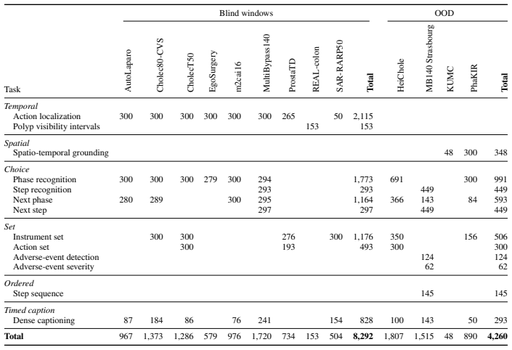
Table 9 .Questions per task in the test-only suites: blind windows by source dataset (left) and the four OOD suites (right).
出典 · CC BY 4.0 · Zhongpai Gao, Anwesa Choudhuri, Meng Zheng, Benjamin Planche, Terrence Chen, Ziyan Wu · Evidence-Aligned Benchmarking and Learning for Medical Video Language Models · 論文の図を引用 · 元のPDFの14ページ目から図の部分を抽出しています。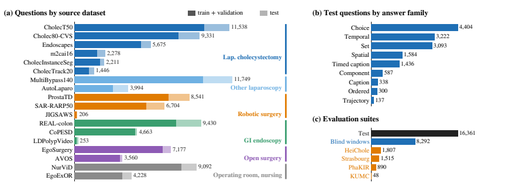
Figure 4 .Composition of MedVidBench-v2.(a) Questions per source dataset, colored by clinical domain. (b) Headline test questions per answer family. (c) Curated test, blind-window, and unseen-center suites.
出典 · CC BY 4.0 · Zhongpai Gao, Anwesa Choudhuri, Meng Zheng, Benjamin Planche, Terrence Chen, Ziyan Wu · Evidence-Aligned Benchmarking and Learning for Medical Video Language Models · 論文の図を引用 · 元のPDFの14ページ目から図の部分を抽出しています。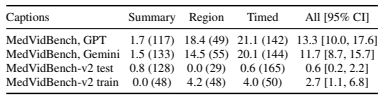
Table 10 .Independent caption audit.Percent of judged items with a substantive error that a second reviewer upheld (number of judged items); rates are lower bounds.
出典 · CC BY 4.0 · Zhongpai Gao, Anwesa Choudhuri, Meng Zheng, Benjamin Planche, Terrence Chen, Ziyan Wu · Evidence-Aligned Benchmarking and Learning for Medical Video Language Models · 論文の図を引用 · 元のPDFの15ページ目から図の部分を抽出しています。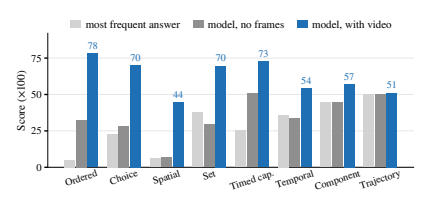
Figure 5 .Video dependence per family.The final 4B model with and without frames, and the most frequent training answer. Families are sorted by the margin that video adds.
出典 · CC BY 4.0 · Zhongpai Gao, Anwesa Choudhuri, Meng Zheng, Benjamin Planche, Terrence Chen, Ziyan Wu · Evidence-Aligned Benchmarking and Learning for Medical Video Language Models · 論文の図を引用 · 元のPDFの15ページ目から図の部分を抽出しています。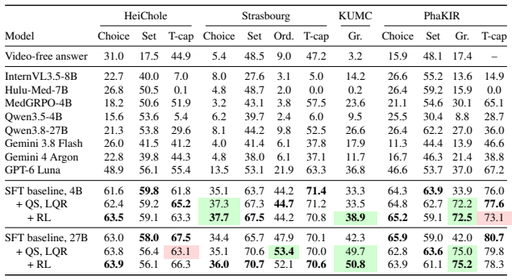
Table 11 .Out-of-distribution suites(×100), all absent from MedVidBench-v2 training. T-cap: timed-caption F1; Gr.: grounding IoU. First row: best video-free answer; reference models: one-shot. Bold: block best; shaded : significantly above the SFT baseline; shaded : significantly below.
出典 · CC BY 4.0 · Zhongpai Gao, Anwesa Choudhuri, Meng Zheng, Benjamin Planche, Terrence Chen, Ziyan Wu · Evidence-Aligned Benchmarking and Learning for Medical Video Language Models · 論文の図を引用 · 元のPDFの16ページ目から図の部分を抽出しています。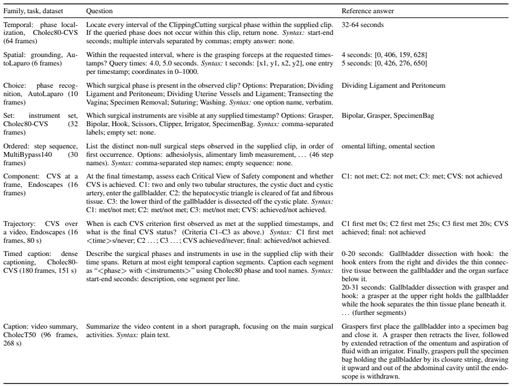
Table 12 .One test question per answer family.The question column gives the instruction, the main constraints, and the answer syntax from the task specification, with long option lists shortened; the reference column gives the scored answer.
出典 · CC BY 4.0 · Zhongpai Gao, Anwesa Choudhuri, Meng Zheng, Benjamin Planche, Terrence Chen, Ziyan Wu · Evidence-Aligned Benchmarking and Learning for Medical Video Language Models · 論文の図を引用 · 元のPDFの17ページ目から図の部分を抽出しています。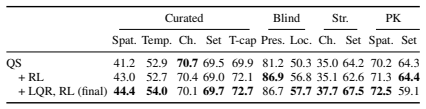
Table 13 .LQR across both stages(4B,×100). From the query- slot model: RL on the original questions, or LQR in the third epoch and the RL pool, then RL. Str., PK: Strasbourg, PhaKIR. Bold: best.
出典 · CC BY 4.0 · Zhongpai Gao, Anwesa Choudhuri, Meng Zheng, Benjamin Planche, Terrence Chen, Ziyan Wu · Evidence-Aligned Benchmarking and Learning for Medical Video Language Models · 論文の図を引用 · 元のPDFの17ページ目から図の部分を抽出しています。この論文を引用
Zhongpai Gao, Anwesa Choudhuri, Meng Zheng, Benjamin Planche, Terrence Chen, Ziyan Wu (2026). Evidence-Aligned Benchmarking and Learning for Medical Video Language Models. arXiv:2611.34465v1. https://arxiv.org/abs/2611.34465v1
BibTeX
@misc{gao2026evidence,
  title = {{Evidence-Aligned Benchmarking and Learning for Medical Video Language Models}},
  author = {Zhongpai Gao and Anwesa Choudhuri and Meng Zheng and Benjamin Planche and Terrence Chen and Ziyan Wu},
  year = {2026},
  eprint = {2611.34465},
  archivePrefix = {arXiv},
  url = {https://arxiv.org/abs/2611.34465v1}
}