論文解説
DecArena: Evaluating Large-Scale Decentralized Multi-Agent Collaboration
DecArena:大規模分散マルチエージェント協調の評価
- 課題 グローバルなレジストリがなく、グラフで接続されたエージェントが、遠隔の資源を自ら見つけて協調しなければならない問題です。
- 手法 合成ツール呼び出しのベンチマークを作り、隣接エージェント間のローカルな判断でリクエストを転送して評価します。
- 結果 Qwen3.8 27Bをベースとするです GraphHarnessは、成功率53.7、協調品質58.1、効率71.5を記録しました。
分散エージェント協調の課題
中央のオーケストレーターがすべてのエージェントと資源を把握して調整する方法は、規模とプライバシーの面で限界があります。この論文では、グローバルなレジストリがなく、各エージェントが自身のローカルな資源と直接の隣接エージェントしか見えない環境で、エージェントが遠隔の資源を自ら見つけて協調できるかを問うています。そのために、Graph-Constrained Dec-POMDPの設定とDecArenaベンチマークを提示します。遠隔へのリクエストは複数のエッジを経由して伝えられる必要があり、エージェントは資源の全体索引や全体トポロジを受け取りません。
DecArenaベンチマークの構成
DecArenaは、決定的な秘密鍵から生成された合成ツールを多段階のパイプラインに組み合わせるタスクを使います。各ツールの鍵は、マスターシードとツール識別子からHMAC-SHA256で導出され、所有者だけが持ちます。そのため、所有者でないエージェントは出力をローカルで再構成できません。各エージェントは、Return、Forward、Reject、Submitのいずれか、またはReturnとForwardの組み合わせを選択します。実際の経路は、受信したエージェントのローカルな判断が連なって形成されます。
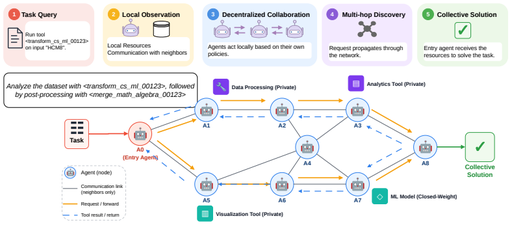
Figure 1 :Illustration of decentralized multi-agent collaboration (Graph-Constrained Dec-POMDP) in DecArena.An entry agent receives a task and can access only its own local resources and immediate neighbors. Each agent decides locally whether to execute an owned resource, return a result, reject the request, or forward it to neighboring agents. Through multi-hop neighbor-to-neighbor communication, the request propagates across the network until the required distributed resources are discovered and composed, after which the final result is returned to the entry agent as the collective solution.
出典 · CC BY 4.0 · Jiali Cheng, Oleg Rokhlenko, Joo-Kyung Kim, Hadi Amiri, Xingzhi Guo · DecArena: Evaluating Large-Scale Decentralized Multi-Agent Collaboration · 論文の図を引用 · 元のPDFの3ページ目から図の部分を抽出しています。協調方式の比較結果
Qwen3.8 27Bを基盤とした表では、GraphHarnessの成功率は53.7、協調品質は58.1、効率は71.5でした。同じ表で、Broadcastは成功率40.6、効率45.7、Oracle Routeは成功率33.6、効率68.7です。ここでOracle Routeは、入口のエージェントに所有者と最短経路を与える特権的な診断条件です。この結果は、その表のベースライン条件で得られたものです。
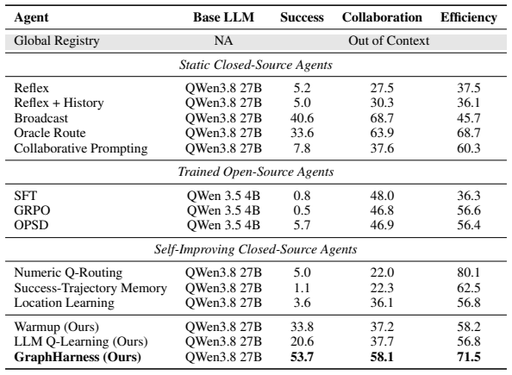
Table 1 : Comparison of decentralized agent designs. Detailed results with more base LLMs are shown in Appendix D Table 6.
出典 · CC BY 4.0 · Jiali Cheng, Oleg Rokhlenko, Joo-Kyung Kim, Hadi Amiri, Xingzhi Guo · DecArena: Evaluating Large-Scale Decentralized Multi-Agent Collaboration · 論文の図を引用 · 元のPDFの8ページ目から図の部分を抽出しています。競合するルーティング情報の影響
リングネットワークでは、各エージェントが2つのローカルなルーティング情報源を受け取り、一方は正しい方向、もう一方は反対方向を指すようにしました。この条件では、タスクの成功率が53.7から27.2に、協調品質が58.1から35.1に、効率が71.5から30.8に下がりました。著者らは、ローカルなルーティングの根拠が食い違うと、ネットワークが連結していても分散協調は大きく低下すると見ています。
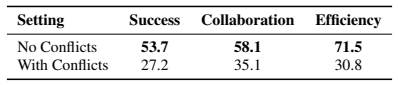
Table 3 : Performance with and without conflicting infor- mation. Each agent receives two local routing sources. Under conflict, one source points toward the required resource owner while the other recommends the oppo- site direction.
出典 · CC BY 4.0 · Jiali Cheng, Oleg Rokhlenko, Joo-Kyung Kim, Hadi Amiri, Xingzhi Guo · DecArena: Evaluating Large-Scale Decentralized Multi-Agent Collaboration · 論文の図を引用 · 元のPDFの8ページ目から図の部分を抽出しています。限界
実験は最大1,000エージェントまでで、著者らは、これがWebスケールのエージェントエコシステムのダイナミクスを完全には再現しないと述べています。主要な設定は、連結したネットワーク、固有の資源の所有、到達可能な必要資源を仮定しているため、失敗はネットワーク分断や資源の不在よりも、探索と調整の問題を測ります。合成ツールタスクは、実際のAPI、曖昧なリクエスト、権限の変化といった複雑さを含みません。
論文情報
- 著者
- Jiali Cheng, Oleg Rokhlenko, Joo-Kyung Kim, Hadi Amiri, Xingzhi Guo
- 学会・ジャーナル
- arXiv · プレプリント
- 公開日
- 2026年11月11日
- 登録日
- 2026年11月13日
- 更新日
- 2026年11月11日
- バージョン
- v1
- arXiv
- 2611.15521
- カテゴリ
- cs.MA · cs.AI · cs.CL
- ライセンス
- CC BY 4.0
- 掲載内容
- 論文情報・解説・論文の図
この解説は、Refivuの韓国語解説をAIで翻訳したものです。不正確な翻訳や誤りが含まれる可能性があります。論文と図の利用条件は各出典に従います。
アブストラクト
Emerging personal AI agents raise fundamental scalability and privacy concerns for centralized multi-agent systems (MASs), which rely on a global orchestrator with broad access to agents, resources, and communication. In decentralized environments, global visibility is unavailable. Agents need to proactively discover non-local resources (e.g. tools, skills), and collaborate with other agents to solve tasks. We study decentralized multi-agent collaboration under graph-constrained communication, a natural reflection of human structures. Each agent observes only its local state and can interact only with neighboring agents. We introduce a benchmark with synthetic scalable distributed tool calling with 100K+ tools. Our experiments reveal that recent LLM agents struggle to discover non-local relevant resources and collaborate in decentralized setting. Moreover, standard reinforcement learning fails to reliably overcome this limitation, suggesting that decentralized MAS needs more explicit harness mechanisms for effective collaboration, even using SOTA LLMs. We then present a strong baseline \textbf{GraphHarness}, combining topology-aware warmup with self-improving LLM-based routing. Results show that GraphHarness substantially improves task success (+48.5) and produces higher quality collaboration (+30.6), while using fewer costs (+34.0) than baselines.
この論文を引用
Jiali Cheng, Oleg Rokhlenko, Joo-Kyung Kim, Hadi Amiri, Xingzhi Guo (2026). DecArena: Evaluating Large-Scale Decentralized Multi-Agent Collaboration. arXiv:2611.15521v1. https://arxiv.org/abs/2611.15521v1
BibTeX
@misc{cheng2026decarena,
  title = {{DecArena: Evaluating Large-Scale Decentralized Multi-Agent Collaboration}},
  author = {Jiali Cheng and Oleg Rokhlenko and Joo-Kyung Kim and Hadi Amiri and Xingzhi Guo},
  year = {2026},
  eprint = {2611.15521},
  archivePrefix = {arXiv},
  url = {https://arxiv.org/abs/2611.15521v1}
}