論文解説
When Does an AUROC Comparison Survive a Change in Population Mix?
集団構成比が変わってもAUROC比較は維持されるか
- 課題 混合比が変わったとき、プールしたAUROCの順序が維持されるかは分かりにくいです。
- 手法 二つのスコアのAUROC差を二次形式に書き換え、許容される混合集合上の最小値を認証する監査手順を用います。
未解決の問い:混合が変わるとAUROCの順序は維持されるか
AUROCのリーダーボードは、特定の混合比の母集団で計算された値です。デプロイ環境でタスク、サイト、破損タイプの比率が変わると、同じ二つのスコアの順序が維持されるかは自動的には保証されません。この論文では、固定されたグループ別の条件付き分布のもとで、混合比qが許容集合Q内で変化するとき、二つのスコアのAUROC差が常に同じ符号を保つかを問います。グループ内の性能がすべて高くても、グループ間のペアが合算されるため、判断は難しくなります。
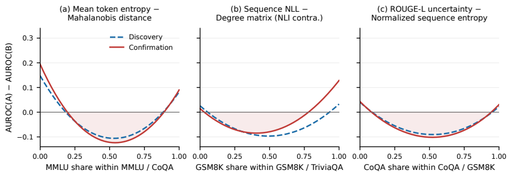
Figure 3 . The first three illustrations under the frozen discovery-only selection rule. Only the two displayed task proportions vary; the other two task masses are zero. Each discovery-selected methodAwins in all four individual tasks, yet the intermediate mixtures can favorB. Lines evaluate the exact finite-bank AUROC function on a dense display grid, using the released Accuracy endpoint. Confirmation uses disjoint input/story clusters. These are not population-confidence curves. The first and third examples change sign under the alternative correctness checks in Table 1; that label sensitivity is retained.
出典 · CC BY 4.0 · Mahtab Movahhedrad, Hamidreza Hasani Balyani, Seyed Pouyan Mousavi Davoudi · When Does an AUROC Comparison Survive a Change in Population Mix? · 論文の図を引用 · 元のPDFの7ページ目から図の部分を抽出しています。比較の恒等式と二次形式
論文では、AUROC差を二つの行列BとCで書いた二次形式の比として表します。混合qにおける∆(q)は、q⊤Bqをq⊤Cqで割った値であり、q⊤Cqはp(q)(1−p(q))に等しいです。したがって、Q全体で∆(q)≥τが成り立つ条件は、最小のq⊤(B−τC)qが0以上であるかどうかと同じです。全単体でτ=0のとき、Bがcopositiveかどうかの問題になります。この恒等式が監査手順の出発点です。
グループ別の点検だけでは不十分な理由
Theorem 2は、すべての有理対称行列Dが有限台のscalar-scoreの分布として実現できることを示し、そこから、すべての混合に対するuniversal dominanceの判定はcoNP-hardだと結論づけています。Theorem 3は、1≤m<Kを満たす任意の整数について、m個以下のグループからなるすべての混合では順序が合っているものの、均等混合では逆転する二つのスコアを構成します。この結果は、グループ内の検査や低次元の混合検査では、universal dominanceを確立できないことを示しています。
MIXAUDITと格子上の上界
MIXAUDITは、指定された混合集合上でq⊤Dqを最小化して大域的な下限を求め、負の値を与える混合が見つかった場合は逆転として記録します。下限が0以上であれば優位性を認証し、どちらとも確定できない場合はunresolvedとしておきます。格子定理は、分母mの格子上の最小値γmと全単体上の最小値γを、mγm−b/(m−1)≤γ≤γmの範囲に収めます。ここでbはグループ単位ベクトルの最大値です。この補正により、格子上の結果で優位性を認証できます。
同時信頼区間と混合の選択
推定された行列要素について、事前に定めたJ個の比較と、すべてのqを同時に含む区間を作ります。ペア単位カーネルのU-statisticとunion boundを用いており、この区間はデータで混合を選んだ後も、同じ事象の中で有効です。ただし、事前に指定されたスコア比較の集合と、独立したサンプリングという仮定が必要です。論文では、クラスタ標本や独立クラスタへの拡張についても、別の条件を示しています。
言語モデルのスコアバンク監査の結果
発見分割でタスク内の勝者だった238個のペアのうち、62個が混合で逆転しました。確認分割では、このうち55個が同じwitnessで依然として負の差を示しました。
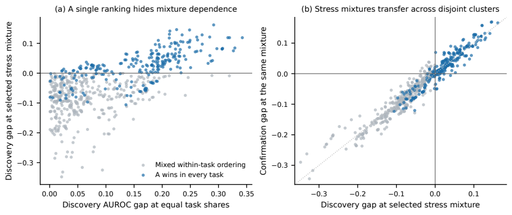
Figure 2 . All 595 primary-endpoint pairs. Blue points denote pairs where the discovery reference winner wins within each task; gray points have mixed within-task ordering. Left: equal-task-reference advantage versus gap at the selected discovery stress mixture. Right: the same stress mixtures evaluated on disjoint confirmation clusters. The stress grid supplies feasible gaps; continuous rational optimization independently establishes the reversal counts. These are finite-bank comparisons, not population confidence plots.
出典 · CC BY 4.0 · Mahtab Movahhedrad, Hamidreza Hasani Balyani, Seyed Pouyan Mousavi Davoudi · When Does an AUROC Comparison Survive a Change in Population Mix? · 論文の図を引用 · 元のPDFの6ページ目から図の部分を抽出しています。ImageNet-Cの失敗検出の結果
固定されたResNet-50で、6つのスコアペアを3つの重大度について比較しました。K=4の設定では、発見分割で比べると18個の比較のうち15個がすべてのファミリーで勝者であり、確認分割ではこの15個が連続混合の認証を受けました。K=15の設定では、14個の勝者のうち10個が認証され、3個はunresolved、1個では明示的な確認での逆転が見られました。この結果は、一つの固定モデルと一つの破損ベンチマークで得られたものです。
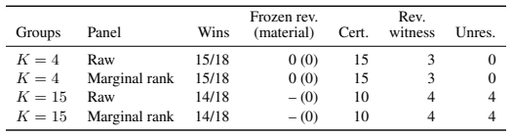
Table 2 . Vision study (O1): ResNet-50 failure detection on ImageNet-C, 18 comparisons (six score pairs at three severities). Wins: all- group winners on discovery. Cert.: confirmation continuum certificates. Rev. witness: explicit confirmation reversal witnesses. Unres.: unresolved. Frozen rev.: among discovery winners, reversals of the frozen discovery witness on confirmation, material ones in parentheses; forK= 15only the material frozen-grid count is computed (–).
出典 · CC BY 4.0 · Mahtab Movahhedrad, Hamidreza Hasani Balyani, Seyed Pouyan Mousavi Davoudi · When Does an AUROC Comparison Survive a Change in Population Mix? · 論文の図を引用 · 元のPDFの7ページ目から図の部分を抽出しています。残された制約
論文が示す制約は次のとおりです。有限のバンクは2つだけで実証しており、言語モデルのラベルは検証済みの正解ではなく、評価したのは単一の分類器と一つの破損ベンチマークだけです。独立したモデル再現研究であるE1は実行されていません。また、分布に独立した母集団の認証には大きな標本が必要で、混合の認証はグループ内の移動や公平性は扱いません。
論文情報
- 著者
- Mahtab Movahhedrad, Hamidreza Hasani Balyani, Seyed Pouyan Mousavi Davoudi
- 学会・ジャーナル
- arXiv · プレプリント
- 公開日
- 2026年11月15日
- 登録日
- 2026年11月17日
- 更新日
- 2026年11月15日
- バージョン
- v1
- arXiv
- 2611.19762
- カテゴリ
- cs.LG · cs.CV
- ライセンス
- CC BY 4.0
- 掲載内容
- 論文情報・解説・論文の図
この解説は、Refivuの韓国語解説をAIで翻訳したものです。不正確な翻訳や誤りが含まれる可能性があります。論文と図の利用条件は各出典に従います。
アブストラクト
Does an AUROC comparison survive a change in the proportions of tasks, populations, or image corruptions? A pooled-AUROC ranking of failure detectors or uncertainty scores describes one particular mix of groups. We study two fixed scores for a common binary target under mixtures of fixed group-conditional laws. Using the cross-group AUC decomposition, we prove that every rational symmetric quadratic comparison geometry is realizable by finite scalar-score distributions. Universal dominance is thus coNP-hard, and even exhaustive checks of every mixture on fewer than $K$ groups can miss a $K$-group reversal. A grid bound gives a dimension-uniform approximation certificate with sharp $1/m$ order. Common score marginals across groups make the comparison numerator linear, with an error envelope for imperfect alignment. These results yield exact finite-bank audits, explicit reversal mixtures and distances, and simultaneous population statements. For failure detection with a frozen ResNet-50 on ImageNet-C, 15 of 18 confidence-score comparisons win in every corruption family on a discovery split, and all 15 are finite-bank certified over all family mixtures on a held-out split; over all 15 corruption types, of 14 discovery winners the corrected grid certifies 10, leaves 3 unresolved, and finds one confirmation reversal of at least 0.05 AUROC. An audit of all 11,019 released Stable LM 2 12B outputs and 35 uncertainty methods finds 66 confirmation-set comparisons that win within all four tasks yet reverse under mixing. Discovery-fitted marginal rank alignment removes all 66; an alignment-error envelope certifies 83 comparisons. Label checks also change several selected reversals. The findings distinguish robustness of frozen scores from robustness after calibration; they do not establish human-error detection, robustness to unseen corruptions, or generalization beyond the evaluated banks.
この論文を引用
Mahtab Movahhedrad, Hamidreza Hasani Balyani, Seyed Pouyan Mousavi Davoudi (2026). When Does an AUROC Comparison Survive a Change in Population Mix?. arXiv:2611.19762v1. https://arxiv.org/abs/2611.19762v1
BibTeX
@misc{movahhedrad2026when,
  title = {{When Does an AUROC Comparison Survive a Change in Population Mix?}},
  author = {Mahtab Movahhedrad and Hamidreza Hasani Balyani and Seyed Pouyan Mousavi Davoudi},
  year = {2026},
  eprint = {2611.19762},
  archivePrefix = {arXiv},
  url = {https://arxiv.org/abs/2611.19762v1}
}