論文解説
Rethinking RGB-D Salient Object Detection: Models, Data Sets, and Large-Scale Benchmarks
RGB-D顕著物体検出の再考:モデル、データセット、大規模ベンチマーク
- 課題 低品質な深度マップを明示的に取り除くモデルと、人を中心としたRGB-Dデータセットが必要です。
- 手法 深度精製ユニットと3つの枝からなる特徴学習モジュールで構成されるD3Netを提案します。
- 結果 論文では、D3Netが評価対象の5つの指標で既存研究を上回ったと報告されています。
RGB-D顕著物体検出の課題
深度情報はスマートフォンにも広く搭載されていますが、既存のRGB-D顕著物体検出の研究は、Kinectやライトフィールドカメラで取得したデータに主に依存してきました。著者らは、スマートフォンのカメラで得た人を中心とした実世界シーンのデータが不足していると指摘します。また、低品質な深度マップは誤検出を引き起こしうる一方で、既存モデルは深度マップを明示的にフィルタリングせず、RGBと深度の特徴を複数の戦略で融合してきました。この論文は、この2つの空白をデータセット構築、モデル設計、大規模ベンチマークによって同時に扱います。
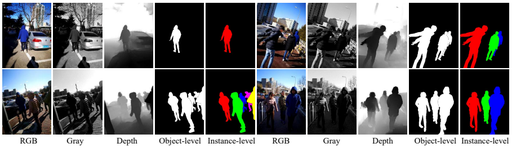
Figure 3 . Examples of images, depth maps and annotations ( i.e., object-level, instance-level) in our SIP dataset with different numbers of salient objects, object sizes, object positions, scene complexities, and lighting conditions. Note that the “RGB” and “Gray” images are captured by two different monocular cameras from short distances. Thus, the “Gray” images are slightly different from the grayscale images obtained from colorful (RGB) image. Our SIP dataset provides a new direction such as depth estimating from “RGB” and “Gray” images, and instance-level RGB-D salient object detection.
出典 · CC BY 4.0 · Deng-Ping Fan, Zheng Lin, Jia-Xing Zhao, Yun Liu, Zhao Zhang, Qibin Hou, Menglong Zhu, Ming-Ming Cheng · Rethinking RGB-D Salient Object Detection: Models, Data Sets, and Large-Scale Benchmarks · 論文の図を引用 · 元のPDFの2ページ目から図の部分を抽出しています。D3Netの構造と深度精製ユニット
D3Netは、深度精製ユニット(DDU)と3つの枝からなる特徴学習モジュール(FLM)で構成されます。FLMはRgbNet、RgbdNet、DepthNetの3つのサブネットワークからなり、各サブネットワークは224×224にリサイズされた入力を受け取り、Srgb、Srgbd、Sdepthの予測マップを生成します。バックボーンにはVGG-16を用い、FPN形式のボトムアップ・トップダウン経路と側方接続を適用します。学習段階では3つのサブネットワークがそれぞれクロスエントロピー損失で学習され、DDUはテスト段階でのみ使用されます。テスト段階では、SdepthとSrgbdの間のMAEベースの距離δがしきい値t=0.15以下であれば、ゲートFcuは1になりSrgbdが選ばれます。
そうでなければSrgbが選ばれます。このゲートは深度マップを完全に取り除くのではなく、深度経路による予測を抑え、RGB経路を選ぶ仕組みとして働きます。
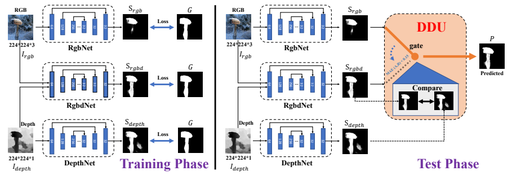
Figure 5 . Illustration of the proposed D 3Net. In the training stage (Left), the input RGB and depth images are processed with three parallel sub-networks, e.g., RgbNet, RgbdNet, and DepthNet. The three sub-networks are based on a same modified structure of Feature Pyramid Networks (FPN) (see § IV-A for details). We introduced these sub-networks to obtain three saliency maps ( i.e., Srgb, Srgbd, and Sdepth ) which considered both coarse and fine details of the input. In the test phase (Right), a novel depth depurator unit (DDU) ( § IV-B) is utilized for the first time in this work to explicitly discard ( i.e., Srgbd) or keep ( i.e., Srgbd) the saliency map introduced by the depth map. In the training/test phase, these components form a nested structure and are elaborately designed ( e.g., gate connection in DDU) to automatically learn the salient object from the RGB image and Depth image jointly.
出典 · CC BY 4.0 · Deng-Ping Fan, Zheng Lin, Jia-Xing Zhao, Yun Liu, Zhao Zhang, Qibin Hou, Menglong Zhu, Ming-Ming Cheng · Rethinking RGB-D Salient Object Detection: Models, Data Sets, and Large-Scale Benchmarks · 論文の図を引用 · 元のPDFの6ページ目から図の部分を抽出しています。ベンチマーク設定と主な比較結果
論文では、NJU2KとNLPRの学習リストを用いてCPFPと同じ学習設定に従い、NJU2KとNLPRのテストセットに加えてSTERE、DES、SSD、LFSD、SIPの全体を評価に用います。評価指標はMAE、F-measure、S-measure、E-measure、PR曲線です。著者らは、D3Netが評価した5つの指標で既存研究を上回ると報告しており、CPFPと比べて6つのデータセットで1.0%から5.8%、SIPで1.4%の向上を示しています。ただし、この数値は該当する学習設定とテスト条件で得られた結果であり、ほかのデータやモデル条件に一般化すべきではありません。
DDUの分析と限界
DDUの上限と下限を分析するため、RgbNetまたはRgbdNetのうち最適な経路を選んで集計しました。この分析では、D3Netは上限との平均差が約1.6%でした。また、著者らはSIPデータセットの画像数が、ほとんどのRGB顕著物体検出データセットより少ないと明らかにしています。3つのサブネットワークで構成される構造は、軽量なデバイスでメモリ使用量を増やしうるという限界もあります。
論文情報
- 著者
- Deng-Ping Fan, Zheng Lin, Jia-Xing Zhao, Yun Liu, Zhao Zhang, Qibin Hou, Menglong Zhu, Ming-Ming Cheng
- 学会・ジャーナル
- arXiv · プレプリント
- 公開日
- 2019年7月15日
- 登録日
- 2026年11月6日
- 更新日
- 2020年7月11日
- バージョン
- v2
- arXiv
- 1907.06781
- DOI
- 10.1109/tnnls.2020.2996406
- カテゴリ
- cs.CV
- ライセンス
- CC BY 4.0
- 掲載内容
- 論文情報・解説・論文の図
この解説は、Refivuの韓国語解説をAIで翻訳したものです。不正確な翻訳や誤りが含まれる可能性があります。論文と図の利用条件は各出典に従います。
アブストラクト
The use of RGB-D information for salient object detection has been extensively explored in recent years. However, relatively few efforts have been put towards modeling salient object detection in real-world human activity scenes with RGBD. In this work, we fill the gap by making the following contributions to RGB-D salient object detection. (1) We carefully collect a new SIP (salient person) dataset, which consists of ~1K high-resolution images that cover diverse real-world scenes from various viewpoints, poses, occlusions, illuminations, and backgrounds. (2) We conduct a large-scale (and, so far, the most comprehensive) benchmark comparing contemporary methods, which has long been missing in the field and can serve as a baseline for future research. We systematically summarize 32 popular models and evaluate 18 parts of 32 models on seven datasets containing a total of about 97K images. (3) We propose a simple general architecture, called Deep Depth-Depurator Network (D3Net). It consists of a depth depurator unit (DDU) and a three-stream feature learning module (FLM), which performs low-quality depth map filtering and cross-modal feature learning respectively. These components form a nested structure and are elaborately designed to be learned jointly. D3Net exceeds the performance of any prior contenders across all five metrics under consideration, thus serving as a strong model to advance research in this field. We also demonstrate that D3Net can be used to efficiently extract salient object masks from real scenes, enabling effective background changing application with a speed of 65fps on a single GPU. All the saliency maps, our new SIP dataset, the D3Net model, and the evaluation tools are publicly available at https://github.com/DengPingFan/D3NetBenchmark.
この論文を引用
Deng-Ping Fan, Zheng Lin, Jia-Xing Zhao, Yun Liu, Zhao Zhang, Qibin Hou, Menglong Zhu, Ming-Ming Cheng (2019). Rethinking RGB-D Salient Object Detection: Models, Data Sets, and Large-Scale Benchmarks. arXiv:1907.06781v2. https://doi.org/10.1109/tnnls.2020.2996406
BibTeX
@article{fan2019rethinking,
  title = {{Rethinking RGB-D Salient Object Detection: Models, Data Sets, and Large-Scale Benchmarks}},
  author = {Deng-Ping Fan and Zheng Lin and Jia-Xing Zhao and Yun Liu and Zhao Zhang and Qibin Hou and Menglong Zhu and Ming-Ming Cheng},
  year = {2019},
  eprint = {1907.06781},
  archivePrefix = {arXiv},
  doi = {10.1109/tnnls.2020.2996406},
  url = {https://arxiv.org/abs/1907.06781v2}
}