論文解説
A Survey of Deep Active Learning
深層能動学習のサーベイ
- 課題 深層学習には多くのラベル付きデータが必要ですが、専門分野ではラベリングの費用が大きくなります。能動学習でラベル費用を抑えつつ、深層学習と組み合わせる方法を体系的に整理する必要があります。
- 手法 ラベルのないプールから獲得関数でバッチ単位のサンプルを選び、質問したサンプルでディープモデルを更新するDeepALのループを、質問戦略、データ拡張、一般的なフレームワークの観点で分類します。
- 結果 バッチ質問では、BatchBALDやExploration-Pのように、サンプル間の相関と冗長性を考慮する方法が示されました。CEALとVAAL系は、疑似ラベルと敵対的表現学習によって、ラベル不足の問題を抑えようとしました。
ラベル費用と能動学習の必要性
深層学習は多くのラベル付きデータを必要としますが、医療画像や音声認識のように専門知識が要る分野では、ラベリング費用が大きく、適用が難しくなります。この論文では、能動学習(Active Learning, AL)によってラベル費用を抑える試みを詳しく整理し、深層学習と能動学習を組み合わせたDeepALの研究を一つの分類体系の下で検討しています。論文では、DeepALを包括的に検討した研究がまだなかったことが、この論文の出発点として示されています。
能動学習は、ラベルのないサンプルの中からモデルの更新に最も価値のあるものを選び、オラクルにラベルを求める方法です。しかし従来の能動学習は高次元データを扱いにくく、深層学習と組み合わせると、モデルの過信、ラベル付きサンプルの不足、特徴学習と分類器学習の処理パイプラインの不一致という問題が生じます。
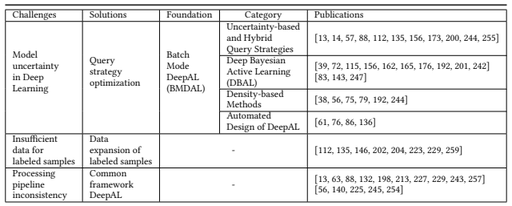
Table 1 . The challenges of combining DL and AL, as well as a summary of related work on the corresponding solutions.
出典 · CC BY 4.0 · Pengzhen Ren, Yun Xiao, Xiaojun Chang, Po-Yao Huang, Zhihui Li, Brij B. Gupta, Xiaojiang Chen, Xin Wang · A Survey of Deep Active Learning · 論文の図を引用 · 元のPDFの21ページ目から図の部分を抽出しています。バッチ質問戦略とDeepALの構成
DeepALの基本構造は、初期のラベル付き学習集合でDLモデルを初期化するか事前学習し、ラベルのないプールから質問戦略によってバッチのサンプルを選び、オラクルからラベルを受け取って、それを学習集合に加えてモデルを再学習する、という繰り返しです。論文では、ラベル予算が尽きるか、あらかじめ定めた終了条件に達するまで、この過程を繰り返すと説明されています。
バッチ質問で各サンプルを独立に評価すると、似ていて情報量の多いサンプルが一緒に選ばれることがあります。BatchBALDは、BALDの相互情報量の考え方をバッチに拡張し、複数のデータ点とモデルパラメータの間の結合相互情報量を推定します。論文の式(4)は、この獲得関数がI(y1:b; ω | x1:b, D_train)で定義されることを示しています。一方、Exploration-Pは、不確実性E(S)から冗長性R(S)を引いた目的関数I(S) = E(S) − α|S|R(S)を用いて、不確実性と多様性を同時に考慮します。
不確実性ベースの戦略とベイズ的手法
不確実性ベースの戦略は、モデルが最も不確実と判断するサンプルを選びます。マージンサンプリングは、最大確率と2番目の確率の差M = P(y1|x) − P(y2|x)が小さいサンプルを選び、情報エントロピーは、クラス確率から計算したE(x)が大きいサンプルを選びます。ただし論文では、ソフトマックス出力は過信しうるため、Softmax Responseは信頼度の指標として不安定だと指摘されています。
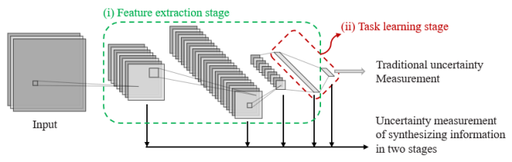
Fig. 8 . Taking a common CNN as an example, this figure presents a comparison between the traditional uncertainty measurement method [56, 140, 243] and the uncertainty measurement method of synthesizing information in two stages [88, 245, 254] (i.e., the feature extraction stage and task learning stage).
出典 · CC BY 4.0 · Pengzhen Ren, Yun Xiao, Xiaojun Chang, Po-Yao Huang, Zhihui Li, Brij B. Gupta, Xiaojiang Chen, Xin Wang · A Survey of Deep Active Learning · 論文の図を引用 · 元のPDFの19ページ目から図の部分を抽出しています。これを補うため、DBALはBayesian convolutional neural networkとBALDを組み合わせます。論文では、MC-dropoutが事後サンプルを得る低コストな手法として用いられていると説明されています。DEBALはアンサンブルとMC-dropoutを組み合わせ、パターン崩壊による過信の問題を減らそうとしています。論文では、こうしたベイズ的手法がさまざまなタスクで使われてきたと紹介されていますが、結果の比較は各研究の条件によって異なります。
多様性・密度ベースの手法と生成ベースのデータ拡張
密度ベースの手法は、元のデータ分布を代表するcore-setを構成して質問を選びます。論文では、この方法は代表性を確保できる一方、大きな距離行列が必要になるため、大規模なラベルなしデータでは計算コストが大きくなりうると説明されています。DALは、能動学習を二値分類問題に置き換え、ラベル集合と非ラベル集合を見分けにくくします。これにより、密度に比例したサンプリングを試みます。
ラベルデータが不足する問題を緩和するため、GAALは生成的敵対ネットワークを質問手法に導入し、BGADLはベイズデータ拡張とACGAN、VAEを組み合わせます。論文では、これらの手法が生成サンプルの情報量を保証できないかもしれないという問題意識も併せて示されています。
損失予測と敵対的表現学習
LLALは損失予測モジュールを対象ネットワークに取り付け、複数の隠れ層の出力を入力として受け取り、ラベルのないサンプルの目標損失を予測します。予測された損失が大きい上位K個を質問し、オラクルに渡します。論文では、この方式はタスクに依存しないフレームワークとして設計されていると説明されています。
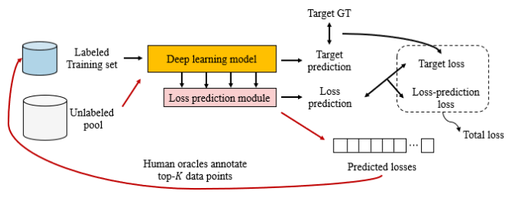
Fig. 9 . The overall framework of LLAL [ 245]. The black line represents the stage of training model parameters, optimizing the overall loss composed of target loss and loss-prediction loss. The red line represents the sample query phase of AL. The output of the multiple hidden layers of the DL model is used as the input of the loss prediction module, while the top-𝐾 unlabeled data points are selected according to the predicted losses and assigned labels by the oracle.
出典 · CC BY 4.0 · Pengzhen Ren, Yun Xiao, Xiaojun Chang, Po-Yao Huang, Zhihui Li, Brij B. Gupta, Xiaojiang Chen, Xin Wang · A Survey of Deep Active Learning · 論文の図を引用 · 元のPDFの20ページ目から図の部分を抽出しています。VAALは、ラベル付きデータとラベルなしデータを使ってVAEを準教師あり方式で学習し、識別器が二つの集合の潜在表現を見分けにくくすることで、情報量の大きいサンプルを選ばせます。TA-VAALはVAALに損失予測モジュールとRankCGANを統合し、データ分布とモデルの不確実性を同時に考慮します。
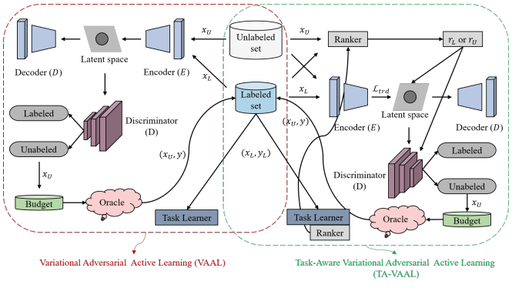
Fig. 3 . Structure comparison chart of VAAL [204] and TA-VAAL [112]. 1) VAAL uses labeled data and unlabeled data in a semi-supervised way to learn the latent representation space of the data, then selects the unlabeled data with the largest amount of information according to the latent space for labeling. 2) TA-VAAL expands VAAL and integrates the loss prediction module [245] and RankCGAN [185] into VAAL in order to consider data distribution and model uncertainty simultaneously.
出典 · CC BY 4.0 · Pengzhen Ren, Yun Xiao, Xiaojun Chang, Po-Yao Huang, Zhihui Li, Brij B. Gupta, Xiaojiang Chen, Xin Wang · A Survey of Deep Active Learning · 論文の図を引用 · 元のPDFの11ページ目から図の部分を抽出しています。CEALの準教師あり更新とフレームワーク
CEALはDeepALフレームワークの代表的な例で、ラベルのないデータを初期化されたCNNに段階的に入れます。不確実な少数のサンプルにはオラクルへラベルを求め、予測信頼度の高い多数のサンプルには疑似ラベルを自動で割り当てます。その後、この二種類のサンプルでCNNをファインチューニングし、同じ過程を繰り返します。この方式は、追加のラベル費用なしに学習集合を広げることを目的としています。
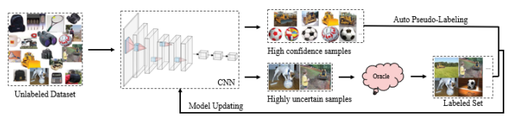
Fig. 5 . In CEAL [ 229], the overall framework of DeepAL is utilized. CEAL [229] gradually feeds the samples from the unlabeled dataset to the initialized CNN, after which the CNN classifier outputs two types of samples: a small number of uncertain samples and a large number of samples with high prediction confidence. A small number of uncertain samples are labeled through the oracle, and the CNN classifier is used to automatically assign pseudo-labels to a large number of high-prediction confidence samples. These two types of samples are then used to fine-tune the CNN, and the updated process is repeated.
出典 · CC BY 4.0 · Pengzhen Ren, Yun Xiao, Xiaojun Chang, Po-Yao Huang, Zhihui Li, Brij B. Gupta, Xiaojiang Chen, Xin Wang · A Survey of Deep Active Learning · 論文の図を引用 · 元のPDFの15ページ目から図の部分を抽出しています。論文では、この学習方式が質問戦略の改善とあわせて、DeepALモデルの学習不足を補うと説明されています。ただし、この構造は特定の実験設定で紹介されたものであり、この論文がすべてのDeepAL手法に共通する構成を示しているわけではありません。
評価の不一致と限界
論文では、DeepAL研究はまだ初期段階にあると見ています。同じ設定であっても、ランダムサンプリングのベースラインの結果は研究ごとに大きく異なることがあり、同一のDeepAL手法でも研究によって異なる結果が出ることがあります。また、多様性ベースの手法が不確実性ベースの手法より常に優れているという主張も、最近の研究では一貫していません。
そのため著者らは、統一された評価プラットフォーム、再現可能な実験設定、複数の初期化にわたる反復実験、アブレーション実験と転移実験の必要性を強調しています。論文が示した数値の差は、異なる研究の設定の違いから生じたものなので、単一の手法の確定的な性能として解釈すべきではありません。
論文情報
- 著者
- Pengzhen Ren, Yun Xiao, Xiaojun Chang, Po-Yao Huang, Zhihui Li, Brij B. Gupta, Xiaojiang Chen, Xin Wang
- 学会・ジャーナル
- arXiv · プレプリント
- 公開日
- 2020年8月30日
- 登録日
- 2026年11月6日
- 更新日
- 2021年12月5日
- バージョン
- v2
- arXiv
- 2009.00236
- カテゴリ
- cs.LG · stat.ML
- ライセンス
- CC BY 4.0
- 掲載内容
- 論文情報・解説・論文の図
この解説は、Refivuの韓国語解説をAIで翻訳したものです。不正確な翻訳や誤りが含まれる可能性があります。論文と図の利用条件は各出典に従います。
アブストラクト
Active learning (AL) attempts to maximize the performance gain of the model by marking the fewest samples. Deep learning (DL) is greedy for data and requires a large amount of data supply to optimize massive parameters, so that the model learns how to extract high-quality features. In recent years, due to the rapid development of internet technology, we are in an era of information torrents and we have massive amounts of data. In this way, DL has aroused strong interest of researchers and has been rapidly developed. Compared with DL, researchers have relatively low interest in AL. This is mainly because before the rise of DL, traditional machine learning requires relatively few labeled samples. Therefore, early AL is difficult to reflect the value it deserves. Although DL has made breakthroughs in various fields, most of this success is due to the publicity of the large number of existing annotation datasets. However, the acquisition of a large number of high-quality annotated datasets consumes a lot of manpower, which is not allowed in some fields that require high expertise, especially in the fields of speech recognition, information extraction, medical images, etc. Therefore, AL has gradually received due attention. A natural idea is whether AL can be used to reduce the cost of sample annotations, while retaining the powerful learning capabilities of DL. Therefore, deep active learning (DAL) has emerged. Although the related research has been quite abundant, it lacks a comprehensive survey of DAL. This article is to fill this gap, we provide a formal classification method for the existing work, and a comprehensive and systematic overview. In addition, we also analyzed and summarized the development of DAL from the perspective of application. Finally, we discussed the confusion and problems in DAL, and gave some possible development directions for DAL.
この論文を引用
Pengzhen Ren, Yun Xiao, Xiaojun Chang, Po-Yao Huang, Zhihui Li, Brij B. Gupta, Xiaojiang Chen, Xin Wang (2020). A Survey of Deep Active Learning. arXiv:2009.00236v2. https://arxiv.org/abs/2009.00236v2
BibTeX
@misc{ren2020survey,
  title = {{A Survey of Deep Active Learning}},
  author = {Pengzhen Ren and Yun Xiao and Xiaojun Chang and Po-Yao Huang and Zhihui Li and Brij B. Gupta and Xiaojiang Chen and Xin Wang},
  year = {2020},
  eprint = {2009.00236},
  archivePrefix = {arXiv},
  url = {https://arxiv.org/abs/2009.00236v2}
}