論文解説
Who Taught the Robot That? Removing One User's Corrections from a Robot Policy That Learns Online
そのロボットは誰に教わったのか:オンラインで学習するロボット政策から1人のユーザーの修正を取り除く
- 課題 複数のユーザーが配備後も修正を続けるロボットで、1人のユーザーの修正を取り除くにはどのような方法が必要かを扱います。
- 手法 修正ログに保存された更新の順序とシードを使い、削除対象のユーザーを除いたセッションを元の順序で再実行する方法を提案し、それを一括再学習と比較します。
- 結果 takeover修正では、順序を保った再実行が反事実政策にノイズフロア程度まで近づき、一括再学習はそうなりません。部分修正では、どの方法も反事実政策に到達できませんでした。
オンライン学習するロボットで1人のユーザーの修正を取り除く問題
配備後も学習を続けるロボットを複数の人が修正するとき、そのうち1人が自分の寄与の削除を求めたら、ロボットがその人を忘れられるかが問題になります。既存のフェデレーテッド学習の削除方法は、各寄与者のデータが他の寄与者と独立していると仮定します。しかしロボットの修正は、ロボットがすでに他のユーザーの修正を受けた状態で行われるため、この仮定が成り立ちません。そのため、この研究では、削除対象のユーザーがいなかった場合の反事実政策π−uをシミュレーションで計算し、削除方法がその政策にどれだけ近づくかを問います。
修正ログと削除方法の動作
基準政策π0は200個のデモで学習されます。各セッションでユーザーがロボットの誤った行動を修正すると、修正のペアが記録されます。セッションの後には200回のgradient stepで政策をファインチューニングします。バッチの50%は現在のセッション、25%は前のセッションのリプレイバッファ、残りの25%はデモからサンプルします。Retrainは削除対象ユーザーの修正を除き、残りをまとめて混ぜて学習します。Replayは削除対象の最初のセッション直前のチェックポイントから始め、以降のセッションを元の順序と同じシードで再実行します。Shuffled replayは残ったセッションの順序だけをランダムに入れ替え、順序の影響を確かめます。
部分修正では、再生中の政策の行動にユーザーが記録したnudgeを加えて修正を記録し直すrelabelled replayも比較します。
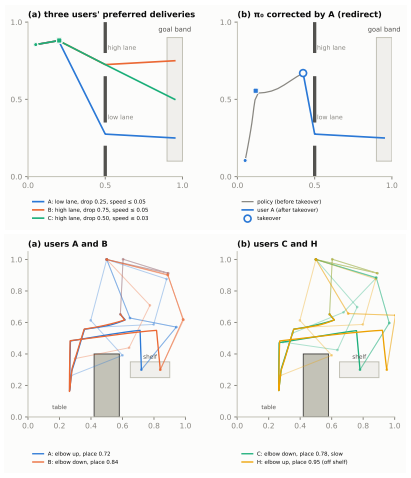
Figure 1 :The two tasks.Top: Delivery2D, seen from above. (a) The robot picks up an object on the left, passes through the low or the high gap in a wall, and puts the object down in the goal band on the right. Users differ in which gap they prefer, where in the band they want the object, and how fast the robot may move. (b) The base policy heads for the wrong gap; user A takes over (circle) and finishes the episode their way. Bottom: Arm3, a planar arm with three joints. Thick lines show each user’s preferred path of the hand; thin lines show the arm at several moments. The arm picks up an object from the table, carries it over the central block and places it on the shelf. Users differ in whether the elbow points up or down while carrying, where on the shelf the object goes, and how fast the joints may move. User H places the object off the shelf.
出典 · CC BY 4.0 · Eshika Pathak, Leela Krishna · Who Taught the Robot That? Removing One User's Corrections from a Robot Policy That Learns Online · 論文の図を引用 · 元のPDFの5ページ目から図の部分を抽出しています。行動距離とノイズフロアによる成功基準
2つの政策の差は、同じ状態で2つの政策が出した行動の間の平均ユークリッド距離d(π1, π2)で測ります。ここでの状態は、π−uが訪れた500個の状態と、uがロボットを修正した500個の状態を合わせた集合です。異なる学習シードでπ−uを再学習したときに得られる距離がノイズフロアです。削除方法の距離をこのノイズフロアで割った値が1に近ければ、学習ノイズ程度の差だと解釈します。影響残存率は、方法のπ−uまでの距離を配備政策のπ−uまでの距離で割ったrです。これは少なくともノイズフロア比率r_minの分だけ残ります。選好一致度は、テストのエピソードでユーザーが好む行動をロボットがとる割合です。2つの方法は同じ20個のシードで対にして比較します。
takeover修正で順序を保った再実行の結果
Delivery2DのtakeoverでのRetrainは、normal deploymentでのπ−uからノイズフロアの1.30倍離れており、frozen-robot controlでも1.30倍で同じです。frozen-robot controlは、各ユーザーが他のユーザーの修正を見られないよう、基準政策π0を修正させる統制実験です。そのためこの結果は、ユーザー間の依存関係だけではRetrainの失敗を説明しにくいという根拠になります。Replayは同じ設定でprefix floorの0.91倍のところでπ−uに到達し、削除対象ユーザーの選好一致度もπ−uと同じ範囲です。順序を入れ替えたreplayは、Retrainよりπ−uから0.44ノイズフロア分だけ遠くなります。
この観察は、takeover修正、Delivery2D、k=1と3人のユーザーという設定の条件で得られたものです。
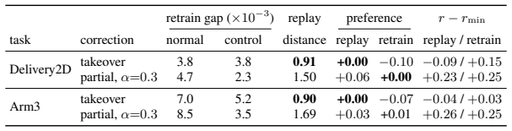
Table 1 :Main results.Each row is one task and one way of correcting, averaged over block lengths and over which user is removed.Retrain gap: distance from retrain to the counterfactual policyπ−u, in action units (×10−3), in the normal deployment and in the frozen-robot control, where no user’s corrections depend on another’s.Replay distance: distance from replay toπ −u as a multiple of the prefix noise floor (1 is as close as training noise allows).Preference: the removed user’s preference match minus that ofπ −u (0 is right; positive keeps too much of the user).r−r min: the share of the user’s influence left beyond what training noise forces (0 is the best possible). Bold marks results within training noise ofπ −u.
出典 · CC BY 4.0 · Eshika Pathak, Leela Krishna · Who Taught the Robot That? Removing One User's Corrections from a Robot Policy That Learns Online · 論文の図を引用 · 元のPDFの6ページ目から図の部分を抽出しています。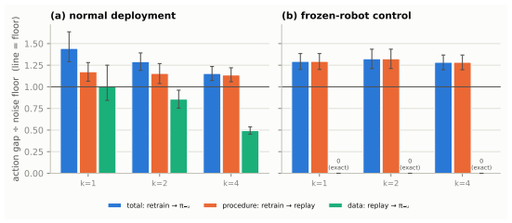
Figure 2 :Where retrain’s error comes from,Delivery2D, takeover users. Each group of bars is one schedule (kis the block length). Blue: total distance from retrain to the counterfactual policy π−u. Orange: distance from retrain to replay (due to the training procedure). Green: distance from replay toπ −u (due to the data). All are divided by the noise floor; the horizontal line at 1 is as close as training noise allows. (a) Normal deployment. (b) Frozen-robot control, where no user’s corrections depend on another’s, so replay equalsπ −u exactly. Retrain’s total error is the same in both panels.
出典 · CC BY 4.0 · Eshika Pathak, Leela Krishna · Who Taught the Robot That? Removing One User's Corrections from a Robot Policy That Learns Online · 論文の図を引用 · 元のPDFの6ページ目から図の部分を抽出しています。部分修正で残る影響
部分修正では、修正の強さαを0.1から1まで変え、Delivery2DでのK=1スケジュールで実験します。αが0.2から0.6の間のとき、Replayはprefix floorより遠くに離れており、α≤0.45では削除対象ユーザーの選好をπ−uより多く保ちます。著者らは、これを他のユーザーの修正にロボットの既存の行動が混ざっているため、削除対象の癖が記録に残るからだと解釈しています。Oracle relabellingは実際の専門家の行動を使い、α≤0.3でReplayの選好誤差を43から64%減らしますが、π−uに対するaction distanceはほとんど変えません。そのため、修正の再計算だけでは残りの誤差をなくせないという根拠になります。
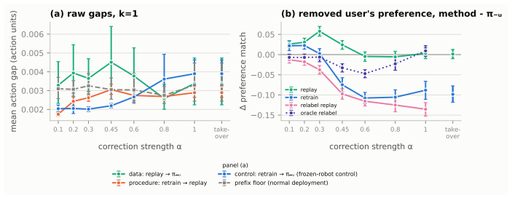
Figure 3 :Effect of correction strengthα,Delivery2D, schedulek=1. “Take-over” is the takeover user, identical toα=1. (a) Distances in action units. Green: replay toπ −u (due to the data). Orange: retrain to replay (due to the training procedure). Blue: retrain toπ −u in the frozen-robot control. Grey: prefix noise floor. (b) The removed user’s preference match minus that ofπ −u for each method; 0 is right, and positive values keep too much of the user.
出典 · CC BY 4.0 · Eshika Pathak, Leela Krishna · Who Taught the Robot That? Removing One User's Corrections from a Robot Policy That Learns Online · 論文の図を引用 · 元のPDFの7ページ目から図の部分を抽出しています。他の削除方法と継続学習の限界
Gradient-ascent unlearningとper-user adapterの削除は、Arm3のtakeover設定でタスク成功率を0.76から、それぞれ0.54と0.02に下げます。そのためこの2つの方法は、ログに基づく再実行とは違い、政策全体を損ないました。また、ユーザーHを削除せず残りのユーザーと学習を続けると、Hの癖はDelivery2DのgapのSelectionで2ラウンド後も約+0.10程度残ります。Hの過去の修正をリプレイバッファから削除すると、8ラウンド後には+0.01まで下がります。そのため、バッファに残った古い修正が癖を維持していると報告されています。ただし、この結果はHが好んでいたgapを残りのユーザーが全員反対している設定で得られたものです。

Table 2 :How H’s preferred gap fadeswhen training continues with the remaining users, Deliv- ery2D, takeover users, all remaining users preferring the other gap, 10 seeds. Each entry is the robot’s share of trips through H’s preferred gap minus the same share for the counterfactual policy π−u (0 means none of H’s habit is left), afterRfurther rounds without H.
出典 · CC BY 4.0 · Eshika Pathak, Leela Krishna · Who Taught the Robot That? Removing One User's Corrections from a Robot Policy That Learns Online · 論文の図を引用 · 元のPDFの7ページ目から図の部分を抽出しています。修正ログから影響の大きいユーザーを探す実験
6人のユーザーの設定で、修正ログからどのユーザーが行動を教えたかが分かるかを確認します。実際の影響は、ユーザーを削除して再実行したときと配備政策の行動の変化で定義されます。Replayに基づく削除の平均Spearman相関は、takeoverユーザーでは0.25、部分ユーザーα=0.3では0.32で、修正回数を数える方法の0.24と0.25とは大きな差がありません。一方、最も影響の大きいユーザー1人を見つける精度は、Replayが45から50%の場合に当たり、修正回数を数える方法は17%でした。悪意のあるユーザーHがいる設定では、ReplayはHを85から95%のシードで最も影響の大きいユーザーとして挙げます。
シミュレーションと小さい効果による適用範囲
この結果は、固定された選好と完全に一貫したスクリプトユーザー、そしてシミュレーション環境で得られたものです。実際のユーザーは一貫性が低く、考えを変え、2つの修正の仕方を混ぜることもあるため、この結果をそのまま実際のユーザーに一般化することはできません。また、配備政策はπ−uから1.0から1.75ノイズフロア分離れており、効果の大きさは小さく、政策は小さなニューラルネットワークです。著者らは、Arm3では修正学習がタスク成功率を大きく下げると報告しています。そのため、より大きな政策や他の入力でも同じ結果になるかは確認されていません。
論文情報
- 著者
- Eshika Pathak, Leela Krishna
- 学会・ジャーナル
- arXiv · プレプリント
- 公開日
- 2026年11月6日
- 登録日
- 2026年11月10日
- 更新日
- 2026年11月6日
- バージョン
- v1
- arXiv
- 2611.10280
- カテゴリ
- cs.RO · cs.HC
- ライセンス
- CC BY 4.0
- 掲載内容
- 論文情報・解説・論文の図
この解説は、Refivuの韓国語解説をAIで翻訳したものです。不正確な翻訳や誤りが含まれる可能性があります。論文と図の利用条件は各出典に従います。
アブストラクト
A robot that keeps learning after deployment is corrected by several people in turn, and one of them may later ask to be removed. We show that whether the robot can forget that person depends on how people correct it. The goal of removal is the robot that would exist if the person had never been there, which we compute exactly in two simulated tasks with scripted users. When users correct the robot by taking over control, an ordered log of training updates is enough: retraining on the remaining sessions in their original order gives a robot as close to the goal as training noise allows. Deleting the person's data and retraining in one pass does not, even when the other users' corrections do not depend on the removed person, because it loses the order of training. When users only nudge the robot's action, the other users' corrections carry the removed person's influence, and no method we tested recovers the goal robot. Continuing to train without the person removes most of their habits, but not what their data in the training buffer keep alive. The log can identify one clearly harmful user, but not rank users by influence better than counting their corrections.
この論文を引用
Eshika Pathak, Leela Krishna (2026). Who Taught the Robot That? Removing One User's Corrections from a Robot Policy That Learns Online. arXiv:2611.10280v1. https://arxiv.org/abs/2611.10280v1
BibTeX
@misc{pathak2026taught,
  title = {{Who Taught the Robot That? Removing One User's Corrections from a Robot Policy That Learns Online}},
  author = {Eshika Pathak and Leela Krishna},
  year = {2026},
  eprint = {2611.10280},
  archivePrefix = {arXiv},
  url = {https://arxiv.org/abs/2611.10280v1}
}