論文解説
DiffRF: Rendering-Guided 3D Radiance Field Diffusion
DiffRF:レンダリング誘導型3D Radiance Field拡散
- 課題 DiffRFは、拡散モデルを3D放射輝度場に直接適用して物体を生成する方法です。正解の放射輝度場があいまいな点は、レンダリング損失で補います。
- 手法 ボクセル格子の放射輝度場に対して3D-UNetでノイズを予測し、予測から復元した放射輝度場をレンダリングして損失を加えます。
- 結果 PhotoShape Chairsでは、DiffRFがEG3Dより低いFIDとMMDを報告しました。マスク補完実験でも平均mPSNRは高くなりました。
研究課題と既存手法の限界
DiffRFは、拡散モデルを2D画像や潜在コード、点群ではなく、3Dの放射輝度場(radiance field)そのものに直接適用する研究です。著者らは、既存の拡散ベースの手法は画像、潜在コード、点群データで動作し、放射輝度場を直接生成したのは初めての試みだと主張しています。放射輝度場はポーズ付きの画像集合から当てはめられるため、学習対象である正解の放射輝度場はあいまいで不正確なことがあります。拡散モデルのノイズ予測の定式化では、ノイズと正解データの間に一対一の対応が必要ですが、放射輝度場ではこの正解を得るのが困難です。そこで本論文は、ノイズ予測の学習にレンダリング損失を加え、レンダリング品質が良くなる方向の事前分布を学習することを中心的な問いとします。
ボクセル放射輝度場の拡散とレンダリング損失
DiffRFは、放射輝度場を明示的なボクセル格子で表現します。この表現では、放射輝度場は格子の軸3つと密度・色チャネルを持つ4Dテンソルで、連続位置はボクセル頂点の双線形補間で問い合わせます。ノイズ予測器ϵθは3D-UNetで実装され、2D-UNetの畳み込みとアテンションの演算子を3D演算子に置き換えた構造です。学習では時間ステップtを抽出して放射輝度場f0にノイズを加えたftを作り、ネットワークが加えられたノイズを予測するように学習します。さらに、予測されたノイズから近似したクリーンな放射輝度場f̃0をレンダリングし、実際の画像Ivと比較するレンダリング損失を加えます。この近似はtが0に近いときに妥当なので、時間ステップごとの重みωtを設け、実装ではωtをᾱt²に設定します。
最終的な目的は、ノイズ予測損失LRFとレンダリング損失LRGBを組み合わせたものです。損失の詳細項は、論文の式(8)、(9)、(11)で定義されています。
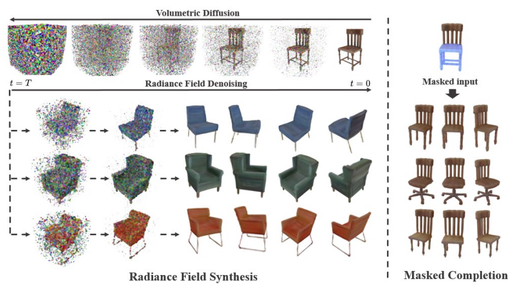
Figure 1 . Our method performs denoising of a probabilistic diffusion process applied to 3D radiance fields. Guided by 3D supervision and volumetric rendering, our model enables the unconditional synthesis of high-fidelity 3D assets (left). We further introduce the novel application of masked completion (right), i.e., the task of recovering shape and appearance from incomplete objects (highlighted in light- blue on the top right chair), solved by our model as conditional inference without task-specific training.
出典 · CC BY 4.0 · Norman Müller, Yawar Siddiqui, Lorenzo Porzi, Samuel Rota Bulò, Peter Kontschieder, Matthias Nießner · DiffRF: Rendering-Guided 3D Radiance Field Diffusion · 論文の図を引用 · 元のPDFの1ページ目から図の部分を抽出しています。無条件生成の比較とレンダリング損失の寄与
PhotoShape Chairsでは、DiffRFをEG3Dおよびπ-GANと比較しました。論文の表では、DiffRFのFIDは15.95、MMDは4.416で、EG3DはFIDが16.54、MMDが5.619と報告されています。この比較では、DiffRFは画質と形状品質が改善したと報告されています。同じ表で2Dレンダリング損失を除いたDiffRF w/o 2Dは、FIDが18.27となり、レンダリング損失を使ったモデルより悪化しました。ABO TablesでもDiffRFはFID 27.06、MMD 7.610を記録し、レンダリング損失を除いた変種はFID 35.89、MMD 8.013と報告されています。
著者らは、レンダリング損失がレンダリングのアーティファクトを減らし、多様性を示すCoverage Scoreを下げうると解釈しています。これは著者の解釈であり、この実験の結果は、2つのデータセットと示された指標の条件で得られたものです。
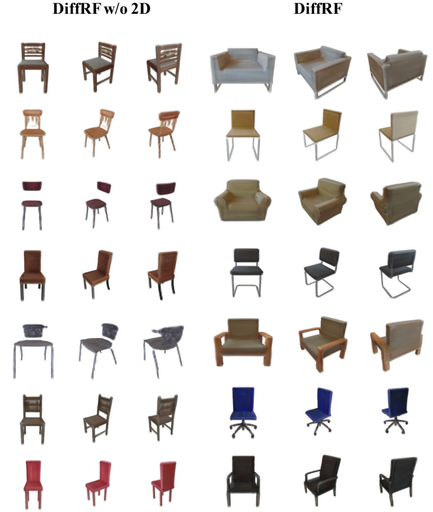
Figure 10 . Qualitative comparison on PhotoShape Chairs [46] when removing the 2D rendering loss.
出典 · CC BY 4.0 · Norman Müller, Yawar Siddiqui, Lorenzo Porzi, Samuel Rota Bulò, Peter Kontschieder, Matthias Nießner · DiffRF: Rendering-Guided 3D Radiance Field Diffusion · 論文の図を引用 · 元のPDFの15ページ目から図の部分を抽出しています。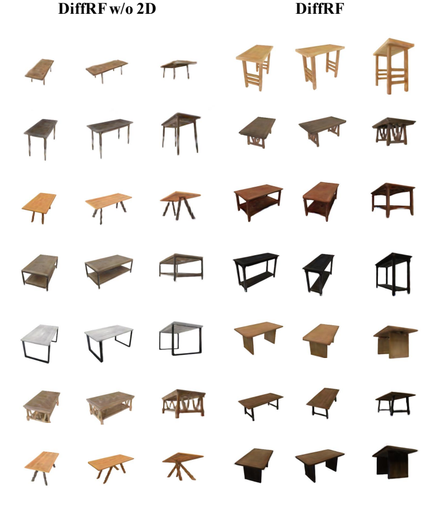
Figure 11 . Qualitative comparison on ABO Tables [12] when removing the 2D rendering loss.
出典 · CC BY 4.0 · Norman Müller, Yawar Siddiqui, Lorenzo Porzi, Samuel Rota Bulò, Peter Kontschieder, Matthias Nießner · DiffRF: Rendering-Guided 3D Radiance Field Diffusion · 論文の図を引用 · 元のPDFの16ページ目から図の部分を抽出しています。マスク補完タスクと条件付きサンプリング
この論文は、学習済みの拡散事前分布を再学習せずにマスク補完に適用します。3Dマスクで隠された放射輝度場の領域を埋める際、各逆方向のステップでマスクの外の入力領域を、ノイズを含む放射輝度場と融合させながらサンプリングを進めます。論文では、この手順をRePaintに着想を得た条件付き補完として説明しています。評価は20%、40%、60%、80%のマスキングで行われ、各条件で200サンプルをランダムにマスクしました。FIDは10個のランダムなビューで評価され、マスクされていない領域の精度はmPSNRで測定されました。平均mPSNRはDiffRFが27.53、EG3Dが24.82です。EG3DはマスクされたGAN逆変換で補完され、マスクされていない領域を忠実に再構成するのは難しいと報告されています。
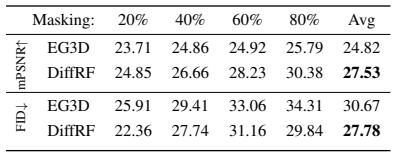
Table 3 . Quantitative evaluation on the task of radiance field com- pletion at different levels of masking. EG3D struggles to faithfully reconstruct non-masked regions of the original sample, while our method maintains the non-masked regions and synthesises coher- ent completions for the masked regions.
出典 · CC BY 4.0 · Norman Müller, Yawar Siddiqui, Lorenzo Porzi, Samuel Rota Bulò, Peter Kontschieder, Matthias Nießner · DiffRF: Rendering-Guided 3D Radiance Field Diffusion · 論文の図を引用 · 元のPDFの6ページ目から図の部分を抽出しています。適用範囲と限界
論文の著者らが挙げる限界は3つです。1つ目は、GANベースの手法と比べて、学習サンプルを作るのに十分な数のポーズ付きビューを必要とすることです。2つ目は、サンプリング時間が長いことです。論文では、1000ステップのDDPMサンプリングに1サンプルあたり48.6秒かかると報告しています。3つ目は、学習時のメモリ制約により、ボクセル格子の最大解像度が制限されることです。論文では、これを適応的または疎な格子、因子分解されたニューラルフィールドで補える可能性があると提案しています。単一ビューの放射輝度場再構成は、ScanNetの椅子に対する分類器誘導サンプリングの定性的結果として示されており、定量評価は報告されていません。
論文情報
- 著者
- Norman Müller, Yawar Siddiqui, Lorenzo Porzi, Samuel Rota Bulò, Peter Kontschieder, Matthias Nießner
- 学会・ジャーナル
- arXiv · プレプリント
- 公開日
- 2022年12月2日
- 登録日
- 2026年11月5日
- 更新日
- 2023年3月27日
- バージョン
- v2
- arXiv
- 2212.01206
- カテゴリ
- cs.CV
- ライセンス
- CC BY 4.0
- 掲載内容
- 論文情報・解説・論文の図
この解説は、Refivuの韓国語解説をAIで翻訳したものです。不正確な翻訳や誤りが含まれる可能性があります。論文と図の利用条件は各出典に従います。
アブストラクト
We introduce DiffRF, a novel approach for 3D radiance field synthesis based on denoising diffusion probabilistic models. While existing diffusion-based methods operate on images, latent codes, or point cloud data, we are the first to directly generate volumetric radiance fields. To this end, we propose a 3D denoising model which directly operates on an explicit voxel grid representation. However, as radiance fields generated from a set of posed images can be ambiguous and contain artifacts, obtaining ground truth radiance field samples is non-trivial. We address this challenge by pairing the denoising formulation with a rendering loss, enabling our model to learn a deviated prior that favours good image quality instead of trying to replicate fitting errors like floating artifacts. In contrast to 2D-diffusion models, our model learns multi-view consistent priors, enabling free-view synthesis and accurate shape generation. Compared to 3D GANs, our diffusion-based approach naturally enables conditional generation such as masked completion or single-view 3D synthesis at inference time.
この論文を引用
Norman Müller, Yawar Siddiqui, Lorenzo Porzi, Samuel Rota Bulò, Peter Kontschieder, Matthias Nießner (2022). DiffRF: Rendering-Guided 3D Radiance Field Diffusion. arXiv:2212.01206v2. https://arxiv.org/abs/2212.01206v2
BibTeX
@misc{mller2022diffrf,
  title = {{DiffRF: Rendering-Guided 3D Radiance Field Diffusion}},
  author = {Norman Müller and Yawar Siddiqui and Lorenzo Porzi and Samuel Rota Bulò and Peter Kontschieder and Matthias Nießner},
  year = {2022},
  eprint = {2212.01206},
  archivePrefix = {arXiv},
  url = {https://arxiv.org/abs/2212.01206v2}
}