論文解説
AdjointFlow: Accelerating Scientific Inverse Problems with Physics-Based Transport
AdjointFlow:物理ベースの輸送による科学的逆問題の高速化
- 課題 科学的逆問題の復元は、非凸最適化と反復的なPDE解法のコストのため難しいです。既存のガウス出発の生成モデルでは、集中した事後分布の周辺で速度場が不安定になることがあります。
- 手法 AdjointFlowは、確率的補間でガウス参照の代わりに、随伴に基づく物理初期値a(y)に集中した参照分布を使います。さらに、ノイズのブリッジを分離したノイズなし速度場と、目標予測のパラメータ化を組み合わせます。
- 結果 複数の実験された逆問題では、AdjointFlowは条件付き拡散のベースラインより精度と推論速度の面で有利だと報告されています。推論時のRED-Flowによる精緻化により、データ一貫性がさらに高まります。
逆問題と既存の生成モデルの限界
科学的逆問題は、間接的な測定値yから媒質の性質mを復元する問題です。順方向の物理モデルが非線形のため、最適化のlandscapeにはspurious local minimaが多く存在します。既存のPDE制約付き最適化では、反復ごとに順方向と随伴のPDEの解が必要になるため、解像度が上がるとコストが急増します。
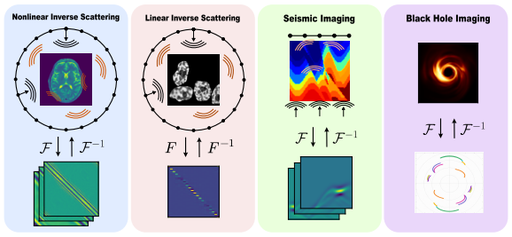
Figure 2 : Diagram of the different settings and modalities of inverse problems we consider. Top: a diagram of the data acquisition setting, including a representative example of the parameters𝑚 represented by the wavespeed (in the case of scattering problems) or brightness (in the case of black holes). Bottom: an example of the measurement data used for the reconstruction. Note that the full aperture scattering is measured in the frequency domain, while the geophysical scattering is measured in the time domain.
出典 · CC BY 4.0 · Ethan Hanold, Nicholas M. Boffi, Qin Li, Leonardo Zepeda-Núñez · AdjointFlow: Accelerating Scientific Inverse Problems with Physics-Based Transport · 論文の図を引用 · 元のPDFの4ページ目から図の部分を抽出しています。拡散モデルなどの生成モデルは、このコストをオフライン学習に移せますが、多くは独立したガウス参照分布から出発します。測定が情報量を持ち事後分布が集中すると、このガウスから目標分布へ向かう輸送速度場が終点付近で正則性を失うことがあります。AdjointFlowは、物理情報を捨てるガウス初期化と、集中した終点での速度場の不安定性という2つの問題を同時に扱います。
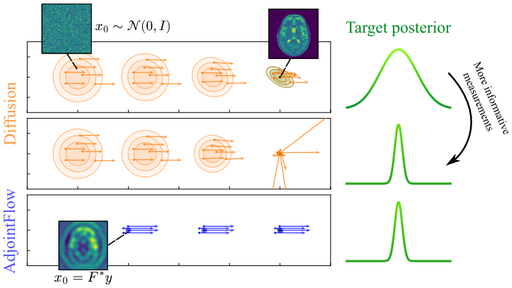
Figure 1 :Overview.Traditional diffusion-based approaches start from uninformative Gaussian noise and can suffer from ill-conditioned transport fields when the target posterior becomes concentrated, such as when more informative measurements are acquired. Conversely, AdjointFlowstartsfromadata-dependentinitialization–forexample,oneconstructedfromtheadjoint 𝐹∗𝑦 asshownabove–reducingtransport distancerelativetoGaussiannoiseandproducingfavorablelearningconditionsforthesolver. AdjointFlowfurtherleveragesanoise-freevelocity which remains regular near concentrated endpoints.
出典 · CC BY 4.0 · Ethan Hanold, Nicholas M. Boffi, Qin Li, Leonardo Zepeda-Núñez · AdjointFlow: Accelerating Scientific Inverse Problems with Physics-Based Transport · 論文の図を引用 · 元のPDFの2ページ目から図の部分を抽出しています。物理ベースの初期化とノイズなしの速度場
AdjointFlowの第1の構成要素は、独立したガウス分布の代わりに、測定値から作った物理ベースの初期値a(y)を確率的補間の参照分布として使うことです。線形または線形化可能な場合、a(y)は随伴演算F*yで与えられ、単一点に集中した終点δ_{a(y)}を用います。
第2の構成要素は、標準の確率的補間速度b_tからノイズのブリッジ項を分離した、ノイズなしの速度v_tです。論文では、b_t = v_t + γ̇_t D_t と分解すると述べられています。また、終点が集中すると標準速度のLipschitz定数が発散しうることを示し、v_tは決定論的初期値とノイズ拡張学習の条件のもとで空間的に正則であることを示しています。
第3に、目標予測のパラメータ化では v_t(x;y)=√α̇_t a(y)+√β̇_t m̂_t(x;y) の形を使い、ネットワークが目標の再構成そのものを予測するようにしています。推論ではa(y)から出発し、学習したODEを積分します。実験では、前進オイラー法の8段階を基本として使用しています。
輸送距離分析の適用範囲
この命題は、線形順方向演算子Fと平均0の参照分布について、物理ベースで平行移動した参照分布ρ_0^adjが、目標事後分布ρ_1までのW2距離を小さくする条件を扱っています。論文の命題3.1では、‖F*F−I‖_op < 1 かつ F*y ≠ 0 のとき、ρ_0^adjの距離がより小さいと述べられています。
この結果は、ガウス終点と特定の条件に限られるため、すべての逆問題に対する一般的な保証とは捉えません。論文では、実際のデータセットにおいてδ_{a(y)}の距離がガウスより小さいと報告されています。
非線形・線形逆散乱と画像化の結果
非線形逆散乱のベンチマークでは、AdjointFlowを既存のCDMと比べ、Shepp–Logan、3–5–10h Triangles、10h Overlapping Squaresのデータセットに対するRRMSEとSinkhorn divergenceを比較しています。Brain Scansでは、AdjointFlowのRRMSEは3.421と報告されており、EquiNet CDMの5.661より低くなっています。
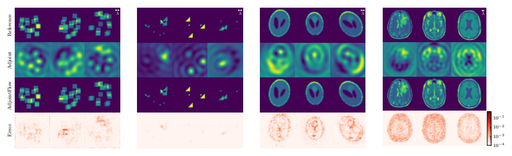
Figure 4 : Qualitative results on nonlinear inverse scattering for (a)10h Overlapping Squares, (b)3–5–10h Triangles, (c)Shepp–Logan, and (d)Brain Scans. Within each panel, columns show distinct test examples; rows show, from top to bottom, the ground-truth perturbation, the adjoint-based initialization, the AdjointFlow reconstruction, and its absolute reconstruction error. The wavelength marker corresponds to 8 points per wavelength (PPW) in (a)–(c) and 5 PPW in (d).
出典 · CC BY 4.0 · Ethan Hanold, Nicholas M. Boffi, Qin Li, Leonardo Zepeda-Núñez · AdjointFlow: Accelerating Scientific Inverse Problems with Physics-Based Transport · 論文の図を引用 · 元のPDFの13ページ目から図の部分を抽出しています。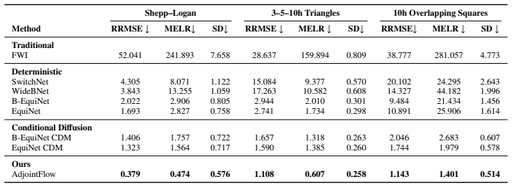
Table 1 : We compare performance on three synthetic datasets (Shepp–Logan, 3–5–10h Triangles, 10h Overlapping Squares) using RRMSE (%), MELR(×10−2), and Sinkhorn divergence (SD) metrics (see Appendix D for definitions, bold indicates best performance for a given metric). All Sinkhorn divergence values, including those of the baselines, are recomputed using an updated library version and therefore differ from those reported in [29]. We find that AdjointFlow outperforms all models, including conditional diffusion, across the board.
出典 · CC BY 4.0 · Ethan Hanold, Nicholas M. Boffi, Qin Li, Leonardo Zepeda-Núñez · AdjointFlow: Accelerating Scientific Inverse Problems with Physics-Based Transport · 論文の図を引用 · 元のPDFの14ページ目から図の部分を抽出しています。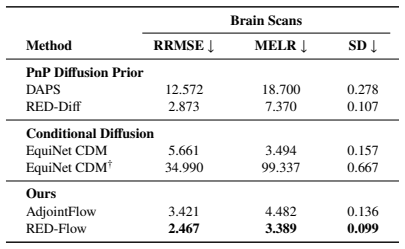
Table 2 : We compare AdjointFlow and RED-Flow to PnP-DP and CDM baselines for nonlinear inverse scattering on theBrain Scansdataset, with bold indicating the best performance on each metric. We report RRMSE as a percentage and MELR×10−2. EquiNet CDM results are obtained from a model we trained using the pipeline from [29]. CDM† indicates that we evaluate the diffusion model at the same number of function evaluations as AdjointFlow (namely, 8 sampling steps), thus demonstrating the advantage of AdjointFlow when compute is limited.
出典 · CC BY 4.0 · Ethan Hanold, Nicholas M. Boffi, Qin Li, Leonardo Zepeda-Núñez · AdjointFlow: Accelerating Scientific Inverse Problems with Physics-Based Transport · 論文の図を引用 · 元のPDFの14ページ目から図の部分を抽出しています。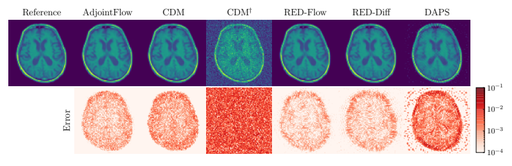
Figure 5 : Qualitative comparison of reconstructions on theBrain Scansdataset for nonlinear inverse scattering. For CDM†, we evaluate the diffusion model at the same number of NFE (number of function evaluations) as AdjointFlow (namely, we fix 8 sampling steps). AdjointFlow clearly performs far better in this iso-compute comparison, demonstrating its superior efficiency.
出典 · CC BY 4.0 · Ethan Hanold, Nicholas M. Boffi, Qin Li, Leonardo Zepeda-Núñez · AdjointFlow: Accelerating Scientific Inverse Problems with Physics-Based Transport · 論文の図を引用 · 元のPDFの15ページ目から図の部分を抽出しています。線形逆散乱では、RED-FlowがPSNRで大きく上回る一方、AdjointFlowはPnP系の手法と競合する性能を示しています。
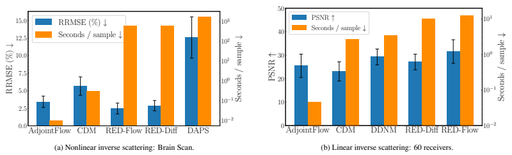
Figure 6 : Comparison of the efficiency–accuracy tradeoff for nonlinear and linear inverse scattering. All timings were measured on the same NVIDIA RTX A6000 GPU. (a) AdjointFlow achieves a strong balance between performance and efficiency, while RED-Diff and RED-Flow offer small accuracy improvements at substantially greater inference cost; the seconds-per-sample axis uses a logarithmic scale. (b) AdjointFlow achieves competitive accuracy at the lowest cost, though the efficiency gain is smaller than in the nonlinear problem.
出典 · CC BY 4.0 · Ethan Hanold, Nicholas M. Boffi, Qin Li, Leonardo Zepeda-Núñez · AdjointFlow: Accelerating Scientific Inverse Problems with Physics-Based Transport · 論文の図を引用 · 元のPDFの16ページ目から図の部分を抽出しています。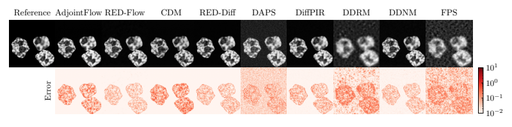
Figure 7 : Qualitative comparisons of reconstructions from AdjointFlow and diffusion baselines on linear inverse scattering with 60 receivers.
出典 · CC BY 4.0 · Ethan Hanold, Nicholas M. Boffi, Qin Li, Leonardo Zepeda-Núñez · AdjointFlow: Accelerating Scientific Inverse Problems with Physics-Based Transport · 論文の図を引用 · 元のPDFの16ページ目から図の部分を抽出しています。アブレーション実験と初期化の役割
アブレーション実験は主に非線形逆散乱の設定で、サンプリング方法、ノイズのブリッジ、参照分布、目標予測のパラメータ化を比較しています。論文では、このデータセットでは低周波の随伴初期値が細部の構造を十分に保持できなかった可能性が指摘されています。

Table 6 : Comparison of reference distribution and model parameterization on the four nonlinear inverse scattering datasets, with mean and standard deviation of RRMSE across the test set shown. We fix the number of sampling steps at 8 for all models. Without TP, we find that a coupledinterpolantdoesnotmeaningfullyimproveresultsonthesedatasets,demonstratingthepracticalnecessityoftheDD-TPparameterization. Bold indicates the best result on each dataset.
出典 · CC BY 4.0 · Ethan Hanold, Nicholas M. Boffi, Qin Li, Leonardo Zepeda-Núñez · AdjointFlow: Accelerating Scientific Inverse Problems with Physics-Based Transport · 論文の図を引用 · 元のPDFの24ページ目から図の部分を抽出しています。線形逆散乱の初期化アブレーションでは、定数、学習平均、随伴演算、正則化された逆演算を比較しています。データ依存の初期化はすべての指標で優れ、正則化逆演算は最も高いPSNRと最も小さい測定誤差を示しました。ただし、定数初期化より平均初期化の方が良い結果になったことは、輸送距離だけでは性能を完全に説明できないことを示しています。
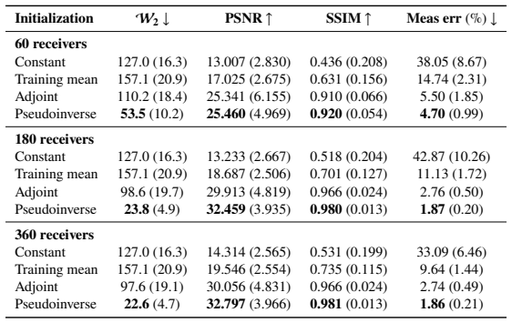
Table 7 : We present the results of AdjointFlow for linear inverse scattering with four choices of initialization𝑎(𝑦) , three different levels of measurement sparsity, and noise level𝜎𝑦 =10−4 following [40] (bold result indicates best for each receiver count). All models share the architecture and training procedure of Section 4.2 and differ only in𝑎(𝑦) ; the pseudoinverse corresponds to AdjointFlow in Table 3. Within each block, the first two initializations are data-independent and the last two are data-dependent.W2 is the empirical transport distance W2(𝛿 𝑎(𝑦), 𝛿𝑚)=∥𝑎(𝑦)−𝑚∥ 2 between singular endpoints (Appendix E.3), averaged over the test set.
出典 · CC BY 4.0 · Ethan Hanold, Nicholas M. Boffi, Qin Li, Leonardo Zepeda-Núñez · AdjointFlow: Accelerating Scientific Inverse Problems with Physics-Based Transport · 論文の図を引用 · 元のPDFの24ページ目から図の部分を抽出しています。適用範囲と限界
著者らは、AdjointFlowの利点は初期化が情報量を持つときに最も大きいと述べています。随伴がない場合、不正確な場合、または目標と弱く相関する設定では、利点が小さくなることがあります。論文では、これを解決するには追加の検証が必要だと説明されています。
また、最良の変種は特異な初期分布とノイズなし速度の学習を使うため、標準の確率的補間理論の一般的な仮定の外にあります。実験データはほとんどが合成または準合成であり、実際の測定ノイズ、モデルの不一致、高リスクな応用における検証は、まだ十分には扱われていません。
論文情報
- 著者
- Ethan Hanold, Nicholas M. Boffi, Qin Li, Leonardo Zepeda-Núñez
- 学会・ジャーナル
- arXiv · プレプリント
- 公開日
- 2026年11月10日
- 登録日
- 2026年11月11日
- 更新日
- 2026年11月10日
- バージョン
- v1
- arXiv
- 2611.13389
- カテゴリ
- cs.LG
- ライセンス
- CC BY 4.0
- 掲載内容
- 論文情報・解説・論文の図
この解説は、Refivuの韓国語解説をAIで翻訳したものです。不正確な翻訳や誤りが含まれる可能性があります。論文と図の利用条件は各出典に従います。
アブストラクト
Inverse problems are ubiquitous across scientific applications ranging from seismic imaging to astrophysics to nondestructive testing, yet classical solvers often struggle with nonconvexity and repeated evaluations of expensive physical models. Diffusion models can amortize this computation offline, but largely data-driven conditional models underutilize known physics and suffer from ill-conditioned transport maps when the target distribution is concentrated. Plug-and-play (PnP) methods explicitly leverage the physical model to guide a learned prior, improving data consistency but reintroducing costly iterative computations. We instead propose AdjointFlow, a framework built on stochastic interpolants that injects the known physics into the generative transport itself. We design a data-dependent, adjoint-based initialization to reduce transport distance to the target, modify the transport velocity to remain regular as the endpoint distributions concentrate, and parameterize the network to build the initialization directly into the learned velocity. Together, these enable accurate reconstruction at substantially lower cost than generative models starting from Gaussian noise. Experiments on inverse scattering, seismic imaging, and black hole imaging show that AdjointFlow consistently produces more accurate reconstructions than conditional diffusion models while being up to five orders of magnitude faster at inference than PnP methods. Optional inference-time refinement that queries the physical model can further improve data consistency, matching or exceeding the accuracy of PnP methods without retraining.
この論文を引用
Ethan Hanold, Nicholas M. Boffi, Qin Li, Leonardo Zepeda-Núñez (2026). AdjointFlow: Accelerating Scientific Inverse Problems with Physics-Based Transport. arXiv:2611.13389v1. https://arxiv.org/abs/2611.13389v1
BibTeX
@misc{hanold2026adjointflow,
  title = {{AdjointFlow: Accelerating Scientific Inverse Problems with Physics-Based Transport}},
  author = {Ethan Hanold and Nicholas M. Boffi and Qin Li and Leonardo Zepeda-Núñez},
  year = {2026},
  eprint = {2611.13389},
  archivePrefix = {arXiv},
  url = {https://arxiv.org/abs/2611.13389v1}
}