論文解説
LAION-Audio-XL: A Web-Scale Corpus and Scaling Studies for Contrastive Language-Audio Pretraining
LAION-Audio-XL:Contrastive Language-Audio Pretrainingのための Web-Scaleコーパスとスケーリング研究
- 課題 対照学習ベースの音声・言語モデルは学習データの規模に大きく依存しますが、公開されている音声・テキストデータは限られています。
- 手法 この論文では、このデータを使ってNaFlex音声エンコーダとModernBERT系テキストエンコーダを最初から学習します。
大規模な音声・テキストデータの不足とスケーリングの問い
対照学習ベースの音声・言語モデル(CLAP)は、学習データの規模と品質に大きく左右されます。しかし、公開されている音声・テキストの資料は、視覚・言語分野のWeb規模データセットと比べて小さく、文書化も十分ではありません。この論文は、この空白を埋めるために大規模な音声・テキストコーパスを構築し、その上でモデルサイズと学習サンプル数が性能にどう作用するかをスケーリングの観点から検討します。
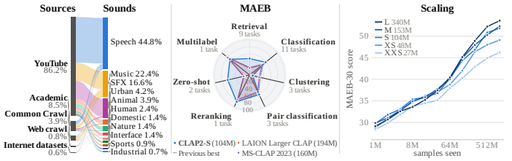
Figure 1 : Our training dataset consists of many sources, spanning diverse sound categories, and our models achieve strong performance that improves with training scale.Left: the 365M training audio samples from source group to predicted sound category using our trained taxonomy classifier (see Section 3.3). Ribbon width is proportional to audio samples.Middle: MAEB [30] of CLAP2-S, LAION Larger CLAP [2] and MS-CLAP 2023 [15]. Dotted: previous best below 500M parameters. Right: Scaling MAEB-30 against samples seen.
出典 · CC BY 4.0 · Gijs Wijngaard, Felix Förster, Ross Wightman, Marianna Nezhurina, Christoph Schuhmann, Jenia Jitsev, A. Sophia Koepke · LAION-Audio-XL: A Web-Scale Corpus and Scaling Studies for Contrastive Language-Audio Pretraining · 論文の図を引用 · 元のPDFの3ページ目から図の部分を抽出しています。この過程が、この論文の1つ目の貢献です。
データ収集、重複除去とキャプション生成
データパイプラインは複数の段階に分かれています。まず長さとデコードの可否を確認し、完全一致(MD5ハッシュ)によって151.1M個を除去します。その後、Olaf音響指紋により1.2M個を、SemDeDupによる意味的近接重複除去で18.2M個を追加で除去します。意味的な重複検査には、テキストなしで学習されたDasheng埋め込みを使います。評価データ(MAEB、HEAR、MSEB)と重なるサンプルも、同じ過程で除去されます。
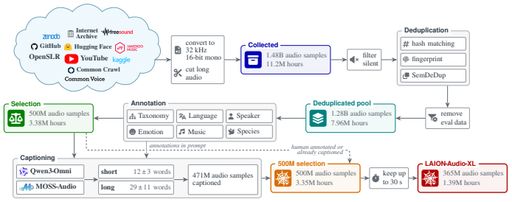
Figure 2 :Overview of the LAION-Audio-XL dataset curation pipeline.We collected 1.48B audio samples from online platforms, of which 1.47B entered deduplication. Removing silent audio, duplicates (including SemDeDup [59]), and evaluation data leaves 1.28B audio samples. We then selected 500M audio samples based on categorical taxonomy annotations. The same annotations were used to prompt Qwen3-Omni [61] and MOSS-Audio [42] to generate short and long captions for 471M audio samples without textual descriptions, resulting in 500M captioned audio samples in total (the 500M selection). The 365M audio samples that are up to 30 seconds long form LAION- Audio-XL.
出典 · CC BY 4.0 · Gijs Wijngaard, Felix Förster, Ross Wightman, Marianna Nezhurina, Christoph Schuhmann, Jenia Jitsev, A. Sophia Koepke · LAION-Audio-XL: A Web-Scale Corpus and Scaling Studies for Contrastive Language-Audio Pretraining · 論文の図を引用 · 元のPDFの5ページ目から図の部分を抽出しています。その後、分類体系(taxonomy)に基づき、過剰に代表されている一般的なカテゴリを減らし、まれなカテゴリは残すよう、決定的ハッシュに基づいて5億個を選びます。
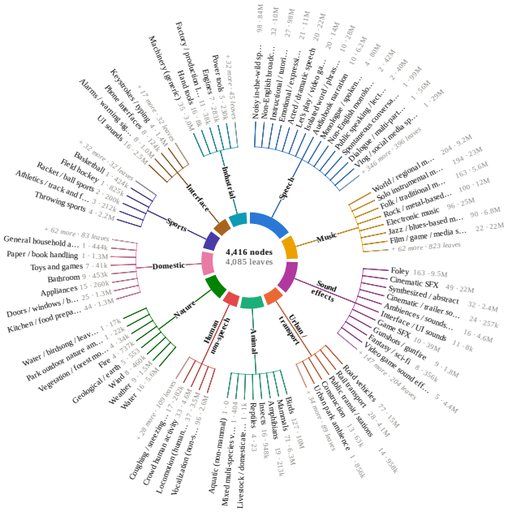
Figure 8 : Visualization of the sound taxonomy. The five levels contain 11, 837, 3,150, 393, and 25 nodes, respectively, for a total of 4,416 nodes, including 4,085 leaves. Coloured inner arcs denote the 11 top-level groups, ordered clockwise from speech at the top. Branches show 77 of the 837 second- level categories, selected by descendant leaf count and audio sample count in the deduplicated pool of 1.28B audio samples (grey numbers, respectively). Italic rows summarize omitted categories and their leaves.
出典 · CC BY 4.0 · Gijs Wijngaard, Felix Förster, Ross Wightman, Marianna Nezhurina, Christoph Schuhmann, Jenia Jitsev, A. Sophia Koepke · LAION-Audio-XL: A Web-Scale Corpus and Scaling Studies for Contrastive Language-Audio Pretraining · 論文の図を引用 · 元のPDFの46ページ目から図の部分を抽出しています。CLAP2のモデル構造と学習目標
CLAP2は、最初から学習される対照学習モデルです。音声エンコーダは可変長の入力を扱うNaFlex Transformerで、log-melパッチとRoPE位置エンコーディングを使います。テキストエンコーダはModernBERT系の双方向Transformerを基にしつつ、SwiGLUとRMSNormを使います。2つのエンコーダの出力は、共有埋め込み空間で対称なInfoNCE目標により学習されます。
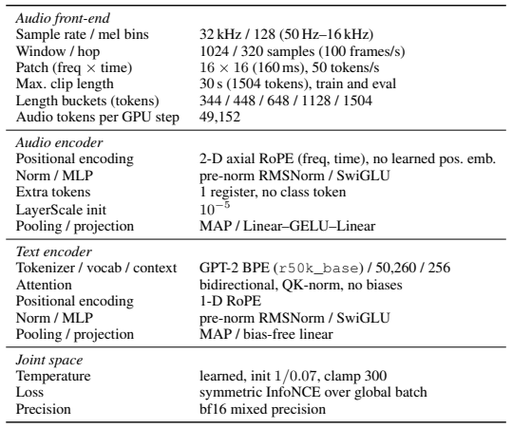
Table 7 : Architecture settings shared by all tiers in the scaling study. For details on architecture shape refer to Table 6 & 8.
出典 · CC BY 4.0 · Gijs Wijngaard, Felix Förster, Ross Wightman, Marianna Nezhurina, Christoph Schuhmann, Jenia Jitsev, A. Sophia Koepke · LAION-Audio-XL: A Web-Scale Corpus and Scaling Studies for Contrastive Language-Audio Pretraining · 論文の図を引用 · 元のPDFの51ページ目から図の部分を抽出しています。学習中は、サンプルを長さのバケットに割り当ててパディングを減らします。論文では、演算量の約80%が音声エンコーダで発生していると報告されています。
演算量に対する性能のスケーリング近似
演算量Cについて、MAEB-30の誤差L(C)をAc·(C+Bc)^(-αc)+Ecの形で近似しており、この論文ではこの近似からα=0.0574を得ています。著者らは、これをもとに演算量が2倍に増えるごとにMAEB-30の誤差が約4%、最大予算の地点で約1.8点減ると報告しています。
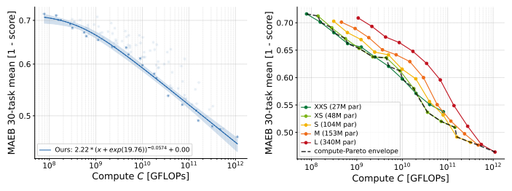
Figure 3 :Scaling behavior on our LAION-Audio-XL dataset.MAEB-30 error rate (1− mean score) per computeC(GFLOPs).Left: the compute-Pareto-optimal runs (solid points) of all warmup-stable-decay and cosine learning-rate-scheduled runs, with our fitted scaling function and its 95% bootstrap CI (1000 resamples). Withα= 0.0574, the error reduces by 3.9% for each doubling of compute (≈+1.8mean MAEB-30 points at the largest budget).Right: each model size, from two WSD runs per size with individual cooldown phases, and the compute-Pareto enve- lope.
出典 · CC BY 4.0 · Gijs Wijngaard, Felix Förster, Ross Wightman, Marianna Nezhurina, Christoph Schuhmann, Jenia Jitsev, A. Sophia Koepke · LAION-Audio-XL: A Web-Scale Corpus and Scaling Studies for Contrastive Language-Audio Pretraining · 論文の図を引用 · 元のPDFの8ページ目から図の部分を抽出しています。計算最適な配分と解釈の範囲
固定された演算予算をモデルサイズとサンプル数にどう配分するかを見るため、長期WSD実行のPareto境界からNopt ∝ C^0.405とDopt ∝ C^0.583を当てはめました。著者らは、これを音声の情報密度が低いことや、Webデータにノイズが混ざっている可能性によるものと解釈しています。
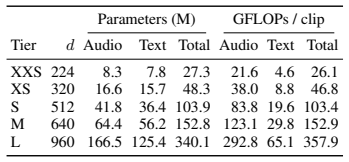
Table 3 :Model tiers for scaling study:Hidden dimensiond, parameter counts, and forward-pass compute per encoder. Audio parameters include the MAP pool and projection layers. Text param- eters include the pool and output projection but excludethe50,260×d t token-embedding table. Total parameters refer to the full model size, in- cluding embeddings. GFLOPs are forward-pass FLOPs per clip at the training length distribution.
出典 · CC BY 4.0 · Gijs Wijngaard, Felix Förster, Ross Wightman, Marianna Nezhurina, Christoph Schuhmann, Jenia Jitsev, A. Sophia Koepke · LAION-Audio-XL: A Web-Scale Corpus and Scaling Studies for Contrastive Language-Audio Pretraining · 論文の図を引用 · 元のPDFの7ページ目から図の部分を抽出しています。ただし、指数はダウンストリームの誤差から得られた値であり、モデルサイズ5つと境界上の最適点を含むため、示唆的な結果と解釈すべきです。外挿分析は、繰り返しサンプルが新しいサンプルと同じ価値を持つという仮定に依存しており、論文ではこの仮定を著者らの分析の前提として示しています。
MAEB-30、HEAR、MSEBのベンチマーク結果
CLAP2-Lは、MAEB-30の平均スコア53.6%を記録し、比較対象のLAION-CLAP 35.2%とGLAP 44.1%を上回りました。音楽タスクでも、3つのモデルが最高記録を上回っています。
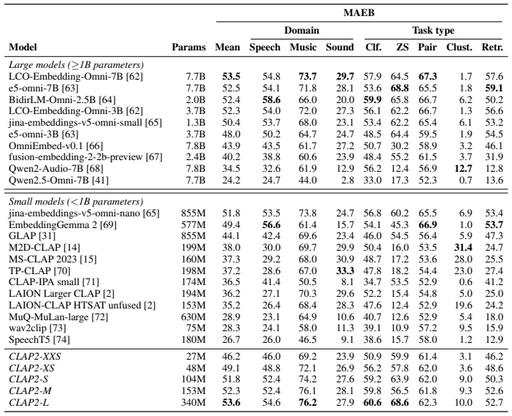
Table 2 : MAEB benchmark results. Parameter counts (Params) include only the audio and text parts of each model. Results for our models use the last checkpoint of each size’s WSD run: 1024M samples for XXS, XS, S, M, L, evaluated with un-normalised audio embeddings and with all-caps text inputs lowercased. We report the mean performance over 30 tasks, domain-specific (18 speech, 6 music, 6 sound tasks), and task-specific results: classification (12, including one multilabel), zero- shot classification (2), pair classification (3), clustering (3), and retrieval (10, including one reranking task). All scores are in %. Models are grouped by size, the best value in each column within a group is bolded.
出典 · CC BY 4.0 · Gijs Wijngaard, Felix Förster, Ross Wightman, Marianna Nezhurina, Christoph Schuhmann, Jenia Jitsev, A. Sophia Koepke · LAION-Audio-XL: A Web-Scale Corpus and Scaling Studies for Contrastive Language-Audio Pretraining · 論文の図を引用 · 元のPDFの6ページ目から図の部分を抽出しています。他のベンチマークでは、HEARでCLAP2-S、CLAP2-M、CLAP2-Lが81.4から81.9の間のスコアを得て、他の音声・テキストモデル(最大81.2)を上回っています。MSEBではCLAP2-Lが30.3点で、M2D-CLAP(30.7)に次ぐ値であり、数十億パラメータのマルチモーダルモデル(最大27.9)を上回ります。論文は、クラスタリングタスクが他のベンチマークと一致しない領域だと説明しているため、強みとしては解釈しません。
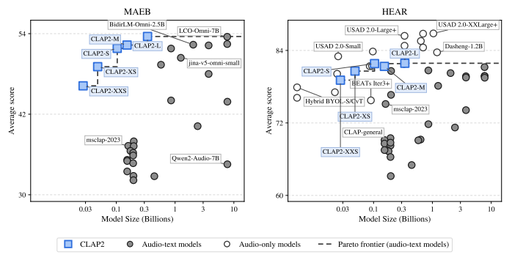
Figure 6 :Embedding model performance by size.Average score across the individual tasks of MAEB (all 30 tasks) and HEAR (17 tasks). Blue squares are our own runs. Filled circles are audio- text models, and unfilled circles are audio-only models with no text component. Model sizes count only the audio and text parts of each model.
出典 · CC BY 4.0 · Gijs Wijngaard, Felix Förster, Ross Wightman, Marianna Nezhurina, Christoph Schuhmann, Jenia Jitsev, A. Sophia Koepke · LAION-Audio-XL: A Web-Scale Corpus and Scaling Studies for Contrastive Language-Audio Pretraining · 論文の図を引用 · 元のPDFの10ページ目から図の部分を抽出しています。適用範囲と残された問い
この論文の結果は、LAION-Audio-XLと、MAEB-30、HEAR、MSEBの構成で得られたものです。
また、論文では検証損失がダウンストリームのベンチマーク性能に直接には反映されないと述べられています。そのため、損失曲線から得られる最適なモデルサイズを、そのままベンチマークの最適点と解釈することはできません。
論文情報
- 著者
- Gijs Wijngaard, Felix Förster, Ross Wightman, Marianna Nezhurina, Christoph Schuhmann, Jenia Jitsev, A. Sophia Koepke
- 学会・ジャーナル
- arXiv · プレプリント
- 公開日
- 2026年11月8日
- 登録日
- 2026年11月10日
- 更新日
- 2026年11月8日
- バージョン
- v1
- arXiv
- 2611.11592
- カテゴリ
- cs.SD · cs.CL
- ライセンス
- CC BY 4.0
- 掲載内容
- 論文情報・解説・論文の図
この解説は、Refivuの韓国語解説をAIで翻訳したものです。不正確な翻訳や誤りが含まれる可能性があります。論文と図の利用条件は各出典に従います。
アブストラクト
Recent progress on contrastive audio-language models can be attributed mainly to the scale and quality of their training data. Larger training datasets expose models to a broader range of sounds and corresponding audio captions. To exploit this, we collect 1.48 billion audio samples from academic datasets, internet datasets, web collections, Common Crawl, and YouTube, and process them with a multi-stage curation pipeline. Furthermore, we generate short and long captions for samples in our corpus that lack them. We use our dataset to study the scaling behavior of contrastive audio-language models based on the NaFlex architecture for the audio encoder. Our experiments identify trade-offs between model size and training data for a given compute budget. Moreover, our resulting models, CLAP2, outperform prior audio-text models of comparable size on the MAEB and HEAR benchmarks. We release our dataset, captions, model checkpoints, and code.
この論文を引用
Gijs Wijngaard, Felix Förster, Ross Wightman, Marianna Nezhurina, Christoph Schuhmann, Jenia Jitsev, A. Sophia Koepke (2026). LAION-Audio-XL: A Web-Scale Corpus and Scaling Studies for Contrastive Language-Audio Pretraining. arXiv:2611.11592v1. https://arxiv.org/abs/2611.11592v1
BibTeX
@misc{wijngaard2026laion,
  title = {{LAION-Audio-XL: A Web-Scale Corpus and Scaling Studies for Contrastive Language-Audio Pretraining}},
  author = {Gijs Wijngaard and Felix Förster and Ross Wightman and Marianna Nezhurina and Christoph Schuhmann and Jenia Jitsev and A. Sophia Koepke},
  year = {2026},
  eprint = {2611.11592},
  archivePrefix = {arXiv},
  url = {https://arxiv.org/abs/2611.11592v1}
}