論文解説
Protein Language Models Fail To Capture Contact Predictions Under Invariant Relabeling
不変な再ラベリング下で接触予測を捉えられないタンパク質言語モデル
- 課題 タンパク質言語モデル(pLM)の接触マップの精度が、共進化統計の学習の証拠になるかどうかは確かめにくいです。
- 手法 アミノ酸アルファベットを全体で一対一に付け替え、列統計は保ったまま残基の文字だけを変えて、接触集合の重なりを測定します。
接触マップは共進化学習の証拠になるか
タンパク質言語モデル(pLM)は、単一の配列だけを入力しても、高い精度の接触マップ(contact map)を作ります。この精度から、モデルはアラインメント(MSA)から共進化統計を暗黙的に学んでいる、という解釈が広まりました。しかし、同じ精度は異なる2つの仕組みからも生じえます。1つは、列統計の共分散を逆に計算する方法です。もう1つは、各位置にどのアミノ酸の文字が置かれているかに合わせてパターンを探す方法です。この論文は、精度だけでは2つの仕組みを区別できないと考え、アラインメントの統計はそのままにして文字だけを変える診断を設計しました。
中心となる診断は、アミノ酸アルファベット20個に対する全体での一対一の置換(global bijective relabeling)です。すべての配列のすべての残基を同じ置換で変えても、列エントロピーや対ごとの相互情報量といったアラインメントレベルの情報は変わりません。したがって、列統計だけを読む推定器であれば、再ラベリングの前後で接触集合は同じになるはずです。この論文は、この対照によってアラインメント統計への依存を調べています。
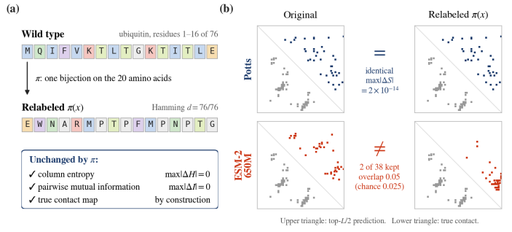
Figure 1 :A global relabeling of the amino-acid alphabet leaves every alignment statistic intact and destroys the pLM’s contact map. (a)The intervention: one bijection π on the twenty amino acids, applied to every residue of every sequence. Both ∆s are measured on 4,000 sequences of the ubiquitin family alignment.(b)The result on the same input. Lower triangle: long-range contacts of the deposited chain (1UBQ_A); upper triangle: each model’s own top-L/2 prediction, over the candidate pairs the alignment covers. Potts returns a bit-identical score matrix (max|∆S|= 2×10 −14, Proposition 2), while ESM-2 650M keeps2of its own38contacts (overlap0.05, chance0.025).
出典 · CC BY 4.0 · Paarth Batra, Aryan Keluskar · Protein Language Models Fail To Capture Contact Predictions Under Invariant Relabeling · 論文の図を引用 · 元のPDFの2ページ目から図の部分を抽出しています。再ラベリングと不変性の証明
接触スコアは共通のパイプラインで計算されます。ペアワイズPottsモデルとpLMはどちらも L×q×L×q の形の結合テンソルを作り、平均中心化、対称化、ブロックごとのFrobeniusノルム、APC後処理を経て、L×Lの接触スコアSになります。pLMでは、categorical Jacobian J[i,a,j,b]がこのテンソルの役割を果たします。再ラベリングは π: A→A の全単射関数で、アラインメントXのすべての要素に適用されます。
擬似尤度(pseudolikelihood)Pottsモデルでは、再ラベリングされたアラインメントに対して、パラメータをπで移した (h^π, J^π) が同じ目的値を持つ最大化解になることが証明されています。逆共分散推定器はW = (C+λI)^(-1)と定義されます。再ラベリングは Q = I_L ⊗ P_π という直交変換で共分散を合同変換するので、W^π = Q^T W Q となり、S^π = S となります。この証明が成り立つ条件は、等方的なリッジ正則化と、固定されたgap記号です。非等方的なリッジやgapの再ラベリングがあると不変性は崩れ、付録の実験では最大 |∆S| が 0.355 または 0.182 として現れました。
再ラベリングによる接触集合の重なりの結果
9つのタンパク質の平均では、ESM-2 650Mのランダムな再ラベリングでの重なりは、m=20のとき0.015でした。同じBLOSUM62グループの中だけで置き換えたin-class再ラベリングでは0.655を保ちました。MSA TransformerとAMPLIFY 120Mも、ランダムな再ラベリングで似た崩壊が見られました。
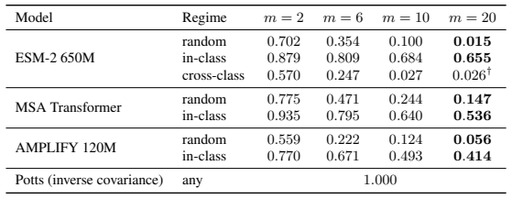
Table 1 : Contact-set overlap under alphabet relabeling; 1 means the model predicts the same contacts. Columns give nominal m: at m= 20 , in-class moves 15 residue types and cross-class 14 to 16. ESM-2 650M: nine proteins, three seeds, n= 27 per cell ( †: n= 9 ). MSA Transformer: four Pfam families, three seeds (n= 12 ). AMPLIFY 120M: three proteins, two seeds (n= 6 ). Potts is bit-identical by Proposition 2.
出典 · CC BY 4.0 · Paarth Batra, Aryan Keluskar · Protein Language Models Fail To Capture Contact Predictions Under Invariant Relabeling · 論文の図を引用 · 元のPDFの5ページ目から図の部分を抽出しています。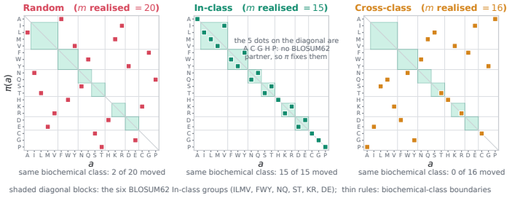
Figure 4 : Each panel is the seed-0, m=20 permutation matrix, with a marker at (a, π(a)). Axes are ordered by biochemical class, so the six BLOSUM62 in-class groups form shaded blocks on the diagonal. Random preserves class only by accident (2 of 20 residues here, 2–4 across seeds). In-class stays inside the blocks; the five diagonal markers are A, C, G, H and P, which have no BLOSUM62 partner. In cross-class, none of the 16 moves stays within a BLOSUM62 group. This is why the cross-class arm can fall faster than the random arm at the same nominalm.
出典 · CC BY 4.0 · Paarth Batra, Aryan Keluskar · Protein Language Models Fail To Capture Contact Predictions Under Invariant Relabeling · 論文の図を引用 · 元のPDFの13ページ目から図の部分を抽出しています。この結果は重なり指標で測定しました。上位L/2の接触集合が再ラベリングの前後でどれだけ重なるかを数えるため、1は同じ接触を予測していることを意味します。著者らは、この崩壊を入力の難しさではなく、残基の識別子への依存によるものと解釈しています。
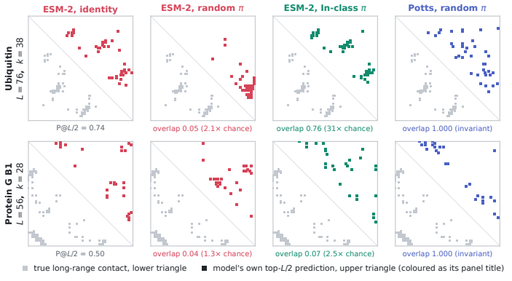
Figure 5 : Contact maps for both precision targets on the restricted candidate set of Figure 3(b). Lower triangle: contacts of the deposited chain. Upper triangle: the model’s top- L/2 prediction. Overlaps are against the same model’s unrelabeled prediction. Top row, ubiquitin: random relabeling destroys the map ( 0.05, 2.1× chance) while in-class relabeling preserves most of it ( 0.76, 31× chance). Bottom row, protein G B1: the in-class arm also collapses ( 0.07, 2.5× chance), the counter-case discussed in §4.2 and §5.3. Potts returns its unrelabeled map exactly in both rows (overlap 1.000, max|∆S| ≤2.3×10
出典 · CC BY 4.0 · Paarth Batra, Aryan Keluskar · Protein Language Models Fail To Capture Contact Predictions Under Invariant Relabeling · 論文の図を引用 · 元のPDFの14ページ目から図の部分を抽出しています。検証範囲と残された問い
実験は、限られた数のタンパク質と、3つの読み出し方式に限られています。読み出し方式は、categorical Jacobian、ESM-2の教師あり接触ヘッド、ProteinGymの変異効果です。多ドメインのタンパク質と浅いアラインメント・ファミリーは検証していません。in-class再ラベリングは、BLOSUM62のグループ1つだけを使いました。
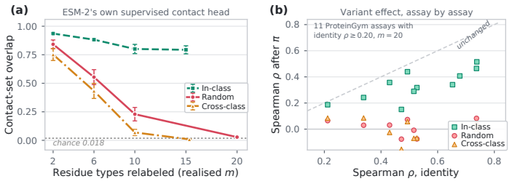
Figure 6 : The failure is not specific to the categorical Jacobian or to one assay.(a)ESM-2 650M’s supervised contact head; nine proteins, three seeds, mean ± SEM, plotted at realized m.(b)Variant- effect Spearman ρ before and after relabeling at m=20, one marker per ProteinGym assay per regime; the dashed line is no change.
出典 · CC BY 4.0 · Paarth Batra, Aryan Keluskar · Protein Language Models Fail To Capture Contact Predictions Under Invariant Relabeling · 論文の図を引用 · 元のPDFの14ページ目から図の部分を抽出しています。また、再ラベリングに対する不変性は、列統計への依存を調べるための必要条件です。不変性が成り立たなかったという結果は、モデルが共進化推論を学習したことを十分に示すものではありません。この研究は、介入によって識別子への依存が明らかになることは示しますが、その原因までは確定しません。再学習またはファインチューニングされたモデルは検証していません。
論文情報
- 著者
- Paarth Batra, Aryan Keluskar
- 学会・ジャーナル
- arXiv · プレプリント
- 公開日
- 2026年11月12日
- 登録日
- 2026年11月13日
- 更新日
- 2026年11月12日
- バージョン
- v1
- arXiv
- 2611.16881
- カテゴリ
- q-bio.QM · cs.AI
- ライセンス
- CC BY 4.0
- 掲載内容
- 論文情報・解説・論文の図
この解説は、Refivuの韓国語解説をAIで翻訳したものです。不正確な翻訳や誤りが含まれる可能性があります。論文と図の利用条件は各出典に従います。
アブストラクト
Protein language models (pLMs) produce highly accurate contact maps from single-sequence inputs. People often take this accuracy as proof that these models implicitly learn invariant coevolutionary statistics, extracting the same signals as classical alignment-based methods like Potts. In this work, we introduce a diagnostic framework around a global bijective relabeling of the amino-acid alphabet. This transformation permutes residue letters while leaving all alignment-level information, column entropies, and pairwise edit distances unchanged. Pseudolikelihood Potts models and inverse-covariance estimators remain invariant under this transformation, but pLMs fail the test. Across multiple architectures (ESM-2, MSA Transformer, AMPLIFY) and model scales (8M to 3B parameters), pLM contact maps collapse under arbitrary relabeling. Using Hamming distance controls and biochemical grouping interventions, we attempt to isolate what likely causes this degradation and find that these models rely on explicit, canonical residue identities (``alphabet anchoring'') rather than pure coevolutionary statistics. Increasing scale makes models more responsive to biochemical classes, but their performance still degrades under relabeling. Our findings show a gap between how pLMs and classical coevolutionary models compute contacts. More broadly, our work shows how diagnostic perturbations that leave classical models provably unchanged can expose hidden representation biases and prevent over-reliance on neural black boxes in biological modeling.
この論文を引用
Paarth Batra, Aryan Keluskar (2026). Protein Language Models Fail To Capture Contact Predictions Under Invariant Relabeling. arXiv:2611.16881v1. https://arxiv.org/abs/2611.16881v1
BibTeX
@misc{batra2026protein,
  title = {{Protein Language Models Fail To Capture Contact Predictions Under Invariant Relabeling}},
  author = {Paarth Batra and Aryan Keluskar},
  year = {2026},
  eprint = {2611.16881},
  archivePrefix = {arXiv},
  url = {https://arxiv.org/abs/2611.16881v1}
}