論文解説
Scaling public input on AI policy with pluralistic agents
Pluralistic Agentsによって広げるAI政策への公衆意見
- 課題 AI安全政策の討論では、人が直接参加するのが難しく、多様な視点を広げることが課題です。
- 手法 個人を代表するAIエージェントの代表がペルソナにインタビューしたうえで、集団の討論に参加する仕組みを構成しました。
政策議論から人が抜け落ちる問題
AI安全政策は技術的に複雑で変化が速い領域のため、一般市民が十分に参加するのは難しいです。既存のAI中心の熟議ツールは、1つのモデルが人の代わりに判断する仕組みのため、多様な視点を十分に反映できません。この論文では、人の代わりを務めるAIエージェントの代表が集団の討論に参加する方法を検証しようとしています。著者らは、この方法によって人が直接参加しにくい多くの議論に関われるようになり、個人の非公開情報が必要な政策選択にも使えるとみています。ただし、これは著者らの提案であり、本実験がその可能性を直接証明するわけではありません。
ペルソナと代表エージェントの討論の構造
ペルソナは、人口統計の分布からサンプルを抽出し、backstoriesという方法で作成したシミュレーション上の人物です。代表エージェントはまずペルソナにインタビューし、その後Deliberate Lab上で他の代表エージェントとラウンドごとに1つずつメッセージを送り合います。Policy Writerエージェントは各ラウンドの後に政策草案を作成し、修正します。政策影響実験では予算配分のテーマを用い、ペルソナの事前の予算の好みと最終的なグループ予算の類似度を、100からtotal variation distanceを引いたパーセントポイントで測定しました。この値は、2つの予算配分に共通する資金の割合を表します。
政策影響の要因
その結果、6要因のうち5要因に有意な影響が見られました。より冗長に話すよう指示した場合、協調性を下げて話すよう指示した場合、数値を明示した場合に、ペルソナの影響が大きくなりました。発言順が後になるほど影響も大きくなりました。分析性(analyticity)だけは有意な効果がありませんでした(p=0.568)。モデル別では、Claude-Opus-5が最も高く、Mistral-Largeが最も低くなりました。
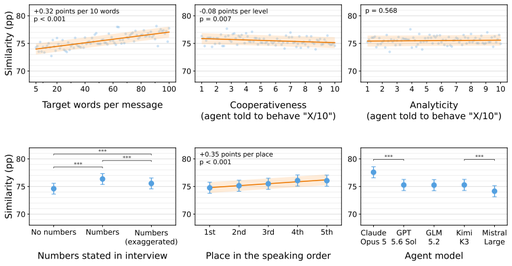
Figure 2 | Personas have more influence over the group policy if they instruct their agent to send long messages, be less cooperative, or state their preferences quantitatively. Instructions to be more or less analytical have no significant effect. Agents who speak later have more influence. We find some differences between the influence of models: Claude has more influence, and Mistral has less than the others. Influence is measured as similarity between the persona’s budget and the final group budget.
出典 · CC BY 4.0 · Jacy Reese Anthis, Ken Burke, David Madras, Crystal Qian, Meredith Ringel Morris, Logan Cross, Caroline Pantofaru, Utsav Prabhu · Scaling public input on AI policy with pluralistic agents · 論文の図を引用 · 元のPDFの6ページ目から図の部分を抽出しています。人の参加者実験における満足度と公正さ
人の参加者による実験は、746名を対象とした事前登録実験で、参加者はDirect Discussion、Pluralistic Agents、Single AIの3つの過程を無作為な順序で行いました。回答者のうち68名は注意確認項目に失敗したため、除外しました。満足度の平均は、Direct Discussionが7.6/10、Pluralistic Agentsが6.9/10、Single AIが6.1/10でした。著者らは、Pluralistic AgentsがSingle AIと比べた満足度の差の68%と、手続き的公正さの差の82%を回復したと報告しています。Direct DiscussionとPluralistic Agentsの手続き的公正さの差は有意ではありませんでした。
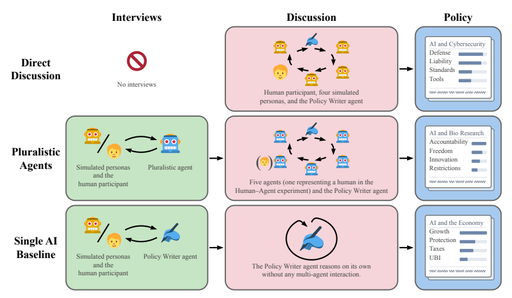
Figure 3 | The three processes compared in the human–agent experiment. InDirect Discussion, there is no interview, and the person speaks in the discussion themselves, alongside four agents emulating other personas and the Policy Writer agent. InPluralistic Agents, an agent interviews the person and then speaks for them in the discussion. InSingle AI, the Policy Writer agent interviews the person and writes the policy on its own, with no multi-agent deliberation.
出典 · CC BY 4.0 · Jacy Reese Anthis, Ken Burke, David Madras, Crystal Qian, Meredith Ringel Morris, Logan Cross, Caroline Pantofaru, Utsav Prabhu · Scaling public input on AI policy with pluralistic agents · 論文の図を引用 · 元のPDFの7ページ目から図の部分を抽出しています。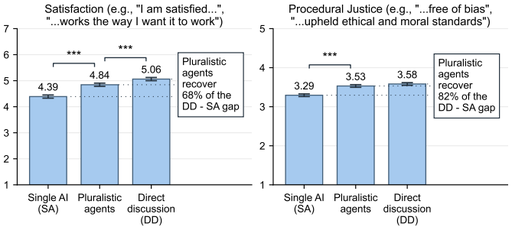
Figure 4 | All pairwise comparisons between the three conditions are significant except the procedural justice of the Direct Discussion and Pluralistic Agents processes with a 95% confidence interval of [−0.01,0.12]. Error bars represent standard errors: ***𝑝 <0.001, **𝑝 <0.01, *𝑝 <0.05.
出典 · CC BY 4.0 · Jacy Reese Anthis, Ken Burke, David Madras, Crystal Qian, Meredith Ringel Morris, Logan Cross, Caroline Pantofaru, Utsav Prabhu · Scaling public input on AI policy with pluralistic agents · 論文の図を引用 · 元のPDFの8ページ目から図の部分を抽出しています。概念実証の範囲
著者らは、この研究を概念実証として説明しており、結果の範囲は限定されるとしています。エージェントのペルソナ生成は、実際の人口を正確に代表するものではないと明記しています。予算配分の課題は結果の差を見るには十分でしたが、他の政策結果を細かく測定するには限界があります。また、参加者の80%は、敵対的な行為者が過程を操作する可能性を平均以上に心配していると回答しました。
論文情報
- 著者
- Jacy Reese Anthis, Ken Burke, David Madras, Crystal Qian, Meredith Ringel Morris, Logan Cross, Caroline Pantofaru, Utsav Prabhu
- 学会・ジャーナル
- arXiv · プレプリント
- 公開日
- 2026年11月11日
- 登録日
- 2026年11月13日
- 更新日
- 2026年11月11日
- バージョン
- v1
- arXiv
- 2611.16028
- カテゴリ
- cs.CY · cs.AI · cs.CL · cs.LG
- ライセンス
- CC BY 4.0
- 掲載内容
- 論文情報・解説・論文の図
この解説は、Refivuの韓国語解説をAIで翻訳したものです。不正確な翻訳や誤りが含まれる可能性があります。論文と図の利用条件は各出典に従います。
アブストラクト
AI is being deployed across a vast range of application domains, cultural environments, and human stakeholders. Safe and responsible AI development requires continuously accounting for diverse perspectives. We develop and test pluralistic agents, AI agent representatives that deliberate on behalf of individuals to align AI systems with diverse human perspectives. Pluralistic agents could help people contribute to many more discussions than they could directly participate in, on technical topics that would require training, and on policy choices that rely on private information that corporations and governments cannot readily share. Our experiments identify opportunities, risks, and perceptions of pluralistic agents. Agents were able to reliably shift policies in the direction of their represented persona's preferences, but the extent of each agent's influence was sensitive to the instructions from its persona, such as having more influence when instructed to be more verbose or less cooperative. This suggests that influence in AI-assisted deliberation could vary based on how participants prompt their agents and how the system is designed. In a preregistered study, 746 humans participated in the pluralistic agents process. Participants viewed pluralistic agents as useful and fair, preferring agents over the baseline of providing input to a single AI reasoning model. Most participants preferred participating themselves over either pluralistic agents or the baseline, but pluralistic agents recovered 68% of the baseline-direct gap in reported satisfaction and 82% in fairness. Because pluralistic agents can be used in many real-world contexts where direct discussion is not, they could be a promising tool to scale AI safety policy development. We encourage cautious exploration of this method, playing to its strengths as an amplifier of human input rather than a replacement.
この論文を引用
Jacy Reese Anthis, Ken Burke, David Madras, Crystal Qian, Meredith Ringel Morris, Logan Cross, Caroline Pantofaru, Utsav Prabhu (2026). Scaling public input on AI policy with pluralistic agents. arXiv:2611.16028v1. https://arxiv.org/abs/2611.16028v1
BibTeX
@misc{anthis2026scaling,
  title = {{Scaling public input on AI policy with pluralistic agents}},
  author = {Jacy Reese Anthis and Ken Burke and David Madras and Crystal Qian and Meredith Ringel Morris and Logan Cross and Caroline Pantofaru and Utsav Prabhu},
  year = {2026},
  eprint = {2611.16028},
  archivePrefix = {arXiv},
  url = {https://arxiv.org/abs/2611.16028v1}
}