論文解説
EDiffSR: An Efficient Diffusion Probabilistic Model for Remote Sensing Image Super-Resolution
EDiffSR:リモートセンシング画像の超解像のための効率的な拡散確率モデル
- 課題 従来のリモートセンシング向けSRには、回帰の目的関数による過度な平滑化、GANの学習の不安定さとアーティファクト、DPMベースのSRにおける大きなUNetとbicubicで条件付けした入力という制約があります。
- 手法 EDiffSRは、拡散確率モデルの逆拡散過程でノイズ予測器を軽量なEANetに置き換えます。bicubicアップサンプリングの代わりに、CPEMでLR画像の事前知識を強めた条件を用います。
- 結果 AIDのテストセットでは、EDiffSRの平均FIDは49.45で、IRSDEの51.08より低いです。PSNRは27.40dBで、SR3の26.24dBより高いです。パラメータ数は26.79Mで、IRSDEの137.15Mより少ないです。
従来のリモートセンシング超解像の限界
リモートセンシング画像の超解像(SR)は、低解像度の入力から細部の質感が豊かな高解像度画像を復元する問題です。MSEやMAEのような回帰の目的関数で学習した畳み込みモデルは、PSNRが高くても画素の平均に収束しやすく、過度に滑らかな結果になりがちです。GANベースの手法は細部の表現を強めますが、学習が不安定で、アーティファクトが生じることがあります。拡散確率モデル(DPM)は、これら2つの問題を減らせる生成手法として注目されました。一方、既存のDPMベースのSRモデルは、大きなUNetでノイズを予測し、条件入力としておもにbicubicでアップサンプリングしたLR画像を使います。この論文は、この2点を同時に変えることを目標としています。
EDiffSRの2つの構造変更
EDiffSRは、拡散確率モデルの逆拡散過程を維持したまま、2つの部分を変更します。1つ目は、ノイズを予測するネットワークをUNetの代わりに、Efficient Activation Network(EANet)で構成することです。2つ目は、条件入力をbicubicでアップサンプリングしたLR画像だけで作らず、Conditional Prior Enhancement Module(CPEM)がLR画像から事前知識を抽出し、強化された条件を作ることです。この2つの変更は、それぞれノイズ予測の計算量と条件の情報量を対象としています。
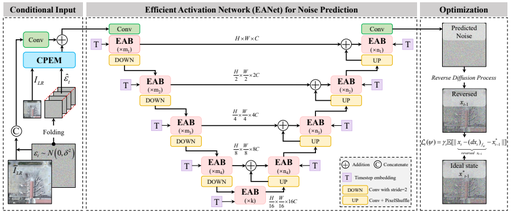
Fig. 3 . Overall framework of our EDiffSR. It consists of three parts: the condition part, Efficient Activation Network (EANet), and the optimization part. In the condition part, CPEM is designed to explore more priors from the original LR image. EANet takes the condition as input and characterizes the noise distribution. Compared to the primary Unet, it is more efficient and effective owing to the efficient activation block (EAB). The optimization process adopts the maximum likelihood learning for a more stable diffusion process.
出典 · CC BY 4.0 · Yi Xiao, Qiangqiang Yuan, Kui Jiang, Jiang He, Xianyu Jin, Liangpei Zhang · EDiffSR: An Efficient Diffusion Probabilistic Model for Remote Sensing Image Super-Resolution · 論文の図を引用 · 元のPDFの4ページ目から図の部分を抽出しています。拡散過程とノイズ予測の目的
この論文は、平均回帰の確率微分方程式(SDE)で拡散過程を定義しています。著者らは、このSDEが閉じた形の解を持つため、サンプリングを効率的にできると説明しています。順方向の過程は、HR画像x0を、bicubicでアップサンプリングしたLR画像µとガウシアンノイズの組み合わせであるxTへ移します。逆方向の過程では、ノイズを予測してHR画像を復元します。学習では、条件付きスコアを使ってノイズを予測し、最終的には逆SDEに基づく理想的な状態x*t-1を目標とする、最大尤度に基づく距離損失を最小化します。論文では、この目的関数の選択はノイズ予測そのものの不安定性を減らすためのものだと述べられています。

Fig. 2 . Overview of the forward and reverse diffusion processes defined by mean-reverting Stochastic Differential Equations (SDE). The forward diffusion gradually degrades the high-quality and high-resolution image x0 to its low-quality counterpart via xT = µ + ε. The reverse diffusion learns to characterize the noise and reconstruct the corresponding high-resolution image.
出典 · CC BY 4.0 · Yi Xiao, Qiangqiang Yuan, Kui Jiang, Jiang He, Xianyu Jin, Liangpei Zhang · EDiffSR: An Efficient Diffusion Probabilistic Model for Remote Sensing Image Super-Resolution · 論文の図を引用 · 元のPDFの3ページ目から図の部分を抽出しています。CPEMと強化された条件
CPEMは、ノイズ状態εtをpixel foldingによってLR画像と同じ空間スケールに合わせます。その後、LR画像と結合し、3×3の畳み込みとReLUで浅い特徴を抽出します。続いて、複数のResidual Channel Attention Block(RCAB)で深い特徴を抽出し、PixelShuffleでアップスケールして条件を作ります。最終的な条件Itは、CPEMの出力と、ノイズとbicubicアップサンプリング画像を結合した項の和として定義されます。この設計の目的は、bicubic補間では失われうる構造情報を、LR画像からより多く取り出すことです。
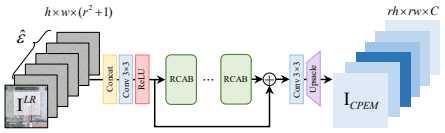
Fig. 4 . The flowchart of Conditional Prior Enhancement Module (CPEM). We adopt the Residual Channel Attention Block (RCAN) to extract rich prior information.
出典 · CC BY 4.0 · Yi Xiao, Qiangqiang Yuan, Kui Jiang, Jiang He, Xianyu Jin, Liangpei Zhang · EDiffSR: An Efficient Diffusion Probabilistic Model for Remote Sensing Image Super-Resolution · 論文の図を引用 · 元のPDFの4ページ目から図の部分を抽出しています。EANetとEfficient Activation Block
EANetはU字型のエンコーダ・デコーダ構造で、Efficient Activation Block(EAB)を繰り返し使います。EABは時刻tをMLPで射影して特徴を変調します。また、サイズの異なる深さ方向の畳み込み(3×3、5×5、7×7)によって、マルチスケールの情報を取得します。各スケールでは、単純チャネルアテンション(SCA)と単純ゲート(SimpleGate)を適用します。単純チャネルアテンションは、元のチャネルアテンションから畳み込み層とsigmoidを取り除いた形で、単純ゲートは特徴マップの要素ごとの積です。この構造は、SRではほとんどの画素がすでに分かっているという点を根拠に、大きなモデルの冗長な計算を減らそうとする設計です。
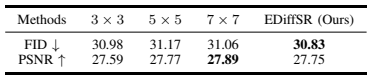
論文の図 TABLE VI. Ablation analysis of EANet with different scales of convolution. 3×3, 5×5, and 7 × 7 represents single-scale design with different DWConv kernels. EDiffSR adopts the multi-scale design and achieves modest improvement.
出典 · CC BY 4.0 · Yi Xiao, Qiangqiang Yuan, Kui Jiang, Jiang He, Xianyu Jin, Liangpei Zhang · EDiffSR: An Efficient Diffusion Probabilistic Model for Remote Sensing Image Super-Resolution · 論文の図を引用 · 元のPDFの12ページ目から図の部分を抽出しています。データと実装設定
学習セットは、AIDから30カテゴリーごとに100枚ずつランダムに選んだ3,000枚で構成されます。テストセットは、AIDの各カテゴリーから10枚ずつの300枚、DOTAの700枚、DIORの1,000枚で構成され、全体で2,000枚です。シミュレーション実験では、bicubic補間で劣化を作ります。NWPU-RESISC45は、シミュレーションの劣化を加えず、実世界の分析にのみ使われます。本論文は×4 SRを扱い、比較対象のSR手法はすべてAIDの学習セットで最初から再学習されました。EDiffSRにも事前学習やファインチューニングは適用していません。
AIDテストセットのFID比較
AIDテストセットの平均FIDは、EDiffSRが49.45、2番目に良いIRSDEが51.08です。論文では、この差を平均1.63と報告しており、EDiffSRは複数のシーンカテゴリーで良好なFIDを示すと説明しています。ただし、このFIDの結果はAIDのテストセットと上記の学習条件で得られたものであり、すべてのリモートセンシングのシーンで常に優位であることを意味するわけではありません。論文でも、シーンの多様性により汎化が難しい課題と見なされています。
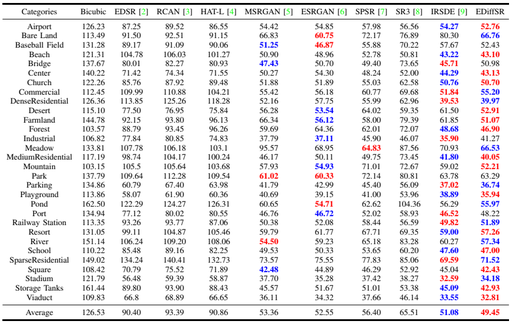
論文の図 TABLE I. Quantitative FID comparison with state-of-the-art SR models on 30 scene categories of the AID test set. The best FID value in each category is highlighted in red while the second best is in blue.
出典 · CC BY 4.0 · Yi Xiao, Qiangqiang Yuan, Kui Jiang, Jiang He, Xianyu Jin, Liangpei Zhang · EDiffSR: An Efficient Diffusion Probabilistic Model for Remote Sensing Image Super-Resolution · 論文の図を引用 · 元のPDFの7ページ目から図の部分を抽出しています。PSNRと知覚品質の違い
AIDテストセットでは、EDiffSRのPSNRは27.40dBで、SR3の26.24dBより高いです。DIORデータセットのLPIPSでは、EDiffSRが0.1898、IRSDEが0.2419です。どちらの結果も同じSR実験設定で確認された値ですが、PSNRとSSIMは指標ごとに優劣が異なります。たとえば、DIORに関する同じ表では、PSNR中心のモデルのほうが高い値を示しています。したがって、EDiffSRの利点は知覚指標や拡散ベースの比較で目立ち、PSNR中心のモデルよりすべての指標で優れているとは読み取るべきではありません。
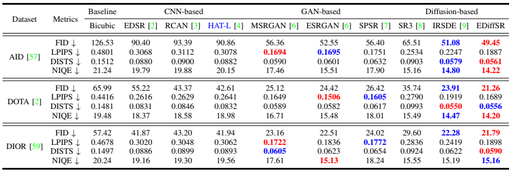
論文の図 TABLE II. Quantitative comparison with state-of-the-art SR models in terms of FID, LPIPS, DISTS, and NIQE across AID, DOTA, and DIOR test sets. The best performance value is highlighted in red while the second best is in blue.
出典 · CC BY 4.0 · Yi Xiao, Qiangqiang Yuan, Kui Jiang, Jiang He, Xianyu Jin, Liangpei Zhang · EDiffSR: An Efficient Diffusion Probabilistic Model for Remote Sensing Image Super-Resolution · 論文の図を引用 · 元のPDFの10ページ目から図の部分を抽出しています。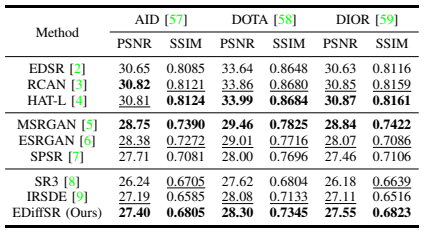
論文の図 TABLE IV. Quantitative comparison with state-of-the-art SR models in terms of PSNR, and SSIM across AID, DOTA, and DIOR test sets. The best performance value in each model type is highlighted in blod while the second best is in underline .
出典 · CC BY 4.0 · Yi Xiao, Qiangqiang Yuan, Kui Jiang, Jiang He, Xianyu Jin, Liangpei Zhang · EDiffSR: An Efficient Diffusion Probabilistic Model for Remote Sensing Image Super-Resolution · 論文の図を引用 · 元のPDFの11ページ目から図の部分を抽出しています。アブレーション実験とUNet置き換えの効果
Table Vのアブレーション実験は、AID、DOTA、DIORの平均結果です。UNetをEANetに置き換えたModel-1とEDiffSRを比べると、FIDは32.68から30.83に下がり、パラメータ数は137.59Mから26.79Mに減っています。本文ではEANetのパラメータを26.31Mと記していますが、Table Vでは26.79Mと報告されており、数値の表記が一致していません。CPEMを加えたModel-2は、パラメータがわずかに増え、FIDが改善しています。この実験は、UNetの置き換えと条件の強化がFIDの改善に寄与することを示しています。ただし、2つの構成要素の効果は、同じ平均結果として解釈すべきです。
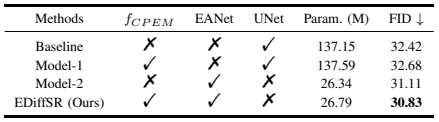
論文の図 TABLE V. Ablation analysis of EDiffSR with different components. The best FID performance is shown in blod.
出典 · CC BY 4.0 · Yi Xiao, Qiangqiang Yuan, Kui Jiang, Jiang He, Xianyu Jin, Liangpei Zhang · EDiffSR: An Efficient Diffusion Probabilistic Model for Remote Sensing Image Super-Resolution · 論文の図を引用 · 元のPDFの11ページ目から図の部分を抽出しています。効率性とサンプリングコスト
効率性の比較では、EDiffSRはパラメータ数26.79M、拡散サンプリング時間19.26s、FID 30.83、PSNR 27.75dBです。同じ表で、IRSDEはパラメータ数137.15M、FID 32.42、PSNR 27.46dBであり、SR3はパラメータ数92.56M、時間137.61sです。この結果は、DPMベースのモデル同士で、パラメータ数とサンプリングコストを減らしたことの根拠となります。一方で、拡散サンプリングが依然として最も大きなコストであることも示しています。
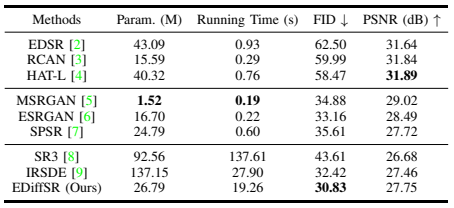
論文の図 TABLE VII. Model efficiency analysis with state-of-the-art SR models. The best performance is shown in blod.
出典 · CC BY 4.0 · Yi Xiao, Qiangqiang Yuan, Kui Jiang, Jiang He, Xianyu Jin, Liangpei Zhang · EDiffSR: An Efficient Diffusion Probabilistic Model for Remote Sensing Image Super-Resolution · 論文の図を引用 · 元のPDFの12ページ目から図の部分を抽出しています。残る限界と適用範囲
著者らは、拡散モデルのサンプリング過程が多くの計算コストを消費し、リアルタイムでの適用を制限すると述べています。また、EDiffSRはリモートセンシング画像の複数の劣化を考慮していないため、実世界への適応性が限られています。実世界の比較であるNWPU-RESISC45実験は参照画像がないため、NIQEとAG指標だけで評価されています。したがって、実世界の結果は参照に基づく定量評価ではなく、これらの指標が実際のシーンでの復元精度を直接保証するものではありません。

論文の図 TABLE III. Quantitative comparison with state-of-the-art SR models in terms of NIQE, and AG on NWPU-RESISC45 test set. The best performance value is highlighted in red while the second best in blue.
出典 · CC BY 4.0 · Yi Xiao, Qiangqiang Yuan, Kui Jiang, Jiang He, Xianyu Jin, Liangpei Zhang · EDiffSR: An Efficient Diffusion Probabilistic Model for Remote Sensing Image Super-Resolution · 論文の図を引用 · 元のPDFの11ページ目から図の部分を抽出しています。論文情報
- 著者
- Yi Xiao, Qiangqiang Yuan, Kui Jiang, Jiang He, Xianyu Jin, Liangpei Zhang
- 学会・ジャーナル
- arXiv · プレプリント
- 公開日
- 2023年10月30日
- 登録日
- 2026年11月6日
- 更新日
- 2023年10月30日
- バージョン
- v1
- arXiv
- 2310.19288
- カテゴリ
- eess.IV · cs.CV
- ライセンス
- CC BY 4.0
- 掲載内容
- 論文情報・解説・論文の図
この解説は、Refivuの韓国語解説をAIで翻訳したものです。不正確な翻訳や誤りが含まれる可能性があります。論文と図の利用条件は各出典に従います。
アブストラクト
Recently, convolutional networks have achieved remarkable development in remote sensing image Super-Resoltuion (SR) by minimizing the regression objectives, e.g., MSE loss. However, despite achieving impressive performance, these methods often suffer from poor visual quality with over-smooth issues. Generative adversarial networks have the potential to infer intricate details, but they are easy to collapse, resulting in undesirable artifacts. To mitigate these issues, in this paper, we first introduce Diffusion Probabilistic Model (DPM) for efficient remote sensing image SR, dubbed EDiffSR. EDiffSR is easy to train and maintains the merits of DPM in generating perceptual-pleasant images. Specifically, different from previous works using heavy UNet for noise prediction, we develop an Efficient Activation Network (EANet) to achieve favorable noise prediction performance by simplified channel attention and simple gate operation, which dramatically reduces the computational budget. Moreover, to introduce more valuable prior knowledge into the proposed EDiffSR, a practical Conditional Prior Enhancement Module (CPEM) is developed to help extract an enriched condition. Unlike most DPM-based SR models that directly generate conditions by amplifying LR images, the proposed CPEM helps to retain more informative cues for accurate SR. Extensive experiments on four remote sensing datasets demonstrate that EDiffSR can restore visual-pleasant images on simulated and real-world remote sensing images, both quantitatively and qualitatively. The code of EDiffSR will be available at https://github.com/XY-boy/EDiffSR
この論文を引用
Yi Xiao, Qiangqiang Yuan, Kui Jiang, Jiang He, Xianyu Jin, Liangpei Zhang (2023). EDiffSR: An Efficient Diffusion Probabilistic Model for Remote Sensing Image Super-Resolution. arXiv:2310.19288v1. https://arxiv.org/abs/2310.19288v1
BibTeX
@misc{xiao2023ediffsr,
  title = {{EDiffSR: An Efficient Diffusion Probabilistic Model for Remote Sensing Image Super-Resolution}},
  author = {Yi Xiao and Qiangqiang Yuan and Kui Jiang and Jiang He and Xianyu Jin and Liangpei Zhang},
  year = {2023},
  eprint = {2310.19288},
  archivePrefix = {arXiv},
  url = {https://arxiv.org/abs/2310.19288v1}
}