論文解説
Online Class Posteriors for Interpretable and Controllable Discrete Diffusion
離散拡散モデルで生成中のクラス事後確率を追跡し論理演算で条件を組み合わせる
- 課題 離散拡散モデルでは、生成の途中で出力がどのクラスに近いかを追う手段や、条件をANDやORで組み合わせる手段がありませんでした。
- 手法 本研究は、条件付きと無条件の予測の差から、各段階のクラス事後確率をトークンごとに更新します。この確率を使い、ANDやORやNOTの論理演算で条件を組み合わせます。
- 結果 NOTゲートは、Cognacで他のクラスに分類された割合を0.70から0.79に高め、無条件モデルより多く対象外の出力を避けられました。
離散拡散の誘導がなぜ遅れているか
離散拡散モデル(DDMs)は、連続拡散のスコア関数の代わりにレート関数を使い、トークン列を離散のまま扱って生成します。DDMsでは、トークンをマスクするか、語彙から一様に引いたトークンで置き換えることでデータを徐々に崩していきます。この遷移率を拡散時間で積分すると連続時間マルコフ連鎖が定義され、連続の場合と同じくノイズからデータへと状態を運びます。言語やDNAのモデリングでは、双方向の文脈と複数トークンの同時生成により、DDMsが自己回帰モデルに並ぶ可能性が示されつつあります。
一方で、連続拡散ではノイズスケジュール、学習のダイナミクス、推論時のガイダンスが広く研究されてきました。それに対し、離散拡散の道具、とくに誘導の手法はまだ十分に開発されていません。著者らは、この空白を埋めるために、離散設定に存在しなかった2つの誘導の道具を移植しようとしています。1つは生成中にクラス事後確率をオンラインで追跡することで、もう1つは論理演算子を通じて条件付き生成過程を合成することです。
分類器なしガイダンス(CFG)は、条件への押し付けを生成過程の全体に一定の強さでかけるため、サンプルが必要としていない場合にも効いてしまいます。連続拡散では、軌跡の状態に応じて必要なときだけガイダンスをかける手法が出ています。また、複数の条件付き過程を合成する場合には、各過程を現在の状態がその条件を満たしそうな度合いで重み付けする必要があります。この重み付けに使われるのが、noisy状態xtが最終的に条件cを満たす確率を表すクラス事後確率pt(c|xt)です。離散拡散では、この事後確率を生成中に追跡する手段も、AND・OR・NOTの論理演算子もまだありませんでした。
事後確率を遷移ごとに積み上げる発想
本節で追跡するのは、生成中のクラス事後確率 p_t(c | x_t) です。著者らは、条件付き予測と無条件予測から、この事後確率をマスキングと均一ノイズの両方について直接追跡できることを示しています。状態は一度に1トークンずつ変わるため、各遷移があるクラスを支持すればその事後確率が上がり、別のクラスを支持すれば下がります。この性質により、事後確率は連続拡散にはない直接的な解釈を持ちます。masked language modelingでは、どの生成トークンがサンプルをあるクラスへ近づけ、どれが遠ざけるかが分かります。
この事後確率の推定は、AND、OR、NOTの論理演算子へ拡張するための土台になっています。ORゲートは、各条件の事後確率に応じて条件同士を調停し、NOTゲートは望ましくない条件を検出したときだけ反発項を有効にします。マスキングでは、一度公開されたトークンは以後変わらないため、遷移の影響が単純に積み上がります。均一ノイズでは、観測トークンが確率1-κ_tで別の値に置き換えられているため、事後確率の計算に順方向カーネルが関わります。各候補トークンの尤度は、クラスの事前確率と観測トークンの説明しやすさを掛け合わせて決まり、κ_t=0では事前確率に、κ_t=1では観測トークンに一致します。
事後確率を追跡するときに使う遷移尤度は、生成に使うサンプラーと同じである必要はありません。均一ノイズでこの等式が成り立つのは、除去カーネルが汚染カーネルの逆として導かれる、つまり祖先サンプラーの場合に限られます。図6aでは、祖先サンプラーの遷移尤度を使うと、追跡される量が真の事後確率と一致しました。一方で図6bでは、DFMの遷移尤度を使うと追跡量と真の値は一致せず、両者は同じ向きに動きながらスケールだけ異なりました。著者らは、実際の学習済みモデルではDFMサンプラーのほうが安定して正確な推定を与えたと報告しています。
対数事後確率の更新と遷移尤度の選び方
対数事後確率は、前の時刻の値に条件付きの遷移尤度の対数を加え、無条件の遷移尤度の対数を引くことで更新されます。この更新式は、状態の列x0からxtまでを用いて、クラスcの事後確率を逐次的に追跡するための式です。条件付きの遷移尤度が無条件の遷移尤度より大きい遷移は、そのクラスの事後確率を押し上げます。最後に全クラスの値へsoftmaxをかけることで、クラス間で正規化された事後分布が得られます。
更新の結果は、遷移尤度をどのサンプラーから計算するかに依存します。著者らは、生成に使うサンプラーと事後確率の追跡に使うサンプラーを別々に選んでもよいとしています。記憶を持たない確率的サンプラーを使うと、追跡した事後確率は現在の状態のみから計算される事後確率と一致します。つまり、途中の経路の情報はすべて最も新しい状態に含まれています。マスキングの場合は、一度公開されたトークンが以後変わらないため、この性質が常に成り立ちます。一方で均一ノイズの場合は、この性質が成り立つのは、デノイズ用のカーネルを破損用のカーネルの逆として導出したとき、つまり祖先サンプラーを使うときに限られます。
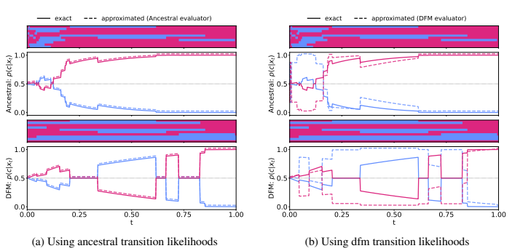
Figure 6 : Illustration of the online posterior evaluation under different samplers and evaluators. In (a), samples are taken from an ancestral sampler at the top and a dfm sampler at the bottom and the posterior likelihoods are updated using the ancestral transition likelihoods. In this case the tracked posterior is equal to the ground truth posterior. In (b), the exact same samples are shown but with this time the DFM transition likelihoods used for the posterior estimation, in which case the tracked quantity is not equal to the exact one anymore.
出典 · CC0 1.0 · Felix Koulischer, Gianni Van De Velde, François Remy, Chris Develder, Thomas Demeester · Online Class Posteriors for Interpretable and Controllable Discrete Diffusion · 論文の図を引用 · 元のPDFの22ページ目から図の部分を抽出しています。図6aでは、祖先サンプラーの遷移尤度で更新したとき、追跡した値が真の事後確率と一致することが示されています。この一致は、生成側が祖先サンプラーであってもDFMサンプラーであっても成り立ちました。一方、図6bのようにDFMの遷移尤度で更新すると、追跡した値は真の事後確率と一致しなくなります。ただし、両者は強く相関しており、たとえば破線と実線の曲線は同じように上下し、スケールだけが異なります。
実際の学習済みモデルでは、DFMサンプラーの方が安定して正確な事後推定を与えたと著者らは報告しています。著者らは、決定論的なODEの軌道が滑らかで確率的な揺らぎが少ないため、学習済みモデルが事後情報を読み取りやすくなるのではないかと仮定しています。この理論と実践のずれの詳細な理解は、今後の課題として残されています。
合成データとMNISTでの追跡結果:事後確率はどこまで正しいか
合成データでは、各データ点が二つのトークンからなり、各クラスは一方のトークンを80%の割合で多数派として持つように作られています。祖先サンプラー(ancestral sampler)の遷移尤度を使った場合、追跡した事後確率は真の事後確率と一致しました。一方、DFMの遷移尤度を使うと、追跡した値は真の事後確率と一致しなくなります。ただし、点線と実線が同じ向きに上下するため、両者は強く相関しており、スケールだけが誤っているといえます。著者らは、実際の学習済みモデルではDFMのサンプラーのほうが安定して正確に事後確率を推定できたと報告しています。その理由として、決定論的なODEはより滑らかで確率的でない軌道を示すため、学習済みモデルが事後情報を読み取りやすくなるという仮説を立てています。
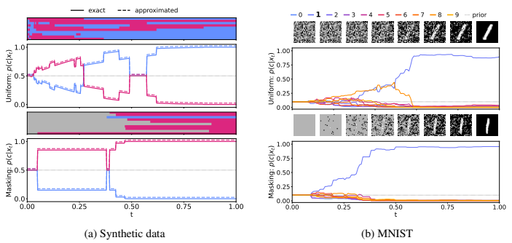
Figure 1 : Illustration of the online posterior evaluation. In (a), evaluated on an analytically tractable setting in which data points consist of two tokens represented by blue and red with each class having an 80% majority of one of the two tokens, trajectories are shown above the posteriors. In (b), the posterior is evaluated on MNIST digit generation. On top for uniform, below for masked diffusion. The increase in the posterior occurs simultaneously with the emergence of the digit.
出典 · CC0 1.0 · Felix Koulischer, Gianni Van De Velde, François Remy, Chris Develder, Thomas Demeester · Online Class Posteriors for Interpretable and Controllable Discrete Diffusion · 論文の図を引用 · 元のPDFの3ページ目から図の部分を抽出しています。MNIST生成では、クラスの事後確率は数字の形が現れるのと同時に上がりました。マスキングノイズでは、均一ノイズよりも速く最終クラスに事後確率が集中しました。これは、一度公開されたトークンを変更できないというマスキングの性質によると考えられています。分類信号は、AUCと正答率のどちらの曲線でも、生成過程のおよそ半分の時点で概ね飽和しました。著者らは、この飽和は低いノイズレベルでの条件付きモデルの分布外性と関係があると述べています。また、条件付きの周辺分布は denoising が進むにつれて互いに離れていくため、その時点で別のクラスの状態を一つのクラスのモデルで評価することは意味を持ちにくくなります。
そのため、事後確率は最終的な分類器としてではなく、生成が終わる前にクラスの目安を得るための指標として使うのに向いています。
抗体配列では、V遺伝子のクラスが十分に分かれているため、オンライン事後推定は早い段階から完全な正答率とAUCを示しました。著者らは、少数のトークンが反転するだけでクラスがほぼ決まるため、この課題では事後推定の仕事が比較的容易だと説明しています。この結果は、強い分類信号が得られる場合には、提案する事後推定がそれを確実に捉えることを示すものだと著者らは位置づけています。
AND・OR・NOTゲートの組み立て
ORゲートは、各条件付きデノイザーを対応するクラスの事後確率で重み付けした平均として定義されます。そのため、ある条件に近い状態ほど、その条件の予測に多く従います。NOTゲートは望ましくない条件の事後確率を見て、必要なときだけ反発項を有効にします。
ANDゲートでは、データレベルの予測量に順方向カーネルを一度だけ含める補正が必要です。各条件付きデノイザーにはすでに順方向カーネルが一度含まれており、目標分布ではそれを一度だけ含めるべきだからです。マスキングではこの補正項はx_1に依存せず、ソフトマックスの中で消えます。一方で均一ノイズでは、pt(xjt|xj1)が観測トークンを好むため、補正項はx_1に依存して残ります。この補正は順方向カーネルだけで決まり、p_1やモデルを必要としません。CFG型の混合では、基底分布が条件付きと無条件の分布の比と掛け合わされるため、この因子は分子と分母に現れて打ち消し合います。ORゲートとNOTゲートは条件付きデノイザーの重み付き平均であり、このような補正を必要としません。
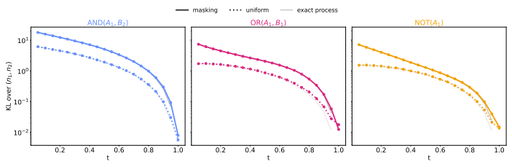
Figure 7 : Evolution of the KL divergence between the distribution of(n 1, n2)of the noisy statex t and that of the clean target, forAND(A 1, B2),OR(A 1, B1)andNOT(A 1), under masking (full) and uniform (dotted) noise. In all cases the derived gates sample from the desired target distribution, illustrated by the KL distance between generated and reference samples going to zero.
出典 · CC0 1.0 · Felix Koulischer, Gianni Van De Velde, François Remy, Chris Develder, Thomas Demeester · Online Class Posteriors for Interpretable and Controllable Discrete Diffusion · 論文の図を引用 · 元のPDFの23ページ目から図の部分を抽出しています。NOTゲートの初期ガイダンススケールs_0は事前分布のパラメータとして働き、逆温度τが事後確率の更新をスケールします。s_0を大きくするとガイダンスが強くなり、τを大きくするとガイダンスはより速く減衰します。著者らは、小さいτ(≤0.05)では、トレードオフがτにほとんど依存しないことを示しました。そのため、以降の実験ではτ=0.01に固定し、オフセットパラメータδは使用しませんでした。グリッドサーチの結果は、FIDと違反率の両方で示されています。
NOTゲートの結果と負のCFGとの比較
Cognacでは、無条件モデルが対象クラス以外に分類した割合は0.70でした。NOTゲートではこの割合が0.79に上がり、正答率は0.79±0.03となりました。負のCFGは0.81±0.02で、NOTゲートとほぼ同じ水準でした。違反率を見ると、無条件モデルの0.23に対して、負のCFGは0.06、NOTゲートは0.08でした。正のプロンプトで「NOT」を指示したモデルも正答率が0.79で、NOTゲートはプロンプトと同程度に働きました。ただし、テキストでは単にプロンプトで指示できるため、この比較は概念実証にとどまります。NOTゲートは理論的な裏付けがある一方で、ハイパーパラメータが3つあるため、著者らは実践者には負のCFGを勧めています。
負のCFGはチューニングするハイパーパラメータが1つだけです。
MNISTでは、動的なNOTゲートと静的な負のガイダンスをFIDと違反率のトレードオフで比較しました。静的なベースラインは、負のガイダンススケールλを変えてFIDと違反率を測定したものです。非常に小さなスケールでも違反率は下がりますが、スケールを大きくするとFIDが急速に悪化しました。動的なNOTゲートは、トレードオフの曲線において静的なベースラインより優れており、追加のハイパーパラメータが1つ必要になります。NOTゲートのガイダンスは生成の初めに強くかかり、その後ほぼ指数関数的に減衰します。つまり、必要なときだけ反発項を有効にする設計が、MNISTでのFIDと違反率のトレードオフの改善につながっています。
図18では、単一の軌道とその平均を示しており、結果は均一ノイズのモデルに対するものです。
連続と離散のCFGの混合の違い
連続拡散モデルのCFGは、周辺分布を乗法的に混ぜるものとして定式化され、実装上はスコア予測の加法的な混合として現れます。一方で離散CFGでは、データ分布そのものを乗法的に混ぜます。離散CFGは予測のロジットを組み合わせる形で導入され、log p̃(x1|xt, c)は log p(x1|xt) に λ(log p(x1|xt, c) − log p(x1|xt)) を加えたものになります。これは予測された トークン分布の乗法的な混合であり、連続側のスコアの加法的な混合とは対照的です。離散の設定でも同様の分解は成り立ちますが、完全に等価ではありません。
著者らは、この2つの操作が等価にならない理由を、ノイズ過程と乗法的な混合が可換でないことに求めています。そのため、連続の周辺分布の混合と離散のデータ分布の混合は、同じ操作として扱えません。この不一致は、本論文が離散CFGを整理する過程で見つけたもので、著者らは従来の研究ではあまり注目されていなかったと述べています。ここでいう対比は、ノイズ過程の定義に基づくものです。離散設定では、Rt(x, y)は状態yからxへ遷移する瞬間的なレートとして定義されます。
連続側では、ガイダンススケールλを時間方向にスケジュールする手法が提案されています。さらに、非条件モデルを意図的に弱めることで、低品質領域や無条件性から離れるようにサンプルを押し出す研究もあります。こうした時間依存のスケジュールは、近年では離散の定式化にも持ち込まれ始めています。ここで扱った混合の違いは、これらの離散版の手法を考える際の前提になります。
限界と未解決の課題
NOTゲートは、初期ガイダンススケール s0 と逆温度 τ の2つのハイパーパラメータを持ちます。s0 は事前分布のパラメータとして働き、大きいほどガイダンスが強くなります。一方で τ は事後の更新を再スケールするもので、大きいほどガイダンスが早く減衰します。著者らはグリッドサーチでこの2つを探索し、小さい τ(≤0.05)では両者のトレードオフがτにほぼ依存しないことを確認しました。MNISTの実験では、τ=0.01に固定して以降のすべての実験を行いました。
均一ノイズとマスキングの比較では、学習のハイパーパラメータを手法ごとに調整していません。そのため、少ないサンプリングステップ数では均一ノイズのモデルがマスキングのモデルより優れたものの、標準の値が均一ノイズのモデルに合っていた可能性があります。サンプリングスケジューラとしては、コサインスケジューラが他より優れていたため、すべての実験で用いられました。
DFMの遷移尤度を用いた場合、追跡される事後確率は正解の値と一致しなくなります。ただし両者は強く相関しており、たとえば破線と実線の曲線は同じように上下します。ただしスケールは誤っています。実際の学習済みモデルでは、フローマッチングのサンプラーのほうが安定で正確な事後推定をもたらすことが観察されました。著者らは、決定論的なODEの軌跡が滑らかで確率的な揺らぎが少ないため、学習済みモデルが事後情報を読み取りやすいという仮説を立てています。この現象の正確な理解は、本論文では解明されておらず、今後の課題として残されています。
論文情報
- 著者
- Felix Koulischer, Gianni Van De Velde, François Remy, Chris Develder, Thomas Demeester
- 学会・ジャーナル
- arXiv · プレプリント
- 公開日
- 2026年11月2日
- 登録日
- 2026年11月4日
- 更新日
- 2026年11月2日
- バージョン
- v1
- arXiv
- 2611.03454
- カテゴリ
- cs.LG
- ライセンス
- CC0 1.0
- 掲載内容
- 論文情報・解説・論文の図
この解説は、Refivuの韓国語解説をAIで翻訳したものです。不正確な翻訳や誤りが含まれる可能性があります。論文と図の利用条件は各出典に従います。
アブストラクト
Discrete diffusion models remain far less understood than their continuous counterparts, despite recent breakthroughs across modalities, most notably in text. Leveraging tools from continuous diffusion, we formulate a theoretical framework to track the class-conditional posterior in an online manner by combining conditional and unconditional model predictions. In masked language modeling, this posterior offers highly interpretable dynamics: tokens aligned with a class boost the posterior, while contradictory ones suppress it. We also show that the posterior can be used for logical guidance operations (AND, OR, NOT) in discrete diffusion. These operations enable precise control over generation, such as avoiding specific classes. In addition, we discuss a mismatch in the formulation of classifier-free guidance between discrete and continuous settings: discrete models mix the data distributions, while continuous models mix the marginals. We validate our methods and discuss their potential applications on synthetic data, with all quantities analytically tractable, as well as on MNIST, text, and antibody sequences.
論文の図
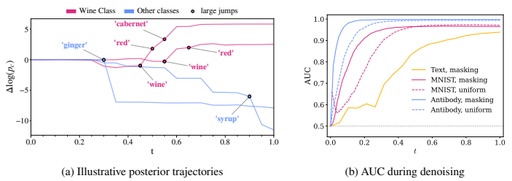
Figure 2 : In (a), the progress of the posterior approximation is shown throughout generation of four sentences on “beverage” with as class “wine”. Highlighted words show large jumps in the posterior, corresponding to those given in Table 1. In (b), one-vs-rest AUC is evaluated throughout generation, using a modality-specific external classifier to determine the final class.
出典 · CC0 1.0 · Felix Koulischer, Gianni Van De Velde, François Remy, Chris Develder, Thomas Demeester · Online Class Posteriors for Interpretable and Controllable Discrete Diffusion · 論文の図を引用 · 元のPDFの7ページ目から図の部分を抽出しています。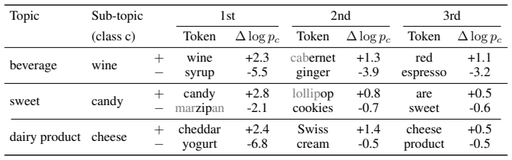
Table 1 : Tokens pushing most towards (+) and away from (−) the class, estimated by our posterior estimation. (Sub)words in gray provide context for the token shown in black. Each gray context corresponds to the actual context for that token in all samples containing that token.
出典 · CC0 1.0 · Felix Koulischer, Gianni Van De Velde, François Remy, Chris Develder, Thomas Demeester · Online Class Posteriors for Interpretable and Controllable Discrete Diffusion · 論文の図を引用 · 元のPDFの7ページ目から図の部分を抽出しています。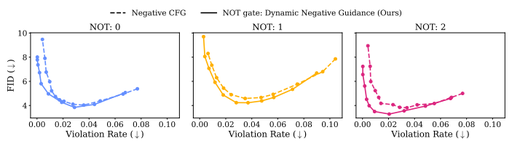
Figure 4 : Pareto curves comparing the quality of the generated samples to the safety of the approach, respectively through the FID and the violation rate. Both negative CFG, as well as the theoretically justified dynamicNOTgate display a trade-off between quality and safety, with the dynamic ap- proach outperforming the static one, albeit at the cost of an additional hyperparameter.
出典 · CC0 1.0 · Felix Koulischer, Gianni Van De Velde, François Remy, Chris Develder, Thomas Demeester · Online Class Posteriors for Interpretable and Controllable Discrete Diffusion · 論文の図を引用 · 元のPDFの8ページ目から図の部分を抽出しています。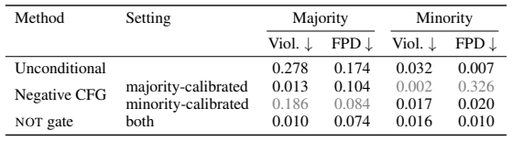
Table 2 :NOTgate performance when removing majority and minority V-gene families. Static guid- ance is calibrated to match the dynamic method’s violation rate in the corresponding regime, then transferred across regimes. Gray entries show performance outside the calibration regime. The full Pareto front is given in Appendix F.5.
出典 · CC0 1.0 · Felix Koulischer, Gianni Van De Velde, François Remy, Chris Develder, Thomas Demeester · Online Class Posteriors for Interpretable and Controllable Discrete Diffusion · 論文の図を引用 · 元のPDFの9ページ目から図の部分を抽出しています。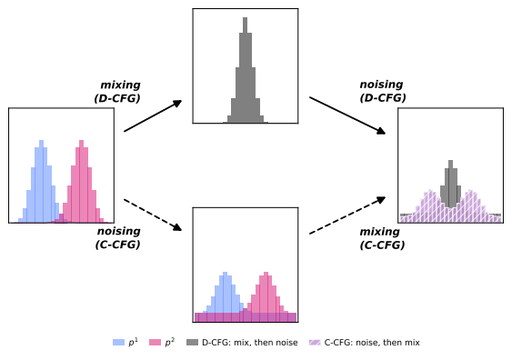
Figure 5 : Illustration of the non-commutativity of noising and mixing in the case of a multiplicative mixture. Continuous CFG first noises the data distribution and mixes the marginals, whereas discrete CFG first mixes the distributions and then only noises.
出典 · CC0 1.0 · Felix Koulischer, Gianni Van De Velde, François Remy, Chris Develder, Thomas Demeester · Online Class Posteriors for Interpretable and Controllable Discrete Diffusion · 論文の図を引用 · 元のPDFの16ページ目から図の部分を抽出しています。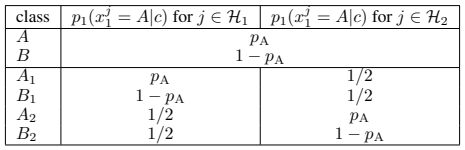
Table 3 : Synthetic data construction. The sequences are split into two halvesH 1,H 2 of 10 tokens each, filled in with a majority token whose strength is set by a tunable parameterp A. For two classes both halves share the same majority likelihood. For four classes only one half is dominated by a token while the other is uniform, which increases the overlap between classes and makes logical operations such asANDmore interesting.
出典 · CC0 1.0 · Felix Koulischer, Gianni Van De Velde, François Remy, Chris Develder, Thomas Demeester · Online Class Posteriors for Interpretable and Controllable Discrete Diffusion · 論文の図を引用 · 元のPDFの21ページ目から図の部分を抽出しています。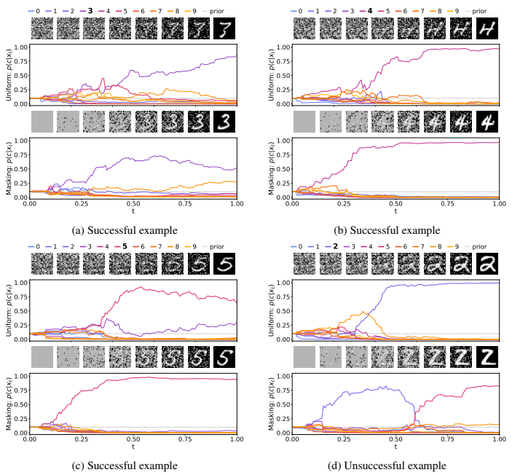
Figure 12 : Illustration of the online posterior evaluation. In (a-c), trajectories for which the online posterior estimate recovers the final class for both masking and uniform noise are shown. In (d), an example is shown for which the masking model does not recover the correct class label. All shown trajectories useτ= 0.1, a value taken from a calibration run on theNOTgate.
出典 · CC0 1.0 · Felix Koulischer, Gianni Van De Velde, François Remy, Chris Develder, Thomas Demeester · Online Class Posteriors for Interpretable and Controllable Discrete Diffusion · 論文の図を引用 · 元のPDFの27ページ目から図の部分を抽出しています。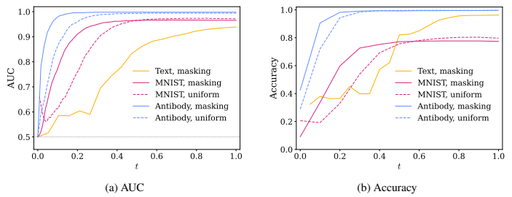
Figure 13 : Evaluation of the online posterior estimation for different modalities during denoising. In (a), the OvR AUC. In (b), the accuracy.
出典 · CC0 1.0 · Felix Koulischer, Gianni Van De Velde, François Remy, Chris Develder, Thomas Demeester · Online Class Posteriors for Interpretable and Controllable Discrete Diffusion · 論文の図を引用 · 元のPDFの28ページ目から図の部分を抽出しています。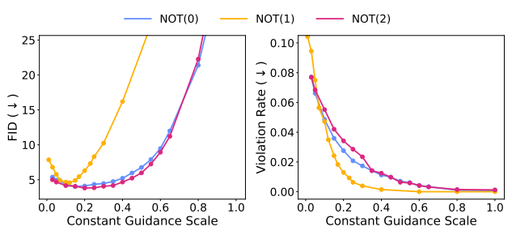
Figure 14 : Static negative guidance (negative prompting): FID and violation rate as a function of the constant guidance scaleλ, forNOT(0),NOT(1) andNOT(2).
出典 · CC0 1.0 · Felix Koulischer, Gianni Van De Velde, François Remy, Chris Develder, Thomas Demeester · Online Class Posteriors for Interpretable and Controllable Discrete Diffusion · 論文の図を引用 · 元のPDFの28ページ目から図の部分を抽出しています。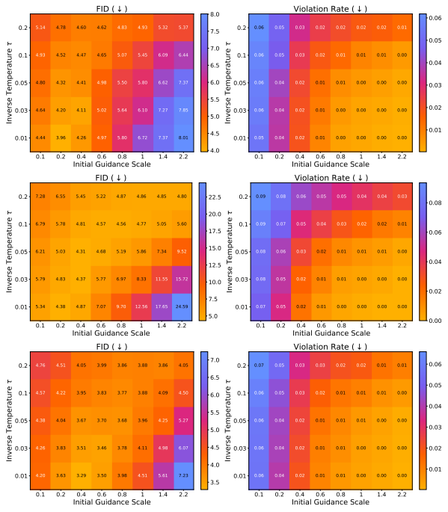
Figure 15 : FID and violation rate of the dynamicNOTgate as a function of the initial guidance scale and the inverse temperatureτ, forNOT(0),NOT(1) andNOT(2) (top to bottom). Amber is best, blue is worst.
出典 · CC0 1.0 · Felix Koulischer, Gianni Van De Velde, François Remy, Chris Develder, Thomas Demeester · Online Class Posteriors for Interpretable and Controllable Discrete Diffusion · 論文の図を引用 · 元のPDFの29ページ目から図の部分を抽出しています。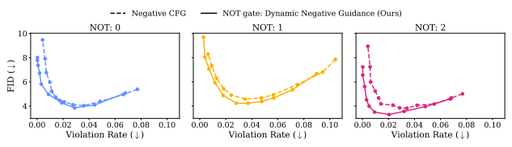
Figure 17 : FID against violation rate for dynamic negative guidance (full) and the static baseline (dashed), forNOT(0),NOT(1) andNOT(2).
出典 · CC0 1.0 · Felix Koulischer, Gianni Van De Velde, François Remy, Chris Develder, Thomas Demeester · Online Class Posteriors for Interpretable and Controllable Discrete Diffusion · 論文の図を引用 · 元のPDFの30ページ目から図の部分を抽出しています。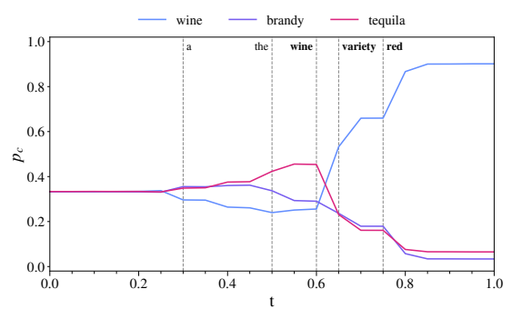
Figure 23 : The posterior of multiple classes during generation of the prompt with ID 76 in the development set of Cognac. The answer of the model is “== Cabernet Sauvignon is a type of red wine made from the Cabernet Sauvignon grape variety. ==”. Some tokens are highlighted with a dashed line at the time step of generation. The blue line, which represents the wine class, clearly jumps on the words “wine”, “variety” and “red” being generated. On the other hand, the posteriors do not move much upon “a” or “the” being generated.
出典 · CC0 1.0 · Felix Koulischer, Gianni Van De Velde, François Remy, Chris Develder, Thomas Demeester · Online Class Posteriors for Interpretable and Controllable Discrete Diffusion · 論文の図を引用 · 元のPDFの34ページ目から図の部分を抽出しています。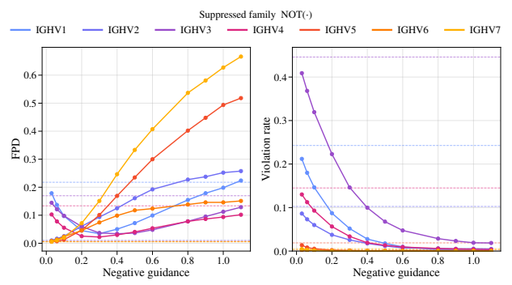
Figure 27 : Negative CFG with static negative logit guidance. On the left, the Frechet Protein Dis- tance measuring distributional coverage and sample quality, and on the right, the violation rate. Notice the strong differences between majority (IGHV1-4) and minority classes (IGHV5-7).
出典 · CC0 1.0 · Felix Koulischer, Gianni Van De Velde, François Remy, Chris Develder, Thomas Demeester · Online Class Posteriors for Interpretable and Controllable Discrete Diffusion · 論文の図を引用 · 元のPDFの41ページ目から図の部分を抽出しています。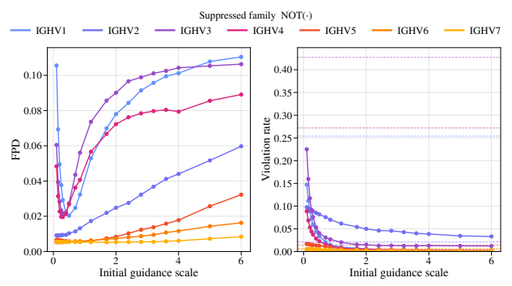
Figure 28 :NOTgate with dynamic negative guidance. On the left, the Frechet Protein Distance measuring distributional coverage and sample quality, and on the rate the violation rate. Here, thanks to the prior weighted initial guidance scale, minority classes are much less harmed when applying guidance.
出典 · CC0 1.0 · Felix Koulischer, Gianni Van De Velde, François Remy, Chris Develder, Thomas Demeester · Online Class Posteriors for Interpretable and Controllable Discrete Diffusion · 論文の図を引用 · 元のPDFの41ページ目から図の部分を抽出しています。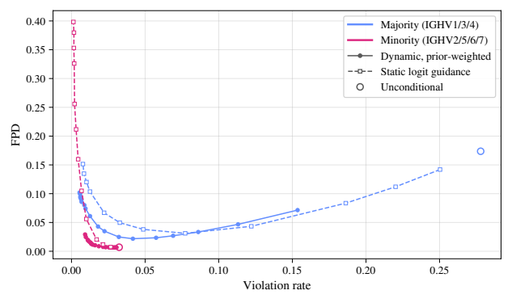
Figure 29 : Pareto front between quality (FPD) and safety (violation rate) for majority and minority classes. Negative CFG with static logit guidance is compared to theNOTgate with dynamic negative guidance.
出典 · CC0 1.0 · Felix Koulischer, Gianni Van De Velde, François Remy, Chris Develder, Thomas Demeester · Online Class Posteriors for Interpretable and Controllable Discrete Diffusion · 論文の図を引用 · 元のPDFの42ページ目から図の部分を抽出しています。この論文を引用
Felix Koulischer, Gianni Van De Velde, François Remy, Chris Develder, Thomas Demeester (2026). Online Class Posteriors for Interpretable and Controllable Discrete Diffusion. arXiv:2611.03454v1. https://arxiv.org/abs/2611.03454v1
BibTeX
@misc{koulischer2026online,
  title = {{Online Class Posteriors for Interpretable and Controllable Discrete Diffusion}},
  author = {Felix Koulischer and Gianni Van De Velde and François Remy and Chris Develder and Thomas Demeester},
  year = {2026},
  eprint = {2611.03454},
  archivePrefix = {arXiv},
  url = {https://arxiv.org/abs/2611.03454v1}
}