論文解説
The Optimal Rate Constant of Heavy-Ball Momentum on Smooth Strongly Convex Functions
平滑かつ強凸な関数に対するHeavy-Ball運動量の最適レート定数
- 課題 滑らかで強凸な関数に対して、定数パラメータのheavy-ballが達成できる最悪時の収束率の定数を求めます。
- 手法 下限は減衰する螺旋を構成して示し、上限は明示的なチューニングとLyapunov関数によって証明します。
問題設定:定数パラメータheavy-ballの最適な収束率
Heavy-ball法は、定数のステップ幅と定数の運動量パラメータを用いると、二次関数では勾配降下法を加速します。しかし、滑らかで強凸な関数クラスF_{μ,L}では、どのようなチューニングでも加速を保証できないことが知られています。この論文では、条件数κ=L/μに対する最適チューニングの最悪時の収束率を1−c(κ)/κと書き、そのときc(κ)がどこまで大きくなりうるかを検討します。論文では、勾配降下法の下限c(κ)≥2κ/(κ+1)と、非加速性がもたらすc(κ)の有界性を併せて示しています。そのうえで、厳密な極限は未解決の問題だったと述べられています。
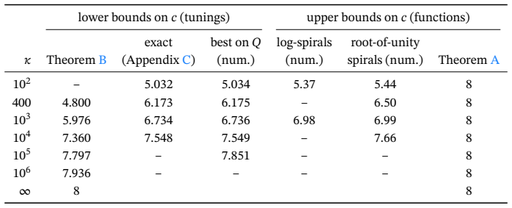
Table 2 :Bounds on𝑐(𝜅) =𝜅(1−𝜌 ⋆(𝜅)) for𝑑≥2 . Lower bounds on𝑐 come from tunings, and upper boundsfromfunctionsthatsloweverytuningdown.Lowerboundsareroundeddownandupperbounds up.Thecolumnsmarked“num.”arefloatingpoint.
出典 · CC BY 4.0 · Marcos Hernanz · The Optimal Rate Constant of Heavy-Ball Momentum on Smooth Strongly Convex Functions · 論文の図を引用 · 元のPDFの24ページ目から図の部分を抽出しています。下限と上限の証明の構造
下限の定理は、どのようなチューニングでも、d≥2ならばρ≥1−8/κが成り立つことを示します。チューニングが二次関数上で1−8/κより速い場合、そのチューニングは二変数関数上で減衰する螺旋x_t=r^t e^{2πit/K}に従うように構成されます。上限の定理は、κ≥400で明示的なチューニングを与え、その収束率が1−(8−64/√κ)/κであることをLyapunov関数で示します。
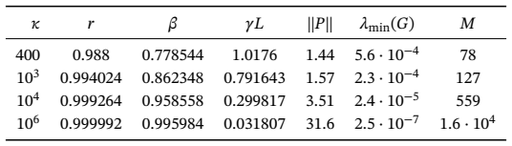
Table3 :ThetuningandtheconstantofTheoremBatsamplevaluesof𝜅,rounded,with𝑀roundedup.
出典 · CC BY 4.0 · Marcos Hernanz · The Optimal Rate Constant of Heavy-Ball Momentum on Smooth Strongly Convex Functions · 論文の図を引用 · 元のPDFの32ページ目から図の部分を抽出しています。適用範囲と残された問い
結果は、定数パラメータと正確な勾配に関する最悪時の主張です。論文では、変数パラメータ、リスタート、勾配を別の点で評価する方法は扱っておらず、確率的ニューラルネットワーク学習に直接当てはまる結果ではないと述べられています。また、有限のκにおける最適チューニング、二次の項、一次元での定数は、まだ未解決の問いとして残されています。
論文情報
- 著者
- Marcos Hernanz
- 学会・ジャーナル
- arXiv · プレプリント
- 公開日
- 2026年11月9日
- 登録日
- 2026年11月10日
- 更新日
- 2026年11月9日
- バージョン
- v1
- arXiv
- 2611.12310
- カテゴリ
- cs.LG · math.OC
- ライセンス
- CC BY 4.0
- 掲載内容
- 論文情報・解説・論文の図
この解説は、Refivuの韓国語解説をAIで翻訳したものです。不正確な翻訳や誤りが含まれる可能性があります。論文と図の利用条件は各出典に従います。
アブストラクト
The heavy-ball method with a constant step size and a constant momentum parameter accelerates gradient descent on quadratics, but no choice of the two parameters does so on the class of smooth strongly convex functions. We determine how much faster than gradient descent it can be made on this class. Writing the best worst-case rate over all tunings as $1-c(κ)/κ$, where $κ$ is the condition number, we prove that $c(κ)$ tends to $8$ in every dimension of two or more. The lower bound on the rate holds for every tuning, because a tuning that is faster than $1-8/κ$ on quadratics follows a slowly decaying spiral on some function of two variables. The matching upper bound comes from an explicit tuning, with nearly the momentum of Polyak's tuning and a step size about $\sqrtκ/8$ times smaller, and from a Lyapunov function whose positivity is verified in exact arithmetic. Optimally tuned heavy-ball is therefore asymptotically four times faster than gradient descent on this class.
この論文を引用
Marcos Hernanz (2026). The Optimal Rate Constant of Heavy-Ball Momentum on Smooth Strongly Convex Functions. arXiv:2611.12310v1. https://arxiv.org/abs/2611.12310v1
BibTeX
@misc{hernanz2026optimal,
  title = {{The Optimal Rate Constant of Heavy-Ball Momentum on Smooth Strongly Convex Functions}},
  author = {Marcos Hernanz},
  year = {2026},
  eprint = {2611.12310},
  archivePrefix = {arXiv},
  url = {https://arxiv.org/abs/2611.12310v1}
}