論文解説
Does the Voice Matter? Evaluating Frustration Detection on Deployed Clinical Voice-Agent Calls
音声は重要か:運用中の臨床音声エージェント通話における苛立ち検出の評価
- 課題 臨床音声エージェントが短い患者ターンで、書き起こしだけでは苛立ちを見逃していないかを検証する必要があります。
- 手法 実際の臨床通話のターンを書き起こしと音声入力に分け、複数のマルチモーダルモデルに同じ評価枠組みで判定させました。
- 結果 1単語のターンでは、書き起こしに基づく判定の苛立ち再現率は9.5%にとどまりました。確信を持って通過させたターンのうち苛立ちだった割合は、書き起こしで13.0%、音声で6.9%でした。
臨床音声エージェントにおける苛立ち検出の課題
自律型音声エージェントが臨床の追跡通話を担うようになり、人がすべての通話を確認することはできないため、自動分類が避けられなくなりました。この分類の過程では、患者が苛立つ瞬間を見逃さないことが重要です。既存のシステムは音声認識で得た書き起こしテキストだけを読むことが多いのですが、実際の臨床発話でそれで十分かどうかはほとんど検証されていません。
この論文は、運用中の臨床音声エージェントによる実際の患者通話で、ターン単位の苛立ち検出を扱います。実際の通話の患者ターンのうち約59%は1〜2単語で、演技された感情のデータセットであるIEMOCAPでは13%です。短いターンが多いことが、この研究の出発点です。
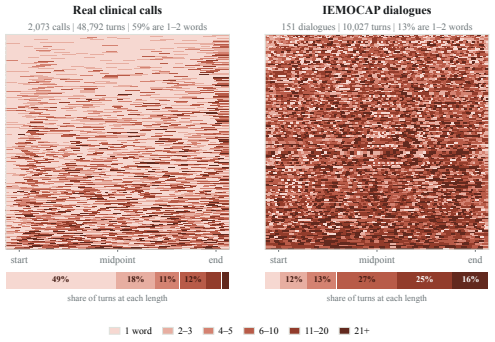
Figure 2 : Distribution of word counts across over 2000 clinical conversations. Each row is one conversation, ordered by mean utterance length; the horizontal axis runs from the start of the conversation to its end. Clinical calls are dominated by 1-2 patient turns throughout. The acted corpus contains proportionally under a quarter as many.
出典 · CC BY 4.0 · Michael, Annika, Ellis, Zachary, Zhou, Yuxiang, Thio, Samuel, He, Yajie Vera, Hazel, Spencer, Joselowitz, Jared · Does the Voice Matter? Evaluating Frustration Detection on Deployed Clinical Voice-Agent Calls · 論文の図を引用 · 元のPDFの6ページ目から図の部分を抽出しています。書き起こし入力と音声入力の比較設計
患者ターン150件(苛立ち75件、非苛立ち75件)を6通話から取り出し、評価セットとしました。3人のアノテーターが独立してラベルを付け、多数決で最終ラベルを決めました。対照群として、発話長の分布を臨床データに合わせたIEMOCAPの150ターンを用意しました。
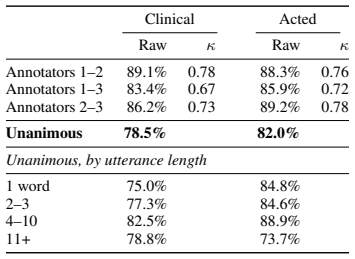
Table 1 : Inter-annotator agreement on the clinical and acted evaluation sets. Pairwise raw agreement and Cohen’s κ are reported alongside overall unanimity and unanimity by utterance length. Inconclu- sive judgements are excluded from the relevant calculation rather than counted as disagreement.
出典 · CC BY 4.0 · Michael, Annika, Ellis, Zachary, Zhou, Yuxiang, Thio, Samuel, He, Yajie Vera, Hazel, Spencer, Joselowitz, Jared · Does the Voice Matter? Evaluating Frustration Detection on Deployed Clinical Voice-Agent Calls · 論文の図を引用 · 元のPDFの4ページ目から図の部分を抽出しています。5つのマルチモーダルモデルをゼロショットで実行しました。各ターンは音声またはテキストのいずれかで1回ずつ入力し、3回繰り返した予測の多数決で判定しました。入力ごとの指示文では、音声には抑揚と話し方を、書き起こしには単語を見るように指示しました。同一の指示文は、両方の入力に同じ文を与えるもので、指示文の影響を切り分けるための統制です。

Table 5 : How each model is run.
出典 · CC BY 4.0 · Michael, Annika, Ellis, Zachary, Zhou, Yuxiang, Thio, Samuel, He, Yajie Vera, Hazel, Spencer, Joselowitz, Jared · Does the Voice Matter? Evaluating Frustration Detection on Deployed Clinical Voice-Agent Calls · 論文の図を引用 · 元のPDFの19ページ目から図の部分を抽出しています。1単語ターンにおける書き起こし判定の失敗
1単語のターンでは、書き起こしに基づく判定は、バランス精度で見ると偶然と同程度にとどまりました。6通話の実験では、苛立ちの1単語ターンの再現率は9.5%でした。30通話の実験でも、39件のうち3~4件しかフラグされませんでした。ターン長だけを使うロジスティック回帰も58.0%を記録しました。
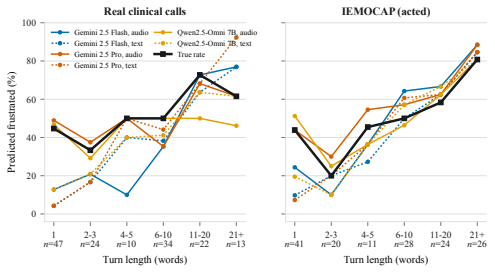
Figure 3 : Predicted-frustration rate against turn length for all three models, against the true rate in black. Every transcript condition starts far below the true rate on the shortest turns and climbs more steeply than it.
出典 · CC BY 4.0 · Michael, Annika, Ellis, Zachary, Zhou, Yuxiang, Thio, Samuel, He, Yajie Vera, Hazel, Spencer, Joselowitz, Jared · Does the Voice Matter? Evaluating Frustration Detection on Deployed Clinical Voice-Agent Calls · 論文の図を引用 · 元のPDFの7ページ目から図の部分を抽出しています。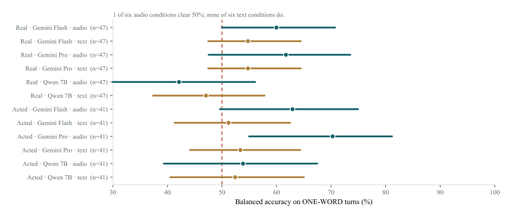
Figure 13 : One-word turns: not one transcript-only condition beats a coin flip. Every model and input, with 95 % Wilson intervals against the chance line. Six transcript conditions, none excluding 50 %.
出典 · CC BY 4.0 · Michael, Annika, Ellis, Zachary, Zhou, Yuxiang, Thio, Samuel, He, Yajie Vera, Hazel, Spencer, Joselowitz, Jared · Does the Voice Matter? Evaluating Frustration Detection on Deployed Clinical Voice-Agent Calls · 論文の図を引用 · 元のPDFの23ページ目から図の部分を抽出しています。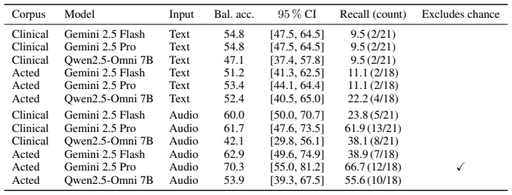
Table 9 : Every condition on one-word turns, the bucket the short-turn claims rest on. Balanced accuracy with its 95 % Wilson interval, and recall as the share of frustrated one-word turns the condition flagged ( 21 such turns on the clinical set, 18 on the acted one). A tick marks the one condition whose interval excludes chance. The audio range quoted in Section 5.2 spans both models and corpora: its floor is the open model on clinical audio, which sits below chance, and its ceiling is Gemini 2.5 Pro on acted audio.
出典 · CC BY 4.0 · Michael, Annika, Ellis, Zachary, Zhou, Yuxiang, Thio, Samuel, He, Yajie Vera, Hazel, Spencer, Joselowitz, Jared · Does the Voice Matter? Evaluating Frustration Detection on Deployed Clinical Voice-Agent Calls · 論文の図を引用 · 元のPDFの24ページ目から図の部分を抽出しています。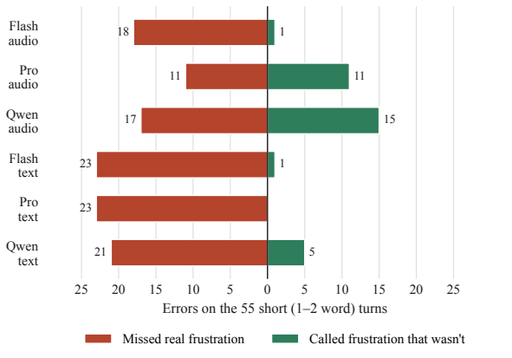
Figure 17 : Direction of error on the 55 short turns. Four of six model–modality conditions err almost exclusively bymissingreal frustration. Gemini 2.5 Pro and the open model on audio err in both directions about equally. Neither failure mode is usable for monitoring.
出典 · CC BY 4.0 · Michael, Annika, Ellis, Zachary, Zhou, Yuxiang, Thio, Samuel, He, Yajie Vera, Hazel, Spencer, Joselowitz, Jared · Does the Voice Matter? Evaluating Frustration Detection on Deployed Clinical Voice-Agent Calls · 論文の図を引用 · 元のPDFの26ページ目から図の部分を抽出しています。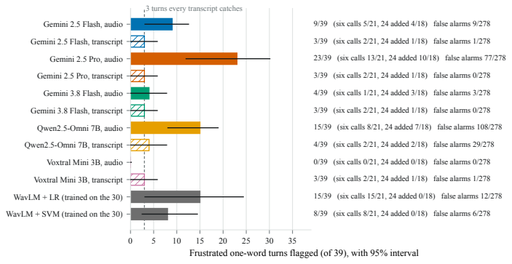
Figure 30 : Frustrated one-word turns flagged, out of 39 in the 30 calls, for each model and input and for the two WavLM probes trained on the 30 calls, with 95 % bootstrap intervals over calls. Beside each bar: the split between the six and the 24 calls, and false alarms among the 278 one-word turns that were not frustrated. The dashed line marks the three turns every transcript flags.
出典 · CC BY 4.0 · Michael, Annika, Ellis, Zachary, Zhou, Yuxiang, Thio, Samuel, He, Yajie Vera, Hazel, Spencer, Joselowitz, Jared · Does the Voice Matter? Evaluating Frustration Detection on Deployed Clinical Voice-Agent Calls · 論文の図を引用 · 元のPDFの37ページ目から図の部分を抽出しています。確信を持って通過させたターンのうち苛立ちだった割合は、書き起こし入力で13.0%、音声で6.9%でした。差は6.1 ppで、30通話の実験で測定しました。この結果は、短いターンで書き起こしに基づく判定が見逃しやすい傾向を示していますが、すべての臨床システムに対する一般的な結論までは広げていません。
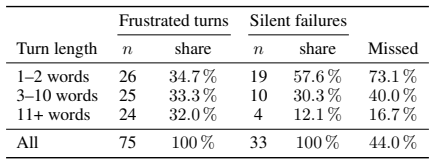
Table 3 : Where the transcript condition’s silent failures fall. A silent failure is a confidently cleared turn that was labelled as frustrated by the human annotators (a falsely-cleared turn). Short turns are a third of the frustrated turns and well over half of the silent failures, and the miss rate falls as turns lengthen. Figure 14 plots the two shares.
出典 · CC BY 4.0 · Michael, Annika, Ellis, Zachary, Zhou, Yuxiang, Thio, Samuel, He, Yajie Vera, Hazel, Spencer, Joselowitz, Jared · Does the Voice Matter? Evaluating Frustration Detection on Deployed Clinical Voice-Agent Calls · 論文の図を引用 · 元のPDFの8ページ目から図の部分を抽出しています。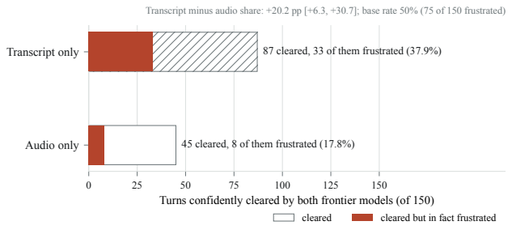
Figure 4 : Turns each input modality confidently clears, and how many of them were in fact frustrated. The transcript clears 87 of 150 turns and 37.9 % of those were frustrated; audio clears 45 and 17.8 % were. The audio rate holds only when its prompt directs the model to delivery (Section 5.5).
出典 · CC BY 4.0 · Michael, Annika, Ellis, Zachary, Zhou, Yuxiang, Thio, Samuel, He, Yajie Vera, Hazel, Spencer, Joselowitz, Jared · Does the Voice Matter? Evaluating Frustration Detection on Deployed Clinical Voice-Agent Calls · 論文の図を引用 · 元のPDFの8ページ目から図の部分を抽出しています。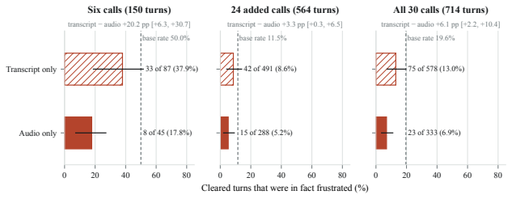
Figure 7 : Share of the frontier pair’s confidently cleared turns that were frustrated, on the six calls (33 of 87 for the transcript, 8 of 45 for audio), the 24 (42 of 491, 15 of 288) and all 30 (75 of 578, 23 of 333), with 95 % bootstrap intervals over calls. Each part’s frustrated base rate is marked: 50 %, 11.5 %and19.6 %.
出典 · CC BY 4.0 · Michael, Annika, Ellis, Zachary, Zhou, Yuxiang, Thio, Samuel, He, Yajie Vera, Hazel, Spencer, Joselowitz, Jared · Does the Voice Matter? Evaluating Frustration Detection on Deployed Clinical Voice-Agent Calls · 論文の図を引用 · 元のPDFの10ページ目から図の部分を抽出しています。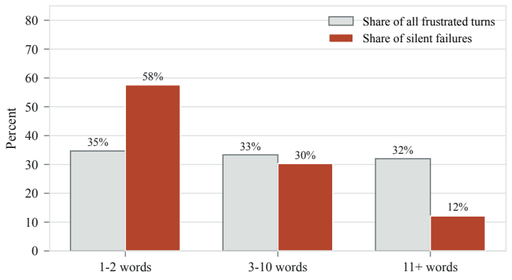
Figure 14 : Silent failures concentrate in short turns for the transcript condition. Turns wrongly cleared, by turn length. The transcript condition’s failures concentrate in the shortest turns.
出典 · CC BY 4.0 · Michael, Annika, Ellis, Zachary, Zhou, Yuxiang, Thio, Samuel, He, Yajie Vera, Hazel, Spencer, Joselowitz, Jared · Does the Voice Matter? Evaluating Frustration Detection on Deployed Clinical Voice-Agent Calls · 論文の図を引用 · 元のPDFの23ページ目から図の部分を抽出しています。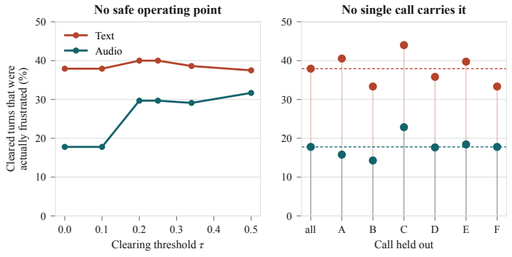
Figure 18 : The clearing gap is neither a threshold artefact nor the product of one call.Left: sweeping the clearing threshold τ leaves text between 37.5 % and 40.0 % wrong, so loosening τ makes text clear more turns without making it safer; audio rises from 17.8 % to 31.7 %, closing much of the gap as the criterion weakens.Right: holding out each call in turn moves neither condition far from its full-sample value, shown dashed.
出典 · CC BY 4.0 · Michael, Annika, Ellis, Zachary, Zhou, Yuxiang, Thio, Samuel, He, Yajie Vera, Hazel, Spencer, Joselowitz, Jared · Does the Voice Matter? Evaluating Frustration Detection on Deployed Clinical Voice-Agent Calls · 論文の図を引用 · 元のPDFの27ページ目から図の部分を抽出しています。指示文によって変わった音声の効果
入力ごとの指示文を使った条件では、2つのGemini 2.5モデルは音声の方が書き起こしより良かったものの、信頼区間は0を含んでいました。30通話では、フロンティアモデルの組における音声の利得は3.0 ppでした。一方、Qwen2.5-Omni 7Bは音声での結果が低くなりました。
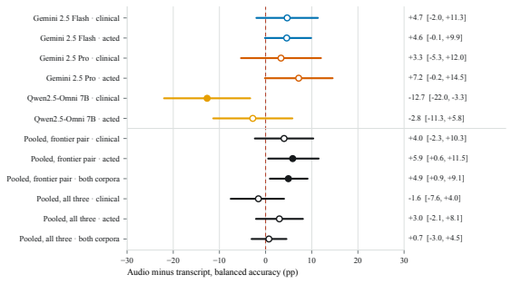
Figure 5 : Comparison of audio against the transcript, as differences with 95 % intervals from a 10 000-draw bootstrap over turns. A filled marker marks an interval that excludes zero. No frontier model’s audio gain excludes zero on its own. Pooled, the frontier pair’s gain excludes zero on the acted corpus and on both corpora together, though not on the real calls alone, and adding the open model removes it. The open model is worse with audio on the real calls, by an interval that excludes zero.
出典 · CC BY 4.0 · Michael, Annika, Ellis, Zachary, Zhou, Yuxiang, Thio, Samuel, He, Yajie Vera, Hazel, Spencer, Joselowitz, Jared · Does the Voice Matter? Evaluating Frustration Detection on Deployed Clinical Voice-Agent Calls · 論文の図を引用 · 元のPDFの9ページ目から図の部分を抽出しています。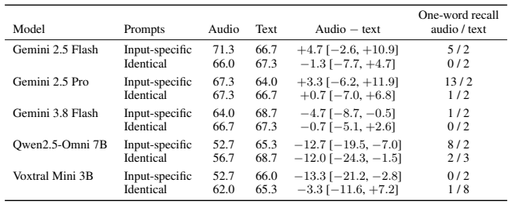
Table 4 : Input-specific prompts against one prompt identical for both inputs, on the six calls, for all five models. Balanced accuracy, the paired audio-minus-text difference in percentage points with its 95 %bootstrap interval over calls, and recall on the21frustrated one-word turns.
出典 · CC BY 4.0 · Michael, Annika, Ellis, Zachary, Zhou, Yuxiang, Thio, Samuel, He, Yajie Vera, Hazel, Spencer, Joselowitz, Jared · Does the Voice Matter? Evaluating Frustration Detection on Deployed Clinical Voice-Agent Calls · 論文の図を引用 · 元のPDFの12ページ目から図の部分を抽出しています。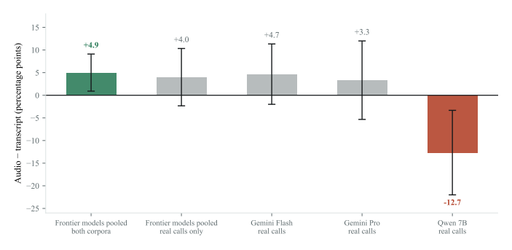
Figure 23 : Does hearing the voice help? The modality comparisons that matter, as differences with 95 %intervals. Solid bars exclude zero.
出典 · CC BY 4.0 · Michael, Annika, Ellis, Zachary, Zhou, Yuxiang, Thio, Samuel, He, Yajie Vera, Hazel, Spencer, Joselowitz, Jared · Does the Voice Matter? Evaluating Frustration Detection on Deployed Clinical Voice-Agent Calls · 論文の図を引用 · 元のPDFの30ページ目から図の部分を抽出しています。両方の入力に同じ指示文を与えた場合、30通話ではどのモデルの音声とテキストの差の信頼区間も0を除外しませんでした。著者らは、音声による利得は入力そのものよりも、指示文が音声を話し方に合わせているかどうかに大きく左右されると解釈しています。
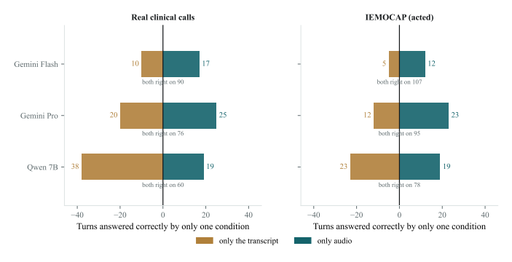
Figure 20 : The paired evidence: turns exactly one input answered correctly, with the count both answered correctly beneath. The two inputs score identical turns, so this is the comparison the pooled difference summarises.
出典 · CC BY 4.0 · Michael, Annika, Ellis, Zachary, Zhou, Yuxiang, Thio, Samuel, He, Yajie Vera, Hazel, Spencer, Joselowitz, Jared · Does the Voice Matter? Evaluating Frustration Detection on Deployed Clinical Voice-Agent Calls · 論文の図を引用 · 元のPDFの28ページ目から図の部分を抽出しています。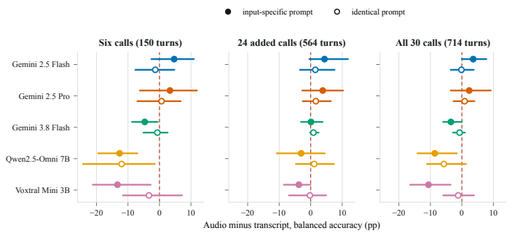
Figure 31 : Audio minus transcript balanced accuracy for the five models on the six, the 24 and all 30 calls, under the input-specific prompts (filled) and the identical prompt (hollow), with 95 % bootstrap intervals over calls.
出典 · CC BY 4.0 · Michael, Annika, Ellis, Zachary, Zhou, Yuxiang, Thio, Samuel, He, Yajie Vera, Hazel, Spencer, Joselowitz, Jared · Does the Voice Matter? Evaluating Frustration Detection on Deployed Clinical Voice-Agent Calls · 論文の図を引用 · 元のPDFの37ページ目から図の部分を抽出しています。学習させた音響プローブの限界
WavLM Base+の凍結表現の上に、ロジスティック回帰またはRBF SVMを載せたプローブを、30件の臨床通話で学習させ、out-of-foldで評価しました。その結果、交差検証のバランス精度はSVMで71.6%でした。しかし、追加の24通話にある1単語の苛立ち18件のうち、1件もフラグしませんでした。
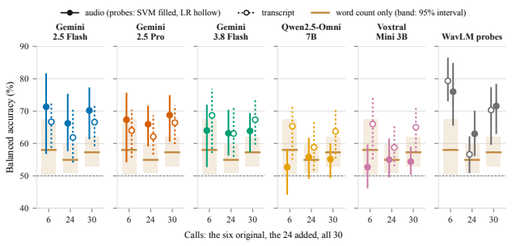
Figure 6 : Balanced accuracy on the six original calls, the 24 added calls and all 30, with 95 % bootstrap intervals over calls. Audio is solid and filled, the transcript dotted and hollow. The last panel shows the two WavLM probes trained on the 30 calls (Section 5.6). The bar and band mark the word-count-only baseline and its interval.
出典 · CC BY 4.0 · Michael, Annika, Ellis, Zachary, Zhou, Yuxiang, Thio, Samuel, He, Yajie Vera, Hazel, Spencer, Joselowitz, Jared · Does the Voice Matter? Evaluating Frustration Detection on Deployed Clinical Voice-Agent Calls · 論文の図を引用 · 元のPDFの10ページ目から図の部分を抽出しています。IEMOCAPで学習したプローブは、臨床通話での汎化が低いことがわかりました。全体の精度は良く見えても、短いターンでの失敗は残りました。
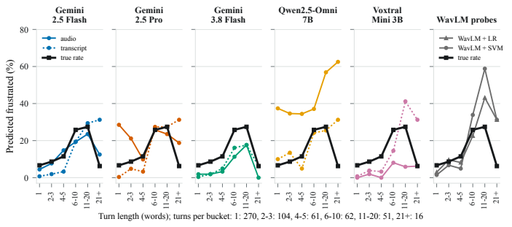
Figure 8 : Predicted-frustration rate by turn length on the 24 added calls (564 turns), against the true rate in black, for the five models and the two WavLM probes trained on the 30 calls. Audio is solid, the transcript dotted.
出典 · CC BY 4.0 · Michael, Annika, Ellis, Zachary, Zhou, Yuxiang, Thio, Samuel, He, Yajie Vera, Hazel, Spencer, Joselowitz, Jared · Does the Voice Matter? Evaluating Frustration Detection on Deployed Clinical Voice-Agent Calls · 論文の図を引用 · 元のPDFの11ページ目から図の部分を抽出しています。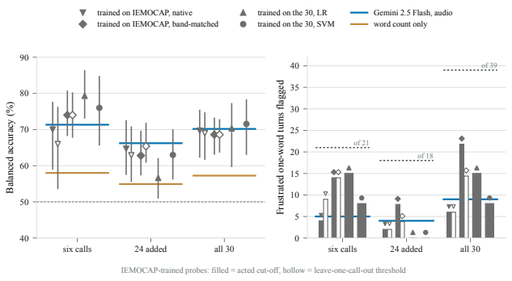
Figure 9 : The four WavLM probes on the six, the 24 and all 30 calls: trained on IEMOCAP with native and band-matched audio, scored at the acted cut-off (filled) and with a threshold chosen leaving one call out (hollow), and trained on the 30 calls with a logistic regression and an SVM. Left: balanced accuracy with 95 % bootstrap intervals over calls. Right: frustrated one-word turns flagged, of 21, 18 and 39; the band-matched counts average five folds. Reference lines: Gemini 2.5 Flash audio and word count only.
出典 · CC BY 4.0 · Michael, Annika, Ellis, Zachary, Zhou, Yuxiang, Thio, Samuel, He, Yajie Vera, Hazel, Spencer, Joselowitz, Jared · Does the Voice Matter? Evaluating Frustration Detection on Deployed Clinical Voice-Agent Calls · 論文の図を引用 · 元のPDFの12ページ目から図の部分を抽出しています。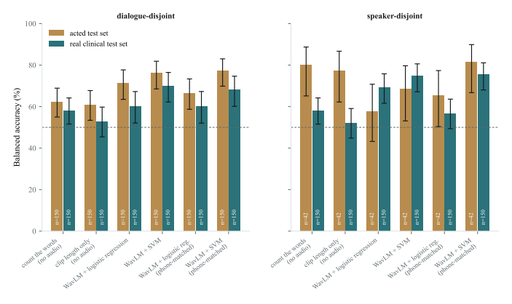
Figure 24 : The probes and the audio-free baselines on both test sets, with 95 % intervals and the number of turns on each bar.Left: training and test split by dialogue, the arrangement Table 14 reports.Right: split by speaker, which trains on more turns but tests the acted side on only42.
出典 · CC BY 4.0 · Michael, Annika, Ellis, Zachary, Zhou, Yuxiang, Thio, Samuel, He, Yajie Vera, Hazel, Spencer, Joselowitz, Jared · Does the Voice Matter? Evaluating Frustration Detection on Deployed Clinical Voice-Agent Calls · 論文の図を引用 · 元のPDFの31ページ目から図の部分を抽出しています。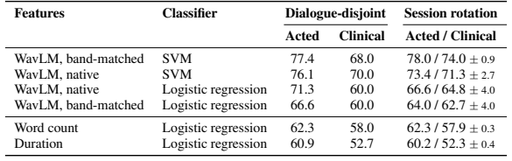
Table 14 : Generalisation from acted IEMOCAP speech to real clinical speech. All values are balanced accuracy (%), so chance is 50%. Models were trained on the larger IEMOCAP pool. Dialogue- disjoint evaluation uses a single held-out acted set and clinical set (n= 150 each; ntrain = 1,810). Session-rotation evaluation pools predictions from five held-out-session folds for the acted set and reports the mean and standard deviation across the five models for the same clinical set.
出典 · CC BY 4.0 · Michael, Annika, Ellis, Zachary, Zhou, Yuxiang, Thio, Samuel, He, Yajie Vera, Hazel, Spencer, Joselowitz, Jared · Does the Voice Matter? Evaluating Frustration Detection on Deployed Clinical Voice-Agent Calls · 論文の図を引用 · 元のPDFの32ページ目から図の部分を抽出しています。データとラベルの限界
主実験の苛立ちラベルは、単一の運用エージェントと単一の臨床経路から得られました。追加の24通話では、Annotator 1だけがラベルを付けたため、一致度の推定はありません。追加通話の書き起こしはWhisper large-v3の出力で、修正は加えていません。
また、精度の差を臨床全体の有病率として解釈することはできません。論文では、サンプリング条件から得られた絶対比率を、運用環境の有病率とみなしてはならないと明記されています。
論文情報
- 著者
- Michael, Annika, Ellis, Zachary, Zhou, Yuxiang, Thio, Samuel, He, Yajie Vera, Hazel, Spencer, Joselowitz, Jared
- 学会・ジャーナル
- arXiv · プレプリント
- 公開日
- 2026年11月16日
- 登録日
- 2026年11月17日
- 更新日
- 2026年11月16日
- バージョン
- v1
- arXiv
- 2611.21001
- カテゴリ
- cs.CL · cs.AI
- ライセンス
- CC BY 4.0
- 掲載内容
- 論文情報・解説・論文の図
この解説は、Refivuの韓国語解説をAIで翻訳したものです。不正確な翻訳や誤りが含まれる可能性があります。論文と図の利用条件は各出典に従います。
アブストラクト
Autonomous voice agents now conduct routine clinical follow-up calls, so some automated triage is unavoidable. A patient becoming frustrated is one thing that triage should catch. These systems typically read only the transcript the speech-to-text stage produces, not the voice, and whether that is enough is largely untested on real clinical speech. We study per-turn frustration detection on real patient calls from a deployed clinical voice agent: 150 turns from six calls labelled by three annotators, with a length-matched acted corpus as a control, and 714 turns from 30 calls. Patient turns are overwhelmingly short: across the deployed calls, roughly 59% are one or two words, against 13% in the full acted corpus, and a corpus accuracy gap remains even after the acted set is length-matched. On one-word turns, transcript-only detection does not exclude chance. Across five audio-capable language models, the transcript flags 3 or 4 of the 39 frustrated one-word turns in the 30 calls, and a classifier given only the word count reaches 57.3%. Whether audio helps depends on the model and on the instruction. Asked to attend to delivery, two Gemini 2.5 models gain 3.0 pp over the transcript across 30 calls (-1.0 to 7.5 pp). Of the turns they confidently clear, 6.9% were in fact frustrated for audio against 13.0% for the transcript, a difference of 6.1 pp (2.2 to 10.4 pp). Across the 30 calls, given one prompt identical for both inputs, no model's audio-text interval excludes zero. Under the input-specific prompts, a newer Gemini model and two smaller open models do worse with audio than with the transcript (-3.5, -8.6 and -10.6 pp). A WavLM probe trained on the clinical calls matches the best prompted model overall (71.6%) but misses every frustrated one-word turn in the 24 added calls. When a patient's turn is short, the transcript alone is not enough to rule out frustration.
この論文を引用
Michael, Annika, Ellis, Zachary, Zhou, Yuxiang, Thio, Samuel, He, Yajie Vera, Hazel, Spencer, Joselowitz, Jared (2026). Does the Voice Matter? Evaluating Frustration Detection on Deployed Clinical Voice-Agent Calls. arXiv:2611.21001v1. https://arxiv.org/abs/2611.21001v1
BibTeX
@misc{annika2026does,
  title = {{Does the Voice Matter? Evaluating Frustration Detection on Deployed Clinical Voice-Agent Calls}},
  author = {Michael, Annika and Ellis, Zachary and Zhou, Yuxiang and Thio, Samuel and He, Yajie Vera and Hazel, Spencer and Joselowitz, Jared},
  year = {2026},
  eprint = {2611.21001},
  archivePrefix = {arXiv},
  url = {https://arxiv.org/abs/2611.21001v1}
}