論文解説
How Short Is Too Short? Length-Conditional Calibration and Abstention for Detecting AI-Generated Text
どこまで短ければ短すぎるのか:AI生成テキスト検出のための長さ条件付き較正と判定保留
- 課題 短いテキストで、AI生成テキスト検出の閾値の偽陽性率が長さによってどう変わるかを扱います。
- 手法 長さbinごとに人間のテキストの較正集合でconformal p-valueの閾値を決め、TPRの上限が低いbinでは判定を保留します。
- 結果 長さ別の較正は、再分割の平均偽陽性率を名目の5%近くに保ちました。一方、最も高いTPRは200トークンのBinocularsで約59%でした。
短いテキストで検出閾値が崩れる問題
AI生成テキストの検出器は、数百トークン規模の文章で調整され評価されることがほとんどです。しかし実際の事例には、もっと短い文章が多く含まれます。この論文は、スコアベースの検出器をテキスト長の関数とみなし、長いテキストで決めた閾値が短いテキストで偽陽性率をどう変えるかを問うています。ゼロショット検出器はトークンごとに証拠を足してスコアを作るため、長さが短くなると検出力が落ちます。人間のテキストのスコア分布は、長さが短くなるほど広がります。そのため同じ閾値でも、偽陽性率が名目値から大きくずれることがあります。
トークン平均スコアの閾値ドリフトと最小長
分析の対象は、トークンごとの統計量の平均として定義されるスコアです。人間のテキストのトークン統計量は平均μ0と標準偏差σ0を持ち、機械のテキストはμ1がμ0より大きく、σ1を持ちます。トークン間の依存性は有効サンプル比率ρを通じて分散に反映され、平均スコアの分散はσ_j²/(ρn)で与えられます。命題3.1は、長さn0で偽陽性率αを与える閾値が、長さnで実現する偽陽性率α(τ,n)を閉じた形で示します。人間の平均μ0がnに依存しなければ、式はα(τ,n)=1−Φ(z_{1−α}√(n/n0))に簡略化され、α<1/2の場合にはn<n0でαより大きくなります。逆に、人間の平均が短い長さで下がると、第2項が判定の基準値を引き上げるため、実現する偽陽性率がαより低くなることもあります。
命題3.2は、μj、σj、ρがnに依存しないとき、偽陽性率αの検定が長さnで検出力1−βを持つのは、n≥n★(α,β)のときと同じだと示しています。ここでn★は(1/ρ)((z_{1−α}σ0+z_{1−β}σ1)/(μ1−μ0))²です。分離幅μ1−μ0が小さいほど必要な長さはその逆二乗で大きくなるため、閾値の調整だけでは小さな分離を補えないことが分かります。
長さbinごとのconformal較正と判定保留
長さの区間を複数のbinに分け、binごとに人間のテキストの較正用文章集合を別々に持たせます。テスト用文章のスコアs(x)について、較正集合の中でs(x)以上のスコアの個数を数え、p(x)=(1+個数)/(m_k+1)を計算します。p(x)≤αなら機械のテキストと判定します。命題4.1は、人間のテスト用文章と較正用文章が交換可能であれば、各binでPr(p(x)≤α)≤αが成り立つと述べています。この保証は較正集合を抽出する際の乱数性についての周辺確率であり、個々の較正集合での実現割合はばらつくことがあります。
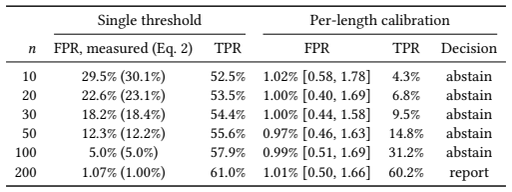
Table 1 . Synthetic check at nominal 1% FPR. The calibrated column gives the mean realized FPR over 200 calibration draws, with the central 95% range in brackets.
出典 · CC BY 4.0 · Ritesh Janga, Justin Zhan · How Short Is Too Short? Length-Conditional Calibration and Abstention for Detecting AI-Generated Text · 論文の図を引用 · 元のPDFの5ページ目から図の部分を抽出しています。判定保留の規則では、binごとに検証用の機械テキストを使って閾値でのTPRを推定します。その信頼上限が下限γより低ければ、そのbin全体について判定を保留します。判定の決定はテスト文のスコアを使わないため、命題4.1の保証は保留されなかった文章に対して維持されます。この規則は検出器の限界を示す出力であり、短いテキストを検出可能にする仕組みではありません。
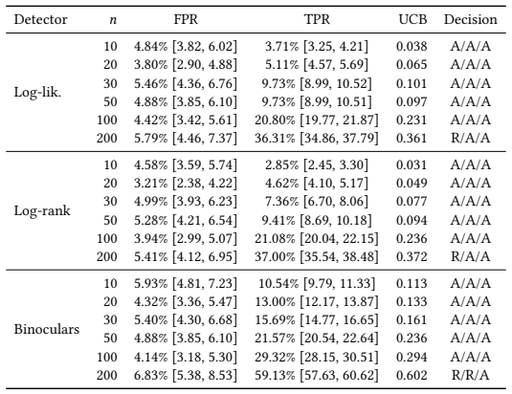
Table 2 . Real-detector results at 𝛼=0.05on the held-out test split, with 95% Clopper–Pearson intervals. UCB is the upper confidence bound of the validation-set TPR. The last column gives the decision at𝛾=0.3/0.5/0.8 (R: report, A: abstain).
出典 · CC BY 4.0 · Ritesh Janga, Justin Zhan · How Short Is Too Short? Length-Conditional Calibration and Abstention for Detecting AI-Generated Text · 論文の図を引用 · 元のPDFの6ページ目から図の部分を抽出しています。実際のゼロショット検出器の長さ別結果
3つのゼロショット検出器(対数尤度、対数順位、Binoculars)を、Wikipedia、AG News、Amazon Reviewsに対して、Llama-3.1-8B-InstructとMistral-7B-Instruct-v0.3が生成した機械テキストに適用しました。200トークンで設定した単一の閾値は、Binocularsでは10トークンのとき偽陽性率29.4%でした。対数尤度は同じ設定で1%前後でした。これは、人間の平均が長さによって変わる方向に応じて、ドリフトが異なる方向に現れた結果です。
長さ別の較正は、300回のランダムな文書単位の再分割で、18個のセルの平均偽陽性率を4.93%から5.02%の間に保ちました。ただし、この数値は再分割の平均であり、1回の分割では一部のセルが5%を超えることがあります。TPRは3つの検出器すべてで長さに応じて緩やかに上がり、最も高い値は200トークンのBinocularsで約59%です。80%のTPR下限ではすべてのセルで判定が保留され、0.30と0.50の下限では200トークンのbinだけが判定対象になりました。プールした較正はコーパス間の差を隠すため、保証はプールした人間テキストの混合に対してのみ成り立ち、コーパスごとには成り立ちません。
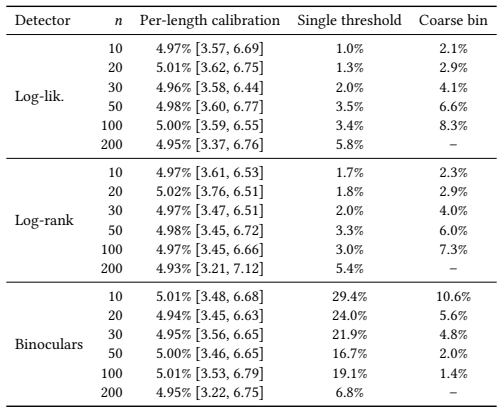
Table 3 . Test-split FPR at nominal 5%. Per-length calibration: mean over 300 random document-level resplits, with the central 95% range of the realized FPR in brackets. Single threshold: set on the𝑛=200calibration set. Coarse bin: one threshold from the pooled calibration sets of𝑛=10to 100.
出典 · CC BY 4.0 · Ritesh Janga, Justin Zhan · How Short Is Too Short? Length-Conditional Calibration and Abstention for Detecting AI-Generated Text · 論文の図を引用 · 元のPDFの7ページ目から図の部分を抽出しています。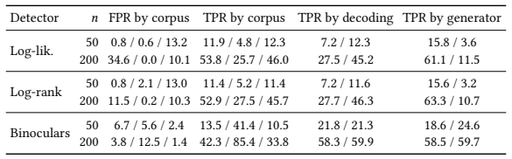
Table 6 . Pooled-threshold rates (%) by subgroup. FPR is by corpus; TPR is by corpus, by decoding setting, and by generator.
出典 · CC BY 4.0 · Ritesh Janga, Justin Zhan · How Short Is Too Short? Length-Conditional Calibration and Abstention for Detecting AI-Generated Text · 論文の図を引用 · 元のPDFの11ページ目から図の部分を抽出しています。正規近似の限界と適用範囲
正規近似は、対数尤度と対数順位ではおおむね近い結果でしたが、Binocularsの人間のスコアは左に偏っており、裾の部分で合いませんでした。このため論文は、正規分布に合わせた閾値ではなく、順位ベースで較正しています。さらに、命題3.2の平均と分散が不変だという仮定は、実際の対数尤度データでは成り立ちません。命題3.1はこのような平均のシフトを扱い、このスコアでは長い長さの閾値が短い長さでの偽陽性率を下げます。論文では、200トークンを超える長さ、機能するウォーターマーク検出器、非ネイティブの作成者は評価していないと述べられています。なお、Abstentionは短いテキストを検出可能にするものではなく、検出器の限界を明示する出力です。
論文情報
- 著者
- Ritesh Janga, Justin Zhan
- 学会・ジャーナル
- arXiv · プレプリント
- 公開日
- 2026年11月7日
- 登録日
- 2026年11月10日
- 更新日
- 2026年11月7日
- バージョン
- v1
- arXiv
- 2611.10901
- カテゴリ
- cs.AI
- ライセンス
- CC BY 4.0
- 掲載内容
- 論文情報・解説・論文の図
この解説は、Refivuの韓国語解説をAIで翻訳したものです。不正確な翻訳や誤りが含まれる可能性があります。論文と図の利用条件は各出典に従います。
アブストラクト
Detectors of AI-generated text are usually tuned and tested on passages of several hundred tokens, yet many real cases are short. We study score-based detection as a function of passage length. We give a closed form for how the false-positive rate of a threshold set on long text changes as length falls, and a formula for the number of tokens a detector needs to reach a target true-positive rate. We calibrate thresholds within length bins with conformal p-values, and we add a bin-level rule that abstains when the detector cannot be informative at that length. On synthetic scores the formulas agree with simulation, and binned calibration holds the false-positive rate at its nominal value at every length. On three zero-shot detectors (log-likelihood, log-rank, Binoculars), three corpora and two open-weight generators, binned calibration gives a mean false-positive rate of 5.0% in every detector-length cell from 10 to 200 tokens, averaged over 300 random document-level resplits. A single threshold set at 200 tokens gives 29% for Binoculars at 10 tokens and about 1% for log-likelihood, as the closed form predicts. No detector reaches an 80% true-positive rate, and the best, Binoculars at 200 tokens, reaches 59%, so the rule abstains in every cell at that floor and releases only the 200-token bins at floors of 0.3 and 0.5.
この論文を引用
Ritesh Janga, Justin Zhan (2026). How Short Is Too Short? Length-Conditional Calibration and Abstention for Detecting AI-Generated Text. arXiv:2611.10901v1. https://arxiv.org/abs/2611.10901v1
BibTeX
@misc{janga2026short,
  title = {{How Short Is Too Short? Length-Conditional Calibration and Abstention for Detecting AI-Generated Text}},
  author = {Ritesh Janga and Justin Zhan},
  year = {2026},
  eprint = {2611.10901},
  archivePrefix = {arXiv},
  url = {https://arxiv.org/abs/2611.10901v1}
}