論文解説
Richness Is Not Evenness: Ordered Renyi Crossings under Self-Training
豊富さは均等さではない:自己学習下における順序付きRényi交差
- 課題 再帰的な自己学習では、語彙の多様性を示す指標が異なる方向に動くことがあります。
- 手法 GPT-2を自身の出力で繰り返しファインチューニングし、学習温度を変えて、固定サンプラーでRényiエントロピーの次数ごとの変化を測定します。
- 結果 英語GPT-2の実験では、次数ごとに符号が切り替わる温度がH∞、H2、H1、H0の順に現れます。その間の区間では単語の種類数が減り、頻度の集中が緩和されます。
多様性指標が示すもの
再帰的な自己学習では、語彙が減る一方で、よく使われる単語の支配力が弱まることがあります。論文は、この二つの現象が同じ方向に動くとは仮定していません。単語の種類数を数えるrichnessと、頻度分布の集中度を反映するRényiエントロピーは異なる性質を測るため、一つの指標だけで品質の悪化を判断すると結論が変わることがあります。著者らは、次数αによってエントロピー変化の符号がどの順序で反転するのかを問いとして据えています。
再帰学習と測定方法
各世代では、現在のGPT-2モデルが学習コーパスをサンプリングし、そのコーパスでモデルを完全にファインチューニングします。学習温度とtop-pを変えて複数の設定を比較し、すべてのモデルはT=1、top-p=0.95の固定測定サンプラーで読み直します。単語レベルのRényiエントロピーは観測された単語頻度から計算され、次数αに応じたH∞、H2、H1、H0の変化を世代0と世代9の間で比較します。
次数ごとの交差温度の順序
英語GPT-2の学習温度グリッドでは、符号が切り替わる温度はH∞が0.927で最も早く現れ、続いてH2が0.962、H1が0.997、H0が1.035です。この区間では、単語の種類数が減り、最も頻出する単語の支配力も弱まります。著者らは、この順序が測定サンプラーや予算を変えても概ね維持されると報告しています。ただし、この結果は主に英語GPT-2の固定されたグリッド条件で得られたものです。
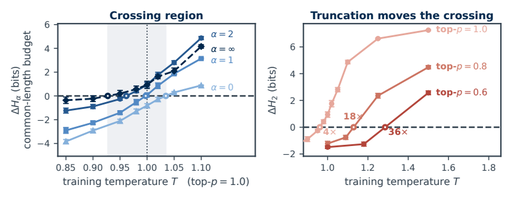
Figure 1 : English GPT-2 after nine rounds of recursive full fine-tuning, five seeds per cell. Changes compare generation 9 with generation 0 under the fixed measurement sampler (T = 1, top-p = 0.95) at common-length budgets.Left:measured means and seed standard deviations near the crossing region. Open circles mark linearly interpolated roots; inside the shaded interval richness falls while min-entropy rises, as measured at four temperatures.Right:collision-entropy changes at three training top-p values. Labels give the cross-perplexity ratio interpolated at each root; no model was trained at exactly those temperatures.
出典 · CC BY 4.0 · Pranjal Srivastava · Richness Is Not Evenness: Ordered Renyi Crossings under Self-Training · 論文の図を引用 · 元のPDFの2ページ目から図の部分を抽出しています。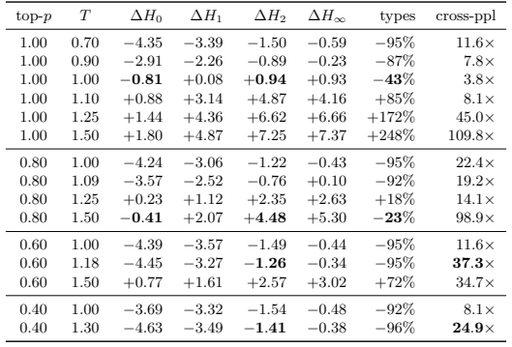
Table 1 : Coarse 15-cell grid for English GPT-2 under full fine-tuning: five-seed means of the change from generation 0 to generation 9 at common-length budgets (48,125–70,367words). “Types” is the seed mean of the relative change in the number of word types, and cross-perplexity is the generation-9 value relative to generation 0. The largest seed standard deviation in the four entropy columns is0.733bits ( H0 at top-p = 0.40, T = 1); per-seed values are released. Bold marks cells where richness and collision entropy move in opposite directions, or where∆H2 moves toward zero while cross-perplexity worsens. Figure 1 adds the five refinement temperatures.
出典 · CC BY 4.0 · Pranjal Srivastava · Richness Is Not Evenness: Ordered Renyi Crossings under Self-Training · 論文の図を引用 · 元のPDFの7ページ目から図の部分を抽出しています。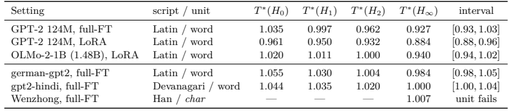
Table 2 : First upward crossings at top-p = 1. Rows 1, 3 and 5 use five seeds and the others three. Row 1 includes both refinements (crossing brackets of 0.02–0.05 in temperature); the other grids are spaced 0.10–0.15 apart, so their third decimals are not resolved. The last column gives the interval between the outer crossings, rounded from the unrounded roots. In Hindi theH∞ root is fragile (see text). The Han-only Chinese unit loses coverage before most roots can be bracketed.
出典 · CC BY 4.0 · Pranjal Srivastava · Richness Is Not Evenness: Ordered Renyi Crossings under Self-Training · 論文の図を引用 · 元のPDFの8ページ目から図の部分を抽出しています。
Table 10 : Crossing temperatures on the top-p = 1axis under alternative measurements of the same endpoint checkpoints. Teacher-forcedH 0 is constant atlog2|V|for a dense softmax, so it has no crossing.
出典 · CC BY 4.0 · Pranjal Srivastava · Richness Is Not Evenness: Ordered Renyi Crossings under Self-Training · 論文の図を引用 · 元のPDFの22ページ目から図の部分を抽出しています。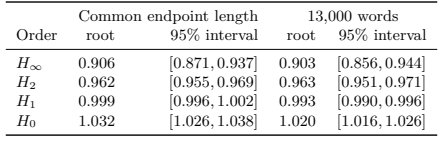
Table 24 : Fresh-seed replication: first upward crossing temperatures and 95% paired-seed bootstrap intervals. The same five resampled seed indices are used across all temperatures. Intervals condition on the selected grid and exclude interpolation error.
出典 · CC BY 4.0 · Pranjal Srivastava · Richness Is Not Evenness: Ordered Renyi Crossings under Self-Training · 論文の図を引用 · 元のPDFの39ページ目から図の部分を抽出しています。切断サンプラーと非切断サンプラーの比較
十個の設定で切断された学習サンプラーと非切断の学習サンプラーを比べると、多くの設定で二つのグループがエントロピー変化の方向によって分かれます。この分離はα=10と∞で最も多く見られ、一部の設定では低い次数でも見られます。この結果は、方向の基準を満たした設定数を示すものであり、すべての設定で常に同じ分離が起きることを意味するわけではありません。
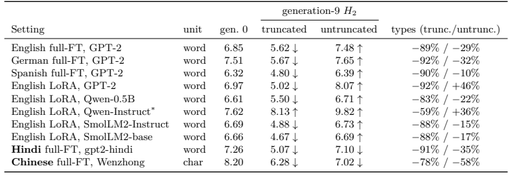
Table 4 : Ten self-training settings: three-seed means under the measurement sampler, with a shared generation 0. TheH2 columns use the logged measurement samples at full length; type changes use the first 13,000 units of separate dumps (Table 6), because richness depends strongly on length. Arrows give the sign of the mean change from generation 0. The English row is an independent rerun of the four-arm study’s truncated and untruncated arms; its separate dumps give5.65and7 .46bits in Table 8, reflecting different measurement samples. On an English generation-0 text (the seed-0 baseline of the main grid), i.i.d. resampling atN = 13,000gives a0 .013-bit H2 bias (Appendix E.4); this is not a general correction. Character and word values have different scales.∗Sampled with the checkpoint’s default repetition penalty of 1.1; without it the truncated arm falls to5.54bits (§6.6).
出典 · CC BY 4.0 · Pranjal Srivastava · Richness Is Not Evenness: Ordered Renyi Crossings under Self-Training · 論文の図を引用 · 元のPDFの9ページ目から図の部分を抽出しています。
Table 5 : Settings, out of ten, in which all truncated seeds move one way and all untruncated seeds the other, by Rényi order. Changes below0.02bits decide some entries, so individual classifications may not be stable across reruns. This sign criterion is stricter than the magnitude separation of §6.4. The counts include the penalized Qwen2.5-0.5B-Instruct setting (§6.6), which meets the criterion atα≤ 1.5; with its penalty-free rerun instead, they are 1, 1, 2, 2, 3, 7, 7, 8 and 7.
出典 · CC BY 4.0 · Pranjal Srivastava · Richness Is Not Evenness: Ordered Renyi Crossings under Self-Training · 論文の図を引用 · 元のPDFの10ページ目から図の部分を抽出しています。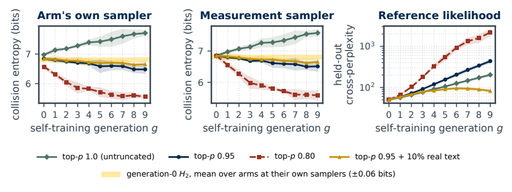
Figure 2 : The four-arm English study with common random numbers, three seeds. Truncated training samplers lower word-levelH2 from generation to generation, while untruncated training (top-p = 1) driftsup. Held-out cross-perplexity rises fastest for the tightest nucleus, and mixing 10% real text into each training corpus limits the rise to1.6×. The shaded band in the twoH2 panels marks the generation-0 value read with the arms’ own samplers, averaged over arms and seeds (6.81bits); its±0.06-bit width is for display only.
出典 · CC BY 4.0 · Pranjal Srivastava · Richness Is Not Evenness: Ordered Renyi Crossings under Self-Training · 論文の図を引用 · 元のPDFの20ページ目から図の部分を抽出しています。解釈の限界
理論はデコードとサンプリングの効果を説明しますが、ニューラルネットワークで見られる交差の順序は、経験的な結果のままです。品質は参照テキストに対する尤度と自動指標だけで測定し、人間による評価は含めていません。したがって、エントロピーの符号変化だけで品質の悪化やその原因を確定することはできません。
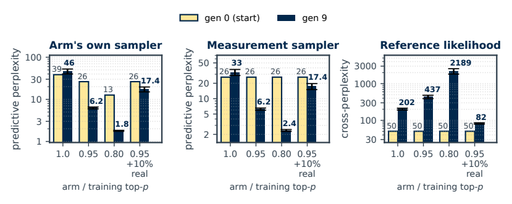
Figure 3 : English GPT-2, generation 0 to 9. On the truncated arms, predictive perplexity2H1(qt) falls while cross-perplexity on held-out real text rises. The first two panels average entropy over human contexts, using the arm’s own sampler or the measurement sampler; they do not score generated sequences. The rightmost group in each panel is the top-p= 0.95arm with 10% real text.
出典 · CC BY 4.0 · Pranjal Srivastava · Richness Is Not Evenness: Ordered Renyi Crossings under Self-Training · 論文の図を引用 · 元のPDFの21ページ目から図の部分を抽出しています。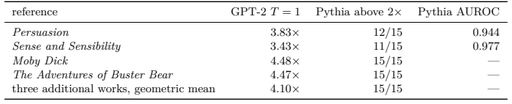
Table 19 : Dependence of the quality label on the reference text, at generation 9. GPT-2 values are mean cross-perplexity ratios over five seeds at top-p = 1, T = 1. Pythia keeps the samemax(|∆H0|,| ∆H2|)score and2× cutoff. A dash marks a single label class. The final row first averages log ratios over the three additional works within each endpoint; no score or threshold is refitted.
出典 · CC BY 4.0 · Pranjal Srivastava · Richness Is Not Evenness: Ordered Renyi Crossings under Self-Training · 論文の図を引用 · 元のPDFの28ページ目から図の部分を抽出しています。論文情報
- 著者
- Pranjal Srivastava
- 学会・ジャーナル
- arXiv · プレプリント
- 公開日
- 2026年11月6日
- 登録日
- 2026年11月9日
- 更新日
- 2026年11月6日
- バージョン
- v1
- arXiv
- 2611.08892
- カテゴリ
- cs.CL
- ライセンス
- CC BY 4.0
- 掲載内容
- 論文情報・解説・論文の図
この解説は、Refivuの韓国語解説をAIで翻訳したものです。不正確な翻訳や誤りが含まれる可能性があります。論文と図の利用条件は各出典に従います。
アブストラクト
Recursive self-training of language models, a setting studied in model collapse, can reduce vocabulary while making frequent words, mostly function words, less dominant. We fine-tune English GPT-2 on its own output for nine generations, vary the training-data sampling temperature, and measure every model with one fixed sampler. As training temperature rises, Renyi entropy changes turn from loss to gain at distinct temperatures: min-entropy first, then collision entropy, Shannon entropy and observed richness. Between the outer crossings, word types fall while the most-common word becomes less dominant. Untruncated training at T = 1 lies in this interval: at 13,000 words, generation 9 has 24% fewer types than generation 0 yet collision entropy is 0.91 bits higher. The ordering persists with a finer grid, different measurement samplers, a fixed word budget and five fresh training seeds. Min-entropy again crosses before richness in four further settings (in Hindi only at interpolated roots) and in 12 of 13 distinct measurements under eight text representations. Next-token identities and a categorical simulation isolate decoding and sampling effects; the crossing order remains empirical. Fine-tuning on human text can produce the same split while likelihood improves, and no single order's sign reliably identifies worse likelihood across the tested settings. We recommend reporting entropy profiles at stated budgets with an independent quality measure.
この論文を引用
Pranjal Srivastava (2026). Richness Is Not Evenness: Ordered Renyi Crossings under Self-Training. arXiv:2611.08892v1. https://arxiv.org/abs/2611.08892v1
BibTeX
@misc{srivastava2026richness,
  title = {{Richness Is Not Evenness: Ordered Renyi Crossings under Self-Training}},
  author = {Pranjal Srivastava},
  year = {2026},
  eprint = {2611.08892},
  archivePrefix = {arXiv},
  url = {https://arxiv.org/abs/2611.08892v1}
}