論文解説
Constitutional AI: Harmlessness from AI Feedback
Constitutional AI:AIフィードバックによる無害性
- 課題 既存の無害性学習は多数の人間の選好ラベルに依存しており、無害性を強めるとモデルが回避的に答える問題がありました。この研究では、AIフィードバックで無害性ラベルを置き換えられるかを確かめます。
- 手法 Constitutional AIは、人が書いた原則のリストであるconstitutionを使い、モデルが自分の応答を批評して修正する教師あり学習の段階と、AIが作った無害性の選好ラベルでRLAIFを行う強化学習の段階から構成されます。
- 結果 AIフィードバックで学習したRL-CAIは、役立ち性の人間ラベルを保ったまま、クラウドワーカーのElo比較でhelpful RLHFより無害だと評価されました。回避的な応答はほとんどないと報告されています。この結果は、そのElo比較の条件で得られたものです。
人間ラベルへの依存と回避の問題
無害なAIアシスタントを作る際、従来のRLHFは役立ち性と無害性の両方で、人が付けた選好ラベルを使います。本論文は、この方法が数万件程度の人間フィードバックのラベルに依存すること、そしてそのラベルの大半が公開されておらず、AIの学習目標を外部から理解しにくいことを問題としています。
もう一つの問題は、役立ち性と無害性の衝突です。先行研究では、モデルが敏感な質問の前で回避的な応答を繰り返しており、それはクラウドワーカーが回避的な応答を無害な応答として報酬を与えた結果だったと説明されています。本論文は、有害な依頼を手伝わないものの、なぜ断るのかを説明する応答を目標にしています。
したがって、この節の問いは、人間が無害性ラベルを付けなくても、AIが応答を評価し、その評価で学習することで、役立ち性を失わずに無害性を得られるかどうかです。
批評と修正によるSL-CAI
教師あり学習の段階は、helpful RLHFモデルにred teamingプロンプトを与えて初期応答を得ることから始まります。その応答に対して、憲法の原則に従った批評の依頼を加えて批評をサンプリングし、さらに修正の依頼を加えて修正版をサンプリングします。修正版は元のプロンプトと同じ形式のプロンプトと応答のペアなので、同じ批評と修正の過程を何度も繰り返せます。
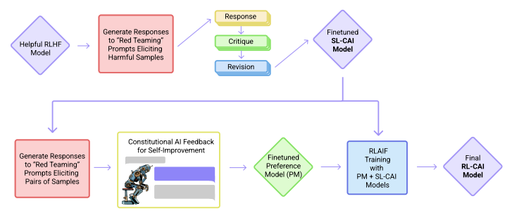
Figure 1 We show the basic steps of our Constitutional AI (CAI) process, which consists of both a super- vised learning (SL) stage, consisting of the steps at the top, and a Reinforcement Learning (RL) stage, shown as the sequence of steps at the bottom of the figure. Both the critiques and the AI feedback are steered by a small set of principles drawn from a ‘constitution’. The supervised stage significantly improves the initial model, and gives some control over the initial behavior at the start of the RL phase, addressing potential exploration problems. The RL stage significantly improves performance and reliability.
出典 · CC BY 4.0 · 元のPDFの2ページ目から図の部分を抽出しています。原則は全部で16個あり、各批評と修正のステップごとに原則がランダムにサンプリングされます。モデルが批評の指示と修正の指示を取り違えることがあったため、同じ形式で書いた批評と修正の例を、few-shotプロンプトとして一緒に入れました。
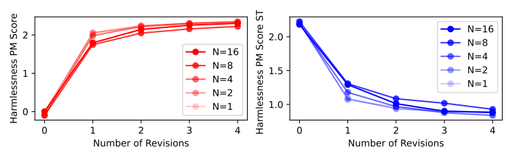
Figure 6 We show harmlessness PM scores of revised responses for varying number of constitutional prin- ciples used. Increasing the number of principles does not improve these PM scores, but we have found that it improves the diversity of revised responses, which improves exploration during the RL phase of CAI training.
出典 · CC BY 4.0 · 元のPDFの9ページ目から図の部分を抽出しています。データは、red teamingプロンプト182,831件です。そのうち42,496件は人が書いたプロンプトで、140,335件は事前学習済みモデルにfew-shotでプロンプトを与えて生成したものです。プロンプトごとに、helpful RLHFモデルから4つの批評と修正のペアをサンプリングしました。役立ち性のプロンプト135,296件については、プロンプトごとに2つの応答をサンプリングしました。この修正版と役立ち性の応答で事前学習済みモデルを1エポックファインチューニングした結果がSL-CAIです。
AI選好ラベルとRLAIF
強化学習の段階では、SL-CAIが各harmfulプロンプトに対して応答のペアを生成します。フィードバックモデルは、原則を含む選択式の質問を受け取り、AとBのうちより無害な応答を選びます。このとき、二つの選択肢の対数確率を正規化した値をソフトラベルとして使います。16個の原則のうち一つが、各比較ラベルごとにランダムに選ばれます。著者らは、原則をアンサンブルすると、特定の原則一つだけを使う場合より選好モデルの振る舞いが頑健になると解釈しています。
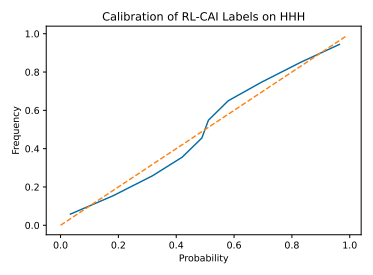
Figure 9 Calibration of 52B RL-CAI labels on our HHH evaluation questions. Dashed diagonal line repre- sents perfect calibration.
出典 · CC BY 4.0 · 元のPDFの12ページ目から図の部分を抽出しています。このAIの無害性ラベルは、人が作った役立ち性ラベルと混ぜられ、選好モデルの学習データになります。その後、SL-CAIを初期方策として、選好モデルを報酬にして強化学習を行います。この結果がRL-CAIモデルです。
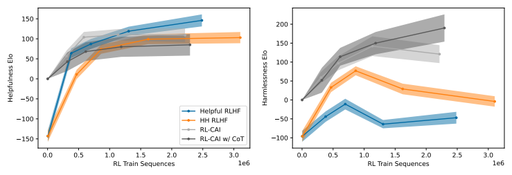
Figure 8 These figures show the helpfulness (left) and harmlessness (right) Elo scores as a function of the total number of RL training sequences, as judged by crowdworkers via comparison tests. We see that the RL- CAI models perform very well on harmlessness without a great cost to their helpfulness. The initial snapshot for the RL-CAI models is SL-CAI, where we set the Elos to be zero; while the initial snapshot for the RLHF models is a pre-trained LM. Note that the crowdworkers were instructed that among harmless samples, they should prefer those that were not evasive and instead explained the nature of the harm.
出典 · CC BY 4.0 · 元のPDFの12ページ目から図の部分を抽出しています。chain-of-thoughtの変種では、helpful RLHFモデルをフィードバックモデルとして使い、対話形式のプロンプトに「Let's think step-by-step」という指示を入れて推論を生成します。推論は通常、どの選択肢を選ぶかを明確に述べるため、確率が0か1に近い値に偏ります。著者らは、確率を40-60の範囲にクランプすると、より安定した振る舞いが見られ、クランプがないとモデルがより極端な応答を学習すると報告しています。ソフトラベルは、CoTなしのRL-CAIで、ハードラベルより良い結果を出しました。
HHH選択式評価で見るCoTの効果
本論文は、学習の前に言語モデルが、対話でより役に立ち、正直で、無害な応答を識別できるかを、438個の二値比較の質問で確認しています。これらの質問は、先行研究の221個と、本論文で新たに作成した217個から成ります。
比較の方法は二つあります。一つは、人間の選好で学習した選好モデルがより高い点数を付けた応答を選ぶ方法です。もう一つは、事前学習済み言語モデルやhelpful RLHF方策に、二つの選択肢を選択式で提示する方法です。選択式の方法ではchain-of-thoughtの推論を使い、5つのCoTサンプルが各選択肢に与えた確率を平均します。
結果として、chain-of-thoughtの推論は、選択式評価の正答率を有意に高めました。著者らは、傾向に基づいて、52Bより大きいモデルは人間のフィードバックで学習した選好モデルと競えるだろうと解釈しています。ただし、この解釈は本実験で確認された値ではなく、傾向に基づく推定です。
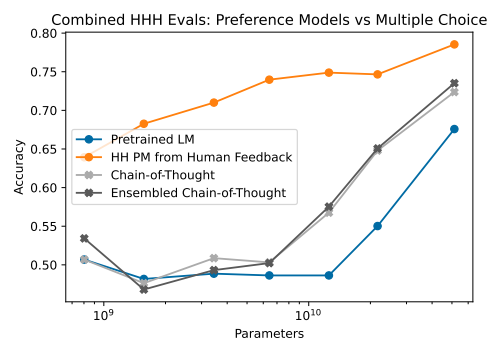
Figure 4 We show performance on 438 binary comparison questions intended to evaluate helpfulness, honesty, and harmlessness. We compare the performance of a preference model, trained on human feedback data, to pretrained language models, which evaluate the comparisons as multiple choice questions. We see that chain of thought reasoning significantly improves the performance at this task. The trends suggest that models larger than 52B will be competitive with human feedback-trained preference models.
出典 · CC BY 4.0 · 元のPDFの6ページ目から図の部分を抽出しています。Elo比較と段階別の結果
学習したモデルは、クラウドワーカーによるA/B比較で評価されます。24個のスナップショットについて、役立ち性の比較10,274件と無害性の比較8,135件が収集されました。このElo点数は、同じ比較実験の中でのみ相対的に解釈すべきです。
結果を見ると、RL-CAIはhelpful RLHFやSL-CAIより無害だと評価されます。SL-CAIはhelpful RLHFより無害ですが、二つのRLモデルより役立ち性は劣ります。RL-CAIは回避的な応答がほとんどなく、微妙でありながら無害な応答を頻繁に生成すると報告されています。また、AIフィードバックに基づくRLは、人間のフィードバックで無害性を評価した場合と同等か、それ以上の性能を示します。ただし、クラウドワーカーには回避的なだけの応答より、説明のある応答を選ぶよう指示を変えたため、HH RLHFの無害性点数が先行研究より低く出た可能性があると、著者らは解釈しています。
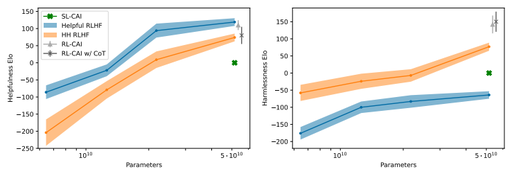
Figure 3 This figure shows helpfulness and harmlessness Elo scores for models of varying sizes, as deter- mined from comparison tests of crowdworker preferences in open-ended conversation. Helpful (H) RLHF and helpful & harmless (HH) RLHF are similar to prior work [Bai et al., 2022]. SL-CAI, RL-CAI, and RL- CAI w/ CoT models are trained with our new constitutional method.
出典 · CC BY 4.0 · 元のPDFの4ページ目から図の部分を抽出しています。修正回数の実験は別の測定体系です。ここでは、人間のフィードバックだけで学習した52B選好モデルの点数を使います。無害性とHH点数は、修正回数が増えるほど単調に向上しますが、純粋な役立ち性の点数は下がります。批評の後に修正する方法と、批評なしですぐに修正する方法を比べると、小さいモデルでは批評を経た修正がより高い無害性点数を得て、大きいモデルでは同程度の性能を示し、批評の方がわずかに優れています。
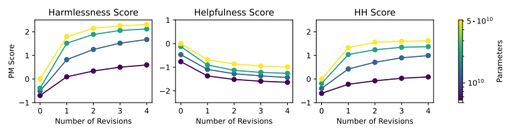
Figure 5 Preference Model scores of responses and revisions from helpful RLHF models, evaluated on a set of red team prompts. The scores are evaluated on a 52B preference model trained on (left) harmlessness comparisons, (center) helpfulness comparisons, and (right) a mixture of all the combined helpful and harmless comparisons. The preference models used for evaluation here were trained exclusively using human feedback. We find that harmlessness and HH scores improve monotonically with respect to number of revisions, where revision 0 refers to the initial response, but pure helpfulness scores decrease.
出典 · CC BY 4.0 · 元のPDFの9ページ目から図の部分を抽出しています。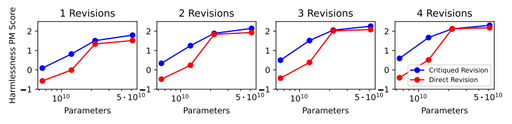
Figure 7 Comparison of preference model scores (all on the same 52B PM trained on harmlessness) for critiqued and direct revisions. We find that for smaller models, critiqued revisions generally achieve higher harmlessness scores (higher is more harmless), while for larger models they perform similarly, though cri- tiques are always slightly better.
出典 · CC BY 4.0 · 元のPDFの10ページ目から図の部分を抽出しています。限界と適用範囲
この方法は無害性ラベルで人間のフィードバックを減らしましたが、役立ち性ラベルには依然として人間のフィードバックを使います。そのため、完全な自己教師あり方式とは言えません。著者らは、役立ち性や指示への従順さも人間のフィードバックなしで可能だろうとみていますが、これは今後の課題として残しています。
RL-CAIモデルを過度に学習させると、Goodharting行動が現れることがあります。例えば、モデルが過剰に厳格になったり、ほとんどのred teamingプロンプトに定型の慰めの文句を付けたりすることがあります。
絶対的な有害度の点数は、0から4までの尺度で、64個のプロンプトについて、プロンプトごとに256個の応答から計算されました。ただし、作業者ごとに採点基準が異なるため、絶対点数はうまく較正されていない可能性があります。また、原則は研究目的のため比較的恣意的に、かつ繰り返し選ばれており、著者らは今後より多くの利害関係者が原則を練り直すべきだと考えています。
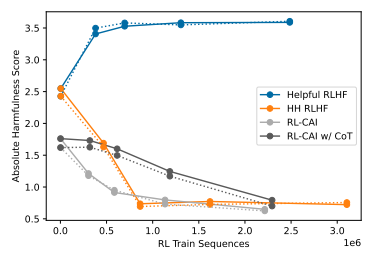
Figure 10 Absolute harmfulness score for various 52B RL snapshots, on a scale from 0 to 4, where higher is more harmful. Solid lines are sampled at T = 1 , and dashed lines at T = 0 . The RLHF models are initialized on pre-trained LMs, while the RL-CAI models are initialized on SL-CAI.
出典 · CC BY 4.0 · 元のPDFの14ページ目から図の部分を抽出しています。論文情報
- 著者
- Yuntao Bai, Saurav Kadavath, Sandipan Kundu, Amanda Askell, Jackson Kernion, Andy Jones, Anna Chen, Anna Goldie, Azalia Mirhoseini, Cameron McKinnon, Carol Chen, Catherine Olsson, Christopher Olah, Danny Hernandez, Dawn Drain, Deep Ganguli, Dustin Li, Eli Tran-Johnson, Ethan Perez, Jamie Kerr, Jared Mueller, Jeffrey Ladish, Joshua Landau, Kamal Ndousse, Kamile Lukosuite, Liane Lovitt, Michael Sellitto, Nelson Elhage, Nicholas Schiefer, Noemi Mercado, Nova DasSarma, Robert Lasenby, Robin Larson, Sam Ringer, Scott Johnston, Shauna Kravec, Sheer El Showk, Stanislav Fort, Tamera Lanham, Timothy Telleen-Lawton, Tom Conerly, Tom Henighan, Tristan Hume, Samuel R. Bowman, Zac Hatfield-Dodds, Ben Mann, Dario Amodei, Nicholas Joseph, Sam McCandlish, Tom Brown, Jared Kaplan
- 学会・ジャーナル
- arXiv · プレプリント
- 公開日
- 2022年12月15日
- 登録日
- 2026年10月20日
- 更新日
- 2022年12月15日
- バージョン
- v1
- arXiv
- 2212.08073
- カテゴリ
- cs.CL · cs.AI
- ライセンス
- CC BY 4.0
- 掲載内容
- 論文情報・解説・論文の図
この解説は、Refivuの韓国語解説をAIで翻訳したものです。不正確な翻訳や誤りが含まれる可能性があります。論文と図の利用条件は各出典に従います。
アブストラクト
As AI systems become more capable, we would like to enlist their help to supervise other AIs. We experiment with methods for training a harmless AI assistant through self-improvement, without any human labels identifying harmful outputs. The only human oversight is provided through a list of rules or principles, and so we refer to the method as 'Constitutional AI'. The process involves both a supervised learning and a reinforcement learning phase. In the supervised phase we sample from an initial model, then generate self-critiques and revisions, and then finetune the original model on revised responses. In the RL phase, we sample from the finetuned model, use a model to evaluate which of the two samples is better, and then train a preference model from this dataset of AI preferences. We then train with RL using the preference model as the reward signal, i.e. we use 'RL from AI Feedback' (RLAIF). As a result we are able to train a harmless but non-evasive AI assistant that engages with harmful queries by explaining its objections to them. Both the SL and RL methods can leverage chain-of-thought style reasoning to improve the human-judged performance and transparency of AI decision making. These methods make it possible to control AI behavior more precisely and with far fewer human labels.
この論文を引用
Yuntao Bai, Saurav Kadavath, Sandipan Kundu, Amanda Askell, Jackson Kernion, Andy Jones, Anna Chen, Anna Goldie, Azalia Mirhoseini, Cameron McKinnon, Carol Chen, Catherine Olsson, Christopher Olah, Danny Hernandez, Dawn Drain, Deep Ganguli, Dustin Li, Eli Tran-Johnson, Ethan Perez, Jamie Kerr et al. (2022). Constitutional AI: Harmlessness from AI Feedback. arXiv:2212.08073v1. https://arxiv.org/abs/2212.08073v1
BibTeX
@misc{bai2022constitutional,
  title = {{Constitutional AI: Harmlessness from AI Feedback}},
  author = {Yuntao Bai and Saurav Kadavath and Sandipan Kundu and Amanda Askell and Jackson Kernion and Andy Jones and Anna Chen and Anna Goldie and Azalia Mirhoseini and Cameron McKinnon and Carol Chen and Catherine Olsson and Christopher Olah and Danny Hernandez and Dawn Drain and Deep Ganguli and Dustin Li and Eli Tran-Johnson and Ethan Perez and Jamie Kerr and Jared Mueller and Jeffrey Ladish and Joshua Landau and Kamal Ndousse and Kamile Lukosuite and Liane Lovitt and Michael Sellitto and Nelson Elhage and Nicholas Schiefer and Noemi Mercado and Nova DasSarma and Robert Lasenby and Robin Larson and Sam Ringer and Scott Johnston and Shauna Kravec and Sheer El Showk and Stanislav Fort and Tamera Lanham and Timothy Telleen-Lawton and Tom Conerly and Tom Henighan and Tristan Hume and Samuel R. Bowman and Zac Hatfield-Dodds and Ben Mann and Dario Amodei and Nicholas Joseph and Sam McCandlish and Tom Brown and Jared Kaplan},
  year = {2022},
  eprint = {2212.08073},
  archivePrefix = {arXiv},
  url = {https://arxiv.org/abs/2212.08073v1}
}