論文解説
Where Should the Code Go? Locating Foundation-Model Errors in Bitemporal Inventory Simulation
コードはどこに置くべきか:二重時間軸在庫シミュレーションにおける基盤モデルの誤り箇所の特定
- 課題 報告書の到着時刻と修正があるため在庫状態の再構成は難しく、基盤モデルは選択・再生・ロールアウトの誤りを同時に起こします。
- 手法 正確なコードをモデルの前、後ろ、呼び出し内部に置く配置を比較し、各配置が取り除く誤りを測定しました。
- 結果 GPT-5.4 miniでは、canonical入力が将来結合精度を生の入力に比べて+29.7 [+20.8, +38.5]パーセントポイント高めました。呼び出し内部のコードツールは、生の入力に対してさらに+54.2 [+45.3, +62.5]パーセントポイントを加えました。
報告書の履歴から状態を再構成する問題
在庫管理エージェントは、注文と入庫の履歴を文脈から読み取り、現在の在庫状態を推定します。ただし運用報告書には、出来事の起きた時刻と報告書の届いた時刻が別々にあり、後から届いた報告書が以前の報告書を修正することもあります。そのため、ある知識時点Kまでに見える報告書だけから目標時点Tの在庫を復元するには、到着時刻による選択、修正版の整理、出来事時刻の順序での再生がすべて必要です。本論文は、この状態再構成の段階と、公表された将来の予定を進めるロールアウトの段階を分けて、どの段階でどの誤りが生じるかを測定しています。実験環境は正確に解ける損失販売の在庫モデルなので、中間結果の正解をコードで計算できます。
コードを配置する3つの位置
研究では、正確なコードをモデルの前、モデルの後ろ、モデル呼び出しの内部に置く配置を比較します。rawの入力は受信時刻順にすべての報告書の版を与え、K以降の報告書も含むため、モデルがそれらを自分で無視しなければなりません。canonicalの入力は、コードが見える報告書を選んで版を整理し、出来事時刻の順に与えます。snapshotの入力は、これに加えて正確に再生された過去の状態も与えるため、モデルに残るのはロールアウトだけです。モデルの後ろに置くhybrid方式では、モデルは過去の在庫と過去の損失という2つの整数だけに答え、コードが公表された予定を適用します。ホスト型のコードツールはOpenAIの構成でのみ使われ、モデルが実行するかどうかを選びます。
保存則により、同じ在庫からコードが将来を計算する場合、hybridの将来精度は再構成の精度と同じになります。
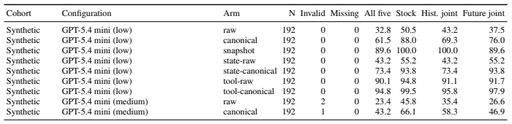
Table 6 : All cells of the original grid and the extension studies (%). State-only arms report the hybrid answer (model historical fields plus executable continuation); their future-joint accuracy equals their stock accuracy by conservation. Tool arms had a code-execution tool available. Invalid answers (missing, malformed or negative) fail every endpoint and remain in denominators.
出典 · CC BY 4.0 · Durga Sandeep Saluru, Lanchen Song, Aditya Kumaran · Where Should the Code Go? Locating Foundation-Model Errors in Bitemporal Inventory Simulation · 論文の図を引用 · 元のPDFの8ページ目から図の部分を抽出しています。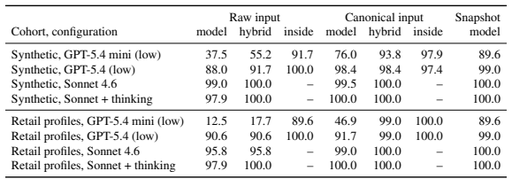
Table 16 : Future-joint accuracy (%, all three scenario outputs exact) by input and code placement; 192 synthetic and 96 profile calls per cell; invalid answers fail.model: all five fields from the model; hybrid: model returns the two historical fields, code applies the schedule (equals reconstruction accuracy by conservation);inside: code-execution tool available during the call (OpenAI only); snapshot: exact state supplied, model rolls out; dashes mark arms not run. All-five accuracy: Appendix B.
出典 · CC BY 4.0 · Durga Sandeep Saluru, Lanchen Song, Aditya Kumaran · Where Should the Code Go? Locating Foundation-Model Errors in Bitemporal Inventory Simulation · 論文の図を引用 · 元のPDFの22ページ目から図の部分を抽出しています。入力方式とコード配置の効果
合成コホートでは、canonicalの入力がGPT-5.4 miniの将来結合精度を、rawの入力に比べて+29.7 [+20.8, +38.5]パーセントポイント高めました。GLM-5.3 Flashでは、canonical入力の効果は+8.3 [+0.0, +16.7]にとどまり、正確な状態を加えても追加の効果はありませんでした。一方、同じcanonicalの回答の上にコードを後ろに置くと+22.9 [+15.1, +30.7]改善しました。このモデルの誤りは主にロールアウトにありました。著者らは、この差をモデルごとに再構成の誤りとロールアウトの誤りの比重が異なることの根拠と解釈しています。
rawの入力では、hybridが弱いモデルで78%を超えませんでしたが、これは誤って選ばれた報告書から作られた状態を、後ろのコードでは直せないためです。
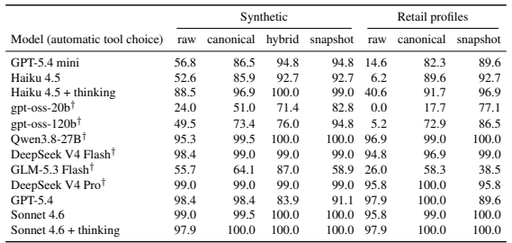
Table 1 : Future-joint accuracy (%, all three scenario outputs exact) by input and code placement, every configuration under automatic tool choice at its lowest requested effort (OpenAI and open-weight models: requested effort low; Anthropic models: no or 4,096-token thinking); 192 synthetic and 96 profile calls per cell; invalid and missing answers fail.raw: model selects, replays and rolls out; canonical: code selects and orders eligible events;hybrid: model returns the two historical fields from canonical input and code applies the schedule (equals reconstruction accuracy by conservation); snapshot: exact state supplied, model rolls out. †Open-weight models through OpenRouter, each pinned to one upstream provider (Appendix F). Forced-call cells and all-five accuracy: Appendix B.
出典 · CC BY 4.0 · Durga Sandeep Saluru, Lanchen Song, Aditya Kumaran · Where Should the Code Go? Locating Foundation-Model Errors in Bitemporal Inventory Simulation · 論文の図を引用 · 元のPDFの3ページ目から図の部分を抽出しています。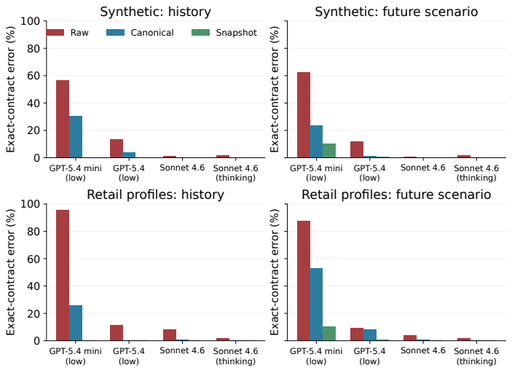
Figure 2 : Historical and future-stage errors under the three representations in the original grid. Snapshot historical answers are supplied by code; their accuracy measures faithful copying. Future- stage errors remain the substantive endpoint for that representation.
出典 · CC BY 4.0 · Durga Sandeep Saluru, Lanchen Song, Aditya Kumaran · Where Should the Code Go? Locating Foundation-Model Errors in Bitemporal Inventory Simulation · 論文の図を引用 · 元のPDFの15ページ目から図の部分を抽出しています。呼び出し内部のコードツールと推論強度
ホスト型のコードツールを使えるGPT-5.4 miniは、合成履歴の生の入力で将来結合精度が+54.2 [+45.3, +62.5]パーセントポイント上がりました。このとき、モデルは576回の呼び出しのうち469回でコードを実行し、実行した呼び出しのうち453回が正確でした。同じ自動選択のベースラインと比べたツール自体の寄与は、生の入力で+34.9 [+26.0, +43.8]でした。推論強度を高める効果は、ツール呼び出しインターフェースによって異なりました。同じモデルを自動選択で実行するとこの低下は見られなかったため、この結果はインターフェースとモデルとプロバイダーの組み合わせとして解釈すべきです。
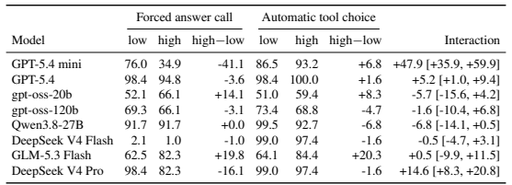
Table 2 : Requested reasoning effort × tool-choice interface, synthetic cohort, canonical input, future- joint accuracy (%; 192 calls per cell). high−low: paired effort effect within an interface. Interaction: automatic-choice effort effect minus forced-call effort effect, paired by history, with a descriptive 95% history-bootstrap interval (10,000 draws); a positive interaction means the forced call turns extra effort into a liability. Requested effort is a family-specific provider setting, not a compute match (observed reasoning tokens: Appendix F).
出典 · CC BY 4.0 · Durga Sandeep Saluru, Lanchen Song, Aditya Kumaran · Where Should the Code Go? Locating Foundation-Model Errors in Bitemporal Inventory Simulation · 論文の図を引用 · 元のPDFの4ページ目から図の部分を抽出しています。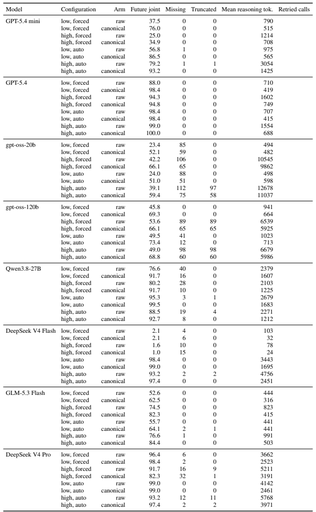
Table 12 : Effort × interface cells on the synthetic cohort (192 calls each): future-joint accuracy (%), calls with no answer (including refusals), calls truncated at the 16,384-token output limit, and mean provider-reported reasoning tokens. Each upstream maps the unified effort parameter onto its own control, so effort levels are comparable within a model family only.
出典 · CC BY 4.0 · Durga Sandeep Saluru, Lanchen Song, Aditya Kumaran · Where Should the Code Go? Locating Foundation-Model Errors in Bitemporal Inventory Simulation · 論文の図を引用 · 元のPDFの19ページ目から図の部分を抽出しています。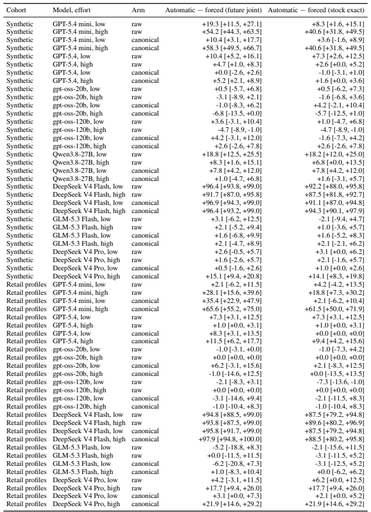
Table 14 : Interface effect: automatic tool choice minus forced answer call at fixed model, effort, input and history; paired differences in percentage points with descriptive 95% history-bootstrap intervals.
出典 · CC BY 4.0 · Durga Sandeep Saluru, Lanchen Song, Aditya Kumaran · Where Should the Code Go? Locating Foundation-Model Errors in Bitemporal Inventory Simulation · 論文の図を引用 · 元のPDFの21ページ目から図の部分を抽出しています。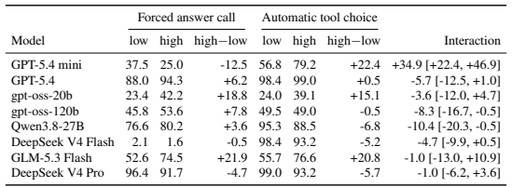
Table 15 : Requested reasoning effort × tool-choice interface, synthetic cohort, raw input, future-joint accuracy (%; 192 calls per cell). high −low: paired effort effect within an interface. Interaction: automatic-choice effort effect minus forced-call effort effect, paired by history, with a descriptive 95% history-bootstrap interval (10,000 draws); a positive interaction means the forced call turns extra effort into a liability. Requested effort is a family-specific provider setting, not a compute match (observed reasoning tokens: Appendix F).
出典 · CC BY 4.0 · Durga Sandeep Saluru, Lanchen Song, Aditya Kumaran · Where Should the Code Go? Locating Foundation-Model Errors in Bitemporal Inventory Simulation · 論文の図を引用 · 元のPDFの22ページ目から図の部分を抽出しています。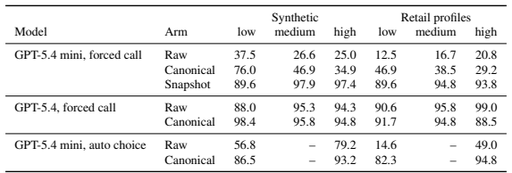
Table 17 : Future-joint accuracy (%) by requested reasoning effort, identical prompts and tasks; 192 synthetic and 96 profile calls per cell; the forced-call low columns are the original cohorts. Forced call: the answer function is the only permitted action; auto choice: the model may respond freely and a missing answer fails. Dashes: not run.
出典 · CC BY 4.0 · Durga Sandeep Saluru, Lanchen Song, Aditya Kumaran · Where Should the Code Go? Locating Foundation-Model Errors in Bitemporal Inventory Simulation · 論文の図を引用 · 元のPDFの22ページ目から図の部分を抽出しています。適用範囲と解釈の限界
9ポイントより小さい差は、未解決の差として扱いました。オープンウェイトのモデルは、それぞれ1つの上流プロバイダーで実行されたため、ツール呼び出しと推論強度の効果は、モデル自体ではなく、モデルとプロバイダーの組み合わせに関する結論です。gpt-oss-20bは、出力予算を使い切るか回答を拒否する場合が多かったため、そのセルでは精度と完了率を合わせて測定しています。また、TSFMは評価していません。予測段階を取り除いたことで、状態の誤りを正確に測定できました。
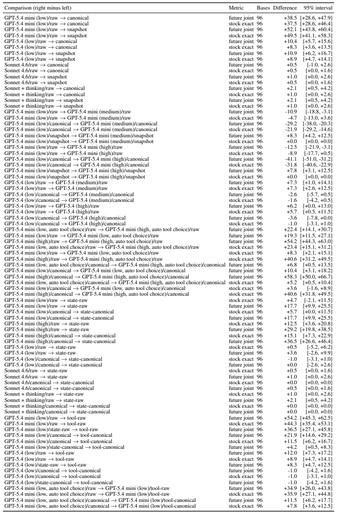
Table 10 : Paired differences in percentage points, synthetic cohort: matched by history and repetition index, averaged within history; descriptive 95% history-bootstrap percentile intervals (10,000 draws), not multiplicity adjusted. The same-period replication moved one identical cell by −8.9 points, so differences of that size are within run-to-run variation. Cells at or near 100% give degenerate intervals. Identical rows arise when two comparisons have identical per-history differences.
出典 · CC BY 4.0 · Durga Sandeep Saluru, Lanchen Song, Aditya Kumaran · Where Should the Code Go? Locating Foundation-Model Errors in Bitemporal Inventory Simulation · 論文の図を引用 · 元のPDFの16ページ目から図の部分を抽出しています。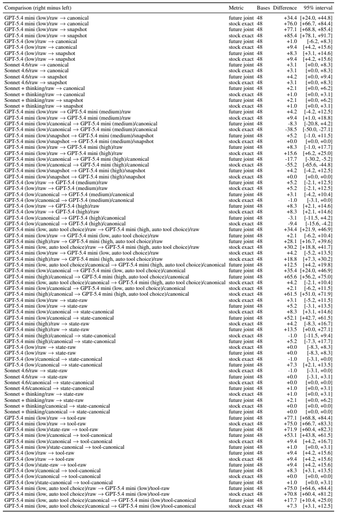
Table 11 : Paired differences in percentage points, retail profiles cohort: matched by history and repetition index, averaged within history; descriptive 95% history-bootstrap percentile intervals (10,000 draws), not multiplicity adjusted. The same-period replication moved one identical cell by −8.9 points, so differences of that size are within run-to-run variation. Cells at or near 100% give degenerate intervals. Identical rows arise when two comparisons have identical per-history differences.
出典 · CC BY 4.0 · Durga Sandeep Saluru, Lanchen Song, Aditya Kumaran · Where Should the Code Go? Locating Foundation-Model Errors in Bitemporal Inventory Simulation · 論文の図を引用 · 元のPDFの17ページ目から図の部分を抽出しています。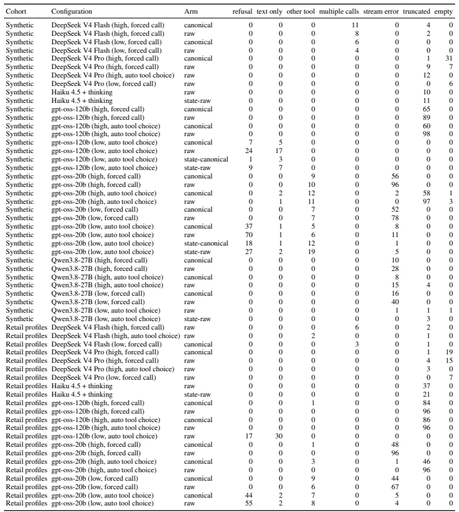
Table 13 : Missing answers by kind for every cell with at least three (all counted as failures in every accuracy):refusal, a text reply declining the task;text only, an answer written in the message instead of the tool call;other toolandmultiple calls, calls to a non-existent tool or more than one call;stream error, a provider-side error after the request was accepted;truncated, the 16,384-token output limit reached (for Anthropic thinking runs, entirely in thinking);empty, no content.
出典 · CC BY 4.0 · Durga Sandeep Saluru, Lanchen Song, Aditya Kumaran · Where Should the Code Go? Locating Foundation-Model Errors in Bitemporal Inventory Simulation · 論文の図を引用 · 元のPDFの20ページ目から図の部分を抽出しています。論文情報
- 著者
- Durga Sandeep Saluru, Lanchen Song, Aditya Kumaran
- 学会・ジャーナル
- arXiv · プレプリント
- 公開日
- 2026年11月10日
- 登録日
- 2026年11月13日
- 更新日
- 2026年11月10日
- バージョン
- v1
- arXiv
- 2611.14671
- カテゴリ
- cs.SE · cs.AI · cs.LG
- ライセンス
- CC BY 4.0
- 掲載内容
- 論文情報・解説・論文の図
この解説は、Refivuの韓国語解説をAIで翻訳したものです。不正確な翻訳や誤りが含まれる可能性があります。論文と図の利用条件は各出典に従います。
アブストラクト
Operational reports carry two clocks: when an event happened and when its report arrived; later reports can revise earlier ones. A foundation-model component that maintains the state supported by the reports visible at a cutoff, then rolls a supplied scenario forward, can be helped by exact code before it, after it or inside the call, or asked to reason harder. We ask which remedy removes which error, for which models, on an exactly solvable lost-sales inventory environment: 36,672 independently rescored requests over twelve configurations of closed and open-weight models, with a forced-answer-call interface as a control and protocols frozen before the calls. Weak models fail in separable ways. Canonical input removes report-selection error, exact continuation removes rollout error, neither repairs the other, and which error dominates differs by model; strong models are at ceiling on raw reports. Asking for more reasoning is no substitute and can depend on the interface: under a forced answer call high effort collapses GPT-5.4 mini and DeepSeek V4 Pro, which gain or hold under automatic choice; on its provider the forced call disables reasoning for DeepSeek V4 Flash; and at high effort gpt-oss exhausts its output budget. The contribution is a controlled component diagnostic, released with every request, and evidence that for some model and provider pairs the tool-calling interface confounds reasoning evaluation.
この論文を引用
Durga Sandeep Saluru, Lanchen Song, Aditya Kumaran (2026). Where Should the Code Go? Locating Foundation-Model Errors in Bitemporal Inventory Simulation. arXiv:2611.14671v1. https://arxiv.org/abs/2611.14671v1
BibTeX
@misc{saluru2026where,
  title = {{Where Should the Code Go? Locating Foundation-Model Errors in Bitemporal Inventory Simulation}},
  author = {Durga Sandeep Saluru and Lanchen Song and Aditya Kumaran},
  year = {2026},
  eprint = {2611.14671},
  archivePrefix = {arXiv},
  url = {https://arxiv.org/abs/2611.14671v1}
}