論文解説
Physics-Informed Identification of Tensegrity Prestress across Taut-Slack Transitions
張りと弛みが切り替わる記録から、テンセグリティのプレストレスを逆算する
- 課題 これまでの同定法は、ケーブルが張ったままの範囲に限られ、弛みを含む記録は扱えませんでした。物理情報付きのネットワークも、既知の部材から応答を予測するだけでした。
- 手法 本研究は、運動方程式の誤差を減らすようにニューラルネットを学習させ、力密度、減衰、軸剛性を同時に推定します。ケーブルは引張力だけを伝える条件を、滑らかな関数で残します。
- 結果 1モジュールの構造で、張りの記録だけでなく切り替えを含む記録からも、同定可能な力密度を1.5%以内の誤差で回収しました。
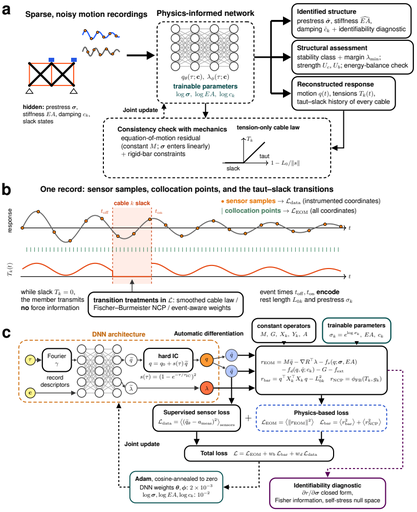
Figure 2 : Physics-informed identification framework:(a)pipeline from sparse, noisy accelerometer records to identified member parameters and the structural assessment;(b)a single record, with sparse sensor samples feeding the data loss and dense collocation points enforcing the physics residual through the taut–slack transitions;(c)the computational graph, with the member parameters entering the residual as trainable inputs.
出典 · CC BY 4.0 · Sandesh Lamsal, Sumit Kumar, Rubi Bhandari, Subhamoy Sen, Andrzej Rutkiewicz, Leszek Małyszko, Landolf Rhode-Barbarigos · Physics-Informed Identification of Tensegrity Prestress across Taut-Slack Transitions · 論文の図を引用 · 元のPDFの7ページ目から図の部分を抽出しています。張り・弛みを含む記録で従来法が止まる理由
テンセグリティでは、自己応力であるプレストレスが剛性、固有振動数、荷重の伝達経路を決めます。プレストレスは幾何からは決まらず、埋め込みセンサなしには測定できません。しかも使用中にクリープ、定着部のすべり、熱サイクルで低下するおそれがあり、その損失は重大な損傷モードとされています。ケーブルは引張力しか伝えないため、強い加振で弛むと動力学が非滑らかになります。さらに計測点は疎なので、部材ごとの力をすべて測ることは現実的ではありません。
既存の同定研究は、モーダル解析で抽出した固有振動数を使い、線形化した張りの領域に限られていました。これらの研究は、モードが幾何剛性ではなく弾性で硬くなっている構造では感度を失うと指摘されています。一方、physics-informed neural networkは、支配方程式を学習の損失の残差として入れることで線形化を避けられます。しかし、テンセグリティへの物理情報付き学習は、張りの構造の順解析に限られていました。
そこで本研究が問うのは、張力のみの条件を保ったまま、どの部材パラメータが記録から決まるかです。さらに、張り・弛みの切り替えが張りの記録にない情報を与えるかどうかも、これまで分かっていませんでした。つまり、既存法では張り・弛みを含む記録を扱うことも、その記録がどの程度情報を持つかを示すこともできなかったといえます。
残差に部材パラメータを入れる仕組み:拘束付きデカルト座標の運動方程式
運動方程式を拘束付きデカルト座標で書くことで、部材パラメータを学習可能変数として残差に直接入れられるようになります。この座標系では質量行列Mが定数になり、学習が安定します。また力密度は残差に線形に入るため、残差の感度を閉じた形で求められます。つまり、この線形性が後段の同定可能性の解析の土台になります。
ネットワークは、変位を出す部分と拘束乗数を出す部分が幹を共有し、スケールされた時間τ=t/T refを入力として受け取ります。変位の出力は自由座標だけで、固定座標は窓関数で構造的に満たします。窓関数s(τ)=(1−e^(−τ/τIC))^2は、q(0)=q0と速度ゼロを厳密に満たすため、初期条件の損失項は要りません。乗数ヘッドは静的平衡の乗数で初期化されますが、その値は合成ベンチマークでのみ真のプレストレス状態から計算されるもので、学習パラメータではありません。実際の適用では、公称値または設計上のプレストレスから同じ初期化を行い、誤差は初期点の違いにとどまります。
残差は、運動方程式(6)を網の出力に代入して作られ、外力fextは既知の入力として扱われます。力密度σ、軸剛性EA、減衰係数ckは学習対象で、正値を保つため対数で表されます。損失は、加速度センサの項、配置点での運動方程式残差、棒長拘束の項を足したもので、各項は代表スケールで割ってから合計されます。ただし、データ項の正規化量は強制記録では0から離れているため、分母の正則化は要りません。
物理パラメータを対数で表すため、更新は相対的なステップになり、桁の違う力密度や減衰係数を一つの学習率で扱えます。重みwbは100の周りで三桁動かしても回収誤差が約2ポイントの範囲に収まり、wbが実質的に効かない場合にのみ大きく悪化しました。つまり、物理項とデータ項の重みの選び方は結果を大きく左右しないことが確認されました。
張り・弛みの切り替えの扱い方:平滑化ケーブル則の選択
張力のみの条件を損失に組み込む方式として、本研究はソフトプラス(softplus)で平滑化したケーブル則を採用しました。比較の相手は、Fischer–Burmeister複相補性残差(Fischer–Burmeister NCP)と、遷移の近くに collocation 点を集めた方式です。Fischer–Burmeister複相補性残差は、張力のみの条件が成り立つときにのみゼロとなる関数で、張力用の追加ヘッドを必要としました。三つの方式は同じ記録に対して同じ手順で比べられ、4つの乱数シードで学習ステップ数を二段階に変えて評価されました。
12,000ステップでは、平滑化ケーブル則の力密度誤差の中央値が18.8%、event-aware collocationが17.9%で、どちらも収束していませんでした。25,000ステップに延ばすと、平滑化ケーブル則は0.77%、event-aware collocationは0.82%まで下がり、差はほぼ消えました。つまり、この条件では学習を十分長く行うことが、処理方式の選択より大きく効きました。
著者らは、Fischer–Burmeister NCPの追加張力ヘッドが決めるべき未知数を増やしたため、収束が遅れたと考えています。ただし、著者らは、どの方式も個別に調整しておらず、比較は測定値のまま報告すると述べています。以上から、追加の未知数なしで同等の精度が得られる最も単純な平滑化ケーブル則が、本研究の方式として選ばれました。
どの部材が記録から決まらないか
同定可能性の分析では、逆解析の前に記録が部材パラメータをどこまで決められるかを調べます。Fisher informationとCramér–Rao boundを使い、力密度が残差に線形に入る性質から、記録が決められない部材を示します。決まらない部材が残る場合は、部材を群にまとめると、適切に定まった推定が得られることがあります。
X1フレームの基部ケーブルは、どちらの記録でも決まりませんでした。10 N/mから始めると、張り記録では21.5 N/mへ漂い、切り替え記録ではゼロに向かい、収束しませんでした。著者らは、これは方法の誤りではなく、記録がその値を決めていないことを表すと説明しています。この構造は、モーダル法にとって不利な例でもあります。X-frameの固有振動数は、プレストレスレベルが50倍に変わっても約12%しか動かず、振動数に基づく更新からは得られる情報がわずかです。
プリズムのプレストレス系列では、プレストレスを15 N/mから1 N/mへ下げると、最悪部材のCramér–Rao boundは0.047%から0.804%へ、17倍になりました。それでも下界は0.80%にとどまり、25,000ステップでの平均誤差31.8%は下界の約40倍でした。つまり1 N/mの結果は情報の不足ではなく、最適化の限界と読めます。
1モジュールと2モジュールでの同定結果
X1フレームでは、σmin=25 N/mのプレストレス水準で同定しました。加振は上部ノードの1点の鉛直座標に作用させ、センサは同じ節点の2座標で、2%のノイズを含む加速度を記録しました。この2座標は自由座標の半分にあたり、そこから得た記録を使いました。逆解析は平滑化したケーブル則のもとで、張り記録(p=10 N、切り替えなし)と切り替え記録(p=40N、20回の張りと緩みの切り替え)の2つに対して実施しました。
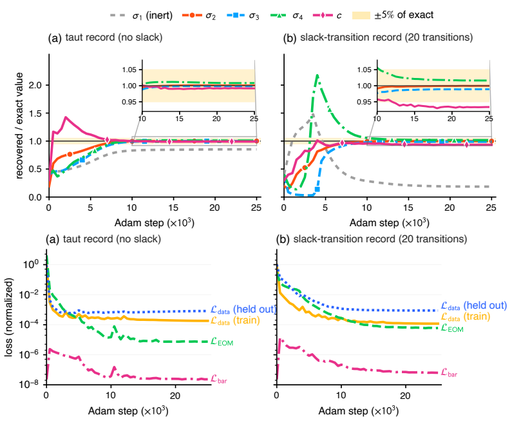
Figure 4 : The X1 inversions on (a) the taut record and (b) the slack-transition record with 20 taut–slack transitions: parameter convergence normalized by the exact values (top, ±5 % band shaded) and the training histories (bottom). The inert base cable does not converge to its value, as expected for a member that cannot be identified.
出典 · CC BY 4.0 · Sandesh Lamsal, Sumit Kumar, Rubi Bhandari, Subhamoy Sen, Andrzej Rutkiewicz, Leszek Małyszko, Landolf Rhode-Barbarigos · Physics-Informed Identification of Tensegrity Prestress across Taut-Slack Transitions · 論文の図を引用 · 元のPDFの13ページ目から図の部分を抽出しています。未測定の2座標の再構成誤差は運動スケールの1.3%で、同定したパラメータで再シミュレーションすると未測定の加速度を相対RMSE 1.7%で再現しました。一方で、基部ケーブルは収束せず、張り記録では21.5 N/mまで漂いました。
減衰係数の誤差は6.2%と張り記録より大きくなり、再構成誤差は運動スケールの0.8%、未測定加速度の再シミュレーションは2.1%でした。基部ケーブルは切り替え記録ではゼロに向かい、こちらでも収束しませんでした。論文は、切り替えを含む記録が張り記録では決まらない部材を決められると述べており、本研究の主要な結論の一つです。
ホールドアウト比は4.6で、適合は良好でしたが、力密度の誤りは検出されませんでした。著者らは、この失敗を情報の不足ではなく、同じモードを励起する冗長な記録に由来すると解釈しています。
実測記録での検証:ばね剛性と単純体のプレストレス
実測記録では、同定した値が独立に測った値とどこまで一致したかを、2つの実験で確かめました。生体模倣脚では、同定したばね剛性が独立に測定した値に対し、平均0.1%の誤差に収まりました。最悪の場合の誤差は8%でした。この脚はプレストレスを持たず、ばねも弛まないため、切り替えの処理は検証されていません。つまり、この実験は小振動の定式化と時間領域の逆解析を、測定の基準値と比べて確かめたものです。
単純体では、各ケーブルに力変換器が組み込まれており、13段階のプレストレスそれぞれで衝撃記録を取りました。著者らは、各段階でのストライクが同じ節点と方位で行われたため、プレストレスの水準だけが記録間で変わる設定になっていると述べています。逆解析に先立ち、再構築したモデルを元の論文の結果と照合しました。基部ケーブル力の計算値の比は0.2079で、単一の自己応力モードから得た0.2091とは0.6%の差でした。同定したプレストレスは、力変換器の値に対し二乗平均平方根誤差2.9%で一致しました。ただし、単純体では各記録から一つの振動数だけを読み、時間領域の残差は使っていません。そのため、この検証は小振動の同定と静的な力の整合性を確かめたものと読むのが妥当です。
限界:検証済みの範囲と未解決の課題
張り・弛みの切り替えを含む評価は、シミュレーション記録だけで行われています。実測記録にはスラック状態のケーブルがなく、著者らは切り替えの扱いが実測では確かめられていないと明記しています。実測による検証は、再構築したモデルと一つの固定されたハードウェア定数による静的な整合性の確認にとどまります。単純体の検証では各記録から振動数を一つだけ読み、時間領域の残差は使っていません。
ケーブルは質量を持たない要素として扱われ、横方向の運動と曲げは含まれていません。ベンチマークでは、ケーブルの軸方向の基本振動数が47Hz付近にあり、横方向の基本振動数は10から36Hzの間にあります。機構モードは1.4Hz付近にあるため、これらのモードとは1から2桁の差があります。横方向の波速は張力とともに消えるため、張力を持たない弦のモデルはスラック域で退化します。減衰は粘性としてケーブルに割り当てられており、実測では関節摩擦が減衰の主因とされているため、減衰の推定値は慎重に扱う必要があります。
構造は2から8の機械的自由度、16本までのケーブルの範囲で試しています。見かけの適合、ホールドアウト比、局所的なFisher information解析では、silent failureを検出できません。誤差の大半はシード間のばらつきではなくバイアスで、シード平均は真値から2から4%ずれていました。そのため、繰り返しの当てはめの散らばりから信頼区間を作っても、このバイアスは捉えられず、推定が最も不正確なところで区間が狭くなるおそれがあります。X3フレームでは、単一点加振の張り記録は適合失敗となり、2点加振でも低振幅の張り記録は失敗が残りました。真の値を使わずにこの種の失敗を検出する方法は、未解決のままです。
論文情報
- 著者
- Sandesh Lamsal, Sumit Kumar, Rubi Bhandari, Subhamoy Sen, Andrzej Rutkiewicz, Leszek Małyszko, Landolf Rhode-Barbarigos
- 学会・ジャーナル
- arXiv · プレプリント
- 公開日
- 2026年11月2日
- 登録日
- 2026年11月5日
- 更新日
- 2026年11月2日
- バージョン
- v1
- arXiv
- 2611.04007
- カテゴリ
- cs.LG · cs.CE · eess.SP · physics.flu-dyn
- ライセンス
- CC BY 4.0
- 掲載内容
- 論文情報・解説・論文の図
この解説は、Refivuの韓国語解説をAIで翻訳したものです。不正確な翻訳や誤りが含まれる可能性があります。論文と図の利用条件は各出典に従います。
アブストラクト
Prestress governs the stability, stiffness, and dynamic behavior of tensegrity structures, but it is not directly observable from sparse structural measurements, and it may decrease during service life. Under strong excitation, the cables may slacken and the dynamics become nonsmooth. Existing identification methods are limited to the taut regime, and physics-informed networks for tensegrities solve only the forward problem of predicting the response from known member parameters. This study formulates the inverse problem. Neural networks are trained on the equation-of-motion residual in constrained Cartesian coordinates, where the mass matrix is constant and the force densities enter linearly. The force densities, damping, and axial stiffness are trainable parameters, and the tension-only cable law is kept. A Fisher-information analysis shows, before inversion, which member parameters a record can determine. The method is tested on simulated planar tensegrity frames with up to five modules and a three-dimensional prism, and on measured records of a biomimetic leg and a full-scale tensegrity simplex. On the one-module frame, the identifiable force densities are recovered within 1.5% from noisy accelerations at half the free coordinates, on records with and without taut-slack transitions. Records with transitions determine members that taut records leave undetermined. On the five-module frame, a 16-cable two-span bridge, the median force-density error rises moderately, to 4.2%. On measured records, an identified spring stiffness is within 0.1% of its independently measured value on average, and the identified simplex prestress at 13 levels agrees with its cable force transducers to 2.9% root-mean-square.
論文の図
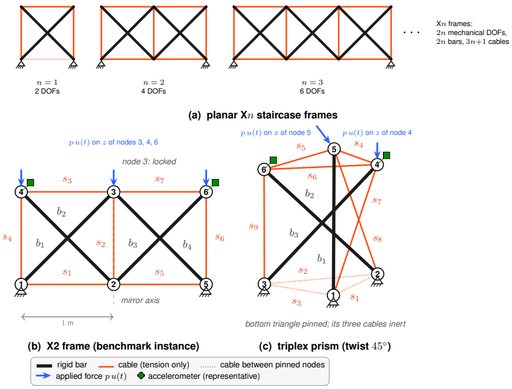
Figure 1 : The benchmark structures, drawn from the simulator geometry:(a)the planar X n staircase frames,(b)the X2 instance,(c)the triplex prism. Blue arrows mark the loaded coordinates and green squares a representative accelerometer placement; properties are given in Table 1.
出典 · CC BY 4.0 · Sandesh Lamsal, Sumit Kumar, Rubi Bhandari, Subhamoy Sen, Andrzej Rutkiewicz, Leszek Małyszko, Landolf Rhode-Barbarigos · Physics-Informed Identification of Tensegrity Prestress across Taut-Slack Transitions · 論文の図を引用 · 元のPDFの5ページ目から図の部分を抽出しています。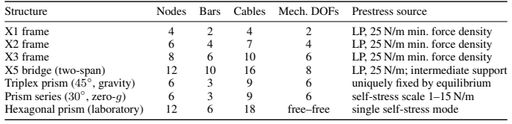
Table 1 : Benchmark structures used for identification. The classic tensegrity forms assessed but not identified are listed in Section S3 of the Supplementary Material.
出典 · CC BY 4.0 · Sandesh Lamsal, Sumit Kumar, Rubi Bhandari, Subhamoy Sen, Andrzej Rutkiewicz, Leszek Małyszko, Landolf Rhode-Barbarigos · Physics-Informed Identification of Tensegrity Prestress across Taut-Slack Transitions · 論文の図を引用 · 元のPDFの9ページ目から図の部分を抽出しています。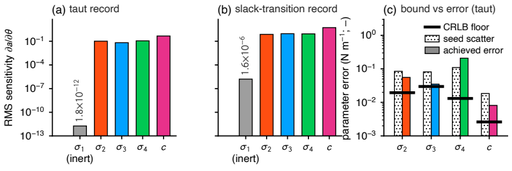
Figure 3 : Model-based identifiability analysis of the X1 frame.(a, b)Root-mean-square sensitivity of the sensor accelerations to each parameter on the taut and slack-transition records.(c)Cramér–Rao lower bounds at 2 % noise (floor lines) against the multi-seed scatter and the single-run achieved error on the taut record.
出典 · CC BY 4.0 · Sandesh Lamsal, Sumit Kumar, Rubi Bhandari, Subhamoy Sen, Andrzej Rutkiewicz, Leszek Małyszko, Landolf Rhode-Barbarigos · Physics-Informed Identification of Tensegrity Prestress across Taut-Slack Transitions · 論文の図を引用 · 元のPDFの12ページ目から図の部分を抽出しています。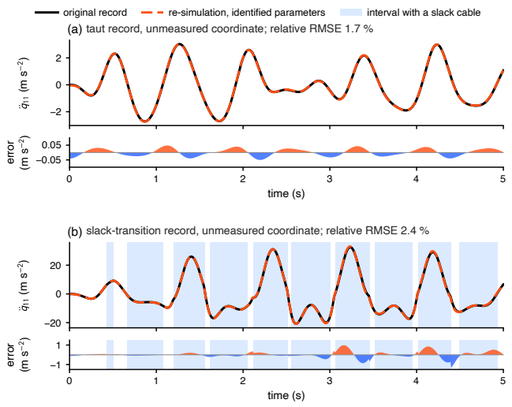
Figure 5 : Posterior-predictive validation for (a) the taut record and (b) the slack-transition record: the structure re- simulated with the recovered parameters under the same forcing, compared with the original record at a coordinate that was never measured. Shading marks the intervals with a slack cable; the strip below each trace is the signed error.
出典 · CC BY 4.0 · Sandesh Lamsal, Sumit Kumar, Rubi Bhandari, Subhamoy Sen, Andrzej Rutkiewicz, Leszek Małyszko, Landolf Rhode-Barbarigos · Physics-Informed Identification of Tensegrity Prestress across Taut-Slack Transitions · 論文の図を引用 · 元のPDFの14ページ目から図の部分を抽出しています。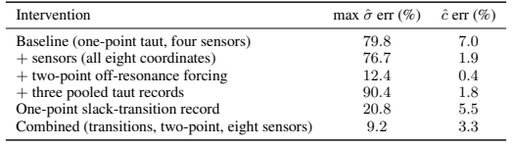
Table 4 : Removal of the silent failure on the X2 taut record. One factor is changed at a time from the baseline record, at a fixed 12,000-step run; the first error column is the maximum over the identifiable force densities and the second is the damping-coefficient error.
出典 · CC BY 4.0 · Sandesh Lamsal, Sumit Kumar, Rubi Bhandari, Subhamoy Sen, Andrzej Rutkiewicz, Leszek Małyszko, Landolf Rhode-Barbarigos · Physics-Informed Identification of Tensegrity Prestress across Taut-Slack Transitions · 論文の図を引用 · 元のPDFの17ページ目から図の部分を抽出しています。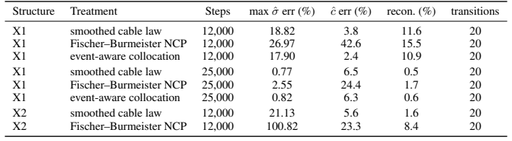
Table 5 : Comparison of the transition treatments on identical slack-transition records, at both training lengths. Every entry is the median over four seeds of the same protocol.
出典 · CC BY 4.0 · Sandesh Lamsal, Sumit Kumar, Rubi Bhandari, Subhamoy Sen, Andrzej Rutkiewicz, Leszek Małyszko, Landolf Rhode-Barbarigos · Physics-Informed Identification of Tensegrity Prestress across Taut-Slack Transitions · 論文の図を引用 · 元のPDFの17ページ目から図の部分を抽出しています。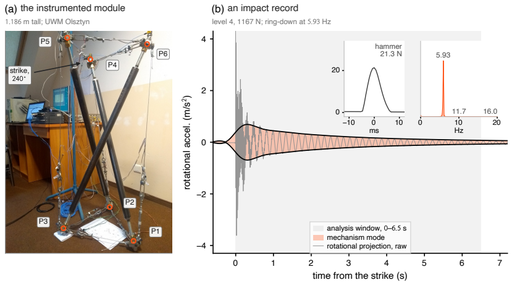
Figure 10 : The tensegrity simplex of Małyszko and Rutkiewicz [15].(a)The instrumented module, photographed by L. Małyszko and A. Rutkiewicz, with the nodes marked: the struts P1–P4, P2–P5 and P3–P6 on their threaded-rod ends, the horizontal cables of the two triangles, the cross cables with their turnbuckles, a force transducer in each of the nine cables, triaxial accelerometers at the three free nodes, and the hammer strike at node 4, azimuth 240◦.(b)A single impact record, at level 4: the rotational projection, the envelope of the mechanism mode, and the time window used to measure the frequency.
出典 · CC BY 4.0 · Sandesh Lamsal, Sumit Kumar, Rubi Bhandari, Subhamoy Sen, Andrzej Rutkiewicz, Leszek Małyszko, Landolf Rhode-Barbarigos · Physics-Informed Identification of Tensegrity Prestress across Taut-Slack Transitions · 論文の図を引用 · 元のPDFの24ページ目から図の部分を抽出しています。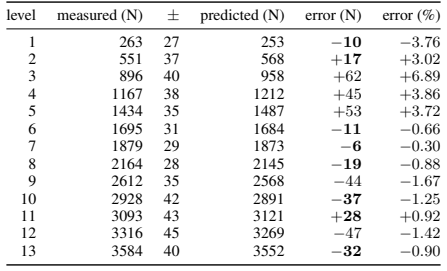
Table 8 : Prestress identified from the vibration record at each of the 13 levels, against the force the cable transducers measured there. Bold marks the levels predicted inside their own transducer uncertainty.
出典 · CC BY 4.0 · Sandesh Lamsal, Sumit Kumar, Rubi Bhandari, Subhamoy Sen, Andrzej Rutkiewicz, Leszek Małyszko, Landolf Rhode-Barbarigos · Physics-Informed Identification of Tensegrity Prestress across Taut-Slack Transitions · 論文の図を引用 · 元のPDFの26ページ目から図の部分を抽出しています。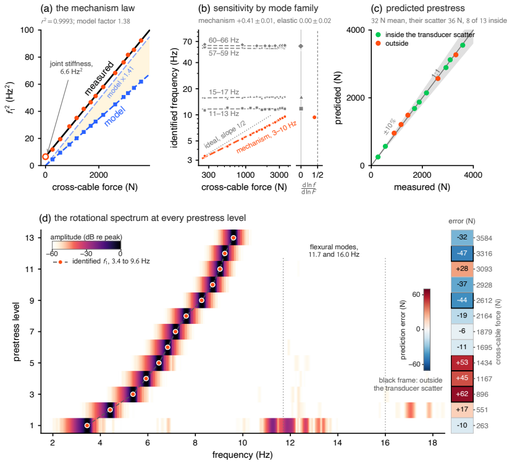
Figure 11 : Identification on the simplex of Figure 10, from 13 impact records at 13 prestress levels:(a)the mechanism law: the measurement, the rebuilt model at the transducer reading, and the same model at the prestress obtained from static equilibrium in the 2020 publication, the shaded band between the two being that factor and the open marker the joint-supplied intercept;(b)frequency against force by mode family, log–log, the mechanism family in color with its 95 % confidence band and the dotted ideal slope of 1/2 anchored at the first point; the side strip shows each family’s exponent d lnf /d lnF, with its 95 % error bar, against the zero and one-half references;(c)prestress predicted against the transducer reading, the joint stiffness alone fitted leave-one-out (±10 % band);(d)the rotational spectrum at every level, each record normalized to its own peak, with the per-level prediction error as the color-graded column on the right, framed in black where it exceeds the transducer scatter.
出典 · CC BY 4.0 · Sandesh Lamsal, Sumit Kumar, Rubi Bhandari, Subhamoy Sen, Andrzej Rutkiewicz, Leszek Małyszko, Landolf Rhode-Barbarigos · Physics-Informed Identification of Tensegrity Prestress across Taut-Slack Transitions · 論文の図を引用 · 元のPDFの27ページ目から図の部分を抽出しています。この論文を引用
Sandesh Lamsal, Sumit Kumar, Rubi Bhandari, Subhamoy Sen, Andrzej Rutkiewicz, Leszek Małyszko, Landolf Rhode-Barbarigos (2026). Physics-Informed Identification of Tensegrity Prestress across Taut-Slack Transitions. arXiv:2611.04007v1. https://arxiv.org/abs/2611.04007v1
BibTeX
@misc{lamsal2026physics,
  title = {{Physics-Informed Identification of Tensegrity Prestress across Taut-Slack Transitions}},
  author = {Sandesh Lamsal and Sumit Kumar and Rubi Bhandari and Subhamoy Sen and Andrzej Rutkiewicz and Leszek Małyszko and Landolf Rhode-Barbarigos},
  year = {2026},
  eprint = {2611.04007},
  archivePrefix = {arXiv},
  url = {https://arxiv.org/abs/2611.04007v1}
}