論文解説
HexaShell: A Thin Harness for Exploring the Limits of VLM Agents as Robot Coding Agents
HexaShell:ロボットコーディングエージェントとしてのVLMエージェントの限界を探るための薄いハーネス
- 課題 VLMエージェントがロボットを制御するには、ピクセルからセンチメートル単位の3D位置を得ることが中心的な難しさです。この論文は、この問題を軸に、薄いハーネスと道具の進化ループを備えたコーディングエージェントがRoboDojoでどこまで到達するかを問います。
- 手法 構成は、薄いハーネス、RGB画像から三角測量で3D位置を得る道具、失敗後に道具を直すループの3つです。道具はロボットが観測できる情報だけを使います。
- 結果 RoboDojoの42個のタスクで、成功率39.7%とprogress score 48.0を報告しています。同じハーネス、ループ、モデルで比べると、三角測量はDepth Anything V2を使った道具より成功率の指標が8.7点高くなりました。
ピクセルをロボットの動作に変える難しさ
コーディングエージェントはリポジトリのコードを読み、実行し、エラーを直します。同じ方法をロボットに当てはめると、観測はテキストではなくピクセルで与えられます。しかも把持には約1 cmの位置精度が必要です。ビジョン言語モデルはこの程度の距離の判断が得意ではないと知られています。単眼の深度ネットワークで1枚の画像から深度を推定する方法もありますが、この論文のRoboDojoの場面では、Depth Anything V2はテーブルでスケールを補正した後も、頭部カメラで中央値41 mm、手首カメラで約100 mmの誤差を示しました。この論文は、この隔たりを埋める計測方法を探し、その上でエージェントがどこまで進み、どこで止まるのかをRoboDojoの42個のタスクで確かめます。
薄いハーネスとコマンドインターフェース
行動エージェントは、ロボットのコマンドrobo 1つとobsディレクトリを受け取ります。obsディレクトリには640×480のRGB画像3枚、各カメラの内部パラメータとワールド座標系のポーズ、2つのTCPポーズ、関節角が入っており、深度映像はありません。基本コマンドはmove、rotate、point、gripper、home、wait、obs、status、doneです。サーバーはコマンドを検証し、2 cm間隔の直線経路を補間します。各経路点で逆運動学を解き、公式の関節限界の内で時間配分を行います。サーバーは目標を決めず、動作を変換するだけです。タスクごとの行動予算であるstep_limでは、観測と思考はコストがかからず、実行された各ステップで1回ずつ消費されます。
3つの幾何学的制約で3D位置を求める
道具は、キャリブレーション済みカメラのピクセルからワールド座標系の光線を得て、さらに光線上の1点を選ぶ制約を1つ加えます。1つ目の制約はテーブル平面です。table_plane道具は、エピソードで初めて呼ばれたときにテーブルの高さを1回計測します。候補の高さごとに、ある1台のカメラ映像を平面経由で別のカメラへワーピングし、最もよく合う高さを選びます。3台のカメラの組の結果は、実行の中で1 mm以内で一致したと報告されています。2つ目の制約は、高さが計測された別の平面です。ブロックの上面や容器の縁がこれに当たります。3つ目の制約は2つ目の視点です。2台のカメラの光線がほぼ交わる点を、三角測量の位置として使います。
対応するピクセルは、行動エージェントが2枚の映像から直接選ぶか、道具の中でテンプレートマッチング、輪郭、円フィッティングによって得ます。手首カメラで2つ目の視点を得るには、ロボットが先に動く必要があり、その移動はタスクのステップ予算を消費します。
失敗後に道具を直すループ
1つのレイアウトで、行動エージェントは現在の道具の集合を使ってタスクを試します。成功すると、最適化エージェントは軌跡を読み、何がなぜ機能したかをplaybook.mdに短く書きます。失敗すると、コマンドログ、コマンドごとのカメラフレーム、現在の道具のコードを読み、skill.mdに診断を書いたうえで、道具を追加するか修正します。受け渡し検査では、ファイルが完全か、道具が読み込まれるか、インターフェースの文言にタスクやオブジェクトの名前が含まれていないかを確認し、失敗すると編集を元に戻します。通過したらシミュレーターを再起動し、同じレイアウトを再び試します。1つのレイアウトにつき編集は最大5回です。
最適化エージェントはtasksディレクトリ以下のタスク道具だけを変更でき、ハーネス、マニュアル、共有プールは変更できません。1回の修正ラウンドには中央値6.3分かかり、ロボットのデータ、学習、モデルの変更は必要ありませんでした。
評価設定と比較対象
RoboDojoは、双腕のARX X5をIsaac Sim 5.1で扱う42個のシミュレーションタスクで、Generalization、Memory、Long-Horizon、Precision、Openの5種類に分かれます。各タスクには3つの評価シードがあり、1つのシードは30個から75個のレイアウトで構成されます。HexaShellの主な点数は、RGB画像のみを使い、道具を固定した状態で得た再試験の結果です。再試験はシード0のレイアウト10から19までで行われ、汎化タスクには標準5個とクラッター5個を使います。道具はシード0の最初の10個のレイアウトで作られたので、再試験のレイアウトは開発には使われていません。
リーダーボードの項目は3つのシードそれぞれで50エピソードを報告しているため、2つの評価設定は同じではありません。比較対象は、道具なしで同じモデルを使ったGPT-6-Astraと、学習ポリシーであるVPP2およびPhysicalRSIです。
42個のタスク全体での結果
固定したRGB道具は、リーダーボードの指標で成功率39.7%とprogress score 48.0を記録しました。同じ指標で、VPP2は32.3%と39.3、PhysicalRSIは31.4%と36.3でした。54種類の変種を単純平均すると、HexaShellは35.4%、VPP2は30.6%、PhysicalRSIは26.1%、道具のない同じモデルは24.3%です。この比較は評価設定が異なるため、公開リーダーボードの点数と著者らの再試験の点数を、同じプロトコルの結果としてまとめて読むべきではありません。タスク種別では、Memoryが65.0%、Openが50.0%と高くなりました。一方、Precisionでは、VPP2が35.2%、Long-Horizonでは37.0%で、HexaShellの31.3%と23.8%を上回りました。
押すタスクは92.5%でした。
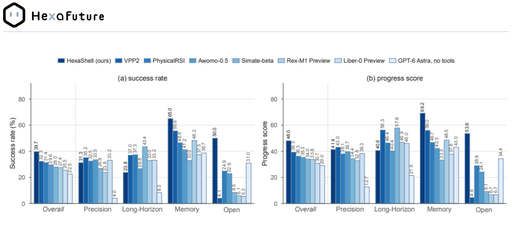
Figure 2 .RoboDojo comparison on the leaderboard’s metrics: success rate (a) and progress score (b).Overall is the leaderboard’s score, the mean of its five task types (Generalization: mean of its standard and cluttered variants). HexaShell uses GPT-6-Astra at medium reasoning effort, RGB images only and frozen tools, tested on ten new layouts of each task, which the tools were not built on (Sec. 4.1). GPT-6-Astra is the same model without tools [69]. Systems are ordered and shaded by Overall success rate.
出典 · CC BY 4.0 · Hongcheng Gao, Alex Zhou, Jay Zhu, Zelin Zheng, Shijia Ge, Xiping Li, Di Wu, Yazhe Wang, Jianshu Zeng, Xuan Shangguan, Yongli Wang, Yexing Wan, Lingyu He, Zhiqi Jia, Sihang Wu, Xiao He · HexaShell: A Thin Harness for Exploring the Limits of VLM Agents as Robot Coding Agents · 論文の図を引用 · 元のPDFの2ページ目から図の部分を抽出しています。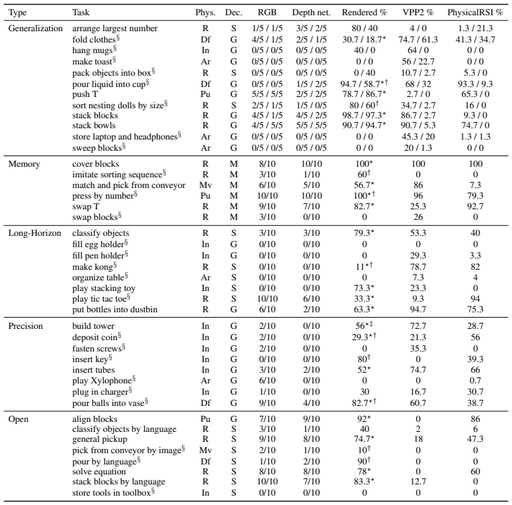
Table 5 .Results on all 42 RoboDojo tasks.Phys. and Dec.: the physical interaction and the decision a task requires (Sec. 5.1): R rigid pick, place or stack; Pu push, slide or press; In tight insertion; Ar articulated object or tool use; Df deformable, fluid or granular; Mv moving objects; G geometry only; S symbols, language or categories; M memory. RGB: frozen retests on ten new layouts, 10 to 19 of seed 0 (Generalization: standard / cluttered 5 to 9); swap blocks with the benchmark’s fix of its button reset and tools developed again under it. Depth net.: frozen retests on the ten seed-0 development layouts (Generalization: five standard / five cluttered). §The optimizer read a note on what the checker requires (Sec. 3.4). Rendered: success in % of the earlier tools with rendered depth; ⋆50 episodes on each of seeds 0–2 (25 per variant for Generalization tasks), otherwise the development layouts; †tools from a run with checker notes, ‡tools rebuilt by a team member (Sec. D). VPP2, PhysicalRSI: leaderboard success in %.
出典 · CC BY 4.0 · Hongcheng Gao, Alex Zhou, Jay Zhu, Zelin Zheng, Shijia Ge, Xiping Li, Di Wu, Yazhe Wang, Jianshu Zeng, Xuan Shangguan, Yongli Wang, Yexing Wan, Lingyu He, Zhiqi Jia, Sihang Wu, Xiao He · HexaShell: A Thin Harness for Exploring the Limits of VLM Agents as Robot Coding Agents · 論文の図を引用 · 元のPDFの23ページ目から図の部分を抽出しています。三角測量と深度ネットワークの比較
同じハーネス、ループ、モデル、レイアウトで比べると、三角測量の道具はDepth Anything V2を使った道具より、リーダーボード指標の成功率が8.7点高くなりました。表1では、成功率は三角測量が38.3%、深度ネットワークが29.6%です。レイアウトごとの対応のある比較では、三角測量は深度ネットワークの失敗57件を成功に変え、23件では逆に失敗しました。正確なMcNemar検定ではp<0.001です。最も大きな改善はpush T(10個中4個から10個へ)、imitate sorting sequence、play Xylophoneで見られました。著者らは、この差を深度推定の精度によるものと解釈しています。
レンダリング深度を基にした300個のフレームの分析では、深度ネットワークのオブジェクトピクセルの中央値誤差は、頭部カメラで41 mm、手首カメラで約100 mmでした。Depth Proと2種類のMoGeは頭部カメラの誤差を20から31 mmに減らしましたが、手首では21から72 mmが残りました。著者らは、レンダリング深度の設定が依然として10.6点高いと報告しています。
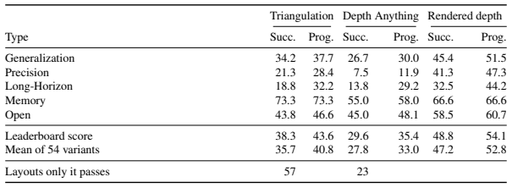
Table 1 .Triangulation against a depth network, same harness, loop and model.Success rate and progress score in %. Triangulation is our RGB tool set; Depth Anything V2 estimates depth from each image. Both are frozen retests on the development layouts. Rendered depth is not part of the standard observation and is shown for reference. Last row: layouts that only one of the two passes, of 420.
出典 · CC BY 4.0 · Hongcheng Gao, Alex Zhou, Jay Zhu, Zelin Zheng, Shijia Ge, Xiping Li, Di Wu, Yazhe Wang, Jianshu Zeng, Xuan Shangguan, Yongli Wang, Yexing Wan, Lingyu He, Zhiqi Jia, Sihang Wu, Xiao He · HexaShell: A Thin Harness for Exploring the Limits of VLM Agents as Robot Coding Agents · 論文の図を引用 · 元のPDFの7ページ目から図の部分を抽出しています。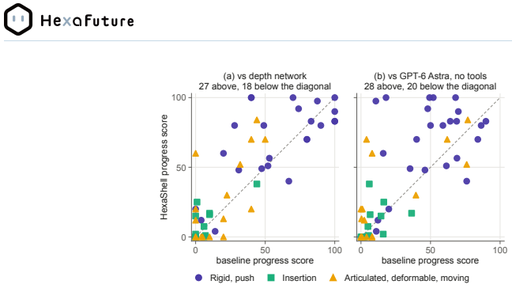
Figure 12 .Progress score per task variant on the development layouts, HexaShell with triangulation against (a) the depth network version and (b) the same model without tools.Points above the diagonal favour triangulation. Colour and shape give the physical class (Sec. 5.1): rigid and push (R, Pu), insertion (In), and articulated, deformable or moving (Ar, Df, Mv). Means over the 54 variants: 40.8, 33.0 and 29.8.
出典 · CC BY 4.0 · Hongcheng Gao, Alex Zhou, Jay Zhu, Zelin Zheng, Shijia Ge, Xiping Li, Di Wu, Yazhe Wang, Jianshu Zeng, Xuan Shangguan, Yongli Wang, Yexing Wan, Lingyu He, Zhiqi Jia, Sihang Wu, Xiao He · HexaShell: A Thin Harness for Exploring the Limits of VLM Agents as Robot Coding Agents · 論文の図を引用 · 元のPDFの21ページ目から図の部分を抽出しています。2つ目の視点を得るコスト
RGB道具は、深度の代わりに手首カメラを動かして2つ目の視点を得る必要があります。著者らは、基本の移動の後に手首カメラで計測する動作が続く場合、それを視点確保のための移動として数えています。420個の再試験エピソードで、三角測量の設定は実行されたステップの3.6%を視点確保に使い、深度ネットワークの設定は0.7%を使いました。視点確保の移動があったエピソードは、三角測量では180個(43%)、深度ネットワークでは40個(10%)でした。視点確保の移動があった180個のレイアウトでは、三角測量が39回、深度ネットワークが22回成功しました。残りの240個のレイアウトでは113回対96回です。コストは、卵パック(egg carton)のように、以前の道具が固定値としていた対象を計測する必要がある場合に集中しました。
逆にplay Xylophoneは、ステップの17%を視点確保に使い、0個から6個のレイアウトに増えました。
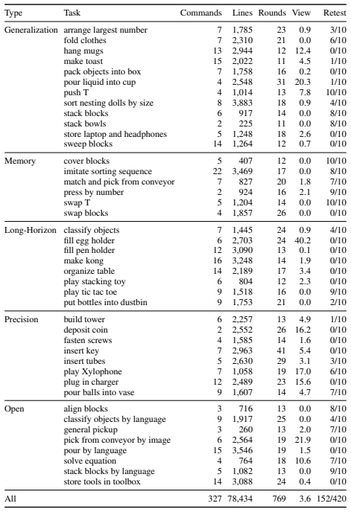
Table 6 .RGB tools per task.Commands: task commands besides the shared tools; Lines: lines of Python in the enabled tools and the modules they import; Rounds: optimizer rounds of the RGB run; View: executed steps spent on viewing moves in the retest, in %; Retest: successes on the ten development layouts.
出典 · CC BY 4.0 · Hongcheng Gao, Alex Zhou, Jay Zhu, Zelin Zheng, Shijia Ge, Xiping Li, Di Wu, Yazhe Wang, Jianshu Zeng, Xuan Shangguan, Yongli Wang, Yexing Wan, Lingyu He, Zhiqi Jia, Sihang Wu, Xiao He · HexaShell: A Thin Harness for Exploring the Limits of VLM Agents as Robot Coding Agents · 論文の図を引用 · 元のPDFの24ページ目から図の部分を抽出しています。接触と精密挿入の限界
結果でもっとも明確な限界は、接触に高い精密さが求められるタスクです。RGB道具はtight insertionで8.3%にとどまりました。同じタスクでレンダリング深度を使った道具は30.1%を記録しました。挿入では、穴と部品の位置を数ミリメートル以内で同じ座標系に揃える必要があります。頭部カメラでは1ピクセルがテーブル上の約2から3 mmを覆い、穴を見る手首の視点は、部品を握ったままで確保しなければなりません。注ぐタスクも大きく下がりました。pour liquid into cupとpour by languageは、レンダリング深度の設定の59から95%から、RGB道具の0から10%へ下がります。
押すタスクとメモリのタスクは比較的うまくいきました。著者らは、この差は計測の精度と接触の境界を示すものだと解釈しています。
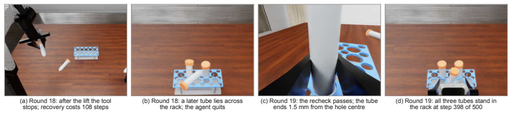
Figure 10 .Insert tubes, layout 4: a stop after the lift.(a, b, d) head camera, cropped; (c) left wrist camera.
出典 · CC BY 4.0 · Hongcheng Gao, Alex Zhou, Jay Zhu, Zelin Zheng, Shijia Ge, Xiping Li, Di Wu, Yazhe Wang, Jianshu Zeng, Xuan Shangguan, Yongli Wang, Yexing Wan, Lingyu He, Zhiqi Jia, Sihang Wu, Xiao He · HexaShell: A Thin Harness for Exploring the Limits of VLM Agents as Robot Coding Agents · 論文の図を引用 · 元のPDFの14ページ目から図の部分を抽出しています。失敗エピソードの終了タイプ
再試験の420個のエピソードのうち268個が失敗しました。そのうち5個は道具のエラーにより早く終わり、残り263個の終了タイプは次のとおりです。57%は行動予算をすべて使い切りました。30%は、エージェントが完了を宣言したものの、検査器がそれを拒否したものです。13%は、予算の4分の1以上が残った状態でエージェントが諦めました。タイプごとに差がはっきりしています。変形材料、関節物体、剛体のタスクでは、失敗の60から77%が予算の使い切りでした。メモリのタスクでは、失敗の半分が完了宣言でした。著者らは、予算の使い切りを実行上の空白、完了宣言の拒否を知覚またはタスク仕様の空白として読んでいます。
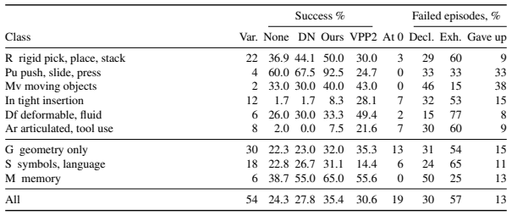
Table 3 .Capability map and failure modes.Mean success over variants for the same model without tools (None, [ 69]), HexaShell with a depth network (DN, development layouts) and with triangulation (Ours, new layouts), and VPP2, the highest learned policy; RGB variants at 0% on the new layouts; and how failed RGB episodes on the development layouts ended: the agentdeclared completion and the checker disagreed, the budget wasexhausted(less than a quarter left), or the agentgave upwith more left.
出典 · CC BY 4.0 · Hongcheng Gao, Alex Zhou, Jay Zhu, Zelin Zheng, Shijia Ge, Xiping Li, Di Wu, Yazhe Wang, Jianshu Zeng, Xuan Shangguan, Yongli Wang, Yexing Wan, Lingyu He, Zhiqi Jia, Sihang Wu, Xiao He · HexaShell: A Thin Harness for Exploring the Limits of VLM Agents as Robot Coding Agents · 論文の図を引用 · 元のPDFの8ページ目から図の部分を抽出しています。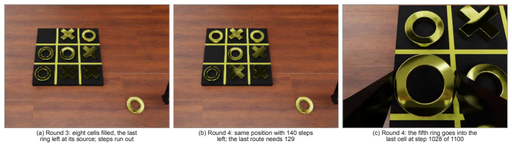
Figure 8 .Play tic tac toe, layout 0: the step budget.(a, b) head camera, cropped, before the last ring; (c) right wrist camera, last frame of the video.
出典 · CC BY 4.0 · Hongcheng Gao, Alex Zhou, Jay Zhu, Zelin Zheng, Shijia Ge, Xiping Li, Di Wu, Yazhe Wang, Jianshu Zeng, Xuan Shangguan, Yongli Wang, Yexing Wan, Lingyu He, Zhiqi Jia, Sihang Wu, Xiao He · HexaShell: A Thin Harness for Exploring the Limits of VLM Agents as Robot Coding Agents · 論文の図を引用 · 元のPDFの13ページ目から図の部分を抽出しています。道具の修正が実際に起きた事例
付録と6章の事例は、失敗した試行から次の試行までの1周分を示しています。push Tでは、最適化エージェントは高さ検査が2台のカメラの面積を比べる際に、解像度の異なる2台のカメラが同じ面積を異なる数え方で数えていることを確認しました。面積を格子セルの数ではなく、平面上の各ピクセルの足跡の合計に変えると、同じレイアウトが通過しました。この事例では、修正は計測道具の1か所にとどまり、行動戦略は行動エージェントに残りました。全769回の最適化ラウンドのうち530回は失敗の後、195回は成功の後、42回は実行を締めくくるラウンドでした。
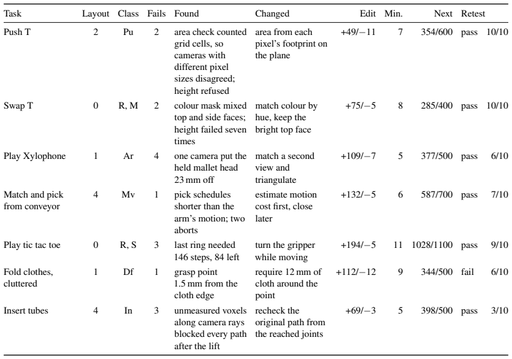
Table 4 .Seven turns of the loop.Each row is one layout: the attempts that failed on it before the success (Fails), what the optimizer found after the last failure, what it changed, the size of the edit in lines added and removed (tests included) and the length of the round in minutes, the action steps of the next attempt, which succeeded, and the frozen retest of the same layout, with the task’s retest over its ten development layouts.
出典 · CC BY 4.0 · Hongcheng Gao, Alex Zhou, Jay Zhu, Zelin Zheng, Shijia Ge, Xiping Li, Di Wu, Yazhe Wang, Jianshu Zeng, Xuan Shangguan, Yongli Wang, Yexing Wan, Lingyu He, Zhiqi Jia, Sihang Wu, Xiao He · HexaShell: A Thin Harness for Exploring the Limits of VLM Agents as Robot Coding Agents · 論文の図を引用 · 元のPDFの10ページ目から図の部分を抽出しています。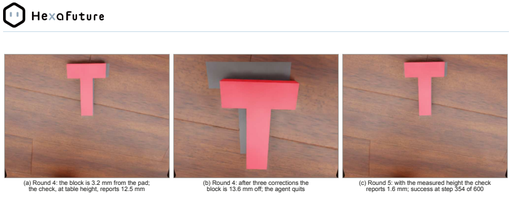
Figure 4 .Push T, layout 2: a height that the tool refused.Left wrist camera. (a) and (c) show almost the same placement; only the measured height of the block’s top differs.
出典 · CC BY 4.0 · Hongcheng Gao, Alex Zhou, Jay Zhu, Zelin Zheng, Shijia Ge, Xiping Li, Di Wu, Yazhe Wang, Jianshu Zeng, Xuan Shangguan, Yongli Wang, Yexing Wan, Lingyu He, Zhiqi Jia, Sihang Wu, Xiao He · HexaShell: A Thin Harness for Exploring the Limits of VLM Agents as Robot Coding Agents · 論文の図を引用 · 元のPDFの11ページ目から図の部分を抽出しています。論文情報
- 著者
- Hongcheng Gao, Alex Zhou, Jay Zhu, Zelin Zheng, Shijia Ge, Xiping Li, Di Wu, Yazhe Wang, Jianshu Zeng, Xuan Shangguan, Yongli Wang, Yexing Wan, Lingyu He, Zhiqi Jia, Sihang Wu, Xiao He
- 学会・ジャーナル
- arXiv · プレプリント
- 公開日
- 2026年10月16日
- 登録日
- 2026年10月20日
- 更新日
- 2026年10月16日
- バージョン
- v1
- arXiv
- 2610.23479
- カテゴリ
- cs.RO
- ライセンス
- CC BY 4.0
- 掲載内容
- 論文情報・解説・論文の図
この解説は、Refivuの韓国語解説をAIで翻訳したものです。不正確な翻訳や誤りが含まれる可能性があります。論文と図の利用条件は各出典に従います。
アブストラクト
Agents built on vision language models (VLMs) now compete with learned policies on robot manipulation leaderboards. We ask how far a coding agent can go when it controls a robot instead of a computer, and where it stops. Our system, HexaShell, keeps the harness thin: it only turns the agent's commands into robot motion. The agent drives a robot with two arms through one command line. It sees three RGB cameras and knows their calibration. After each failed attempt, the agent reads the log, finds the cause, and writes or fixes small programs called tools. In this way it keeps what it learns as code, as a coding agent does when it fixes a failing test. The tools may use only what the robot observes. They use triangulation to find where objects are, relative to each other and to the gripper. If two cameras see the same point, the point lies where the two camera rays meet. If a point lies on a known plane, such as the table or the top of a block, it lies where its ray meets that plane. When the head camera is not enough, the robot moves a wrist camera to get a second view. We build the tools on only ten layouts of one seed per task, then freeze them and test them on ten new layouts of the same seed. We use Codex with GPT-6-Astra at medium reasoning effort. On all 42 RoboDojo tasks, HexaShell reaches a success rate of 39.7% and a progress score of 48.0, averaged in the same way as the leaderboard. This is a new state of the art on RoboDojo. The limit is contact, not reasoning: pushing reaches 92.5% and memory tasks 65.0%, but tight insertion only 8.3%. When the agent fails, it usually sees the failure but cannot make the motion work. We open source the tools evolved so far at https://github.com/HexaFuture/HexaShell.
この論文を引用
Hongcheng Gao, Alex Zhou, Jay Zhu, Zelin Zheng, Shijia Ge, Xiping Li, Di Wu, Yazhe Wang, Jianshu Zeng, Xuan Shangguan, Yongli Wang, Yexing Wan, Lingyu He, Zhiqi Jia, Sihang Wu, Xiao He (2026). HexaShell: A Thin Harness for Exploring the Limits of VLM Agents as Robot Coding Agents. arXiv:2610.23479v1. https://arxiv.org/abs/2610.23479v1
BibTeX
@misc{gao2026hexashell,
  title = {{HexaShell: A Thin Harness for Exploring the Limits of VLM Agents as Robot Coding Agents}},
  author = {Hongcheng Gao and Alex Zhou and Jay Zhu and Zelin Zheng and Shijia Ge and Xiping Li and Di Wu and Yazhe Wang and Jianshu Zeng and Xuan Shangguan and Yongli Wang and Yexing Wan and Lingyu He and Zhiqi Jia and Sihang Wu and Xiao He},
  year = {2026},
  eprint = {2610.23479},
  archivePrefix = {arXiv},
  url = {https://arxiv.org/abs/2610.23479v1}
}