論文解説
SO-Arena: Benchmarking the Capability Spectrum and Reliability of System One Models
SO-Arena:System Oneモデルの能力スペクトラムと信頼性のベンチマーク
- 課題 System Oneモデルの能力の広がりと意思決定の信頼性は、集計精度だけでは分かりません。
System Oneモデルの評価方法
System Oneモデルは、明示的な推論トークンを生成せず、定められた結果集合上の確率分布を一度の順伝播で出力します。ルーティング、ツール行動の選択、タスク完了の確認のように素早い判断が必要な場面で使われます。ただし既存のベンチマークは集計精度が中心のため、能力の幅と判断の信頼性を一緒に見ることが難しくなっています。この論文では、この2つの側面を同時に測るベンチマークSO-Arenaを提案しています。
SO-Arenaは、11個のドメインと5つの能力系列にまたがる2,919個の課題で構成されています。課題そのものは40個の公開ソースから取得するか派生させたもので、ソースのラベルを参照として保持しています。さらに、手動とLLMによるレビューで疑わしい項目を除外しています。
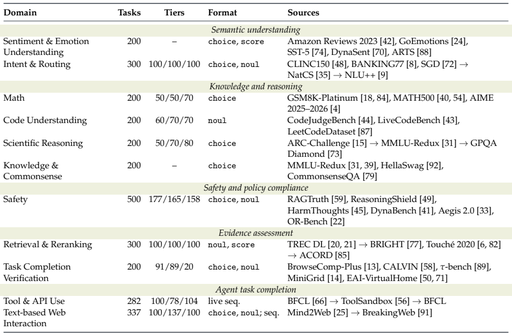
Table 3 :Composition of SO-Arena.Counts are natural tasks. Tiers give easy/medium/hard counts; Math addition- ally has 30 very hard AIME problems, and “–” marks domains without tiers. Where tiers draw on different sources, sources are listed from easy to hard, separated by→. “Seq.” denotes a sequence ofchoicerequests.
出典 · CC BY 4.0 · Lichen Li, Ziping Dong, Sicheng Feng, Qi Li, Xinchao Wang · SO-Arena: Benchmarking the Capability Spectrum and Reliability of System One Models · 論文の図を引用 · 元のPDFの21ページ目から図の部分を抽出しています。能力スコアと信頼性スコアの計算
能力スコアC(m)は、各課題のクレジットc_i(m) ∈ [0, 1]をドメインごとに平均し、ドメイン数Dで割ってから100を掛けた値です。平均の対象は、ドメインごとに最も難しいティアの課題だけです。Mathではhardとvery hardのティアを使い、ティアのないドメインはすべての課題を使います。ドメイン間の重みは同じにし、大きなドメインがリーダーボードを左右しないようにしています。
信頼性は2つの要素に分けています。オプション順序の安定性S(m)は、各項目を元の順序と12通りの並べ替えで評価し、元の答えを保った割合A(m)を偶然の一致率p_eで補正した値です。正解不在の認識指標N(m)は、正解の選択肢を取り除いた複製に対して、p_null = 1 − p(inc) のAUCで計算し、2AUC − 1に変換した値です。最終的な信頼性R(m)は、両方の値が0より大きい場合に√(S·N)、そうでなければ0です。Sは一貫性を測るもので、正しさを直接測るものではないというのが著者らの明示的な区別です。
21モデルの能力・遅延・信頼性の比較
オープンウェイトのSystem Oneモデルは、0.3秒以内に課題へ応答しました。これはSystem Twoの参照モデルより数十倍速いです。能力面では、GPT-6 SolとLunaがすべてのSystem Oneモデルを上回りました。最も強いSystem OneモデルであるGLiDEとKnowLine-31Bは、Lunaより約10点低い結果でした。
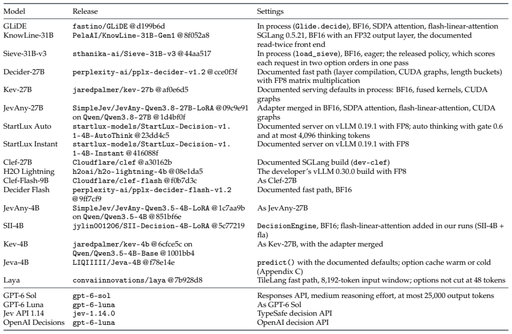
Table 4 :Releases and settings.Open-weight models: the Hugging Face repository at the revision used, and the inference path of our latency and reliability runs, which follows each developer’s documented fast path. APIs: the model identifier and settings of the evaluation runs.
出典 · CC BY 4.0 · Lichen Li, Ziping Dong, Sicheng Feng, Qi Li, Xinchao Wang · SO-Arena: Benchmarking the Capability Spectrum and Reliability of System One Models · 論文の図を引用 · 元のPDFの26ページ目から図の部分を抽出しています。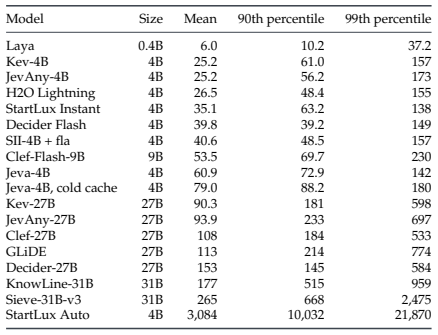
Table 5 :Latency per task (ms)on the 1,109 timed tasks: mean, 90th and 99th percentiles over tasks. Jeva-4B is timed with a warm and a cold option cache.
出典 · CC BY 4.0 · Lichen Li, Ziping Dong, Sicheng Feng, Qi Li, Xinchao Wang · SO-Arena: Benchmarking the Capability Spectrum and Reliability of System One Models · 論文の図を引用 · 元のPDFの30ページ目から図の部分を抽出しています。信頼性は性能と同じ順序では動きませんでした。信頼性が最も高かったJevAny-27BとJev API 1.14は、性能順位ではそれぞれ18個中8位と6位でした。オプション順序の安定性は、ほとんどのモデルで0.83から0.94の間でした。一部のモデルは順序に敏感でした。
ドメイン別のSystem Twoとの差
GPT-6 Lunaと2つのSystem Oneモデルとの差は、ドメインによって大きく異なりました。感情理解のような直接的な意味判断では、System OneモデルがLunaと同程度でした。細かい根拠判断のドメインでは、GLiDEがLunaとの差を4点以内に縮めました。一方、StartLux Instantは最大29点低い結果でした。多段階の導出ドメインであるMath、Scientific Reasoning、Code Understandingでは、両モデルともLunaに大きく及びませんでした。
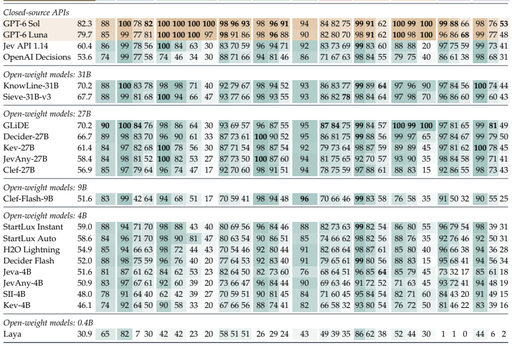
Table 2 :Scores by domain and difficulty tier.E, M, H, and V denote the easy, medium, hard, and very hard tiers; All marks untiered domains. Score is the leaderboard score (Equation (4)). Rows are grouped by access and size and sorted by Score within each group; the two System Two references are shaded orange. Darker is higher; bold is the best in each column. Tiers are not calibrated across domains.
出典 · CC BY 4.0 · Lichen Li, Ziping Dong, Sicheng Feng, Qi Li, Xinchao Wang · SO-Arena: Benchmarking the Capability Spectrum and Reliability of System One Models · 論文の図を引用 · 元のPDFの9ページ目から図の部分を抽出しています。バックボーンの効果と思考の効果を分けて見ると、より大きなバックボーンは細かい根拠判断のドメインで、思考の効果より大きく現れました。Mathでは、StartLux Autoは思考機能をオンにしたとき50.8から92.5に上がりました。
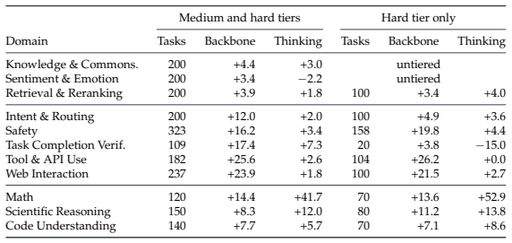
Table 7 :Backbone and thinking gains on the medium and hard tiers and on the hard tier alone.Gains as in Figure 7b and c (thinking:alwaysminusnever). The untiered domains are identical in both selections.
出典 · CC BY 4.0 · Lichen Li, Ziping Dong, Sicheng Feng, Qi Li, Xinchao Wang · SO-Arena: Benchmarking the Capability Spectrum and Reliability of System One Models · 論文の図を引用 · 元のPDFの32ページ目から図の部分を抽出しています。正解不在の認識と性能の関係
オプション順序の安定性は性能とともに上がる傾向が見られました。一方、正解不在の認識は性能とゆるくしか結びついていませんでした。性能が近いモデル同士でも、正解がないことに気づく度合いは大きく異なりました。したがって、性能スコアだけではモデルが欠けた正解に気づくかどうかは分からず、この性質は個別に測る必要があります。
論文情報
- 著者
- Lichen Li, Ziping Dong, Sicheng Feng, Qi Li, Xinchao Wang
- 学会・ジャーナル
- arXiv · プレプリント
- 公開日
- 2026年11月11日
- 登録日
- 2026年11月13日
- 更新日
- 2026年11月11日
- バージョン
- v1
- arXiv
- 2611.15777
- カテゴリ
- cs.CL · cs.AI · cs.LG
- ライセンス
- CC BY 4.0
- 掲載内容
- 論文情報・解説・論文の図
この解説は、Refivuの韓国語解説をAIで翻訳したものです。不正確な翻訳や誤りが含まれる可能性があります。論文と図の利用条件は各出典に従います。
アブストラクト
System One models promise fast, general-purpose decision-making without lengthy token generation. However, understanding their capability spectrum and decision reliability requires more than aggregate performance on current benchmarks. Existing evaluations often provide limited insight into the breadth of model capabilities and the reliability of their decisions. We introduce SO-Arena, a benchmark characterizing the capability spectrum and decision reliability of System One models across 11 domains and five capability families. For the capability spectrum, SO-Arena offers evidence-grounded evaluation through reliable sources and manual verification of reference labels against model-visible inputs; fine-grained capability assessment through domain-specific difficulty criteria; and realistic interactive evaluation, where models iteratively execute actions in sandboxes. Reasoning-intensive tasks further enable system one-two comparison. Beyond accuracy, SO-Arena assesses decision reliability through two complementary measures: decision stability under controlled option-set changes and missing-answer recognition when no valid option is available. Evaluations across 21 models reveal that the benefits of scaling and additional reasoning vary substantially across domains. More importantly, strong overall performance does not necessarily imply reliable decision-making: the best-performing System One model ranks only seventh in reliability. Together, these findings highlight the need to characterize capability spectrum and decision reliability as complementary dimensions, providing a systematic view of the strengths and limitations of System One models.
この論文を引用
Lichen Li, Ziping Dong, Sicheng Feng, Qi Li, Xinchao Wang (2026). SO-Arena: Benchmarking the Capability Spectrum and Reliability of System One Models. arXiv:2611.15777v1. https://arxiv.org/abs/2611.15777v1
BibTeX
@misc{li2026arena,
  title = {{SO-Arena: Benchmarking the Capability Spectrum and Reliability of System One Models}},
  author = {Lichen Li and Ziping Dong and Sicheng Feng and Qi Li and Xinchao Wang},
  year = {2026},
  eprint = {2611.15777},
  archivePrefix = {arXiv},
  url = {https://arxiv.org/abs/2611.15777v1}
}