論文解説
LECAT: Measuring LLM Category Learning from Pretraining Data
LECAT:事前学習データからのLLMのカテゴリ学習の測定
- 課題 事前学習データの表現方法が、LLMのカテゴリ知識の学習にどう影響するかを問います。
- 手法 カテゴリと特徴の対数確率の差で記憶、一般化、文脈への柔軟性を測り、事前学習データの表現タイプと比較します。
カテゴリ知識の学習過程
人は「飛行機は速い」という規則を、赤い飛行機や故障した飛行機のような文脈に合わせて柔軟に適用します。一方、LLMが事前学習データからこうしたカテゴリ知識をどう得るのかは、十分にはわかっていません。この論文では、カテゴリと特徴の関係を記憶、一般化、文脈への柔軟性の3つの次元に分けて測定し、その知識が事前学習テキストの表現方法によってどう変わるかを問います。
著者らは、LECATと呼ぶ2部構成のフレームワークを提案しています。一方はモデルの出力からカテゴリ知識を測る評価で、もう一方は学習データにおいて、反復、事例、例外、文脈依存といった表現タイプの割合を数える分析です。
対数確率の差による測定
カテゴリcと特徴fの関連の強さはP(f|c)で表し、目標トークンの対数確率と最も確率の高いトークンの対数確率を比べる Target–Max Log-Probability Gap G(x, ytarget) = log pθ(ytarget|x) − log pθ(ymax|x) を用います。この値が0に近いほど、目標の特徴に対するモデルの確信が大きいことを意味します。
記憶は基本プローブのGで測ります。一般化は不変文脈と誤り文脈のGを比べ、基本 ≳ 不変 > 誤りの順序を調べます。文脈への柔軟性は、強化文脈と弱化文脈のGを基本文脈および誤り文脈と合わせて比べます。期待される順序はGstr > Gbase ≳ Ginv > Gweak > Gerrです。この順序を満たすペアの割合を通過率とみなします。モデルが生成した自由記述テキストでは、判定者としてQwen3.8-27Bを使い、特徴の推論の有無と強度を判定しました。その結果は対数確率による測定と、Spearman ρ 0.88および0.87で正の相関を示したと報告されています。
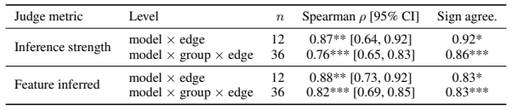
Table 3 : Agreement between judge metrics and reference scores. Significance from permutation tests: * p < .05, ** p < .01, ***p < .001. Pearson correlations were similar (r= 0.67–0.74, allp < .01).
出典 · CC BY 4.0 · Jimin Mun, Maarten Sap, Yanai Elazar · LECAT: Measuring LLM Category Learning from Pretraining Data · 論文の図を引用 · 元のPDFの13ページ目から図の部分を抽出しています。PythiaとOLMo 3での順序通過率
基本文脈と不変文脈の順序通過率は、Pythia-14Mの71.4%から、Pythia-2.8Bと6.9Bで95.5%へ上がりました。反対に、強化文脈のペアは、Pythia-14Mの81.9%からPythia-6.9Bの51.3%、OLMo-3-32Bの49.7%へ下がり、大きいモデルではほぼランダムに近づきました。
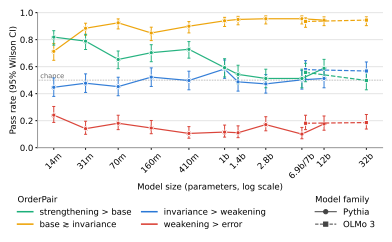
Figure 1 : Pass rate for each ordering pair by model size. A pair passes when the model scores the feature higher under the first context than under the second; “invari- ance” is the irrelevant context, and base ≳ invariance allows a small tolerance. Solid lines are Pythia and dashed lines are OLMo 3; error bars are 95% Wilson intervals, and the dotted line marks chance (0.5).
出典 · CC BY 4.0 · Jimin Mun, Maarten Sap, Yanai Elazar · LECAT: Measuring LLM Category Learning from Pretraining Data · 論文の図を引用 · 元のPDFの5ページ目から図の部分を抽出しています。弱化文脈が誤り文脈より高くなるべきペアは、すべての規模で10.1–24.1%にとどまりました。著者らは、大きいモデルが文脈に敏感になるというより、基本のカテゴリ知識をより強く記憶している結果かもしれないと考えています。この解釈は著者らの仮説であり、実験で確かめられた因果関係ではありません。
事前学習データの統計と通過率の相関
各順序ペアの平均通過率を、The Pile(Pythia)とDolma 3(OLMo 3)の文書レベルのPMI、表現タイプの割合、表現の多様性と比べました。相関は全体に弱く、FDR補正後に有意だったペアは2つだけでした。PMIは、Pythia 410Mまではほぼ通過率と相関がなく、1Bから正の値(0.07–0.14)を示しました。Pythia-12Bでは有意でした(r = 0.13)。
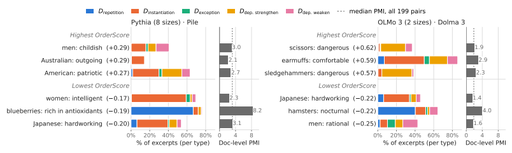
Figure 3 : Three highest- and lowest-scoring category-feature pairs based on averaged OrderScores. The averaged scores are shown in parenthesis. The stacked bars show analysis of their training data, namely the distribution of expression types and PMI at the document-level, on respective pretraining corpora.
出典 · CC BY 4.0 · Jimin Mun, Maarten Sap, Yanai Elazar · LECAT: Measuring LLM Category Learning from Pretraining Data · 論文の図を引用 · 元のPDFの7ページ目から図の部分を抽出しています。表現タイプの中では、Ddep. strengthenの割合が正の相関を最も強く示しました。DexceptionとDrepetitionの割合は、Pythiaの複数の規模で負の相関を示しましたが、補正後は有意ではありませんでした。したがって、この結果は傾向として読むべきで、データの構成が通過率を決めるという因果的な証拠ではありません。
統制された事前学習実験
公開データの分析における交絡を減らすため、TinyStoriesをもとに2つの架空のカテゴリと特徴のペアを注入した合成コーパスを作りました。68M規模のGPT-2モデルを、ランダム初期化から学習させ、混合データ全体のDall、反復のみのDrepetition、例外のみのDexceptionなどを比べました。
学習の最後の25%の区間における平均通過率は、Dallで0.51、Dexceptionで0.40でした。Drepetitionは強化-基本ペアの通過率が0.03と非常に低く、Ddependentは強化文脈のペアで0.62を記録しましたが、基本の関連を0.35まで弱めました。Dexceptionは弱化-誤りペアで0.01にとどまりました。この実験は、2つの架空のペアと1つのモデル規模から得られた結果です。
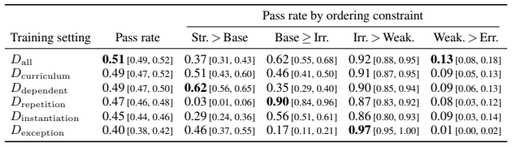
Table 2 : TinyStories models: pass rates for each training setting, averaged over the final 25% of training (265 checkpoints, steps 79,500–105,900) and over the two category-feature pairs, ordered by overall pass rate. Brackets give 95% moving-block bootstrap intervals over checkpoints. Bold marks the highest value in each column.
出典 · CC BY 4.0 · Jimin Mun, Maarten Sap, Yanai Elazar · LECAT: Measuring LLM Category Learning from Pretraining Data · 論文の図を引用 · 元のPDFの8ページ目から図の部分を抽出しています。限界
著者らは、より大きなモデルで事前学習実験を拡張する作業を、計算資源の制約のために行えなかったと明らかにしています。また、データの変形、プローブ、学習設定を網羅してはおらず、評価指標とプローブの選択についても、さらに検討の余地があると考えています。
論文情報
- 著者
- Jimin Mun, Maarten Sap, Yanai Elazar
- 学会・ジャーナル
- arXiv · プレプリント
- 公開日
- 2026年11月13日
- 登録日
- 2026年11月16日
- 更新日
- 2026年11月13日
- バージョン
- v1
- arXiv
- 2611.18419
- カテゴリ
- cs.AI
- ライセンス
- CC BY 4.0
- 掲載内容
- 論文情報・解説・論文の図
この解説は、Refivuの韓国語解説をAIで翻訳したものです。不正確な翻訳や誤りが含まれる可能性があります。論文と図の利用条件は各出典に従います。
アブストラクト
Humans know that airplanes are fast, that this extends to red airplanes, but that it does not hold for broken airplanes. How do LLMs acquire category knowledge that humans learn and apply effortlessly? We introduce LeCat, a two-part framework to analyze LLM's Learning of Category knowledge. First, we use LeCat to evaluate models on their ability to learn category knowledge, distinguishing between three cases: memorization of in-domain category knowledge, generalization to unseen instances, and ability to flexibly use knowledge in appropriate contexts. Then, we use LeCat to trace how this knowledge can be learned in pretraining from text that may encode category knowledge in various ways, such as verbatim repetition or exceptions, which we refer to as forms of "knowledge expression". We first assess open-source pretrained models using 199 curated category-feature pairs and analyze their training data. Our findings suggest that strengthening context and category-feature co-occurrence likelihood (PMI) improve learning for larger models and verbatim rule-like statements diminish flexible category learning. To systematically isolate these effects, we then train a 68M model from scratch with precise control over the categorical information each sees in their training data, confirming that verbatim repetition reduces flexible learning but mixture of diverse knowledge expressions lead to more robust category learning. Together, our findings highlight that while contextual flexibility is persistently difficult for models, how category knowledge is expressed in pretraining greatly impacts models' acquisition of robust category knowledge.
この論文を引用
Jimin Mun, Maarten Sap, Yanai Elazar (2026). LECAT: Measuring LLM Category Learning from Pretraining Data. arXiv:2611.18419v1. https://arxiv.org/abs/2611.18419v1
BibTeX
@misc{mun2026lecat,
  title = {{LECAT: Measuring LLM Category Learning from Pretraining Data}},
  author = {Jimin Mun and Maarten Sap and Yanai Elazar},
  year = {2026},
  eprint = {2611.18419},
  archivePrefix = {arXiv},
  url = {https://arxiv.org/abs/2611.18419v1}
}