論文解説
TASK Memory: Beyond Text-Only Memory with Activation Steering and Knowledge Editing against Memory Hallucination
テキスト記憶を操作して、記憶と矛盾する回答を抑える仕組みを作る
- 課題 LLMは外部から渡された正しいメモを読み込んでも、重みに残った古い事実を優先して答えてしまうことがあります。また、関係の似た別の対象にもそのメモを当ててしまいます。
- 手法 TASK memoryは、テキストのメモにActivation Steeringと知識編集を組み合わせます。両者は同じモデル内のアドレスを共有し、問い合わせごとに記憶を採用するかを決めます。
- 結果 CounterFactで、近傍の質問への誤用率が、テキスト記憶のみの39.2%から7.5%に下がりました。
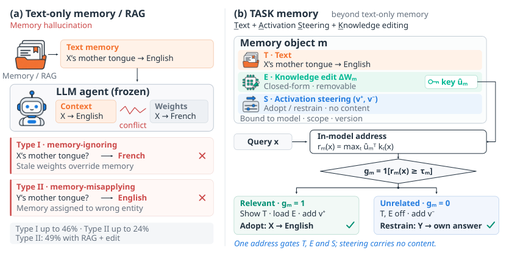
Figure 1 : Memory hallucination: the memory is correct, the answer is not. (a)Text-only memory or RAG puts the retrieved note into the prompt and leaves the rest to the frozen model, where the note in the context conflicts with the stale fact in the weights. On a question about the memory, the weights win and the model answers with the stale fact (Type I, memory-ignoring). On a question about another entity, the note wins and the model assigns the memory to the wrong entity (Type II, memory-misapplying). Across our five models these rates reach 46% and 24%, and Type II reaches 49% when retrieval is combined with weight editing.(b)TASK memory goes beyond text-only memory. Each memory object holdsText content, aKnowledge edit ∆Wm whose key ˆum serves as the in-model address, and a pair ofActivation-Steering vectors (v+, v−) that carry no content. For a query x, the address response rm(x) is compared with the threshold τm. A relevant query showsT, loadsEand adds v+, so the model adopts the memory; an unrelated query leavesTandEoff and addsv −, so the model keeps its own answer.
出典 · CC BY 4.0 · Jinkun Zhao, Wenjun Wu · TASK Memory: Beyond Text-Only Memory with Activation Steering and Knowledge Editing against Memory Hallucination · 論文の図を引用 · arXivのHTML版にある論文の画像ファイルをPNGに変換しています。正しい記憶が使われない失敗
エージェントは、モデルの重みにない事実や古くなった事実を、テキストのメモとして保存します。質問に関係するときは、そのメモをプロンプトに入れて補います。保存と検索を改善すれば解決しそうに見えますが、HaluMemの分析が示すように、記憶の抽出や更新の段階でも幻覚は生じます。一方、本論文が扱うのは、保存された記憶が正しく、プロンプトにも入っているのに回答が矛盾する場合です。これをuse-time memory hallucinationと呼び、モデルのパラメトリックな知識と記憶が競合することで起きると考えられます。
最初のType I(memory-ignoring hallucination)は、重みに古い事実が残っているのに記憶を無視し、古い値を答えてしまう現象です。no-memoryモデルがなお古い事実を答えるクエリに絞ると、テキスト記憶の採用率は14.8–28.6 pp低くなります。その条件では古い答えが4.9–46.3%の割合で出ます。図2の(a)では、古い事実が重みにあるクエリを塗りつぶしの点で、それ以外を白抜きの点で分けて示しています。
Type II(memory-misapplying hallucination)は逆方向で、同じ関係を持つが主語の違う近傍の質問に、記憶の答えを当ててしまいます。近傍の質問では、記憶なしの誤用が1%未満なのに対し、テキスト記憶を入れると5.3–24.3%に上がります。さらに重みの編集を加えたRAG+editingでは、この率が最大49%まで上がります。Type III(version-confusion hallucination)は事実が改訂された後に起き、両方のバージョンが残っている場合、回答の53%が古い値を主張します。
Type IとType IIは逆向きに働くため、どちらか一方を防ぐ大域的な対策では、もう一方が悪化してしまいます。文脈への忠実性を高める手法は、文脈への押し出しを全体に与えるので、Type Iを減らす代わりにType IIを増やします。実際、ゲートのない根拠方向を加えると、Compositeは0.811から0.780に下がり、テキスト記憶のみより低くなりました。知識編集を加えると、今度はType IIが強まります。
記憶を使うかどうかを、モデル内の判断として扱う
TASK memoryの着想は、記憶を使うかどうかを、モデルの内部で行われる独立した判断として扱うことです。判断がネットワーク内にあるなら、それを読み出して操作できます。そこで、記憶を3つの担体(テキスト、ステアリング、知識編集)で構成します。3つは同じモデル内アドレスを共有し、そのアドレスが記憶の表示、パッチの読み込み、ステアリングの選択を同時に決めます。
テキストTは内容を担い、何が事実なのかを版管理された形で保持します。知識編集Eは、MLPに閉形式で書き込み、取り外しのできる局所的な変更です。主語の内部表現をキーとし、そのキーがそのまま記憶のアドレスになります。重みの変更は多段推論の合成にも使われるため、Eはアドレスと合成の二つの役割を持ちます。ステアリングSは内容を持たず、v+で採用を促し、v-で本来の回答を維持させる一対のベクトルです。Sに内容を持たせないのは、テキストがなければ事実は伝わらないためです。テキストのないSだけでは1.7%しか答えられず、モデル本来の値と同じでした。
ゲートを一か所にまとめれば、テキスト、パッチ、ステアリングが互いに矛盾しないと考えられます。大域的な方向は、パラメトリックな知識の上書きを記憶の上書きに変えてしまいます。記憶ごとに採否を決めれば、同じ文脈でも関係のない質問には記憶を当てない使い分けが可能になります。MemT-1.0のように内容をモデルに書き込む方式は、どちらの情報を使うかの仲裁までは変えません。
書き込み・読み出し・改訂の処理
書き込みでは、観測からテキスト記録、アドレスのキー、知識編集のパッチ、ステアリングベクトルの対を作ります。アドレスのキーは、主語の最後のトークンでMLPの下流射影への入力を平均した値です。複数の書き込み文脈から作り、その二次モーメントCの逆行列で方向を重み付けします。読み出し時のアドレス応答は、\\( r_m(x)=\\max_t \\hat u_m^{\\top}k_t(x) \\) として、クエリの各トークンに対する最大で定義されます。閾値τmは、記憶自身の文脈での最小応答と、同じ関係の他の主語での最大応答の中間に設定されます。
編集Eは、ROMEに従ってランク1の更新を作ります。残差δmを\\( \\Delta W_m k_m=\\delta_m \\) を満たすように定めます。この更新は低ランクの因子として保存され、フックでW+BAとして適用されるため、後で元に戻せます。ステアリングSは、残差ストリームの決定位置にだけ加えられ、ゲート値によってv+とv-を切り替えます。学習では凍結したモデルのθを固定し、v+は採用側の損失、v-は注記なしの出力へのKLで訓練します。v-は、関係は同じだが主語が違い、注記を含む近傍の文脈で学習されるため、テキストが誤用される場面を直接抑えます。
読み出しでは、BM25が候補を取り出し、1回の部分順伝播でアドレス応答を計算します。候補は構造化された記憶では上位2件、対話では上位5件の和集合です。ゲート値が1の記憶だけをテキストとして表示し、そのパッチを読み込み、v+を加えます。多段推論では、橋渡しの実体が質問に現れないため、v-を使わずv+だけを使います。改訂時は、新しい観測を直近2件と照合し、エージェント自身のモデルがUPDATEかDIFFERENTかを判定します。UPDATEなら古い記録のT、E、Sを同時に引退させます。Eを残すと2版のキーが似て閉形式解が崩れ、Sを残すと両方の採用ベクトルが働いて二つの対象を押します。
記憶無視と誤用を同時に抑えられるか
CounterFactでは、テキスト記憶のCompositeが0.811で、TASK(T+S)は0.919に上がりました。内訳では、言い換えへの採用率が88.2%から96.7%に上がり、近傍への誤用が39.2%から7.5%に下がりました。ゲートのない根拠方向を加えると誤用は43.5%に増え、Compositeは下がりました。このため、効果はベクトルそのものより、ゲート付きの方向にあると読めます。
図4では、古い事実が重みにある質問でのType Iの回帰率が、4.9–46.3%から0–1.5%に下がっています。Llama-3.1-8BのCounterFactでは46.3%が0%になり、差は−46.3 pp([−53.5, −39.1])でした。Type IIの誤用は5.3–24.3%から1.2–7.4%に下がり、4つのモデルで有意です。Qwen3-14Bは元の誤用が5.3%と低いため、差が小さくなります。二つの失敗が同時に減ることから、Sは文脈への一律の偏りではなく、仲裁の方針を学んでいると解釈されています。
Sを平均方向と記憶ごとの残差に分けると、平均方向だけで0.909に達します。完全なSの0.919との差は統計的に区別できませんでした。残差だけでは0.866で、別の記憶のベクトルでも0.875になり、効果の約60%は再利用できる方向にあります。同じ方向をゲートなしで使うContextFocusやKSDは、10組のうち9組で有意に劣ります。そのため、記憶ごとの特異性はベクトルではなくアドレスにあると読めます。
ライブラリの読み出しと改訂
300件のライブラリでは、BM25 RAGが無関係なクエリにも近い記憶を入れてしまい、局所性は64.9%まで下がりました。アドレスで候補を検証すると局所性は96.9%に戻り、Sを加えるとCompositeは0.950になります。BM25 RAGに対する差は、CounterFactで+16.4 pp、zsREで+16.2 pp です。重みの共通パッチを常に入れると局所性は51.3%まで落ちるため、記憶ごとにゲートしたパッチが重要になります。
記憶数を3,000件まで増やすと、BM25 RAGのCompositeは0.782から0.731に下がり、局所性は56.3%まで落ちます。一方、アドレスで検証したT+Sは0.926を保ち、局所性は91%を超えました。ゲート付きEを加えた構成は0.916で、この設定では重みの寄与は小さいと読めます。
改訂を扱わずに新旧の版を両方残すと、回答の半分が古い値を主張しました。supersessionを入れると、Qwen3-8Bの陳腐化バージョン率は54.7%から10.0%に下がり、Llama-3.1-8Bでは48.0%から0%になりました。この改善は、Qwen3-8Bで48.7 pp、Llama-3.1-8Bで54.7 pp です。ただし、Qwen3-8Bの判定は真の更新の14%を見逃し、オラクルの連結には10.7 pp届きません。
多段推論と他手法との比較
MQuAKE-CF-3kの多段推論では、テキストのみが69.0%、T+Eが76.8%、T+E+S(v+)が76.5%でした。一方、v-まで使うペア型のSは62.2%まで下がります。橋渡しの実体を含む推論では、抑えるべき証拠まで消してしまうためです。旧回答の割合は6.5%から3.0%に半減しており、古い答えが残りにくくなりました。
同じ凍結プロトコルを5つのモデルに適用すると、CounterFactでの改善はモデルによって大きく違います。Llama-3.1-8Bは元のテキスト記憶のCompositeが0.518と低く、+43.0 pp改善しました。一方、Qwen3-14Bはもともと0.923と高く、改善は+2.2 pp にとどまります。モデルが文脈を強く拒むほど改善が大きいと読めます。
同じ文脈を与えた場合でも、TASKはKSD、ContextFocus、CASTに対して10組のうち9組で有意に上回りました。LoCoMoでは、Qwen3-8Bの判定で、セマンティックアドレスのテキストのみが32.8、T+Sが34.2で、BM25の30.8を上回りました。ただし、全文脈の60.3や、トークン数の多いA-Memとは差があり、対話記憶での改善は限定的です。
限界と未解決の課題
文脈に従いやすいモデルでは、TASKの利点が小さくなります。Qwen3-14BのCounterFactでは+2.2 pp にとどまりました。
対話記憶では改善が小さく、リテラルな主語キーは自由形式の質問で関連する事実を取りこぼします。改訂の自動判定は、Qwen3-8Bで真の更新の14%を見逃します。多くの事実を持つ主語では、Llama-3.1-8Bの判定が34%の記憶を誤って置き換えました。書き込みには、1基のGPUで約25秒のステアリング学習と約4秒の編集が必要です。ライブラリの規模も3,000件までです。
CounterFact、zsRE、MQuAKEは合成された反事実の更新であり、回答分類器やLLM判定器は公式の採点器ではありません。AppWorldでは8Bのエージェントがほとんどタスクを完了せず、Sはテストの部分的な合格率だけを+2.2 pp改善しました(有意ではありません)。記憶を採用しやすくすることは、誤った記憶も採用しやすくすることでもあります。そのため、書き込み元の検証が前提になります。
論文情報
- 著者
- Jinkun Zhao, Wenjun Wu
- 学会・ジャーナル
- arXiv · プレプリント
- 公開日
- 2026年11月25日
- 登録日
- 2026年11月27日
- 更新日
- 2026年11月25日
- バージョン
- v1
- arXiv
- 2611.34762
- カテゴリ
- cs.AI
- ライセンス
- CC BY 4.0
- 掲載内容
- 論文情報・解説・論文の図
この解説は、Refivuの韓国語解説をAIで翻訳したものです。不正確な翻訳や誤りが含まれる可能性があります。論文と図の利用条件は各出典に従います。
アブストラクト
LLM agents increasingly rely on external memory, yet they still hallucinate about what they remember. Often the correct memory is retrieved and placed in the prompt, but the answer contradicts it or the memory is applied to the wrong question. We call these use-time memory hallucinations. Across five open models, we find that they arise from the conflict between parametric knowledge and external memory and take three forms: memory-ignoring, where the model returns to a stale fact in its weights (up to 46% of queries); memory-misapplying, where it attributes the memory to unrelated entities (up to 24%, and 49% when retrieval is combined with weight editing); and version confusion, where 53% of answers about revised facts assert the superseded value when both versions remain stored. We propose TASK memory, which goes beyond text-only memory by combining a Text note with Activation Steering and Knowledge editing that share one in-model address. The text holds the content. A removable knowledge edit supplies the address through its subject key and supports multi-hop composition. A pair of steering vectors decides, query by query, whether the model adopts the memory or keeps its own answer; the vectors store no content and control how the text memory is used. On frozen models under a pre-registered, test-once protocol, TASK reduces memory-ignoring hallucinations to at most 1.5% in all ten model-dataset cells and cuts neighbour misuse from 39.2% to 7.5% (+10.8 pp composite on CounterFact). It improves a 300-memory library over BM25 RAG by 16.4 pp, an advantage that holds at 3,000 memories, resolves fact revisions without fact IDs, and adds 7.5 pp of multi-hop accuracy on MQuAKE. 21 of 23 cross-model comparisons (8B-27B, four families) are significant, and TASK beats three recent context-steering methods in 9 of 10 model-dataset cells.
論文の図
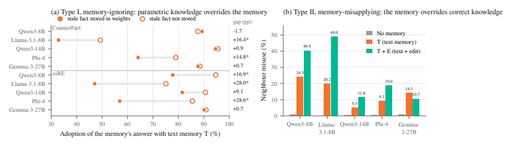
Figure 2 : Use-time memory hallucinations caused by the conflict between parametric knowledge and external memory(test splits, text memory in context, greedy decoding).(a)Type I, memory-ignoring: adoption of the memory’s answer on paraphrased questions. Filled markers: queries on which the no-memory model states the stale fact, i.e. the old fact is in the weights. Hollow markers: all other queries. The gap is in percentage points; ∗ marks a paired world-level bootstrap 95% CI that excludes 0.(b)Type II, memory-misapplying: on neighbour questions (same relation, different subject) that the no-memory model answers correctly, the rate at which the model instead states the memory’s answer. Without memory this is ≤0.9%. With text memory it rises on every model, and with text memory plus a weight edit (T+E) it rises further on four of the five models. All numbers come from frozen predictions (Section A).
出典 · CC BY 4.0 · Jinkun Zhao, Wenjun Wu · TASK Memory: Beyond Text-Only Memory with Activation Steering and Knowledge Editing against Memory Hallucination · 論文の図を引用 · 元のPDFの3ページ目から図の部分を抽出しています。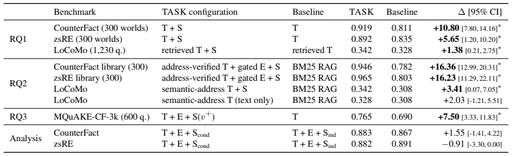
Table 2 : Pre-registered test comparisons(Qwen3-8B; one frozen configuration; each test set run once). ∆ in percentage points with 95% paired-bootstrap CI; bold and ∗: CI excludes 0. The upper bound 0.00 in the last row is exactly zero, so that interval includes 0. Composite = harmonic mean of paraphrase accuracy, canonical accuracy and locality preserved.
出典 · CC BY 4.0 · Jinkun Zhao, Wenjun Wu · TASK Memory: Beyond Text-Only Memory with Activation Steering and Knowledge Editing against Memory Hallucination · 論文の図を引用 · 元のPDFの9ページ目から図の部分を抽出しています。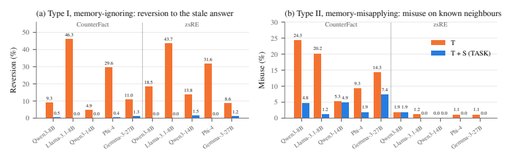
Figure 4 : TASK reduces both types of use-time memory hallucinationon five models and two datasets (test).(a)Type I, memory- ignoring: reversion to the stale parametric answer on queries whose stale fact is in the weights.(b)Type II, memory-misapplying: misuse on neighbour questions that the no-memory model answers correctly. This subset is why the values differ from the misuse over all neighbours in Table 3 (e.g. 24.3% vs. 39.2% for Qwen3-8B withT). Bars give values in %. Per-cell bootstrap CIs are in Section A.
出典 · CC BY 4.0 · Jinkun Zhao, Wenjun Wu · TASK Memory: Beyond Text-Only Memory with Activation Steering and Knowledge Editing against Memory Hallucination · 論文の図を引用 · 元のPDFの10ページ目から図の部分を抽出しています。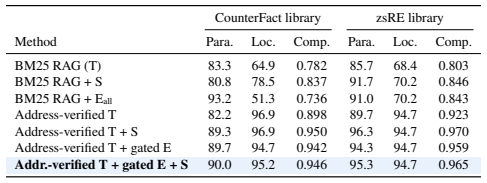
Table 4 : One agent, 300 memories(test; BM25 top-2 candidates) andcontinual revision(dev; 100 insertions then 50 revisions). Eall: one joint patch over all memories, always on.
出典 · CC BY 4.0 · Jinkun Zhao, Wenjun Wu · TASK Memory: Beyond Text-Only Memory with Activation Steering and Knowledge Editing against Memory Hallucination · 論文の図を引用 · 元のPDFの10ページ目から図の部分を抽出しています。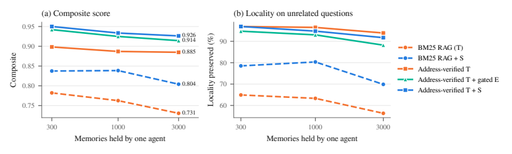
Figure 5 : Scaling the library to 3,000 memories(CounterFact test queries; distractors are training-split memories written by the same writer). Dashed: BM25 retrieval; solid: address-verified reading. Colours follow the carriers as in Figures 2 and 4. At 300 memories, address-verifiedTandT+Shave the same locality (96.9%), so their markers coincide in (b). The full configuration with gatedE(address-verifiedT+ gatedE+S, Table 4) scores 0.946 / 0.928 / 0.916 and lies between the two upper curves in (a); it is omitted for legibility.
出典 · CC BY 4.0 · Jinkun Zhao, Wenjun Wu · TASK Memory: Beyond Text-Only Memory with Activation Steering and Knowledge Editing against Memory Hallucination · 論文の図を引用 · 元のPDFの11ページ目から図の部分を抽出しています。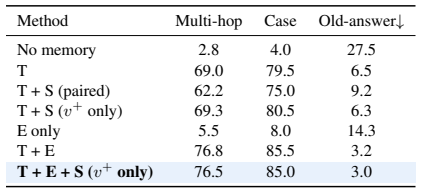
Table 5 : Composition and the parametric carrier.Left:MQuAKE-CF-3k test (200 cases, 600 questions; only edited base facts are written).Right:our closed-formEagainst the original EasyEdit implementations on zsRE test (300 edits).
出典 · CC BY 4.0 · Jinkun Zhao, Wenjun Wu · TASK Memory: Beyond Text-Only Memory with Activation Steering and Knowledge Editing against Memory Hallucination · 論文の図を引用 · 元のPDFの11ページ目から図の部分を抽出しています。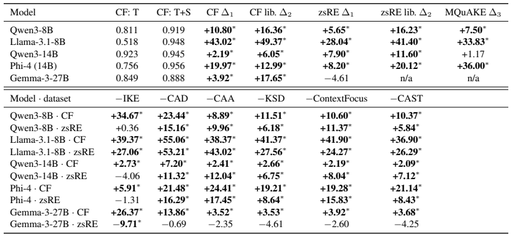
Table 6 : Same frozen protocol on five models(test).Top:gains of TASK. ∆1: T+S − T; ∆2: address-verified T + gated E + S − BM25 RAG (300-memory library); ∆3: T+E+S+ − T (MQuAKE).Bottom:T+S (TASK) minus each context-use baseline with the same note (composite, pp). Bold and ∗: 95% CI excludes 0, in either direction (full CIs in Section D). n/a: not run for Gemma-3-27B, as fixed in advance for compute reasons.
出典 · CC BY 4.0 · Jinkun Zhao, Wenjun Wu · TASK Memory: Beyond Text-Only Memory with Activation Steering and Knowledge Editing against Memory Hallucination · 論文の図を引用 · 元のPDFの12ページ目から図の部分を抽出しています。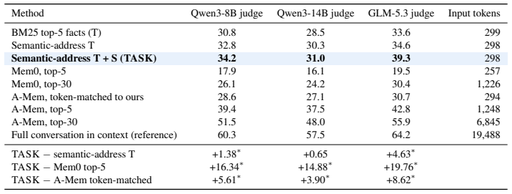
Table 7 : LoCoMo test(8 conversations, 1,230 questions; same answering model, Qwen3-8B). Accuracy under three judges and mean input tokens. Bold: best among methods with at most about 300 input tokens. Paired differences use a conversation-level bootstrap.
出典 · CC BY 4.0 · Jinkun Zhao, Wenjun Wu · TASK Memory: Beyond Text-Only Memory with Activation Steering and Knowledge Editing against Memory Hallucination · 論文の図を引用 · 元のPDFの13ページ目から図の部分を抽出しています。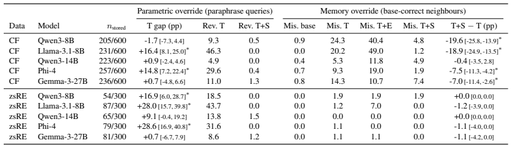
Table 8 :Per-cell conflict statistics (test; %, unless marked pp).
出典 · CC BY 4.0 · Jinkun Zhao, Wenjun Wu · TASK Memory: Beyond Text-Only Memory with Activation Steering and Knowledge Editing against Memory Hallucination · 論文の図を引用 · 元のPDFの18ページ目から図の部分を抽出しています。
Table 10 :Write-time and read-time cost per memory (Qwen3-8B, BF16, one GPU).
出典 · CC BY 4.0 · Jinkun Zhao, Wenjun Wu · TASK Memory: Beyond Text-Only Memory with Activation Steering and Knowledge Editing against Memory Hallucination · 論文の図を引用 · 元のPDFの19ページ目から図の部分を抽出しています。
Table 11 :Revised facts in the version-conflict test (150 revised facts per model). Accuracy columns give the rate of answers with the current value; stale columns give the rate of answers with the superseded value (Type III). For reference, BM25 RAG without supersession has a stale rate of 0.533 (Qwen3-8B) and 0.140 (Llama-3.1-8B).
出典 · CC BY 4.0 · Jinkun Zhao, Wenjun Wu · TASK Memory: Beyond Text-Only Memory with Activation Steering and Knowledge Editing against Memory Hallucination · 論文の図を引用 · 元のPDFの19ページ目から図の部分を抽出しています。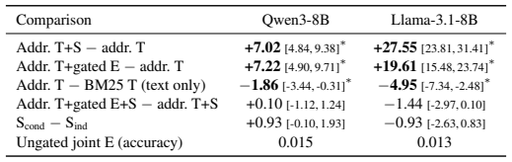
Table 12 :Same-subject library (accuracy differences, pp). Bold and ∗: 95% CI excludes 0, in either direction.
出典 · CC BY 4.0 · Jinkun Zhao, Wenjun Wu · TASK Memory: Beyond Text-Only Memory with Activation Steering and Knowledge Editing against Memory Hallucination · 論文の図を引用 · 元のPDFの20ページ目から図の部分を抽出しています。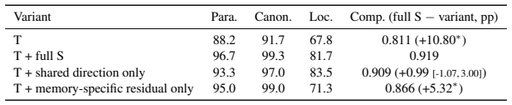
Table 13 :Shared/memory-specific decomposition ofS(CounterFact test, Qwen3-8B; exploratory). Shared = mean of all 300 memories’v + (andv −); residual = own vector minus shared. Every variant keeps the memory’s own address gate.
出典 · CC BY 4.0 · Jinkun Zhao, Wenjun Wu · TASK Memory: Beyond Text-Only Memory with Activation Steering and Knowledge Editing against Memory Hallucination · 論文の図を引用 · 元のPDFの20ページ目から図の部分を抽出しています。この論文を引用
Jinkun Zhao, Wenjun Wu (2026). TASK Memory: Beyond Text-Only Memory with Activation Steering and Knowledge Editing against Memory Hallucination. arXiv:2611.34762v1. https://arxiv.org/abs/2611.34762v1
BibTeX
@misc{zhao2026task,
  title = {{TASK Memory: Beyond Text-Only Memory with Activation Steering and Knowledge Editing against Memory Hallucination}},
  author = {Jinkun Zhao and Wenjun Wu},
  year = {2026},
  eprint = {2611.34762},
  archivePrefix = {arXiv},
  url = {https://arxiv.org/abs/2611.34762v1}
}