論文解説
Pretraining Data Statistics Shape the Phases of Learning Entity Comparison in Language Models
事前学習データの統計が言語モデルにおけるエンティティ比較の学習段階を形作る
- 課題 事前学習データの頻度分布と合成タスクデータが、エンティティ比較タスクでヒューリスティックが現れる順序をどう決めるのかは、難しい問いです。
- 手法 国の面積などのエンティティ比較タスクを、小型モデルとOLMo-2のチェックポイントで、頻度・位置・値の特徴に対する回帰分析により追跡します。
- 結果 小型モデルでは頻度・位置・正解アルゴリズムの3段階が現れ、OLMo-2 13Bと32Bでも同じ順序が観察されました。
研究の問いと背景
この論文は、事前学習データの統計的性質が、言語モデルの学習するヒューリスティックの出現順序をどう決めるのかを問うています。扱う例は、2つのエンティティのうちどちらが特定の数値属性で大きいかを選ぶエンティティ比較です。正解を得るには各エンティティの実際の値を検索して比べる必要がありますが、モデルはプロンプトで先に出てきたエンティティを選んだり、学習中に多く見たエンティティを選んだりするだけでも正解できてしまいます。そのため、どの戦略がいつ現れていつ消えるのかを追跡することが、この研究の出発点です。
著者らはこの問いを2つに分けています。1つ目は、戦略が学習過程のいつ現れていつ消えるのかであり、2つ目は、事前学習データのエンティティ頻度分布がその力学をどう変えるのかです。そのために、小型の制御実験と、公開されているOLMo-2のチェックポイントの分析を併用しています。
タスクの定義と測定方法
タスクは(d, e1, e2)の3つの値で定義されます。ここでdは面積のように数値属性を表すドメイン、e1とe2はエンティティです。正解アルゴリズムは、2つのエンティティの値のうち大きい方を選ぶ最大値演算として定義されます。研究では国、米国の州、大学、映画、人物の9種類の比較タスクを扱い、各タスクには大きい値と小さい値の2つの方向があります。
評価では、2つのエンティティが分かれる最初の生成トークンにおける教師強制のロジットからモデルの選択を得ます。そのうえでチェックポイントごとにロジスティック回帰を行い、頻度・位置・値の特徴がその選択をどの程度説明するかを測定します。重要度は、ある特徴を1つ取り除いたときに精度がどれだけ下がるかを示す、drop-one accuracyで表します。
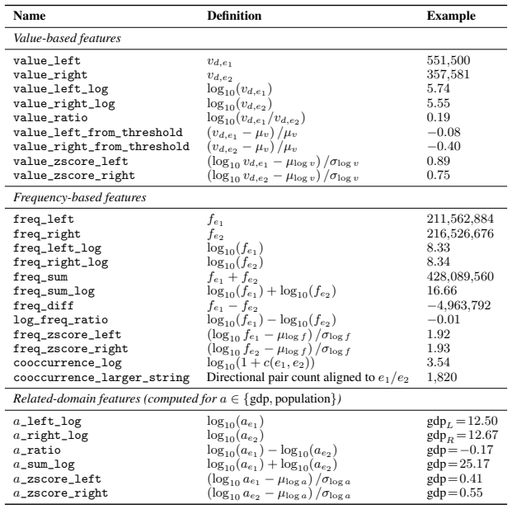
Table 2 : Features evaluated for modeling the LM behavior. Examples are illustrative values for the country area task with e1 = France (vd,e1 = 551,500km2, fe1 = 211,562,884) and e2 = Germany (vd,e2 = 357,581km2,f e2 = 216,526,676).
出典 · CC BY 4.0 · Yik Siu Chan, Jing Huang, Yanai Elazar, Atticus Geiger · Pretraining Data Statistics Shape the Phases of Learning Entity Comparison in Language Models · 論文の図を引用 · 元のPDFの16ページ目から図の部分を抽出しています。合成データ比率による3段階
制御実験では、自然テキストに、評価テンプレートと同じ形式の合成比較文を混ぜました。トークンの総予算は1.1Bに固定し、合成データの比率を0%、0.01%、0.1%、1%と変えています。その結果、頻度ヒューリスティックが最初に現れ、次に位置ヒューリスティックが現れ、タスクデータが十分にあるときに正解アルゴリズムが現れる、3段階が観察されました。
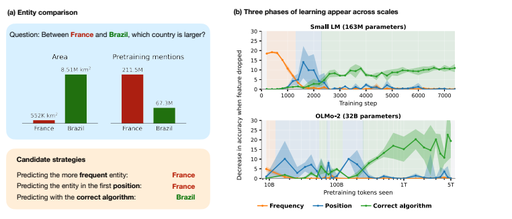
Figure 1 : (a) An example of the entity comparison task we use to disentangle the three candidate strategies. The task requires comparing the areas of two countries; the correct answer is Brazil in the given example. However, if the model relies on positional or frequency bias, it would predict France. (b) The importance of each strategy across training checkpoints, measured by the decrease in accuracy when the feature for that strategy is removed.The frequency heuristic (orange) is most predictive of LM behavior in the earliest checkpoints, but is quickly taken over by the positional heuristic (blue), and the correct algorithm (green) appears in late training.The three-phase structure appears in both the small controlled setting and the large-scale natural text pretraining setting of OLMo-2 models, up to 32B parameters.
出典 · CC BY 4.0 · Yik Siu Chan, Jing Huang, Yanai Elazar, Atticus Geiger · Pretraining Data Statistics Shape the Phases of Learning Entity Comparison in Language Models · 論文の図を引用 · 元のPDFの2ページ目から図の部分を抽出しています。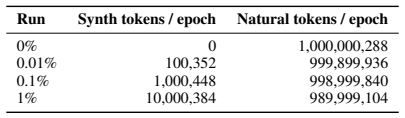
Table 4 : Synthetic and natural text token splits for experiments in Section 3.1.
出典 · CC BY 4.0 · Yik Siu Chan, Jing Huang, Yanai Elazar, Atticus Geiger · Pretraining Data Statistics Shape the Phases of Learning Entity Comparison in Language Models · 論文の図を引用 · 元のPDFの23ページ目から図の部分を抽出しています。合成データが少ないと、正解アルゴリズムは現れませんでした。0%と0.01%では、正解特徴は学習を通して0に近いままでした。0.1%では約2.5Kステップ頃に現れています。1%では1Kステップ以内に現れ、学習の最後に drop-one accuracy 18を記録しました。位置の段階は合成比率が増えるほど縮小し、1%では消えました。頻度の段階は合成比率に関係なく、ほぼ同じ形を示しました。
頻度分布を均一にした実験
2つ目の実験では、自然テキストと合成データの国の頻度分布を、それぞれZipfian分布と均一分布に変えました。自然テキストがZipfianであれば、どの合成分布でも初期の頻度段階が強く現れました。自然テキストが均一だとこの段階は弱まり、両方の分布が均一だとほぼ消えました。
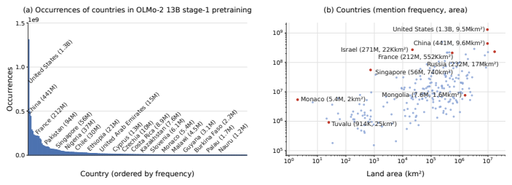
Figure 2 : (a) Occurrences of 215 countries (and territories) in the OLMo-2-13B pretraining corpus, which follow a Zipfian distribution with a long tail. (b) Country frequency correlates with the area attribute (log-log Pearson’s r = 0.62), meaning that predicting the more frequently mentioned country as the larger one is a viable heuristic the model can adopt.
出典 · CC BY 4.0 · Yik Siu Chan, Jing Huang, Yanai Elazar, Atticus Geiger · Pretraining Data Statistics Shape the Phases of Learning Entity Comparison in Language Models · 論文の図を引用 · 元のPDFの4ページ目から図の部分を抽出しています。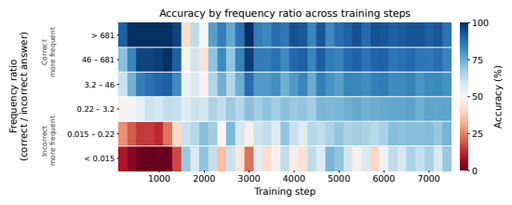
Figure 5 : Accuracy by entity frequency ratio (correct / incorrect entity) across training steps under Zipfian data. Early in training, accuracy is high only when the correct answer is much more frequent, which corresponds to the frequency bias phase. Throughout training, accuracy is consistently higher when the correct entity is more frequent than when it is less frequent.
出典 · CC BY 4.0 · Yik Siu Chan, Jing Huang, Yanai Elazar, Atticus Geiger · Pretraining Data Statistics Shape the Phases of Learning Entity Comparison in Language Models · 論文の図を引用 · 元のPDFの7ページ目から図の部分を抽出しています。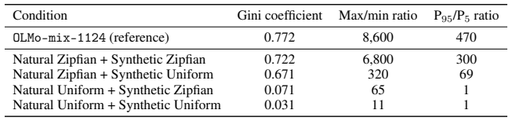
Table 5 : Data distribution statistics across the four training conditions in Section 3.2. We compute the Gini ratio (0 = uniform, 1 = maximally unequal) and range ratios. Max/min is the count of the most mentioned country divided by the count of the least mentioned country, while P95/P5 uses the 95th and 5th percentile counts.
出典 · CC BY 4.0 · Yik Siu Chan, Jing Huang, Yanai Elazar, Atticus Geiger · Pretraining Data Statistics Shape the Phases of Learning Entity Comparison in Language Models · 論文の図を引用 · 元のPDFの23ページ目から図の部分を抽出しています。正解アルゴリズムは逆のパターンを示しました。両方の分布が均一なときに最も早く現れ、drop-one accuracyも最大でした。両方の分布がZipfianのときは最も弱くなりました。著者らは、エンティティの頻度分布が初期の頻度段階を生み、正解アルゴリズムの出現時期にも影響すると解釈しています。この結果は国の面積と国のGDPで確認されており、人物の出生年は付録C.2に別途報告されています。
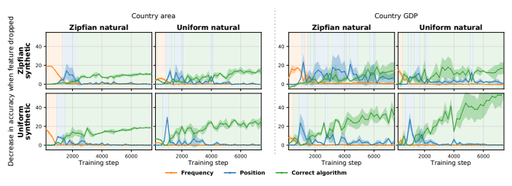
Figure 4 : Learning trajectories for country area (left) and country GDP (right) across four combina- tions of natural text and synthetic data distributions (Zipfian × Uniform).Both tasks show the same frequency, position, correct algorithm ordering. The frequency phase is strongest when natural text is Zipfian.Solid lines and shaded regions show mean and standard deviation across 3 seeds.
出典 · CC BY 4.0 · Yik Siu Chan, Jing Huang, Yanai Elazar, Atticus Geiger · Pretraining Data Statistics Shape the Phases of Learning Entity Comparison in Language Models · 論文の図を引用 · 元のPDFの6ページ目から図の部分を抽出しています。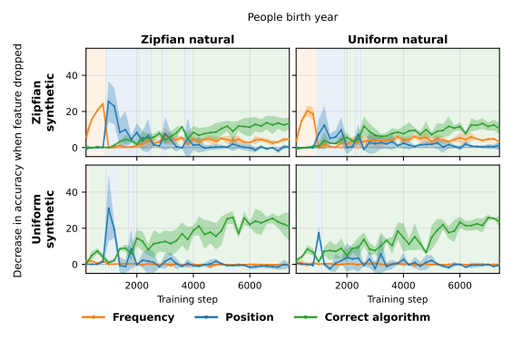
Figure 18 : Learning trajectories for the people birth year task across four combinations of natural text and synthetic data distributions (Zipfian or uniform). Solid lines and shaded regions show mean and standard deviation across 3 seeds.
出典 · CC BY 4.0 · Yik Siu Chan, Jing Huang, Yanai Elazar, Atticus Geiger · Pretraining Data Statistics Shape the Phases of Learning Entity Comparison in Language Models · 論文の図を引用 · 元のPDFの25ページ目から図の部分を抽出しています。OLMo-2チェックポイントにおける段階構造
小型の制御実験と同じ分析を、OLMo-2の1B、7B、13B、32Bのチェックポイントに適用しました。すべての規模で頻度の段階は位置の段階より先に現れました。1Bと7Bのモデルは長い位置ヒューリスティックの段階にとどまり、タスクを学習できませんでした。13Bは約1Tトークンで、32Bは約400Bトークンで正解アルゴリズムの段階に移りました。
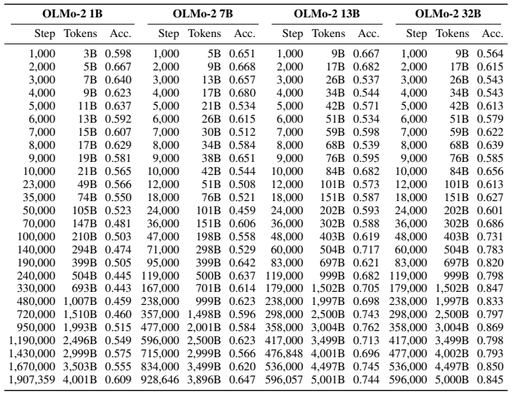
Table 6 : OLMo-2 checkpoints used in our evaluation, with comparison accuracy at each checkpoint. We compare the logprobs of the first token at which the entity names diverge (e.g., when comparing United StatesandUnited Kingdom, we take the logprobs ofStatesandKingdom).
出典 · CC BY 4.0 · Yik Siu Chan, Jing Huang, Yanai Elazar, Atticus Geiger · Pretraining Data Statistics Shape the Phases of Learning Entity Comparison in Language Models · 論文の図を引用 · 元のPDFの26ページ目から図の部分を抽出しています。頻度の段階が最初の公開チェックポイントより前に存在しうるという点は、別途確認が必要でした。著者らはOLMo-2 1Bのstage-1学習を初期化から1,000ステップまで再実行し、9つの課題のうち7つで、最初の200ステップ以内に頻度の段階が現れたと報告しています。残りの2つの課題は値の段階として現れましたが、1Bの精度が低いため、ノイズの可能性があると解釈しています。
9つの課題と18の変種
OLMo-2 32Bを、9つの課題について大きい値と小さい値の2つの方向、合計18の変種で分析しました。最も早いチェックポイントである9Bトークンでは、18の変種のうち15で頻度ヒューリスティックが支配的でした。このうち、小さい値の方向の変種9つのうち8つが含まれます。小さい値の比較では、より多く出現したエンティティを選ぶことは通常誤答になるため、この結果は、初期段階が部分的なタスク知識よりもエンティティの頻度統計を反映しているという解釈を裏付けます。
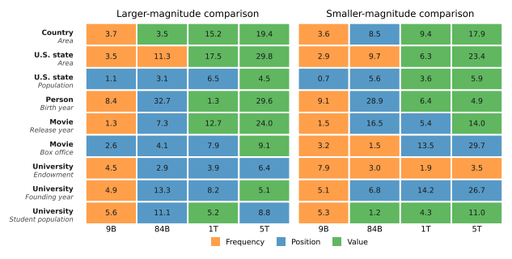
Figure 7 : Dominant phase for OLMo-2 32B across all 18 task variants at four stage-1 checkpoints (9B, 84B, 1T, and 5T tokens). Each cell is colored by the feature with the largest drop-one accuracy at that checkpoint, and the number is that feature’s drop-one accuracy (%). Left: larger-magnitude comparisons; right: smaller-magnitude comparisons.Frequency dominates the earliest checkpoint for most variants, and later phases largely follow the frequency–position–value structure.
出典 · CC BY 4.0 · Yik Siu Chan, Jing Huang, Yanai Elazar, Atticus Geiger · Pretraining Data Statistics Shape the Phases of Learning Entity Comparison in Language Models · 論文の図を引用 · 元のPDFの9ページ目から図の部分を抽出しています。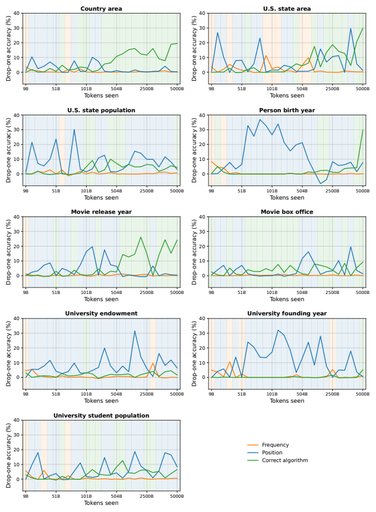
Figure 19 : Learning trajectories for each of the nine comparison tasks for OLMo-2 32B, where the correct answer is thelargerentity.
出典 · CC BY 4.0 · Yik Siu Chan, Jing Huang, Yanai Elazar, Atticus Geiger · Pretraining Data Statistics Shape the Phases of Learning Entity Comparison in Language Models · 論文の図を引用 · 元のPDFの28ページ目から図の部分を抽出しています。すべての段階が現れるわけではありませんが、現れる段階の順序はおおむね保たれました。複数の段階が支配的になるチェックポイントでは、主に頻度、位置、値の順序が観察されました。
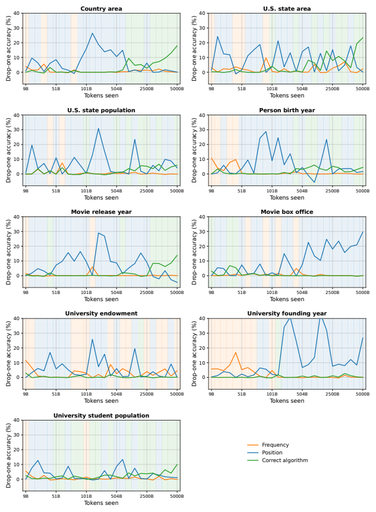
Figure 20 : Learning trajectories for each of the nine comparison tasks for OLMo-2 32B, where the correct answer is thesmallerentity.
出典 · CC BY 4.0 · Yik Siu Chan, Jing Huang, Yanai Elazar, Atticus Geiger · Pretraining Data Statistics Shape the Phases of Learning Entity Comparison in Language Models · 論文の図を引用 · 元のPDFの29ページ目から図の部分を抽出しています。残された課題
制御実験は163Mの規模で行われており、この規模の結果をそのまま大規模モデルに当てはめるには限界があります。著者らは、小規模な介入実験からも学習の力学に関する洞察が得られたと見ていますが、OLMo-2の分析では、規模が大きくなったときにデータの役割を因果的に示すことはできません。
また、頻度分布を変えるためにシーケンスを選び直すと、ドメインの変化や他の交絡要因が入り込む可能性があり、それを制御する方法は未解決の問題として残っています。エンティティ比較以外のタスク構造でも同じ段階構造が現れるかどうかは、この論文では確認していません。
論文情報
- 著者
- Yik Siu Chan, Jing Huang, Yanai Elazar, Atticus Geiger
- 学会・ジャーナル
- arXiv · プレプリント
- 公開日
- 2026年11月12日
- 登録日
- 2026年11月13日
- 更新日
- 2026年11月12日
- バージョン
- v1
- arXiv
- 2611.16882
- カテゴリ
- cs.CL · cs.LG
- ライセンス
- CC BY 4.0
- 掲載内容
- 論文情報・解説・論文の図
この解説は、Refivuの韓国語解説をAIで翻訳したものです。不正確な翻訳や誤りが含まれる可能性があります。論文と図の利用条件は各出典に従います。
アブストラクト
How does data shape language model (LM) behavior throughout pretraining? We investigate this question through a case study on entity comparison, e.g., Between France and Brazil, which country is larger?, across nine comparison tasks spanning five entity types. We begin with controlled experiments in which we train small LMs (163M parameters) on mixtures of natural text from pretraining corpora and synthetic task data. Our analysis identifies three distinct phases of learning: (1) an early phase where the LM selects entities by frequency, (2) a middle phase where the LM selects entities by position in the prompt (first vs. last mentioned entity), and (3) a late phase where the LM selects the entity that is the correct answer. We show that the emergence of these three phases is causally determined by statistical properties of the training data. With small amounts of task-specific synthetic data, we observe only the first two phases and the model fails to learn the task; with large amounts, the model jumps directly from the frequency-based heuristic to solving the task correctly. Moreover, changing the entity frequency distribution from a naturally occurring Zipfian distribution (a small number of entities are very common and the vast majority are rare) to a uniform one weakens the frequency phase and speeds up learning of the task. Lastly, we show that the three phases of training dynamics from our controlled experiments appear in the open source model OLMo-2 32B. Together, our findings demonstrate that properties of pretraining data are causal drivers of heuristic learning and show that small-scale synthetic experiments can predict training dynamics at larger scales.
この論文を引用
Yik Siu Chan, Jing Huang, Yanai Elazar, Atticus Geiger (2026). Pretraining Data Statistics Shape the Phases of Learning Entity Comparison in Language Models. arXiv:2611.16882v1. https://arxiv.org/abs/2611.16882v1
BibTeX
@misc{chan2026pretraining,
  title = {{Pretraining Data Statistics Shape the Phases of Learning Entity Comparison in Language Models}},
  author = {Yik Siu Chan and Jing Huang and Yanai Elazar and Atticus Geiger},
  year = {2026},
  eprint = {2611.16882},
  archivePrefix = {arXiv},
  url = {https://arxiv.org/abs/2611.16882v1}
}