論文解説
Electrocardiographic Imaging via Posterior Sampling under Operator Discrepancy
演算子不一致下の事後サンプリングによる心電図イメージング
- 課題 ECGIの逆問題では、名目上の順方向演算子と実際の記録演算子との差が、拡散事後サンプリングによる再構成を揺るがす問題です。
- 手法 信号条件付きの近似誤差モデルで演算子を補正し、残った不一致を白色化された尤度に入れて、固定された拡散事前分布と結合します。
- 結果 肺の伝導度の不一致と皮下脂肪の不一致の両条件で、40 dBの生理学テストにおけるREが最も低いと報告されています。
心臓表面電位の再構成の難しさ
心電図イメージング(ECGI)は、体表で測定した電位から心臓表面電位(HSP)を復元する逆問題です。この問題は不良設定(ill-conditioned)なので、測定誤差やモデル誤差がわずかにあるだけでも、復元結果が大きく揺れます。TikhonovやTotal Variationといった既存の正則化は安定性を高めますが、一般的な滑らかさの仮定だけを用いるため、局所的な活性化パターンがぼやけることがあります。
拡散事後サンプラーは、学習された拡散事前分布と明示的な順方向演算子を組み合わせて、このような逆問題を解きます。ただし、この方法は順方向演算子が正確だと仮定しています。ECGIで再構成に使う名目演算子は、解剖学モデルと仮定された組織伝導度から作られた推定値です。そのため、呼吸、姿勢、電極位置、皮下脂肪などの要因によって、実際の測定時の記録演算子と異なることがあります。この差を演算子不一致と呼び、その誤差は心臓信号に応じて構造的に変わります。
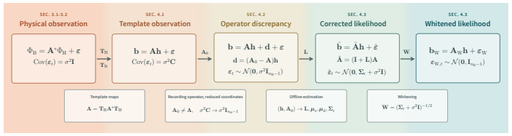
Figure 2 :Model. The diagram traces the observation model from the physical forward problem to the whitened likelihood consumed by the posterior sampler. The recording operator A0 generates the observation, while the nominal operator A is used for reconstruction; from the discrepancy panel onward, all quantities are expressed in reduced coordinates.
出典 · CC BY 4.0 · Ricarda Buttmann, Andreas M. Lehrmann · Electrocardiographic Imaging via Posterior Sampling under Operator Discrepancy · 論文の図を引用 · 元のPDFの6ページ目から図の部分を抽出しています。この論文では、演算子不一致を信号と無関係な測定ノイズとして扱わず、名目信号に条件付けされた近似誤差としてモデル化する手法を扱います。
論文情報
- 著者
- Ricarda Buttmann, Andreas M. Lehrmann
- 学会・ジャーナル
- arXiv · プレプリント
- 公開日
- 2026年11月13日
- 登録日
- 2026年11月16日
- 更新日
- 2026年11月13日
- バージョン
- v1
- arXiv
- 2611.17851
- カテゴリ
- cs.LG
- ライセンス
- CC BY 4.0
- 掲載内容
- 論文情報・解説・論文の図
この解説は、Refivuの韓国語解説をAIで翻訳したものです。不正確な翻訳や誤りが含まれる可能性があります。論文と図の利用条件は各出典に従います。
アブストラクト
Electrocardiographic imaging (ECGI) reconstructs heart-surface potentials from body-surface potentials, an ill-posed inverse problem. Diffusion posterior samplers combine a learned prior with an explicit forward operator that they assume to be accurate. In ECGI this operator is only an estimate, because the body changes with respiration and posture, and body composition such as subcutaneous fat is rarely known for an individual patient. The resulting operator discrepancy is structured and depends on the heart signal. We introduce OpDis-PS, a diffusion posterior sampler that models this discrepancy instead of treating it as signal-independent noise. OpDis-PS learns how the discrepancy depends on the signal, folds this into a corrected forward operator, and reconstructs with a fixed prior across all operator conditions. We study two realistic sources of discrepancy, changing lung conductivity and an added subcutaneous-fat layer. Across both, OpDis-PS reconstructs more accurately than classical regularization and learned predictors, with its largest gains on held-out cardiac pathologies.
この論文を引用
Ricarda Buttmann, Andreas M. Lehrmann (2026). Electrocardiographic Imaging via Posterior Sampling under Operator Discrepancy. arXiv:2611.17851v1. https://arxiv.org/abs/2611.17851v1
BibTeX
@misc{buttmann2026electrocardiographic,
  title = {{Electrocardiographic Imaging via Posterior Sampling under Operator Discrepancy}},
  author = {Ricarda Buttmann and Andreas M. Lehrmann},
  year = {2026},
  eprint = {2611.17851},
  archivePrefix = {arXiv},
  url = {https://arxiv.org/abs/2611.17851v1}
}