論文解説
Don't Match the Noise: Distribution Matching under Unknown Measurement Error with an Audit Sample
ノイズに合わせない:監査サンプルを用いた未知の測定誤差下での分布マッチング
- 課題 ノイズを含む目標サンプルでMMDを計算すると、潜在分布ではなく測定過程に合わせてしまうバイアスが生じます。
- 手法 監査サンプルで観測されるカーネル差分項を使って、qqとpqのカーネル和を補正するMEC-MMDを提案します。
- 結果 単純無作為監査のもとでオラクルMMDに対して不偏であることを証明しました。密度推定実験では、複数の監査サイズについてconvMMDおよびXDGMMと比較しています。
測定誤差を含む目標サンプルの問題
多くの科学・機械学習のパイプラインでは、潜在的な目標値Yを直接観測できず、測定誤差を含む代理値eYしか得られません。このとき、eYで直接計算したMMDは潜在分布qではなく、測定過程の産物に合わせてしまうため、バイアスが生じます。この論文は、大量のノイズ付きサンプルと小規模な監査サンプルが同時にある状況で、ノイズモデルを明示せずに潜在的な目標分布に対するMMDを推定する問題を扱います。
監査サンプルでカーネル和を補正する手法
提案手法のMEC-MMDは、オラクル経験的MMDのqqカーネル和とpqカーネル和を、監査サンプルで補正します。監査集合Lの各ペアについて、Γ_jj' = k(Y_j, Y_j') − k(eY_j, eY_j')とΛ_ij = k(X_i, Y_j) − k(X_i, eY_j)を計算できるため、ノイズ付きサンプルに基づく和に、監査ペアの補正項を加えます。単純無作為監査では、この補正はHorvitz–Thompson形式で書け、各監査単位とペアに、包含確率の逆数に相当する重みN/mとN(N−1)/{m(m−1)}を掛けます。ノイズモデルや補正関数を別途推定しない点が鍵です。
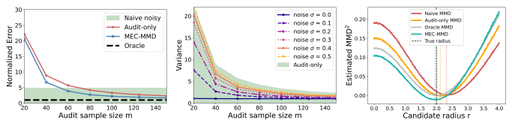
Figure 1 :Left Panel.Normalized error (MSE divided by the oracle’s) versus audit size. The naive estimator is low-variance but biased, the audit-only estimator is unbiased but high-variance, and MEC-MMD removes bias while reducing variance.Middle Panel.Effect of measurement noise on MMD estimation variance for several noise levels σ. The shaded region is the audit-only variance, independent of σ.Right Panel.MEC-MMD closely matches the oracle objective and correctly identifies the true parameter with lower bias and variance. See Supplementary Materials for details.
出典 · CC BY 4.0 · Arya Farahi, Ritwik Vashistha · Don't Match the Noise: Distribution Matching under Unknown Measurement Error with an Audit Sample · 論文の図を引用 · 元のPDFの6ページ目から図の部分を抽出しています。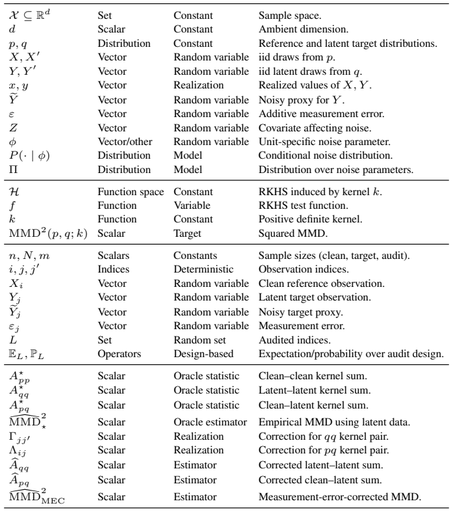
Table 6 : Summary of notation.
出典 · CC BY 4.0 · Arya Farahi, Ritwik Vashistha · Don't Match the Noise: Distribution Matching under Unknown Measurement Error with an Audit Sample · 論文の図を引用 · 元のPDFの19ページ目から図の部分を抽出しています。不偏性と一貫性の保証
定理3.1は、単純無作為監査の条件では、MEC推定量の期待値がオラクル経験的MMDと一致することを示しています。定理3.5は、監査サイズが標本サイズに比例する条件で、MEC-MMDがMMD²(p, q; k)に確率収束し、誤差がO_P(N^{-1/2})で与えられると述べています。分散は、監査設計に由来する1次の射影項と、退化した2次の残差項に分かれ、1次の項がほとんどを説明します。これらの結果は、カーネルが有界であり、監査が固定サイズの単純無作為標本であるという仮定のもとで成り立ちます。

Table 8 : Numerical check of Theorems 3.1, 3.2 and 3.4; 40 populations, 3000 simple random audits
出典 · CC BY 4.0 · Arya Farahi, Ritwik Vashistha · Don't Match the Noise: Distribution Matching under Unknown Measurement Error with an Audit Sample · 論文の図を引用 · 元のPDFの29ページ目から図の部分を抽出しています。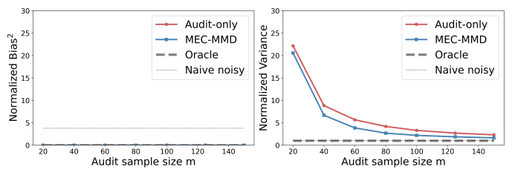
Figure 5 : Bias (left panel) and variance (right panel) for the Gaussian measurement-error experiment in Figure 1. The left panel reports empirical bias relative to MMD2(p, q;k), and the right panel reports empirical variance. The naïve noisy estimator has the smallest variance among practical methods because it uses all N observed target points, but it is biased because it ignores measurement error. The audit-only estimator is unbiased but has substantially larger variance since its effective target sample size is only m. MEC-MMD uses the noisy sample to retain efficiency and the audit sample to remove bias, yielding a markedly better bias–variance tradeoff: much lower variance than audit-only estimation and far smaller bias than the naive noisy estimator. The oracle variance serves as the lower benchmark corresponding to full access to the latent target sample.
出典 · CC BY 4.0 · Arya Farahi, Ritwik Vashistha · Don't Match the Noise: Distribution Matching under Unknown Measurement Error with an Audit Sample · 論文の図を引用 · 元のPDFの30ページ目から図の部分を抽出しています。密度推定と次元拡張の実験
実験4では、10成分のガウス混合で作った猫の足裏形の密度を、N=2000とし、監査サイズmを変えた条件で推定しました。評価指標はISEで、比較対象としてconvMMDとXDGMMを置きました。実験7では、らせん状のリボンをd∈{3,7,11,15,20,30}に拡張し、監査サイズm=400を固定して、sliced Wasserstein distanceに√dを掛けた値を比較しました。この2つの実験はデータ、指標、条件が異なるため、結果を1つの評価にまとめてはいません。
小さな監査サンプルと非一様監査の限界
著者らは、監査サンプルが小さい場合、補正項が分散を大きくするため、naive推定量よりMSEが大きくなりうると見ています。監査が無作為ではなく層化や結果依存の方法で行われる場合、本文の分散とCLTの結果は適用されません。非一様監査へのIPW拡張はAppendix CとEで扱いますが、逆確率重みが大きくなることによる分散の問題と、包含確率の推定は今後の課題として残しています。

Table 2 : ISE under a non-uniform (stratified) audit with known inclusion probabilities (Gaussian noise, N = 2000; mean ± standard error over 10 seeds). MEC-MMD-IPW uses inverse-probability (Hájek) weights; bold marks the best non-oracle method.
出典 · CC BY 4.0 · Arya Farahi, Ritwik Vashistha · Don't Match the Noise: Distribution Matching under Unknown Measurement Error with an Audit Sample · 論文の図を引用 · 元のPDFの8ページ目から図の部分を抽出しています。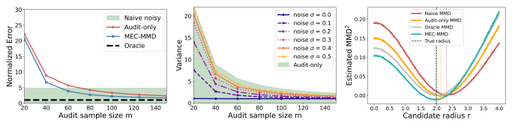
Figure 6 :Left Panel.Estimation error. The oracle estimator uses the full latent sample and yields a lower-variance bound. The naive estimator based on the full noisy sample has low variance but is biased for MMD2(p, q;k). The audit-only estimator removes this bias but has a much larger variance because it uses only m latent target points. MEC-MMD combines noisy samples with audit-based correction, thereby removing bias induced by noisy measurements while achieving substantially lower variance than audit-only estimation.Middle Panel.Measurement error effect on estimator variance. The horizontal axis shows the audit sample size m, and the vertical axis shows the variance of the estimator. Colored curves correspond to different noise levels σ∈ {0,0.1,0.2,0.3,0.4,0.5} . As measurement noise increases, the variance of the MEC-MMD estimator rises substantially, especially when the audit sample is small, because the correction must be estimated from a limited number of latent target points. For every noise level, increasing m reduces variance, reflecting the improved precision of the audit-based correction. When σ= 0 , the variance equals oracle variance and is flat in m, since no measurement-error correction is needed. The results illustrate that measurement noise primarily affects statistical efficiency rather than identifiability: larger noise inflates uncertainty, but this effect can be mitigated by increasing the audit sample size.Right Panel.Parameter estimation. The horizontal axis shows candidate radii, and the vertical axis shows the corresponding empirical MMD objective. Vertical lines indicate the minimizing radius for each estimator. The naive estimator (red) is biased because it compares candidate models to noisy observations. The audit-only estimator (orange) removes this bias but has higher variability due to the small audit sample. The proposed MEC-MMD estimator (teal) combines the full noisy dataset with audit-based corrections and closely matches the oracle estimator (gray), correctly identifying the true radius.
出典 · CC BY 4.0 · Arya Farahi, Ritwik Vashistha · Don't Match the Noise: Distribution Matching under Unknown Measurement Error with an Audit Sample · 論文の図を引用 · 元のPDFの32ページ目から図の部分を抽出しています。論文情報
- 著者
- Arya Farahi, Ritwik Vashistha
- 学会・ジャーナル
- arXiv · プレプリント
- 公開日
- 2026年11月10日
- 登録日
- 2026年11月13日
- 更新日
- 2026年11月10日
- バージョン
- v1
- arXiv
- 2611.14749
- カテゴリ
- stat.ML · cs.LG · stat.ME
- ライセンス
- CC BY 4.0
- 掲載内容
- 論文情報・解説・論文の図
この解説は、Refivuの韓国語解説をAIで翻訳したものです。不正確な翻訳や誤りが含まれる可能性があります。論文と図の利用条件は各出典に従います。
アブストラクト
Real-world machine learning systems often operate on imperfect measurements: sensors are noisy, annotations are produced by non-experts, and scientific observations are often indirect. In these settings, classic distribution comparison tools such as maximum mean discrepancy (MMD) can be systematically biased, matching artifacts of the measurement process rather than the underlying mechanisms of interest. We study a practical regime in which noisy observations are abundant, but only a small audited subset contains ground-truth measurements. We propose measurement-error-corrected MMD (MEC-MMD), an audit-based estimator that debiases kernel evaluations without requiring a noise model. MEC-MMD is exactly unbiased for the oracle MMD under simple random auditing, admits an explicit variance decomposition, and is consistent for the population MMD, achieving the standard $O_p(N^{-1/2})$ rate when the audit size scales with the dataset. We demonstrate the utility of distributional matching with MEC-MMD loss for both parameter estimation and unsupervised applications, showing that MEC-MMD consistently outperforms MMD and alternative methods. These results provide a principled foundation for robust distribution comparison, simulation-based inference, and learning in noisy real-world machine learning pipelines.
この論文を引用
Arya Farahi, Ritwik Vashistha (2026). Don't Match the Noise: Distribution Matching under Unknown Measurement Error with an Audit Sample. arXiv:2611.14749v1. https://arxiv.org/abs/2611.14749v1
BibTeX
@misc{farahi2026match,
  title = {{Don't Match the Noise: Distribution Matching under Unknown Measurement Error with an Audit Sample}},
  author = {Arya Farahi and Ritwik Vashistha},
  year = {2026},
  eprint = {2611.14749},
  archivePrefix = {arXiv},
  url = {https://arxiv.org/abs/2611.14749v1}
}