論文解説
Learning-Based Interpolation of Detector Gaps in Photon-Counting X-ray Imaging
光子計数X線イメージングにおける検出器ギャップの学習ベース補間
- 課題 検出器ギャップは位相復元や再構成の前に埋める必要がありますが、ギャップの外を変えず、ギャップ内の強度統計も保存しなければならないため難しい問題です。
- 手法 線形補間で事前に埋めた入力にU-Netの残差を加え、反転したマスクでギャップの画素だけが変わるように制限しました。
- 結果 シミュレーションのギャップでは、WGAN-GPとPix2PixがLPIPSとヒストグラム距離で最も良い結果を記録しました。Pix2Pixの学習時間は31.2 GPU-hoursで、WGAN-GPの154.4 GPU-hoursより短くなりました。
検出器ギャップが再構成に与える問題
タイル型の検出器は、モジュールの間に物理的なギャップが生じます。この空白領域は、位相復元や断層再構成の前に埋める必要があります。自然画像のインペインティングと異なり、検出器ギャップの補間ではギャップの外の画素を一切変えてはならず、ギャップ内の強度統計も保存しなければなりません。ギャップ内部の平均強度がわずかでもずれると、再構成後にリングアーティファクトが生じるおそれがあるためです。この論文は、この条件のもとで、従来の線形補間、Navier–Stokesインペインティング、MADFを、WGAN-GPとPix2Pixの生成モデルと比較しています。
マスキングされたU-Net生成器と損失の構成
WGAN-GPとPix2Pixは、同じ5段階のU-Net生成器を使います。入力は、線形補間で事前に埋めた画像と二値のギャップマスクです。生成器が予測した残差に反転したマスクを掛けてから、入力に加えます。そのため、ギャップの外の画素は数学的に変わらず、生成器は線形補間に対する補正のみを学習します。損失は、ギャップ内部のMSE、ギャップ内部の平均差、soft histogramに基づくEMD項、敵対的項を重み付きで足し合わせたものです。soft histogramは、各画素をbin幅と同じガウシアンカーネルに分配し、勾配が残るようにしたものです。EMDは、二つの累積分布の間の面積として計算します。
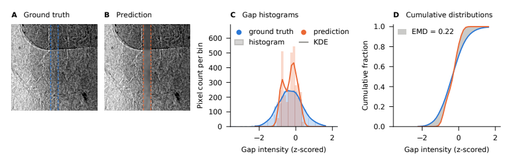
Figure 1 :Histogram-based training loss. AGround-truth patch with a detector gap (dashed lines).BGap prediction with correct mean intensity yet over-smoothed.CHard and soft histograms of the gap pixels. In the soft histogram, each pixel contributes a Gaussian of one bin width.DCumulative distributions of the soft histograms. The area between them is the estimated Earth Mover’s Distance (EMD).
出典 · CC BY 4.0 · Johannes B. Thalhammer, Patrick Ilg, Tina Dorosti, Sebastian Peterhansl, Theresa Hiu, Daniel Frey, Zijin Huang, Florian Schaff, Daniela Pfeiffer, Franz Pfeiffer · Learning-Based Interpolation of Detector Gaps in Photon-Counting X-ray Imaging · 論文の図を引用 · 元のPDFの3ページ目から図の部分を抽出しています。シミュレーションのギャップにおける手法の比較
シミュレーションのギャップの評価は、projectionデータセットのテストセットから256×128画素のパッチを使って行いました。WGAN-GPとPix2Pixは、LPIPSとヒストグラム距離で最も良い結果を記録しました。線形補間を除けば、推論時間も最も短くなりました。Pix2Pixの学習時間は31.2 GPU-hoursで、WGAN-GPの154.4 GPU-hoursより短くなりました。平均差、LPIPS、ヒストグラム距離は、いずれも値が小さいほど良い指標です。
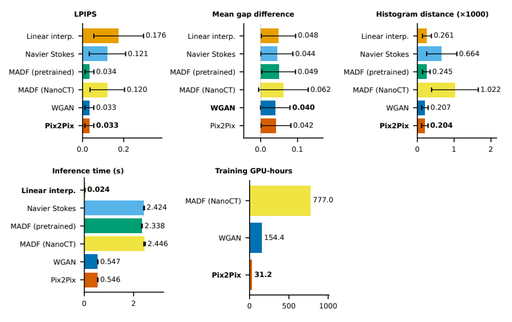
Figure 4 : Quantitative comparison of all methods on simulated gaps in the test set. Top: LPIPS, mean gap difference, and histogram distance (×1000). Bottom: inference time per 256×128 -pixel patch and training time in GPU-hours on an NVIDIA RTX 3090. For all quantities, lower is better; the best value in each panel is shown in bold. Bars show the mean and error bars the standard deviation, except for the training time, which is a single value per model.
出典 · CC BY 4.0 · Johannes B. Thalhammer, Patrick Ilg, Tina Dorosti, Sebastian Peterhansl, Theresa Hiu, Daniel Frey, Zijin Huang, Florian Schaff, Daniela Pfeiffer, Franz Pfeiffer · Learning-Based Interpolation of Detector Gaps in Photon-Counting X-ray Imaging · 論文の図を引用 · 元のPDFの8ページ目から図の部分を抽出しています。マスキングと損失項の寄与
WGAN-GPでは、マスクを使わないplainモデルで予測値のずれが見られました。出力にマスクを掛けると出力は安定しましたが、平均オフセットは残りました。ここにEMD項と平均項を加え、線形の事前補間を入れると、平均ギャップ差はおよそ半分に減りました。Pix2Pixのアブレーション実験は、マスクを常に適用した状態で行いました。線形の事前補間と二つの損失項は、主に平均差とヒストグラム距離を改善しました。著者らは、ネットワーク出力のマスキングが最も大きな効果をもたらした要素だと解釈しています。
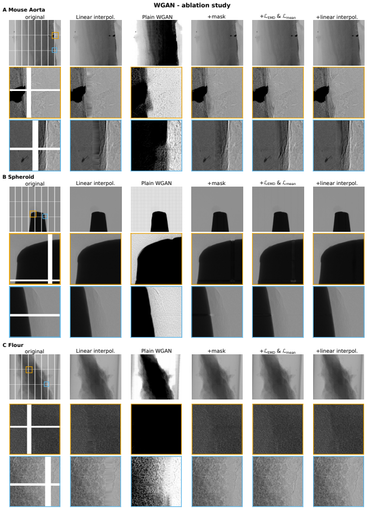
Figure 5 : WGAN-GP ablation study on measured projections with real detector gaps ofAa mouse aorta,Ba spheroid, andCa flour sample. Columns: original projection, linear interpolation, plain WGAN-GP, and WGAN-GP with components added cumulatively from left to right (masking, LEMD and Lmean, linear pre-interpolation). Rows: full image (1475×1679pixels) and the regions marked in orange (200×200pixels) and blue (150×150pixels).
出典 · CC BY 4.0 · Johannes B. Thalhammer, Patrick Ilg, Tina Dorosti, Sebastian Peterhansl, Theresa Hiu, Daniel Frey, Zijin Huang, Florian Schaff, Daniela Pfeiffer, Franz Pfeiffer · Learning-Based Interpolation of Detector Gaps in Photon-Counting X-ray Imaging · 論文の図を引用 · 元のPDFの9ページ目から図の部分を抽出しています。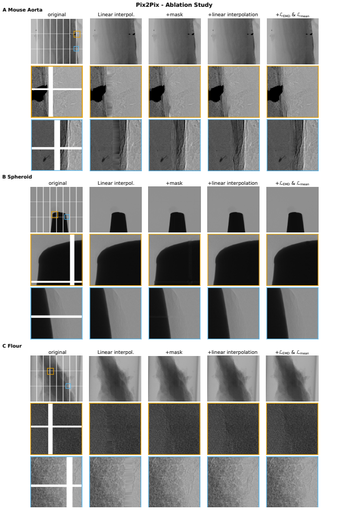
Figure 7 : Pix2Pix ablation study on measured projections with real detector gaps ofAa mouse aorta,Ba spheroid, and Ca flour sample. Columns: input with the gaps set to zero, linear interpolation, and Pix2Pix with components added cumulatively from left to right (masking, linear pre-interpolation, LEMD and Lmean). Rows: full image (1475×1679 pixels) and the regions marked in orange (200×200pixels) and blue (150×150pixels).
出典 · CC BY 4.0 · Johannes B. Thalhammer, Patrick Ilg, Tina Dorosti, Sebastian Peterhansl, Theresa Hiu, Daniel Frey, Zijin Huang, Florian Schaff, Daniela Pfeiffer, Franz Pfeiffer · Learning-Based Interpolation of Detector Gaps in Photon-Counting X-ray Imaging · 論文の図を引用 · 元のPDFの11ページ目から図の部分を抽出しています。サイノグラムでのギャップ補間と再構成
Pix2Pixは、投影データセットと拡張データセットを混ぜて、サイノグラム領域でさらに学習させました。このとき、ミニバッチの構成は、サイノグラム50%、投影35%、ImageNet 15%としました。サイノグラムへの適用結果では、ギャップが周囲とほとんど区別できないほど自然に見えました。一方、再構成では線形補間と比べて明確な改善は見られませんでした。リングアーティファクトは3つの手法すべてで大きく減りました。投影単位だけで埋めたPix2Pix(proj)は、隣接する投影角度の間で値が合わず、縞模様が残りました。
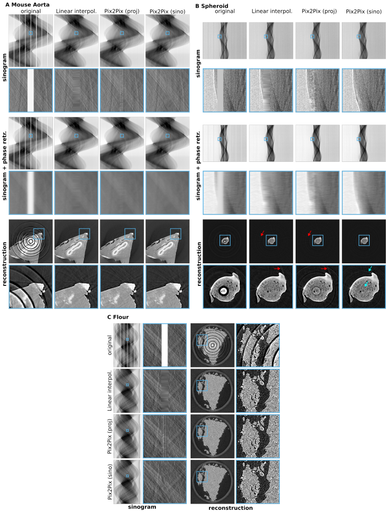
Figure 8 : Effect of the gap filling on the sinogram, the Paganin phase-retrieved sinogram, and the FDK reconstruction (top to bottom, each with a zoomed-in region) forAthe mouse aorta andBthe spheroid. Columns: constant-filled gap (original), linear interpolation, Pix2Pix applied to the projections (proj), and Pix2Pix applied to the sinogram (sino).C Sinogram and reconstruction of the flour sample, with the four variants arranged in rows. Red arrows inBmark the streak artifact after linear interpolation and Pix2Pix (proj); cyan arrows mark the finer streak and the faint ring after Pix2Pix (sino).
出典 · CC BY 4.0 · Johannes B. Thalhammer, Patrick Ilg, Tina Dorosti, Sebastian Peterhansl, Theresa Hiu, Daniel Frey, Zijin Huang, Florian Schaff, Daniela Pfeiffer, Franz Pfeiffer · Learning-Based Interpolation of Detector Gaps in Photon-Counting X-ray Imaging · 論文の図を引用 · 元のPDFの12ページ目から図の部分を抽出しています。モジュール端と3D文脈に関する残された課題
モデルは、検出器モジュールの内部でシミュレーションしたギャップを使って学習されました。そのため、実際のモジュール端で生じる効果は捉えられていません。著者らは、2Dインペインティングだけではアーティファクトのない再構成は保証されないと見ています。そのうえで、投影角度と検出器の行の間の一貫性を強制する3D文脈モデルが、今後の改善の方向だとしています。
論文情報
- 著者
- Johannes B. Thalhammer, Patrick Ilg, Tina Dorosti, Sebastian Peterhansl, Theresa Hiu, Daniel Frey, Zijin Huang, Florian Schaff, Daniela Pfeiffer, Franz Pfeiffer
- 学会・ジャーナル
- arXiv · プレプリント
- 公開日
- 2026年11月11日
- 登録日
- 2026年11月13日
- 更新日
- 2026年11月11日
- バージョン
- v1
- arXiv
- 2611.15614
- カテゴリ
- cs.CV · cs.AI
- ライセンス
- CC BY 4.0
- 掲載内容
- 論文情報・解説・論文の図
この解説は、Refivuの韓国語解説をAIで翻訳したものです。不正確な翻訳や誤りが含まれる可能性があります。論文と図の利用条件は各出典に従います。
アブストラクト
Image detectors assembled from tiled modules have physical gaps in the field of view that must be filled before downstream processing such as phase retrieval or tomographic reconstruction. Unlike natural-image inpainting, detector-gap interpolation must leave all other pixels unmodified and preserve the intensity statistics of the filled region, since even a small shift in mean intensity can cause ring artifacts after reconstruction. We adapted two generative models, a Wasserstein GAN with gradient penalty (WGAN-GP) and a conditional Pix2Pix model, to this task. We implemented a masking strategy that restricts all changes to the gap pixels and loss terms that constrain the mean intensity and the intensity distribution of the filled region. Both models were trained on nanoCT projections with simulated gaps and compared with linear interpolation, Navier--Stokes inpainting, and the deep image-inpainting network MADF, quantitatively on simulated gaps and visually on real detector gaps. WGAN-GP and Pix2Pix achieved the best perceptual similarity (LPIPS) and histogram distance and, apart from linear interpolation, the shortest inference time. Pix2Pix required about five times fewer training GPU-hours than WGAN-GP. Ablation studies showed that masking the network output contributes by far the most to plausible inpainting results. Applied to sinograms, Pix2Pix produced the most natural gap filling but improved the reconstruction only slightly compared with linear interpolation. The source code and the weights of the final Pix2Pix model are available at https://github.com/J-3TO/detectorGapRemoval_Pix2Pix.
この論文を引用
Johannes B. Thalhammer, Patrick Ilg, Tina Dorosti, Sebastian Peterhansl, Theresa Hiu, Daniel Frey, Zijin Huang, Florian Schaff, Daniela Pfeiffer, Franz Pfeiffer (2026). Learning-Based Interpolation of Detector Gaps in Photon-Counting X-ray Imaging. arXiv:2611.15614v1. https://arxiv.org/abs/2611.15614v1
BibTeX
@misc{thalhammer2026learning,
  title = {{Learning-Based Interpolation of Detector Gaps in Photon-Counting X-ray Imaging}},
  author = {Johannes B. Thalhammer and Patrick Ilg and Tina Dorosti and Sebastian Peterhansl and Theresa Hiu and Daniel Frey and Zijin Huang and Florian Schaff and Daniela Pfeiffer and Franz Pfeiffer},
  year = {2026},
  eprint = {2611.15614},
  archivePrefix = {arXiv},
  url = {https://arxiv.org/abs/2611.15614v1}
}