論文解説
Does Deep Knowledge Tracing Learn Semantic Relations Between Knowledge Components?
Deep Knowledge TracingはKC間の意味的関係を学習しているか
- 課題 DKTが学習したKC間の関係は、テキストに基づく意味構造と一致するのか。また、意味表現はDKTの予測を改善するのかを問います。
- 手法 質問テキストから9パイプラインでKC埋め込みを作り、DKTが導く関係行列とコサイン構造を比べます。あわせて、事前学習済みの埋め込みでDKTの入力を初期化します。
- 結果 ASSISTments 2012ではピアソン相関0.0894で整列が最も高かったものの、弱い値にとどまりました。検証AUCで選ばれた意味初期化の設定は、どのデータセットでもベースラインのテストAUCを上回りませんでした。
DKTの関係学習と意味に関する問い
Deep Knowledge Tracing(DKT)は、KCと応答の相互作用系列で共有の潜在状態を更新します。そのため、あるKCへの相互作用が、別のKCの予測にも影響します。例えば、x切片の問題に対する正答が、y切片の問題の予測を変える現象があります。これは、2つのKCの数学的内容が近いという解釈につながります。著者らはこの解釈をすぐには信じず、テキストに基づく意味構造とDKTが導く関係を直接比べて検証します。
もう一つの問いは、意味表現をDKTの入力に入れると予測性能が良くなるかです。これは一つ目の問いと関連していますが、別の検証です。関係構造が意味と合わないなら、意味初期化も期待ほどには役立たないかもしれません。そのため、2つの検証は合わせて読む必要があります。
質問テキストによるKC表現の作成
質問テキストは埋め込みモデルで質問ベクトルになり、複数の質問ベクトルはKC単位のベクトルにまとめられます。著者らは9パイプラインを3×3の設計で構成しています。KCを平均プロトタイプとみるか、代表となる質問を1つとみるか、文書の窓とみるかという軸と、応答状態を鏡像対称、反意語の付加、テキストへの直接挿入で扱う軸を組み合わせます。
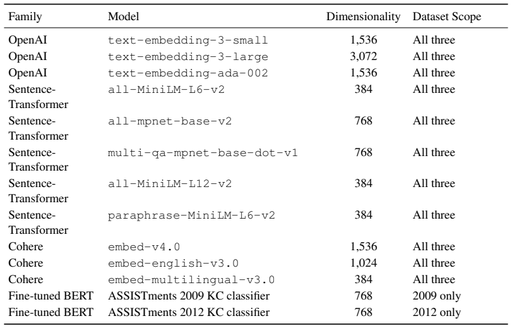
Table 2 : Embedding models used in the semantic representation pipelines. Dimensionalities are those used in the evaluated configurations.
出典 · CC BY 4.0 · Kia Karbasi, Mahdi Saiedi, Kevin Hong, Gregory Pottie · Does Deep Knowledge Tracing Learn Semantic Relations Between Knowledge Components? · 論文の図を引用 · 元のPDFの6ページ目から図の部分を抽出しています。最後の段階で、KC表現はDKTが必要とする、応答別の2つの相互作用埋め込みになります。鏡像方式では、1つのベクトルeを置き、もう一方を-eとします。反意語方式では、KCベクトルと応答マーカーベクトルを連結し、次元を2倍にします。テキスト直接挿入方式では、応答状態がすでに修正された質問テキストに含まれるため、KC単位の追加変換はありません。
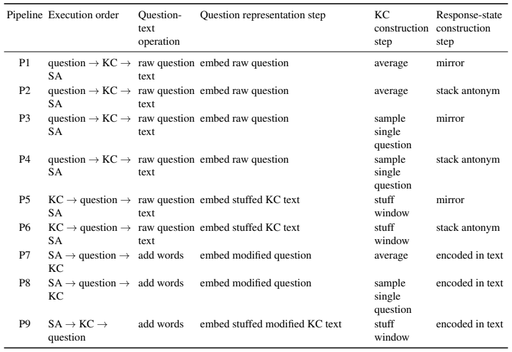
Table 3 : Nine evaluated pipelines for generating response-specific KC embeddings. SA denotes student action, the response state attached to a KC.
出典 · CC BY 4.0 · Kia Karbasi, Mahdi Saiedi, Kevin Hong, Gregory Pottie · Does Deep Knowledge Tracing Learn Semantic Relations Between Knowledge Components? · 論文の図を引用 · 元のPDFの8ページ目から図の部分を抽出しています。DKT関係行列とコサイン構造の比較
DKTの関係はinfluence-score法で抽出します。式はJ_ij = y(j|i) / Σ_k y(j|k)です。ここで、y(j|i)は1つ目の時点でKC iに正解した後の、2つ目の時点におけるKC jの正答確率です。分母は、同じテキストと連結されたKC集合に含まれるすべての元のKC kについての和です。得られた有向行列は、両方向の重みを平均して対称化し、対角成分を0とします。
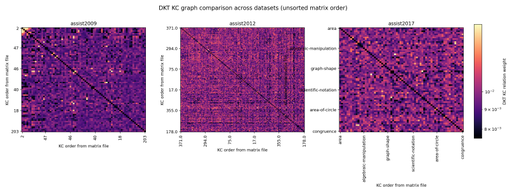
Figure 7 : DKT-derived target matrices for RQ1. Each panel shows the symmetrized, zero- diagonal complete weighted relation matrix used for the RQ1 comparison over the corre- sponding trimmed text-linked KC set. KCs follow the numeric index order in that dataset’s keyid2idx.json. Color normalization is panel-specific; the displayed colorbar corresponds to the ASSISTments 2017 panel.
出典 · CC BY 4.0 · Kia Karbasi, Mahdi Saiedi, Kevin Hong, Gregory Pottie · Does Deep Knowledge Tracing Learn Semantic Relations Between Knowledge Components? · 論文の図を引用 · 元のPDFの16ページ目から図の部分を抽出しています。意味側では、事前学習済みKCベクトルのペアごとのコサイン類似度から対称行列を作ります。2つの行列の上三角成分について、ピアソン相関とスピアマン相関を計算します。あわせて、上位k個のエッジの重なりも測定します。重なりは|A∩B|/kで正規化します。ここでは統計的有意性の検定は行わず、著者らはこれらの値を記述的な比較としてのみ用います。
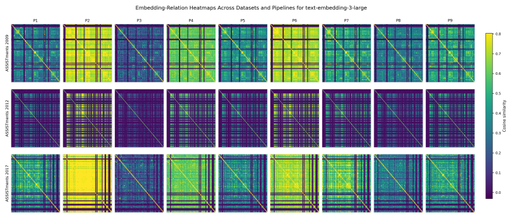
Figure 12 : Pipeline-induced embedding-relation heatmaps fortext-embedding-3-large.
出典 · CC BY 4.0 · Kia Karbasi, Mahdi Saiedi, Kevin Hong, Gregory Pottie · Does Deep Knowledge Tracing Learn Semantic Relations Between Knowledge Components? · 論文の図を引用 · 元のPDFの35ページ目から図の部分を抽出しています。事前学習埋め込みによるDKTの初期化
基本のpyKT DKTは、2N個のKC-応答状態について、ランダムに初期化された埋め込みテーブルを学習します。この研究では、そのテーブルをパイプラインが作った事前学習行列Ẽに置き換えます。各行は、質問テキストから作った応答別のKC埋め込みです。したがってモデルは、同じ位置でランダム行列の代わりにテキストに基づく行列を入力として受け取ります。
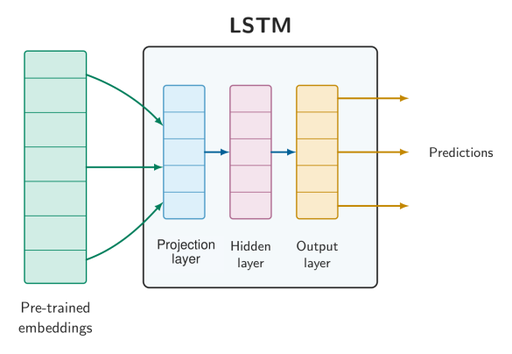
Figure 4 : Projection bottleneck applied to the pretrained-input DKT model.
出典 · CC BY 4.0 · Kia Karbasi, Mahdi Saiedi, Kevin Hong, Gregory Pottie · Does Deep Knowledge Tracing Learn Semantic Relations Between Knowledge Components? · 論文の図を引用 · 元のPDFの12ページ目から図の部分を抽出しています。この比較は、埋め込みテーブルの役割だけを変える方法です。ただし、事前学習行列が次元を決めるため、入力の次元や再帰モデルの容量も変わることがあります。そのため、結果を純粋な意味内容の効果だけとして読んではいけません。
関係構造の整列結果
3つのデータセットでの整列は、いずれも弱く、一貫していませんでした。ASSISTments 2012では、embed_english_v3.0とPipeline 3がピアソン相関0.0894を記録しました。ASSISTments 2009ではbert_ft_assist2009とPipeline 5が0.0573、ASSISTments 2017ではall_MiniLM_L6_v2とPipeline 5が0.0247を記録しました。最も高い設定でも、DKTが導くグラフを強くは再現できませんでした。

Table 4 : Highest-Pearson dataset-level alignment results between semantic KC representations and DKT-derived KC graphs. Each row is selected by Pearson correlation within that dataset’s evaluated configurations. Spearman and top-10% overlap are reported for the same Pearson- selected configuration. They are not selected separately by those metrics. Boldface marks the highest displayed value in each metric column.
出典 · CC BY 4.0 · Kia Karbasi, Mahdi Saiedi, Kevin Hong, Gregory Pottie · Does Deep Knowledge Tracing Learn Semantic Relations Between Knowledge Components? · 論文の図を引用 · 元のPDFの16ページ目から図の部分を抽出しています。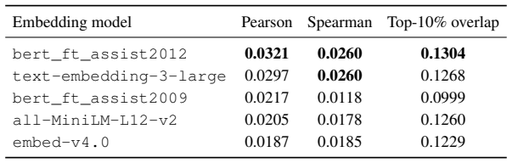
Table 14 : Displayed embedding-model means. Models are ordered by mean Pearson correla- tion across each model’s evaluated dataset–pipeline configurations. Boldface marks the highest displayed value in each metric column, including ties.
出典 · CC BY 4.0 · Kia Karbasi, Mahdi Saiedi, Kevin Hong, Gregory Pottie · Does Deep Knowledge Tracing Learn Semantic Relations Between Knowledge Components? · 論文の図を引用 · 元のPDFの34ページ目から図の部分を抽出しています。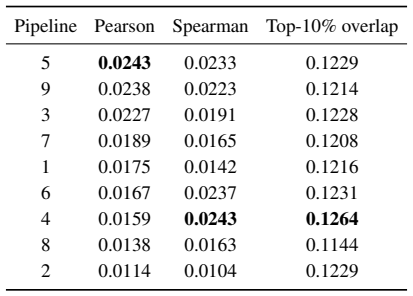
Table 15 : Reported pipeline summary across datasets. Pipelines are ordered by mean Pearson correlation. Boldface marks the highest displayed value in each metric column.
出典 · CC BY 4.0 · Kia Karbasi, Mahdi Saiedi, Kevin Hong, Gregory Pottie · Does Deep Knowledge Tracing Learn Semantic Relations Between Knowledge Components? · 論文の図を引用 · 元のPDFの34ページ目から図の部分を抽出しています。テキストを使わない参照であるKC共起行列は、ASSISTments 2009と2012では、最も強い意味構成よりもDKT行列と強く整列しました。2017では、参照の2つの相関がどちらも負でした。この結果は、DKTの関係に行動上の共起成分が含まれているという解釈と合いますが、その源までは確定していません。
全データでの予測性能
全データでの実験では、検証AUCで選ばれた意味初期化の設定が、どのデータセットでもベースラインDKTのテストAUCを上回りませんでした。不足分は0.0011から0.0240の範囲でした。一部の設定はテスト精度で局所的な向上を示しましたが、これを一貫した利点と見るには根拠が足りません。
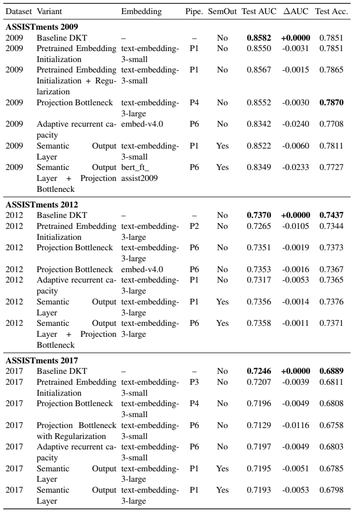
Table 5 : Combined full-data results across datasets. For each experimental condition, the re- ported row is the validation-selected configuration, together with its test AUC and test accuracy. Boldface indicates the highest value in each dataset block at the reported precision. Across the reported validation-selected semantic configurations, none exceeded the baseline test AUC on any dataset, although some configurations show localized accuracy gains. Pipe. denotes pipeline, SemOut the semantic-output condition, and Acc. accuracy.
出典 · CC BY 4.0 · Kia Karbasi, Mahdi Saiedi, Kevin Hong, Gregory Pottie · Does Deep Knowledge Tracing Learn Semantic Relations Between Knowledge Components? · 論文の図を引用 · 元のPDFの20ページ目から図の部分を抽出しています。パイプラインごとに見ると、最も高いAUCを出すパイプラインはデータセットごとに異なりました。ASSISTments 2009ではPipeline 1が0.8567、2012ではPipeline 2、3、6が0.7358で並び、2017ではPipeline 3が0.7207を記録しました。これらの値は、各条件で検証AUCに基づいて選んだ設定の結果です。
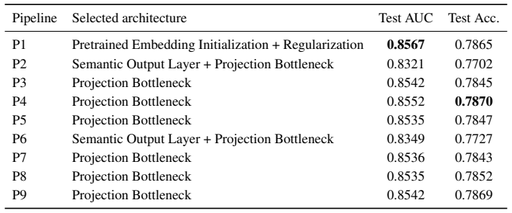
Table 10 : Detailed pipeline comparison for ASSISTments 2009, with each pipeline represented by its validation-selected configuration. Boldface marks the highest displayed test value in each metric column. Pipeline 1 achieved the highest semantic test AUC, while Pipeline 4 achieved the highest semantic test accuracy.
出典 · CC BY 4.0 · Kia Karbasi, Mahdi Saiedi, Kevin Hong, Gregory Pottie · Does Deep Knowledge Tracing Learn Semantic Relations Between Knowledge Components? · 論文の図を引用 · 元のPDFの30ページ目から図の部分を抽出しています。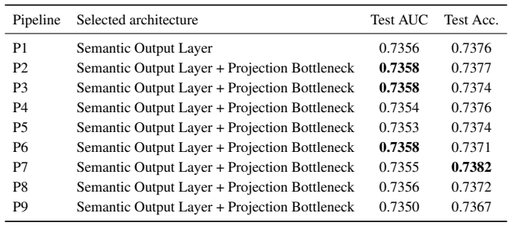
Table 11 : Detailed pipeline comparison for ASSISTments 2012, with each pipeline represented by its validation-selected configuration. Boldface marks the highest displayed test value in each metric column, including ties. Pipelines 2, 3, and 6 tie for the highest semantic test AUC, while Pipeline 7 achieved the highest semantic test accuracy.
出典 · CC BY 4.0 · Kia Karbasi, Mahdi Saiedi, Kevin Hong, Gregory Pottie · Does Deep Knowledge Tracing Learn Semantic Relations Between Knowledge Components? · 論文の図を引用 · 元のPDFの31ページ目から図の部分を抽出しています。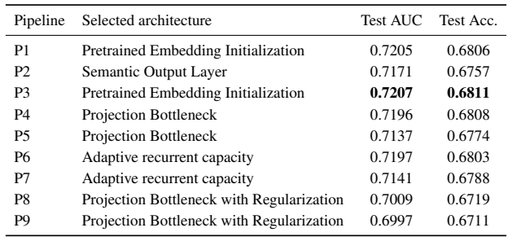
Table 12 : Detailed pipeline comparison for ASSISTments 2017, with each pipeline represented by its validation-selected configuration. Boldface marks the highest displayed test value in each metric column. Pipeline 3 achieved the highest semantic test AUC and test accuracy.
出典 · CC BY 4.0 · Kia Karbasi, Mahdi Saiedi, Kevin Hong, Gregory Pottie · Does Deep Knowledge Tracing Learn Semantic Relations Between Knowledge Components? · 論文の図を引用 · 元のPDFの31ページ目から図の部分を抽出しています。縮小データでの効果
縮小データの実験では、10%から90%まで入れ子になった部分標本を使いました。ASSISTments 2017では、事前学習の設定が9つの標本サイズのうち8つでテストAUCを高め、平均の向上は約0.01でした。このデータセットでのみ、はっきりした傾向が見られました。
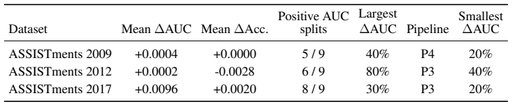
Table 6 : Dataset-level summary of the data-efficiency experiments. Mean deltas are computed as pretrained minus baseline across the nine sampled percentages from10%to90%of each complete trimmed text-linked base dataset’s interaction-row count; one row represents one stu- dent KC-response interaction. The Positive AUC splits column counts how often the selected pretrained run exceeds the selected baseline run on test AUC. The Largest∆AUC and Small- est∆AUC columns identify the sampled percentages with the largest and smallest pretrained- minus-baseline test-AUC differences, respectively. The Pipeline column identifies the pipeline used at the split with the largest difference.
出典 · CC BY 4.0 · Kia Karbasi, Mahdi Saiedi, Kevin Hong, Gregory Pottie · Does Deep Knowledge Tracing Learn Semantic Relations Between Knowledge Components? · 論文の図を引用 · 元のPDFの21ページ目から図の部分を抽出しています。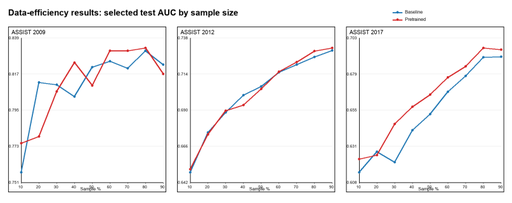
Figure 10 : Selected test AUC by sample size for the baseline and pretrained data-efficiency ex- periments. Each sample size is a percentage of the complete trimmed text-linked base dataset’s interaction-row count, where one row represents one student KC-response interaction. Each curve uses the validation-selected run at each sampled percentage.
出典 · CC BY 4.0 · Kia Karbasi, Mahdi Saiedi, Kevin Hong, Gregory Pottie · Does Deep Knowledge Tracing Learn Semantic Relations Between Knowledge Components? · 論文の図を引用 · 元のPDFの22ページ目から図の部分を抽出しています。ASSISTments 2009は9パイプラインすべてを評価し、5つの標本サイズでAUCが高くなりましたが、平均の差はほぼ0でした。2012は平均AUCの変化がほぼ0に近く、平均精度はわずかに下がりました。2012と2017はPipeline 3だけを使ったため、2009と同じパイプラインの多様性の比較ではありません。
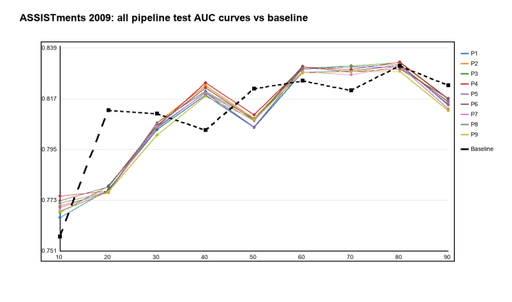
Figure 11 : ASSISTments 2009 data-efficiency comparison across all nine pipelines and the baseline. Each sample size is a percentage of the complete trimmed text-linked base dataset’s interaction-row count, where one row represents one student KC-response interaction. Each pipeline curve shows the validation-selected configuration for that pipeline at each sampled percentage.
出典 · CC BY 4.0 · Kia Karbasi, Mahdi Saiedi, Kevin Hong, Gregory Pottie · Does Deep Knowledge Tracing Learn Semantic Relations Between Knowledge Components? · 論文の図を引用 · 元のPDFの33ページ目から図の部分を抽出しています。KC教師ありのBERTエンコーダ
KCラベルでファインチューニングしたBERT分類器は、2009では0.9967、2012では0.9795のテスト精度を記録しました。2017は学習サンプルが448個しかなく、0.1354にとどまりました。そのため、この分類器は診断用としてのみ使いました。
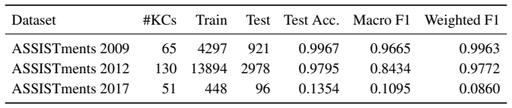
Table 7 : KC-classification performance of the dataset-specific BERT classifiers after the stated filtering and split procedure. The #KCs column reports the classifier’s retained label count. The ASSISTments 2017 classifier is included as a diagnostic and was not used for downstream DKT initialization.
出典 · CC BY 4.0 · Kia Karbasi, Mahdi Saiedi, Kevin Hong, Gregory Pottie · Does Deep Knowledge Tracing Learn Semantic Relations Between Knowledge Components? · 論文の図を引用 · 元のPDFの23ページ目から図の部分を抽出しています。2009のマッチング実験では、ファインチューニングしたBERTの構成がテストAUCを0.0029高めましたが、精度は変わりませんでした。2012ではAUCはほぼ同じで、精度はわずかに下がりました。著者らは、KCの識別力が一部の設定では役立つかもしれないが、複数のデータセットで一貫してはいないと考えています。このAUCの差も、実行間の安定性を確認していない小さな値です。
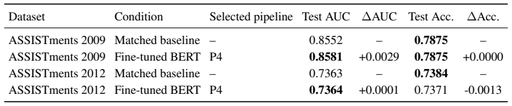
Table 8 : Matched downstream DKT comparison for the KC-supervised BERT encoders. The matched baseline is the no-embedding-initialization DKT baseline used for the same down- stream comparison. For each dataset, the baseline and fine-tuned rows are selected by validation AUC within their respective comparison conditions. Boldface marks the highest displayed test value within each dataset and metric, including ties.
出典 · CC BY 4.0 · Kia Karbasi, Mahdi Saiedi, Kevin Hong, Gregory Pottie · Does Deep Knowledge Tracing Learn Semantic Relations Between Knowledge Components? · 論文の図を引用 · 元のPDFの23ページ目から図の部分を抽出しています。データ範囲と再現性の限界
分析は、3つのASSISTmentsデータセットのうち、テキストが連結された部分集合に限られます。特に2017は、テキストと連結された問題が638個、KCが68個しかないため、表現の分散が大きくなる可能性があります。著者らは、このデータ不足が弱い整列と弱いKC分類器の一因となった可能性を見ていますが、原因を切り分けてはいません。
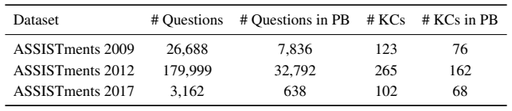
Table 1 : Question and KC counts in the ASSISTments logs and in the matched Problem Bodies subset used for text-based analyses in this study.
出典 · CC BY 4.0 · Kia Karbasi, Mahdi Saiedi, Kevin Hong, Gregory Pottie · Does Deep Knowledge Tracing Learn Semantic Relations Between Knowledge Components? · 論文の図を引用 · 元のPDFの5ページ目から図の部分を抽出しています。また、選ばれた全データ実行の再実行によるばらつきや、DKT関係行列の再学習の安定性は推定していません。そのため、整列の大きさは再現性に合わせて補正された値ではありません。この限界は、AUC差の解釈にもそのまま当てはまります。
論文情報
- 著者
- Kia Karbasi, Mahdi Saiedi, Kevin Hong, Gregory Pottie
- 学会・ジャーナル
- arXiv · プレプリント
- 公開日
- 2026年11月12日
- 登録日
- 2026年11月13日
- 更新日
- 2026年11月12日
- バージョン
- v1
- arXiv
- 2611.16323
- カテゴリ
- cs.LG · cs.CL
- ライセンス
- CC BY 4.0
- 掲載内容
- 論文情報・解説・論文の図
この解説は、Refivuの韓国語解説をAIで翻訳したものです。不正確な翻訳や誤りが含まれる可能性があります。論文と図の利用条件は各出典に従います。
アブストラクト
Deep Knowledge Tracing (DKT) is a knowledge tracing (KT) model that updates a shared latent state from sequences of interactions, each pairing a knowledge component (KC) with a response. An interaction with one KC can therefore affect predictions for other KCs. We ask: Are the KC relations learned by DKT semantic? We construct text-derived semantic KC representations using nine pipelines to test whether the conclusions hold across alternative ways of constructing those representations. The first test compares DKT-derived KC relation graphs with semantic relation structures induced by pairwise cosine similarities among the KC representations. Across the evaluated datasets, embedding models, and pipelines, the two structures align only weakly and inconsistently. The second test introduces semantic information into DKT; the pretrained text-derived representations do not consistently outperform the standard DKT baseline. In the reduced-data experiments, semantic initialization yields a higher test area under the ROC curve (AUC) than the baseline at eight of nine nested sample sizes for ASSISTments 2017. KC-supervised fine-tuned BERT produces small positive AUC differences in some matched comparisons, but the study does not establish their stability across runs. These effects remain limited and inconsistent. The findings suggest that behavioral, temporal, structural, or psychometric signals may also shape DKT's learned relations. DKT-derived relations are not primarily semantic: the tested text-derived semantic structures do not strongly recover the DKT-derived relation structure.
この論文を引用
Kia Karbasi, Mahdi Saiedi, Kevin Hong, Gregory Pottie (2026). Does Deep Knowledge Tracing Learn Semantic Relations Between Knowledge Components?. arXiv:2611.16323v1. https://arxiv.org/abs/2611.16323v1
BibTeX
@misc{karbasi2026does,
  title = {{Does Deep Knowledge Tracing Learn Semantic Relations Between Knowledge Components?}},
  author = {Kia Karbasi and Mahdi Saiedi and Kevin Hong and Gregory Pottie},
  year = {2026},
  eprint = {2611.16323},
  archivePrefix = {arXiv},
  url = {https://arxiv.org/abs/2611.16323v1}
}