論文解説
Variational Quantum Circuits for Deep Reinforcement Learning
深層強化学習のための変分量子回路
- 課題 古典的な深層Q学習を、ノイズのある中規模量子(NISQ)デバイスで実行できる変分量子回路に置き換え、frozen lakeとcognitive radioで方策学習が可能かを確認します。
- 手法 観測状態を計算基底状態にエンコードし、CNOTと学習可能な単一量子ビット回転からなる回路の出力期待値で行動を選びます。学習には経験再生とターゲットネットワークを使います。
- 結果 frozen lakeの構成(a)では総報酬0.9に収束し、cognitive radioの2チャネルと5チャネルの設定では最大報酬100に到達しました。frozen lakeのパラメータ数は、テーブル形式Q学習と比べて56.25%少ない28個です。
NISQデバイスで深層強化学習を扱う理由
古典的な深層強化学習は、ニューラルネットワークで行動価値関数を近似し、経験再生とターゲットネットワークによって学習を安定させます。この論文は、この方式を、ノイズのある中規模量子(NISQ)デバイスで実行できる変分量子回路に置き換える問題を扱っています。量子誤り訂正が不足している現在のデバイスでは深い回路を実行しにくいため、浅い回路と古典コンピュータでの反復最適化を組み合わせるハイブリッドな方法が必要です。著者らは、この方法でfrozen lakeとcognitive radioの環境において方策学習が可能かどうかを確認しています。この研究は小規模な実証例であり、量子ビット数の多いシステムを扱ったものではありません。
状態エンコードと変分回路の構造
観測された状態はまず2進数に変換されます。その後、各量子ビットに単一量子ビット回転を適用し、計算基底状態へエンコードします。frozen lakeでは16個の状態を4量子ビットで表し、状態11は2進数の1011なので、対応する量子ビット状態は|1011⟩です。この準備段階の回転角は学習の対象ではありません。エンコード後には、CNOTゲートで量子ビットをもつれさせる層と、学習可能な一般の単一量子ビットユニタリ層をつないだブロックを2回繰り返します。このブロックの学習可能なパラメータはα、β、γで表され、4量子ビットの設定では、ブロック1つあたり量子ビット4個とパラメータ3個を使い、2回繰り返すと24個になります。
これに測定後のバイアスベクトル4個を加えると、frozen lakeの総パラメータ数は28個になります。cognitive radioでは、チャネル数nに合わせて量子ビット数を調整します。3チャネルの場合、状態数は3²=9より大きい32なので、4量子ビットのシステムを使います。
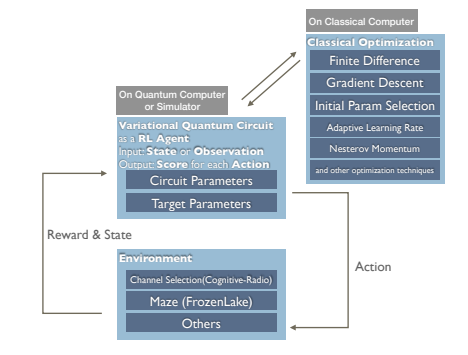
FIGURE 4 : Overview of variational quantum circuits for DRL. In this work, we study the capability of variational quantum circuits in performing DRL tasks. This DRL agent includes a quantum part and a classical part. Under cur- rent limitations on the scale of quantum machines and the capabilities of quantum simulations, we select frozen-lake and cognitive-radio environments for the proof-of-principle study. The proposed framework is rather general and is ex- pected to solve complicated tasks when larger-scale quantum machines are available.
出典 · CC BY 4.0 · Samuel Yen-Chi Chen, Chao-Han Huck Yang, Jun Qi, Pin-Yu Chen, Xiaoli Ma, Hsi-Sheng Goan · Variational Quantum Circuits for Deep Reinforcement Learning · 論文の図を引用 · 元のPDFの5ページ目から図の部分を抽出しています。行動選択と経験再生に基づく学習
行動は、回路の出力量子ビットの測定値のうち期待値が最も大きい量子ビットのインデックスで決めます。シミュレータでは期待値を解析的に計算しますが、実機では複数回測定した平均で推定します。この処理は、1回の測定結果ではなく期待値を使うために、同じ状態を繰り返し測定する方法です。学習は古典的なQ学習と同じターゲット値を使い、予測値Q(s,a;θ)とターゲット r+γ max Q(s′,a′;θ⁻) の間のMSE損失を小さくする方向に進みます。遷移(s,a,r,s′)は再生メモリに保存され、ミニバッチサイズ5でランダムにサンプリングされます。ターゲットネットワークのパラメータθ⁻は、メインの回路とは異なり20ステップごとに更新されます。
この方法は、連続する状態どうしの相関を下げ、ターゲット値を比較的固定することで学習を安定させる役割を果たします。オプティマイザはRMSpropで、学習率は0.01に設定されました。この値は、この論文のこのオプティマイザ設定に関するものです。
検証環境と報酬設計
検証には、frozen lakeとcognitive radioの2つの環境を使います。frozen lakeでは、目標に到達すると+1.0、穴に落ちると-0.2、各移動ごとに-0.01の報酬を得る設計で、最短経路を学習します。cognitive radioでは、主ユーザーと衝突しないチャネルを選ぶと+1、衝突すると-1を受け取ります。1エピソードは、3回連続で失敗するか100ステップを超えると終了するため、最大スコアは100です。チャネルの干渉は周期パターンで与えられ、観測はチャネルと時間の組で構成されます。実験には、frozen lakeの3つの構成と、cognitive radioの2、3、4、5チャネルの設定が含まれ、基本のcognitive radio設定は構成(a)です。
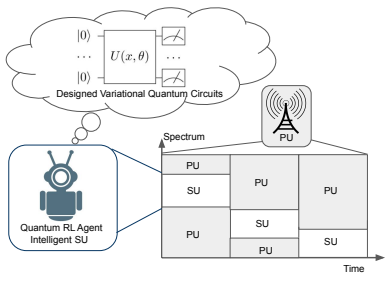
FIGURE 2 : Cognitive-Radio environment for the varia- tional quantum DRL agent. In the cognitive-radio environ- ment, the agent is expected to select a channel that is free of interference in each time step. For example, there is a primary user (PU) that will occupy a specific channel in each time step periodically. Our agent, which is the secondary user (SU), can only select the channels that are not occupied without the knowledge of the PU in advance. The agent is expected to learn the policy through the interaction with the environment.
出典 · CC BY 4.0 · Samuel Yen-Chi Chen, Chao-Han Huck Yang, Jun Qi, Pin-Yu Chen, Xiaoli Ma, Hsi-Sheng Goan · Variational Quantum Circuits for Deep Reinforcement Learning · 論文の図を引用 · 元のPDFの2ページ目から図の部分を抽出しています。学習結果とパラメータ数の比較
frozen lakeの構成(a)では、変分量子回路ベースのDQLエージェントが総報酬0.9に達し、198エピソード目以降に収束すると報告されています。同じ実験では、直近100エピソードの平均と標準偏差で安定性を確認しており、301回目の反復以降は方策がより安定すると説明しています。cognitive radioでは、2チャネルと5チャネルの設定で、エージェントが数回の反復以内に最大報酬100に到達し、3チャネルと4チャネルでは最適に近い方策に到達しました。ノイズモデルを適用したIBMのシミュレーションでは、2チャネルと4チャネルの設定が約110回の反復以内に最適報酬に近づきました。パラメータ数については、frozen lakeのVQ-DQLは28個で、テーブル形式Q学習のテーブルサイズ64と比べると56.25%少なくなっています。
この比率はfrozen lake設定での比較であり、cognitive radioのニューラルネットワークを基準にした比較とは別に読む必要があります。IBM Qの実機実験は、frozen lakeの構成(c)とcognitive radioの4チャネル構成(c)で、それぞれ5回と7回のエピソードで行われ、総報酬は0.94から0.95の範囲でシミュレータの結果と同程度の値でした。この実機実験のエピソード数は限られています。

TABLE 2 : Comparison of the number of parameters in classical Q-learning and variational quantum deep Q network (VQ- DQN).
出典 · CC BY 4.0 · Samuel Yen-Chi Chen, Chao-Han Huck Yang, Jun Qi, Pin-Yu Chen, Xiaoli Ma, Hsi-Sheng Goan · Variational Quantum Circuits for Deep Reinforcement Learning · 論文の図を引用 · 元のPDFの8ページ目から図の部分を抽出しています。
TABLE 3 : Results of the trained VQ-DQL (VQ-DQN) for the cognitive-radio experiment conducted on the IBM Q quantum computer, ibmq-valencia. In this experiment, we test the trained quantum DRL model in the cognitive- radio experiment of configuration (c) in the 4-channel case described in Fig. 3. Even if the training is on the simulation software without the quantum noise, the trained model still performs well on the real quantum computer.
出典 · CC BY 4.0 · Samuel Yen-Chi Chen, Chao-Han Huck Yang, Jun Qi, Pin-Yu Chen, Xiaoli Ma, Hsi-Sheng Goan · Variational Quantum Circuits for Deep Reinforcement Learning · 論文の図を引用 · 元のPDFの12ページ目から図の部分を抽出しています。
TABLE 4 : Results of the trained VQ-DQL (VQ-DQN) for the frozen-lake experiment conducted on the IBM Q quantum computer, ibmq-valencia. In this experiment, we test the trained quantum DRL model in the frozen-lake experiment of configuration (c) in Fig.1. Even if the training is on the simulation software without the quantum noise, the trained model still performs well on the real quantum computer.
出典 · CC BY 4.0 · Samuel Yen-Chi Chen, Chao-Han Huck Yang, Jun Qi, Pin-Yu Chen, Xiaoli Ma, Hsi-Sheng Goan · Variational Quantum Circuits for Deep Reinforcement Learning · 論文の図を引用 · 元のPDFの13ページ目から図の部分を抽出しています。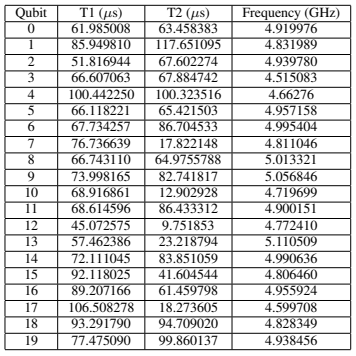
TABLE 6 : Qubit relaxation time T1, dephasing time T2 and qubit frequency data of the 20-qubit machine ibmq-poughkeepsie downloaded from the IBM Q sys- tem service at the time when the numerical simulation in Sec.VI-C performed.
出典 · CC BY 4.0 · Samuel Yen-Chi Chen, Chao-Han Huck Yang, Jun Qi, Pin-Yu Chen, Xiaoli Ma, Hsi-Sheng Goan · Variational Quantum Circuits for Deep Reinforcement Learning · 論文の図を引用 · 元のPDFの16ページ目から図の部分を抽出しています。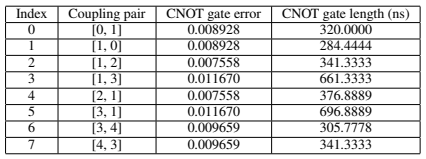
TABLE 7 : Two-qubit coupling and CNOT gate error and gate length data of the 5-qubit machine ibmq-valencia downloaded from the IBM Q system service at the time when the experiment in Sec.VI-E performed.
出典 · CC BY 4.0 · Samuel Yen-Chi Chen, Chao-Han Huck Yang, Jun Qi, Pin-Yu Chen, Xiaoli Ma, Hsi-Sheng Goan · Variational Quantum Circuits for Deep Reinforcement Learning · 論文の図を引用 · 元のPDFの16ページ目から図の部分を抽出しています。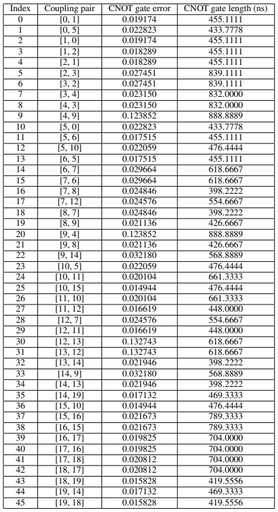
TABLE 8 : Two-qubit coupling and CNOT gate er- ror and gate length data of the 20-qubit machine ibmq-poughkeepsie downloaded from the IBM Q sys- tem service at the time when the numerical simulation in Sec.VI-C performed. The two-qubit CNOT gate error and lengths are usually different for different two-qubit coupling pairs due to different coupling strength and different qubit frequencies in the qubit pairs.
出典 · CC BY 4.0 · Samuel Yen-Chi Chen, Chao-Han Huck Yang, Jun Qi, Pin-Yu Chen, Xiaoli Ma, Hsi-Sheng Goan · Variational Quantum Circuits for Deep Reinforcement Learning · 論文の図を引用 · 元のPDFの16ページ目から図の部分を抽出しています。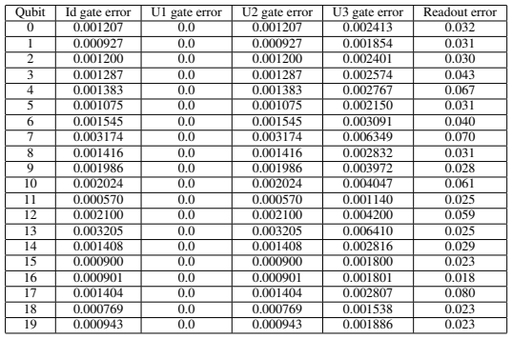
TABLE 9 : Single-qubit U1, U2 and U3 gate errors, and readout error data of the 20-qubit machine ibmq-poughkeepsie downloaded from the IBM Q system service at the time when the numerical simulation in Sec. VI-C performed. Different single-qubit gates have different gate lengths, but the gate length of the same single-qubit gate is the same for every qubit. The gate lengths of the Identity (Id) gate, U1 gate, U2 gate, and U3 gate, are 113.7778 ns, 0.0 ns, 103.1111 ns, and 206.2222 ns, respectively.
出典 · CC BY 4.0 · Samuel Yen-Chi Chen, Chao-Han Huck Yang, Jun Qi, Pin-Yu Chen, Xiaoli Ma, Hsi-Sheng Goan · Variational Quantum Circuits for Deep Reinforcement Learning · 論文の図を引用 · 元のPDFの17ページ目から図の部分を抽出しています。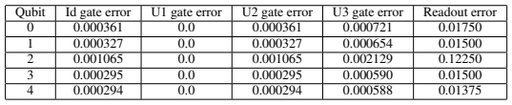
TABLE 10 : Single-qubit U1, U2 and U3 gate errors, and readout error data of the 20-qubit machine ibmq-valencia downloaded from the IBM Q system service at the time when the experiment in Sec. VI-E performed. The gate lengths of the Identity (Id) gate, U1 gate, U2 gate, and U3 gate, are 35.55556 ns, 0.0 ns, 35.55556 ns, and 71.11111 ns, respectively.
出典 · CC BY 4.0 · Samuel Yen-Chi Chen, Chao-Han Huck Yang, Jun Qi, Pin-Yu Chen, Xiaoli Ma, Hsi-Sheng Goan · Variational Quantum Circuits for Deep Reinforcement Learning · 論文の図を引用 · 元のPDFの17ページ目から図の部分を抽出しています。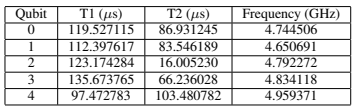
TABLE 11 : Qubit relaxation time T1, dephasing time T2 and qubit frequency data of the 5-qubit machine ibmq-valencia downloaded from the IBM Q system ser- vice at the time when the experiment in Sec.VI-E performed.
出典 · CC BY 4.0 · Samuel Yen-Chi Chen, Chao-Han Huck Yang, Jun Qi, Pin-Yu Chen, Xiaoli Ma, Hsi-Sheng Goan · Variational Quantum Circuits for Deep Reinforcement Learning · 論文の図を引用 · 元のPDFの17ページ目から図の部分を抽出しています。解釈の範囲と残る制約
この結果は、frozen lakeとcognitive radioという小規模な環境で得られたものです。著者らは、現在のNISQデバイスは量子誤り訂正が不足しており深い回路に向かないため、回路の深さを低く保つ設計が必要だと説明しています。振幅エンコーディングはパラメータ数を対数的なスケールで減らせる可能性がありますが、古典ベクトルを量子レジスタに効率よく準備する既知のアルゴリズムがないため、この論文では実装されていません。したがって、パラメータ削減の主張は、この論文の計算基底エンコーディングと測定した環境に限って解釈すべきです。また、実機の評価は限られたエピソード数で行われており、大規模な量子ビットシステムでの性能はまだ検証されていません。
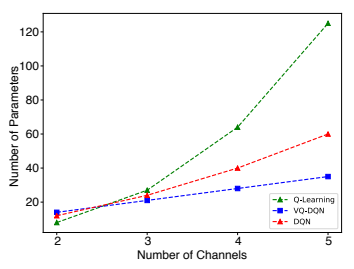
FIGURE 11 : Comparison of memory consumption in different learning schemes. The figure shows our pro- posed variational quantum circuits based DQL-agent has the quantum advantage in memory consumption compared to classical Q-learning and DQL (DQN). Specifically, in our cognitive-radio channel selection experiment, we set up four different testing environments with 2,3,4,5 possible channels, respectively. With the classical Q-learning, the number of parameters grow with n3, and in DQL (DQN), the number of parameters grow with n2. However, with our proposed variational quantum circuits based DQL (DQN), the number of parameters grows asn× (3× 2 + 1) only.
出典 · CC BY 4.0 · Samuel Yen-Chi Chen, Chao-Han Huck Yang, Jun Qi, Pin-Yu Chen, Xiaoli Ma, Hsi-Sheng Goan · Variational Quantum Circuits for Deep Reinforcement Learning · 論文の図を引用 · 元のPDFの13ページ目から図の部分を抽出しています。論文情報
- 著者
- Samuel Yen-Chi Chen, Chao-Han Huck Yang, Jun Qi, Pin-Yu Chen, Xiaoli Ma, Hsi-Sheng Goan
- 学会・ジャーナル
- arXiv · プレプリント
- 公開日
- 2019年6月30日
- 登録日
- 2026年11月6日
- 更新日
- 2020年7月20日
- バージョン
- v3
- arXiv
- 1907.00397
- カテゴリ
- cs.LG · cs.AI · quant-ph · stat.ML
- ライセンス
- CC BY 4.0
- 掲載内容
- 論文情報・解説・論文の図
この解説は、Refivuの韓国語解説をAIで翻訳したものです。不正確な翻訳や誤りが含まれる可能性があります。論文と図の利用条件は各出典に従います。
アブストラクト
The state-of-the-art machine learning approaches are based on classical von Neumann computing architectures and have been widely used in many industrial and academic domains. With the recent development of quantum computing, researchers and tech-giants have attempted new quantum circuits for machine learning tasks. However, the existing quantum computing platforms are hard to simulate classical deep learning models or problems because of the intractability of deep quantum circuits. Thus, it is necessary to design feasible quantum algorithms for quantum machine learning for noisy intermediate scale quantum (NISQ) devices. This work explores variational quantum circuits for deep reinforcement learning. Specifically, we reshape classical deep reinforcement learning algorithms like experience replay and target network into a representation of variational quantum circuits. Moreover, we use a quantum information encoding scheme to reduce the number of model parameters compared to classical neural networks. To the best of our knowledge, this work is the first proof-of-principle demonstration of variational quantum circuits to approximate the deep $Q$-value function for decision-making and policy-selection reinforcement learning with experience replay and target network. Besides, our variational quantum circuits can be deployed in many near-term NISQ machines.
この論文を引用
Samuel Yen-Chi Chen, Chao-Han Huck Yang, Jun Qi, Pin-Yu Chen, Xiaoli Ma, Hsi-Sheng Goan (2019). Variational Quantum Circuits for Deep Reinforcement Learning. arXiv:1907.00397v3. https://arxiv.org/abs/1907.00397v3
BibTeX
@misc{chen2019variational,
  title = {{Variational Quantum Circuits for Deep Reinforcement Learning}},
  author = {Samuel Yen-Chi Chen and Chao-Han Huck Yang and Jun Qi and Pin-Yu Chen and Xiaoli Ma and Hsi-Sheng Goan},
  year = {2019},
  eprint = {1907.00397},
  archivePrefix = {arXiv},
  url = {https://arxiv.org/abs/1907.00397v3}
}