論文解説
Equal Steps, Unequal Curvature: Where Muon's Update Goes Wrong
Muonの更新幅を損失の曲率で測り直し、配分を改善する
- 課題 Muonは、運動量のすべての特異方向に同じ長さのステップを与えますが、その配分が損失の曲率に合っているかは確かめられていませんでした。
- 手法 本研究は、Muonの更新を特異値の帯とニューロンの群に分け、群ごとに最適な倍率を保持データで測ります。曲率はHessian-vector productsで求めます。
- 結果 Q、K、Vを融合せず別々に直交化すると、融合したMuonより最終損失が0.0250 nats下がりました。
Muonの更新が抱える二つの配分
Muonは、各隠れ重み行列の運動量を極性因子で置き換えた方向へ更新する最適化手法です。運動量を\(N=U\Sigma V^\top\)と特異値分解すると、更新方向は\(UV^\top\)になり、スペクトルノルムの下で最急降下方向として説明されています。この理論は、どのノルムで最急降下するかを決めるものです。そのため、ステップが特異方向の間でどう配分されるべきかには答えません。\(UV^\top\)は、どの特異方向にも同じ長さのステップを与えます。その方向の勾配の大きさや、そこでの損失の曲率は区別しません。
配分のもう一つの軸は、出力ニューロンごとの移動量です。細長い行列では、極性因子の行ノルムが運動量の列空間のleverage scoresの平方根に等しくなるため、行によって移動量に大きな差が生じます。Q、K、Vを一つの融合行列に格納すると、各射影の更新が他の二つの運動量に依存してしまいます。行ノルムは任意に偏りうるため、この依存は移動量の偏りとして表れます。
後続研究は、この二つの配分のどちらか、または両方を別の方法で変えています。NorMuonやAuroraはニューロンを、DynMuonやFreon/Kaonはスペクトルを扱います。ただ、これらの変更が良いかどうかは、更新の方向の理論だけでは判定できません。判定には、損失の曲率に対してどの配分が合っているかを測る必要があります。そこで本論文は、等しい更新幅という仮定を曲率から測り直すことを問いにしています。
曲率で測る群ごとの最適乗数
本研究は、Muonのステップを特異値帯またはニューロンの群に分け、群ごとに二次近似で最適な乗数を求めます。各群bのステップ\(D_b\)に倍率\(c_b\)をかけ、重みを更新したときの保持損失の変化を二次で近似します。損失の変化は次の式で表されます。gは群ごとの勾配との整合を、Hは群どうしの曲率行列を表します。\[ q(c) = -g^\top c + \tfrac{1}{2} c^\top H c \]\(g_b = \langle \nabla \hat{L}, D_b \rangle\)と\(H_{bb'} = \langle D_b, \nabla^2 \hat{L} D_{b'} \rangle\)で、\(\hat{L}\)は保持トークン上の損失です。
Hは群どうしの交差項を含みます。Hの計算には、Hessian–vector productsを用います。これにより、ヘッセ行列を明示的に作らずに曲率の情報を得られます。Muonは全群で倍率が1の場合にあたり、二次近似で最適な倍率の組は\(c^\star = H^{-1} g\)です。各群を単独で最適にする倍率は\(c_b = g_b / H_{bb}\)で、Muonのフラットなフィルタが全体の最適と一致するのは、\(c^\star\)が1に比例するときだけです。
一段先だけを見る貪欲な判断は、全体のステップ長を誤りやすいことが知られています。そこで本研究は、Muonの二次ギャップをステップ長(scale)と形状(shape)の二つに分けます。その恒等式では、\(\gamma^\star = \mathbf{1}^\top g / \mathbf{1}^\top H \mathbf{1}\)は全体を一様に倍したときの最適倍率で、右辺の第一項がscale、第二項がshapeです。\[ q(1)-q(c^\star) = \tfrac{1}{2}(1-\gamma^\star)^2\,\mathbf{1}^\top H\mathbf{1} + \tfrac{1}{2}(\gamma^\star\mathbf{1}-c^\star)^\top H(\gamma^\star\mathbf{1}-c^\star) \]shape項は、\(c^\star\)が平坦でない限り正になります。
ただし、shape項が正であることは、同じノルムの別のステップがMuonより良いことを意味しません。同一ノルムの再配分では、各帯のサイズを対角に並べた\(N\)を用いて、Frobeniusノルムを保つ条件のもとで損失を比べます。モデル勾配\(r = H\mathbf{1} - g\)のうち、\(N\mathbf{1}\)に直交する成分\(p\)が0でなければ、同じノルムでも損失を下げるcが存在します。そこで本研究は、同じノルムの楕円面上で最良のステップを厳密に解き、その予測改善量を求めます。この最適化は楕円面上で大域的に最適と認証されています。
検証では、124.5Mモデルの学習ランから1,024、1,536、2,048ステップのチェックポイントを取り、そこから次のNesterov入力を求めます。1,024は一定の学習率の途中、1,536はクールダウンの開始、2,048は終了時に当たります。g、Hessian–vector products、実際の損失変化は、互いに素な三つの保持データ集合(393k、98k、393kトークン)で求めます。12のテストステップで、予測と実測の損失変化は符号が一致し、差は3倍以内に収まりました。一方、Hの条件数は約10^4と悪く、c⋆は帯域ごとに不規則になるため、本研究はc⋆を実測の損失とTheorem 3を通してだけ使います。
上位の特異方向でMuonは過剰に動く
どのチェックポイントでも、群ごとの最適乗数は上位の帯から末尾へ単調に増えていました。末尾と上位の比は、1,024ステップで48、クールダウン開始で38、終了時で190となりました。その原因は曲率と勾配の減り方の違いにあります。1,024ステップでは上位帯の曲率H11が次の帯の29×倍ある一方、勾配との整合g1は9×倍にとどまります。曲率は順位とともに信号より速く減るため、等しいステップ長は、勾配が集まる上位の方向を過剰に動かしてしまいます。ただし、これらの比は帯を一つずつ見た量で、ノルムを揃えた判定とは別のものです。
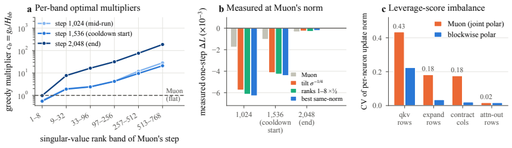
Figure 1 : Anatomy of Muon’s step (124M decoder, Muon seed 43; screen schedule with cooldown over steps 1,536–2,048). (a) Per-band second-order optimal multiplier cb = gb/Hbb for the exact-polar step restricted to each singular-value band. Muon’s flat filter is cb = 1 (dashed). Multipliers scale as 1/η, and η is 10× smaller at step 2,048, so compare profiles rather than levels. The tail-to-top ratio is 48, 38 and 190 at the three checkpoints. These isolated-band ratios are not the fixed-norm criterion (Theorem A.27); panel (b) uses the full curvature. (b) Measured change of the held-out loss after one step at Muon’s own update norm (393k tokens; Table 4). Bars show Muon, the exact tilt σ −1/4 , halving ranks 1–8, and the best same-norm filter from the quadratic model (Theorem 4). Moving step length off the top helps severalfold mid-training and at the start of the cooldown, and not at its end, where Muon’s top band is no longer over-stepped. (c) Spread (coefficient of variation) of per-neuron update norms of Muon’s step, mean over the 12 matrices of each type, at step 1,024. The fused 2304 × 768 QKV matrix carries the largest imbalance. Block-wise polar factors halve the QKV spread and nearly remove the MLP spread.
出典 · CC BY 4.0 · Biswa Sengupta, Jinhua Wang, Léo Maxime Brunswic · Equal Steps, Unequal Curvature: Where Muon's Update Goes Wrong · 論文の図を引用 · 元のPDFの5ページ目から図の部分を抽出しています。ノルムを揃えた条件で全体の曲率を使うと、上位からステップ長を取り、ランク97–512へ渡す配分が最良になりました。極端な末尾へ渡すのではありません。この予測の利得は、全体の二次ギャップの87%と92%に当たります。著者らは、観測された誤差が12の校正ステップで最大5.4×10⁻⁴、同一ノルム利得で1.4–1.5×10⁻³であり、ここでの予測利得より十分小さいと見ています。
クールダウン終了時には、上位帯の倍率が0.98まで下がり、上位が過剰に動く状態ではなくなります。つまり、学習率の減衰が上位の過剰な更新を自然に抑えるため、同一ノルムの再配分が使える余地は中盤からクールダウン開始までに限られます。
ニューロンごとの更新ノルムの偏りは、融合したQKV行列で最も大きく、変動係数(coefficient of variation)が0.43となりました。QKVの範囲は0.14から0.73に広がり、MLPの行と列は0.18、アテンション出力の正方行列は0.02にとどまります。ニューロンを更新量の大きさで群に分けると、帯と同じように単調な傾向が出ます。最も動く群の倍率は1.5、最も動かない群は7.1です。その群のギャップのうち形状で説明されるのは1,024ステップで5%だけなので、ブロック化の利得は重み付けの変更よりも、新しい方向を生むことから来ると読めます。
配分の修正が効いた場所
最初の介入は、融合したQKV行列を直交化の単位として分け、Q、K、Vをそれぞれ768×768のブロックとして別々に直交化することです。100.7Mトークン、3シードの対応比較では、分割QKVのMuonは融合QKVのMuonより最終損失が−0.0250 nats [−0.0290, −0.0210]低くなりました。正方ブロックを全体に適用しても、分割QKVを超える利得はなく(+0.0011 [−0.0029, +0.0051])、利得はQKVの分割によるものと読めます。
正確な傾きは固有分解を要するので、本研究はNS5出力\(O\)と\(S = ON^\top\)の多項式を使い、\(D = P(S/\Lambda)\,O\)として行列積だけで評価します。この式は、Oの特異ベクトルを保ったまま特異値の重みだけを変えるため、比較のMuonとの差はスペクトルの配分に限られます。
効果はほぼ加算的で、tiltが組み合わせの利得の約4分の3を担っています。分割QKV Muonが同じ損失に達するには、約4.3%多くのトークンが必要と推定されます。これは、分割QKVベースラインの損失曲線(1倍化あたり0.260 nats)から推定した値です。図2bでは、tiltの効果がクールダウンの256ステップ目で−0.050 natsまで広がり、その後−0.0120に収束します。この推移は、前節の上位の過剰が終盤に減るという予測と一致します。
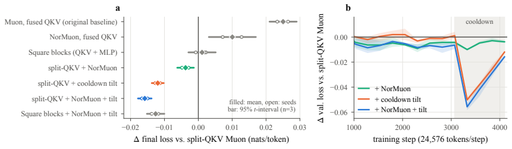
Figure 2 : Controlled results at 100.7M tokens(124M, three paired seeds).(a)Paired difference in final loss against split-QKV Muon. Splitting Q, K and V explains the whole square-block gain; NorMuon on fused QKV is worse than the split; the tilt and NorMuon add on top of the split.(b)Paired difference over training (mean, with the seed range shaded). Intermediate points use 98k held-out tokens; the last point uses 4.18M. Before the cooldown the tilt arm is mathematically identical to its baseline (A/A differences ≤0.009). The tilt’s lead peaks at−0.050 nats 256 steps into the cooldown and settles at−0.0120.
出典 · CC BY 4.0 · Biswa Sengupta, Jinhua Wang, Léo Maxime Brunswic · Equal Steps, Unequal Curvature: Where Muon's Update Goes Wrong · 論文の図を引用 · 元のPDFの7ページ目から図の部分を抽出しています。一方で、既存の幾何学的な変更の多くは効きませんでした。入力白色化は、ノルムを揃えても損失を+0.021から+0.060悪化させました。白色化した更新は入力の分散が小さい方向に集中するため、同じノルムでも層の出力をあまり動かせないと読めます。コストとして、分割QKV自体はFLOPsを増やさず、NorMuon + tiltのウォールクロック時間は124Mと355Mでそれぞれ+12%増えました。トークン節約は約4.3%なので、利得はトークン数の上で現れ、実時間ではまだ示されていません。
限界
データは一種類のFineWeb-Eduで、モデルは124Mと355Mの二つ、それぞれ三シードだけです。学習トークンは最大100.7Mで、パラメータあたり1トークン未満の範囲に限られます。効果の大きさはこの条件に固有なので、他の規模やデータにそのまま広げることはできません。
診断は局所的で、一段先を見る二次近似に基づき、単一のランから得られており、区間推定は付いていません。gとHは別々の保持データ集合から求めており、Hの最適解は条件が悪いため、帯方向の摂動だけで評価しています。摂動はAdamWと減衰の部分を外し、隠れ行列の極性帯方向だけに限っています。同一ノルムの解析も帯だけを対象としています。証明書の定数はまだ測っておらず、tiltの次数は先行研究から取っています。
異常の解析は事前登録されておらず、区間は名目上のもので、多くのスクリーン条件は単一シードです。クールダウンの長さと最終学習率はベースラインで調整していないため、別のクールダウンでは最終利得が変わる可能性があります。融合QKVや正方ブロックの比較は別版のコードで行われ、QKVの仕組みは仮説に留まります。形式検証の結果は訓練上の利得を予測するものではなく、白色化のように等変性を持っても悪化する例があります。
論文情報
- 著者
- Biswa Sengupta, Jinhua Wang, Léo Maxime Brunswic
- 学会・ジャーナル
- arXiv · プレプリント
- 公開日
- 2026年11月18日
- 登録日
- 2026年11月20日
- 更新日
- 2026年11月18日
- バージョン
- v1
- arXiv
- 2611.24644
- カテゴリ
- cs.LG
- ライセンス
- CC BY 4.0
- 掲載内容
- 論文情報・解説・論文の図
この解説は、Refivuの韓国語解説をAIで翻訳したものです。不正確な翻訳や誤りが含まれる可能性があります。論文と図の利用条件は各出典に従います。
アブストラクト
Muon updates each hidden weight matrix along the polar factor of its momentum, the steepest-descent direction under the spectral norm. That choice fixes two allocations without consulting the loss: every singular direction of the momentum receives the same step, and in a non-square matrix each neuron's step is set by its leverage score. Whether they are good is a question about curvature, which steepest-descent arguments do not answer; we measure it. Using held-out gradients and Hessian-vector products, we decompose Muon's step by singular-value band and by neuron group and compute each group's second-order optimal multiplier. In a 124M-parameter decoder trained on FineWeb-Edu, the multipliers rise monotonically from the top singular directions to the tail: Muon over-steps the high-curvature top of its spectrum. We prove in Lean when such a diagnostic licenses an intervention at Muon's own update norm. On the measured curvature, the criterion predicts, and held-out losses confirm, that moving step length off the top helps mid-training and early in the cooldown, but not at its end. We then test interventions under per-step norm matching, tuned baselines and paired seeds. Orthogonalizing Q, K and V separately rather than as one fused matrix lowers the loss by 0.0250 nats and accounts for all of the gain of block-wise variants. A matmul-only, rotation-equivariant spectral tilt $σ^{-1/4}$ applied in the cooldown lowers the loss of this stronger baseline by a further 0.0120 nats, additively with NorMuon (0.0158 nats together, three seeds; the baseline needs about 4.3% more tokens to match), and by 0.0188 nats at 355M parameters (three seeds). Energy-matched Schatten-1 weight decay adds a further 0.0052 nats. Geometrically principled changes that do not act on the measured miscalibration, namely exact polar factors, steepest-descent input whitening and top-heavy decay, do not help.
論文の図
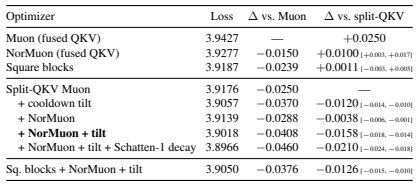
Table 1 : Confirmation at 100.7M tokens(124M model, three paired seeds per arm). Mean final held-out loss and mean paired differences against the original fused-QKV Muon and against the stronger split-QKV Muon. Brackets give 95% t-intervals for the latter; intervals against fused-QKV Muon are in the text. Lower is better.
出典 · CC BY 4.0 · Biswa Sengupta, Jinhua Wang, Léo Maxime Brunswic · Equal Steps, Unequal Curvature: Where Muon's Update Goes Wrong · 論文の図を引用 · 元のPDFの6ページ目から図の部分を抽出しています。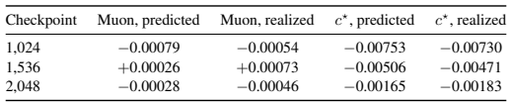
Table 3 :Quadratic-model calibration (bands, all matrices): predicted versus realized change in held-out loss (393k disjoint tokens) for Muon’s step (c=1) and the model-optimal band shape (c=c ⋆).
出典 · CC BY 4.0 · Biswa Sengupta, Jinhua Wang, Léo Maxime Brunswic · Equal Steps, Unequal Curvature: Where Muon's Update Goes Wrong · 論文の図を引用 · 元のPDFの17ページ目から図の部分を抽出しています。
Table 4 :Measured change of the held-out loss ( ×10−3) after one step at Muon’s own update norm: the exact tilt σp for several p, halving ranks 1–8, and the best same-norm filter, plus the slopedL/dpatp= 0.
出典 · CC BY 4.0 · Biswa Sengupta, Jinhua Wang, Léo Maxime Brunswic · Equal Steps, Unequal Curvature: Where Muon's Update Goes Wrong · 論文の図を引用 · 元のPDFの18ページ目から図の部分を抽出しています。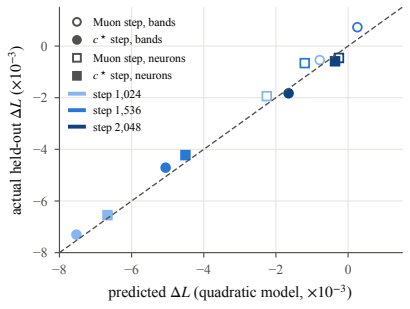
Figure 3 :Predicted (quadratic model) versus realized held-out loss change for 12 test steps.
出典 · CC BY 4.0 · Biswa Sengupta, Jinhua Wang, Léo Maxime Brunswic · Equal Steps, Unequal Curvature: Where Muon's Update Goes Wrong · 論文の図を引用 · 元のPDFの18ページ目から図の部分を抽出しています。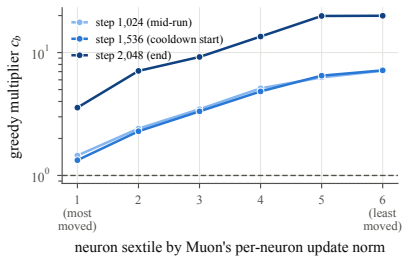
Figure 4 :Greedy multiplier per neuron sextile, ranked by Muon’s per-neuron update norm. The most-moved neurons sit in higher-curvature directions.
出典 · CC BY 4.0 · Biswa Sengupta, Jinhua Wang, Léo Maxime Brunswic · Equal Steps, Unequal Curvature: Where Muon's Update Goes Wrong · 論文の図を引用 · 元のPDFの18ページ目から図の部分を抽出しています。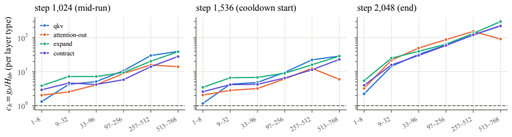
Figure 5 :Band multipliers computed separately for each layer type. The top band has the smallest multiplier in every case.
出典 · CC BY 4.0 · Biswa Sengupta, Jinhua Wang, Léo Maxime Brunswic · Equal Steps, Unequal Curvature: Where Muon's Update Goes Wrong · 論文の図を引用 · 元のPDFの19ページ目から図の部分を抽出しています。
Table 6 :Coefficient of variation of per-neuron update norms of Muon’s step and of the block-wise polar step.
出典 · CC BY 4.0 · Biswa Sengupta, Jinhua Wang, Léo Maxime Brunswic · Equal Steps, Unequal Curvature: Where Muon's Update Goes Wrong · 論文の図を引用 · 元のPDFの19ページ目から図の部分を抽出しています。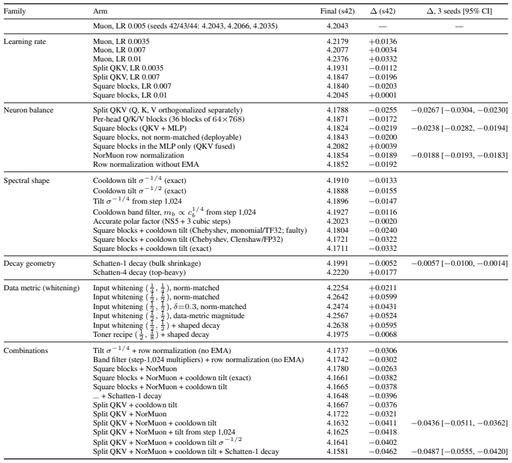
Table 7 :Screen results. Final held-out loss (4.18M tokens) at seed 42 and paired differences from fused-QKV Muon.
出典 · CC BY 4.0 · Biswa Sengupta, Jinhua Wang, Léo Maxime Brunswic · Equal Steps, Unequal Curvature: Where Muon's Update Goes Wrong · 論文の図を引用 · 元のPDFの20ページ目から図の部分を抽出しています。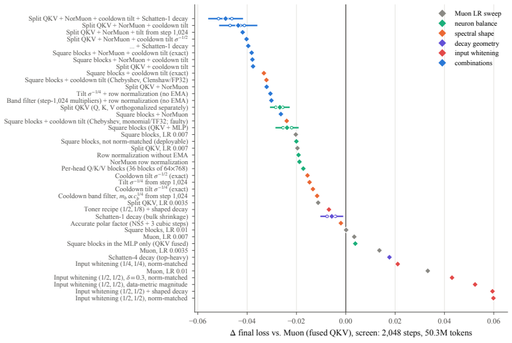
Figure 6 :Screen arms sorted by their mean paired difference from fused-QKV Muon (seed 42, or the three-seed mean with 95% t-interval and open circles for seeds where three seeds exist).
出典 · CC BY 4.0 · Biswa Sengupta, Jinhua Wang, Léo Maxime Brunswic · Equal Steps, Unequal Curvature: Where Muon's Update Goes Wrong · 論文の図を引用 · 元のPDFの21ページ目から図の部分を抽出しています。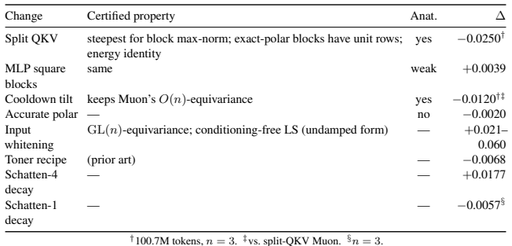
Table 8 : Theory versus training.What the Lean statements certify, whether the anatomy implies a gain, and the measured paired ∆ against fused-QKV Muon (screen, one seed, unless marked). Formal properties alone did not predict which changes help.
出典 · CC BY 4.0 · Biswa Sengupta, Jinhua Wang, Léo Maxime Brunswic · Equal Steps, Unequal Curvature: Where Muon's Update Goes Wrong · 論文の図を引用 · 元のPDFの22ページ目から図の部分を抽出しています。この論文を引用
Biswa Sengupta, Jinhua Wang, Léo Maxime Brunswic (2026). Equal Steps, Unequal Curvature: Where Muon's Update Goes Wrong. arXiv:2611.24644v1. https://arxiv.org/abs/2611.24644v1
BibTeX
@misc{sengupta2026equal,
  title = {{Equal Steps, Unequal Curvature: Where Muon's Update Goes Wrong}},
  author = {Biswa Sengupta and Jinhua Wang and Léo Maxime Brunswic},
  year = {2026},
  eprint = {2611.24644},
  archivePrefix = {arXiv},
  url = {https://arxiv.org/abs/2611.24644v1}
}