論文解説
Data-Free Metrics Don't Work: The Missing Invariance Under Functionally Preserving Reparameterisations
データなしの指標は機能しない:関数を保つ再パラメータ化のもとで欠けていた不変性
- 課題 この論文は、データなしのRMT指標αが、関数を保つ再パラメータ化のもとで安定しているか、また性能を予測できるかを問います。
- 手法 学習済みの層を再初期化または再ランダム化して、関数をおおむね保つ変形を作り、αと精度の関係を測定します。
- 結果 MNIST、ImageNet、WikiText103での実験では、αと精度の相関は弱く、ResNet34ではSpearman相関0.006でした。
データなし指標の予測力の問題
ニューラルネットワークの重みだけからモデル品質を判断する、データなしの指標が複数の研究で使われています。この論文は、行列固有値のべき乗則指数αを中心に、関数を変えない再パラメータ化のもとでもこうした指標が安定しているかを問います。従来の主張は、良いモデルは良い指標の範囲をもつという方向でした。著者らは、この方向を逆にして確かめられるかを検討します。
中心となる問いは2つです。1つ目は、αが再初期化や再ランダム化の後も値を保つかどうかです。2つ目は、αが頑健な層と臨界層、そして再初期化と再ランダム化の性能差を区別できるかどうかです。
再パラメータ化と層ごとの指標計算
著者らは、学習済みモデルの個々の層を2通りの方法で変えます。再初期化は、層のパラメータを学習前の初期値に戻します。再ランダム化は、同じ初期化分布から新しいランダムな値を抽出します。頑健な層は、この変更を加えても精度がほぼ保たれる層です。臨界層は、精度が大きく下がる層です。
指標は、各層の重み行列Wから計算します。αは、Wの相関行列の固有値に合わせたべき乗則の指数です。論文では、2から6の間を良い範囲として示しています。Theorem 1は、2層ReLUネットワークでは、スケール再パラメータ化Tbのもとで、α以外の指標が任意の値に変わりうることを示しています。論文では、αはこの定理の例外で、同じスケール変換のもとでおおむね不変だと説明されています。
MNIST小規模実験
小規模な実験では、MNISTで学習したReLU FCN 5x512を使いました。100個のモデルを学習し、初期化と学習済みモデルの代表的なサンプルを作りました。各層を再初期化または再ランダム化した後、αとテスト精度の関係を、Spearman相関、線形回帰のRMSE、Kendallのタウで評価しました。
その結果、αは再パラメータ化の後に広い範囲に散らばり、精度の変化との関係も弱いことがわかりました。再初期化ではFC1だけが大きな精度低下を示し、臨界層に見えました。しかしαはこの差を区別できませんでした。再ランダム化では、すべての層がランダムと同程度の精度まで落ちましたが、α分布に大きな差はありませんでした。
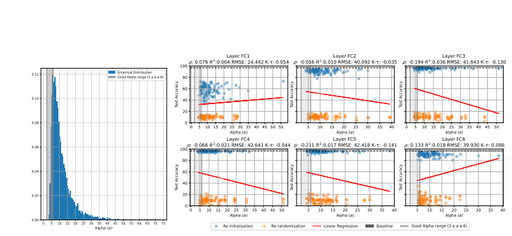
Figure 2 : (a) Empirical distribution of α values on a 512x512 fully connected layer, sampled from 10,000 initialisations. (b) Layer re-initialisation ( •) and re-randomisation ( •) test accuracy vs α. In § D we present the descriptive statistics for sub-figure (a) along with other initialisation schemes.
出典 · CC BY 4.0 · Gabryel Mason-Williams, Israel Mason-Williams, Fredrik Dahlqvist · Data-Free Metrics Don't Work: The Missing Invariance Under Functionally Preserving Reparameterisations · 論文の図を引用 · 元のPDFの6ページ目から図の部分を抽出しています。大規模な事前学習モデルの再ランダム化
大規模な実験では、ImageNetのResNet34とViT、WikiText103のGPT2とGPT2-Largeを使いました。事前学習済みモデルでは学習前の初期化にアクセスできないため、再ランダム化だけを行い、層ごとに10回繰り返しました。
ResNet34とViTでは、αとテスト精度の間の平均Spearman相関は、それぞれ0.006と-0.036と報告されています。GPT2とGPT2-Largeでは、-0.038と-0.134でした。論文は、この結果を、αが頑健な層でも不変ではないという主張と一致すると解釈しています。
限界と残された課題
Pythia-1Bの実験では、再初期化と再ランダム化による精度の保存と、αの範囲との間に強い関係は確認されませんでした。論文では、このモデルで再ランダム化された層は、良いαの範囲にほとんど入らなかったと記録されています。

Table 9 : The impact of re-initialisation across a range of layers within the Pythia-1B model, alongside the correlation statistics ofαand test accuracy.
出典 · CC BY 4.0 · Gabryel Mason-Williams, Israel Mason-Williams, Fredrik Dahlqvist · Data-Free Metrics Don't Work: The Missing Invariance Under Functionally Preserving Reparameterisations · 論文の図を引用 · 元のPDFの15ページ目から図の部分を抽出しています。Linear CKAは、他のデータに基づく指標より予測力が低いと報告されています。著者らは、データに基づく指標全体は調べていないこと、また音声のような別のデータ領域では実験していないことも、限界として挙げています。
論文情報
- 著者
- Gabryel Mason-Williams, Israel Mason-Williams, Fredrik Dahlqvist
- 学会・ジャーナル
- arXiv · プレプリント
- 公開日
- 2026年11月11日
- 登録日
- 2026年11月13日
- 更新日
- 2026年11月11日
- バージョン
- v1
- arXiv
- 2611.15621
- カテゴリ
- cs.LG · cs.AI
- ライセンス
- CC BY 4.0
- 掲載内容
- 論文情報・解説・論文の図
この解説は、Refivuの韓国語解説をAIで翻訳したものです。不正確な翻訳や誤りが含まれる可能性があります。論文と図の利用条件は各出典に従います。
アブストラクト
Data-free methods for analysing and understanding the layers of neural networks offer many metrics for quantifying notions of 'strong' versus 'weak' layers, with the promise of increased interpretability. In particular, random matrix theory (RMT) offers data-free metrics that claim predictive power over the quality of pre-trained models at a layerwise precision and the ability to identify model pathologies, indicating a unique relationship with generalisation. As a result, metrics from RMT are championed for pre-training optimisation strategies and post-training compression. We establish that RMT-based metrics are unrelated to performance or training by showing that functionally preserving reparametrisations of a pre-trained model can have arbitrary metrics. We show this across a range of architectures and scales. To create functionally preserving reparametrisations, we exploit the well-established phenomenon of criticality: some layers can be re-initialised or re-randomised without affecting the functional behaviour of the model -- they are called robust -- while others cannot -- they are called critical. Re-initialising or re-randomising robust layers provides functionally preserving reparametrisations for which RMT-based metrics are arbitrary. Moreover, we show that relationships between metrics offered by RMT are spuriously related to generalisation. We conclude by showing that if many pre-trained models have data-free metrics in a 'good' range, it is, in part, dependent on model initialisation. Project page available at: https://gmw99.github.io/data-free-metrics-dont-work
この論文を引用
Gabryel Mason-Williams, Israel Mason-Williams, Fredrik Dahlqvist (2026). Data-Free Metrics Don't Work: The Missing Invariance Under Functionally Preserving Reparameterisations. arXiv:2611.15621v1. https://arxiv.org/abs/2611.15621v1
BibTeX
@misc{masonwilliams2026data,
  title = {{Data-Free Metrics Don't Work: The Missing Invariance Under Functionally Preserving Reparameterisations}},
  author = {Gabryel Mason-Williams and Israel Mason-Williams and Fredrik Dahlqvist},
  year = {2026},
  eprint = {2611.15621},
  archivePrefix = {arXiv},
  url = {https://arxiv.org/abs/2611.15621v1}
}