논문 해설
REinforcement learning based Adaptive samPling: REAPing Rewards by Exploring Protein Conformational Landscapes
강화학습 기반 적응형 샘플링: 단백질 입체구조 지형을 탐색하며 REAP으로 보상 거두기
- 연구 문제 분자동역학에서 반응 좌표를 사전에 알아야 하는 샘플링 한계를 줄이기 위해 탐색 중 반응 좌표 중요도를 추정하는 방법을 제안합니다.
- 연구 방법 REAP는 least-count 샘플링에 강화학습 개념을 결합해 반응 좌표 가중치를 보상 함수 최대화로 갱신하고, 그 가중치에 따라 다음 시뮬레이션의 시작 구조를 고릅니다.
- 주요 결과 L자형과 원형 모델 포텐셜, 알라닌 디펩타이드, Src 키나아제 실험에서 REAP는 비교한 조건 안에서 SL 및 LC보다 더 넓은 지형을 발견하거나 활성 상태에 더 빨리 도달했다고 보고합니다.
분자동역학 샘플링의 병목과 반응 좌표 의존성
분자동역학(MD) 시뮬레이션은 단백질의 구조-기능 관계를 이해하는 데 널리 쓰이지만, 일반적인 계산 환경에서는 하루에 나노초 단위의 데이터만 얻을 수 있습니다. 그런데 단백질의 중요한 구조 변화는 밀리초 이상의 시간에서 일어날 수 있어 연산 자원이 큰 병목이 됩니다. 이를 줄이기 위한 향상 샘플링 방법 중 하나의 부류는 미리 지정한 반응 좌표를 따라 샘플링을 편향시키며, 이 부류는 어떤 반응 좌표가 관련 있는지를 사전에 알아야 합니다. 본 연구는 이 사전 지식 의존성을 줄이는 것을 문제로 삼습니다.
반응 좌표는 단백질이 한 상태에서 다른 상태로 변하는 진행을 나타내는 계의 자유도 함수입니다. 예를 들어 키나아제 활성화는 A-루프 펼쳐짐과 K-E 염다리 형성이라는 두 좌표로 L자형 지형에 투영될 수 있으며, 이때 한 좌표가 변하는 동안 다른 좌표는 상대적으로 일정하게 유지됩니다. 그러나 최적의 방향이 구조 차이에 기반해서만 알려지는 경우가 많으므로, 구조 정보가 부족하면 모든 방향을 무차별적으로 탐색해야 합니다.
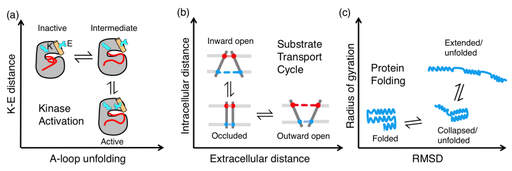
Figure 1 : The above figures illustrate that three significant biological processes can be pro- jected onto an L-shaped landscape given the selection of appropriate reaction coordinates. These include: (a) The activation process in kinases, (b) transport cycle for transporter proteins, and (c) protein folding. In (a), the inactive kinase state is denoted as state 1, the intermediate state as 2, and the activated state as 3.
원문 · CC BY 4.0 · Zahra Shamsi, Kevin J. Cheng, Diwakar Shukla · REinforcement learning based Adaptive samPling: REAPing Rewards by Exploring Protein Conformational Landscapes · 원문 그림 인용 · 원본 PDF 5쪽에서 그림 영역을 추출했습니다.REAP의 가중치 기반 보상과 반복 절차
REAP(REinforcement learning based Adaptive samPling)는 최소 개수 기반 적응형 샘플링(least-count adaptive sampling)을 바탕으로, 각 반응 좌표의 중요도를 나타내는 가중치를 탐색 중에 추정합니다. 기존 least-count 방법은 가장 적게 채워진 상태에서 새 구조를 고르는 반면, REAP는 보상 함수로 구조를 고릅니다. 이 보상 함수는 가중치와 클러스터가 전체 클러스터 분포에서 얼마나 떨어져 있는지에 따라 정해집니다.
구체적으로는 후보 반응 좌표 집합에 대해 가중치를 설정하고 데이터를 클러스터로 묶은 뒤, 개수가 가장 적은 클러스터 집합 Cp를 고릅니다. 각 클러스터 cm의 보상은 rK(cm)으로 계산되며, 이는 가중치 wS_i에 대해 RC 값과 전체 클러스터 평균의 차이 절댓값을 표준편차로 나눈 항의 합입니다. 선택된 클러스터들의 누적 보상 R(Cp)는 개별 보상의 합입니다. 이후 SLSQP로 누적 보상을 최대화하도록 가중치를 갱신하며, 가중치 합은 1이고 한 단계에서 변하는 양은 δ 이하로 제한됩니다. 갱신된 가중치로 보상이 높은 클러스터의 구조를 골라 새 시뮬레이션을 시작하고 이 과정을 반복합니다.
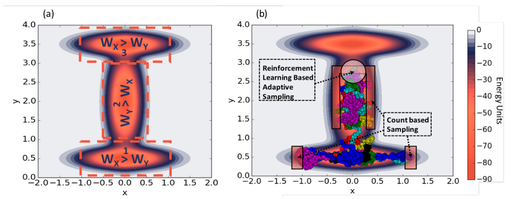
Figure 2 : (a) The ’I’ (Illinois) landscape illustrates that the local optimal sampling strategy changes depending which basin that is currently being sampled (each labeled 1, 2, and 3). The importance of each reaction coordinate is denoted as weights that are updated in each iteration of the REAP algorithm, WX and WY . (b) Given that sampling occurs in basin 2, the orange regions shows structures selected from count based sampling are not optimal for reaching basin 3. Instead, REAP is able to identify the appropriate structures (white circular highlight) that facilitate sampling along Y, eventually reaching basin 3.
원문 · CC BY 4.0 · Zahra Shamsi, Kevin J. Cheng, Diwakar Shukla · REinforcement learning based Adaptive samPling: REAPing Rewards by Exploring Protein Conformational Landscapes · 원문 그림 인용 · 원본 PDF 6쪽에서 그림 영역을 추출했습니다.여기서 가중치는 학습 중 갱신되는 값이며, 보상 함수의 최대화 변수는 가중치 wS_i입니다. 정책은 어떤 반응 좌표 집합을 사용하는지와 구조를 고르는 방식에 따라 정해집니다. 반응 좌표 중요도가 낮으면 반복이 진행되면서 가중치가 0에 가까워진다는 것이 저자의 설명입니다.
L자형과 원형 모델 포텐셜에서의 비교
먼저 L자형 포텐셜에서는 두 반응 좌표 X와 Y가 과감쇠 Langevin 방정식으로 지배되는 이상화 모델을 사용합니다. SL, LC, REAP에 같은 시뮬레이션 시간을 배정했고, 세 방법은 모두 오른쪽 아래 모서리에서 시작했습니다. 가중치 변화는 초기 라운드에서 X와 Y가 같은 중요도를 가지다가, 궤적이 Y 방향의 고에너지 상태에 도달하면 X 가중치가 늘고 Y 가중치가 줄어드는 방식으로 나타납니다. 추가로 넣은 무관한 좌표 Z의 가중치는 0으로 떨어졌습니다.
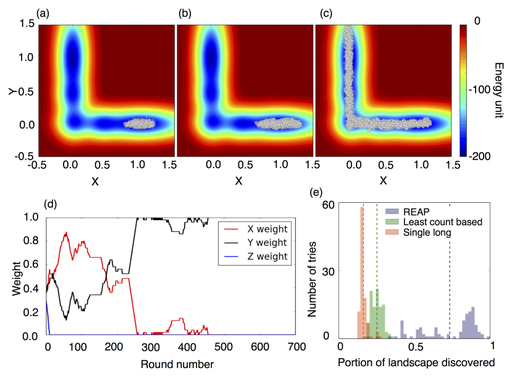
Figure 3 : Regions sampled using (a) single long trajectory, (b) least count based adaptive sampling, and (c) REAP algorithm methods performed on L-shaped potentials are shown with white circles on top of the potential. The white circles represents a data point generated from Eq. 3 (d) Weights for each RC signify the importance of each RC depending on the round number (or iteration of the algorithm). The fluctuations of weights show that the algorithm is able to identify the importance of each weight. The weight of an additional RC orthogonal to X and Y, called Z, was expected and shown to go to zero. For more information on what the weights signify, see step 2 in the REAP Algorithm section. (e) A plot showing the distribution for the portion of landscape discovered using REAP, LC, and SL sampling over 100 repeated trials. Dashed lines represent the expected value of each distribution.
원문 · CC BY 4.0 · Zahra Shamsi, Kevin J. Cheng, Diwakar Shukla · REinforcement learning based Adaptive samPling: REAPing Rewards by Exploring Protein Conformational Landscapes · 원문 그림 인용 · 원본 PDF 20쪽에서 그림 영역을 추출했습니다.100회 반복 실험에서 SL과 LC의 분포는 각각 약 0.2와 0.25 부근에 몰려 있었고, REAP의 분포는 주로 0.8 부근에 있었습니다. 원문은 REAP의 기대값이 LC와 SL의 최소 두 배라고 보고합니다. 원형 포텐셜은 우선 샘플링 방향이 없는 경우를 검증하기 위한 것입니다. 여기서 REAP는 SL과 LC보다 높은 분포를 보였지만, 원문은 이 결과를 방향성이 없는 경우에 REAP가 LC와 같아진다는 설명과 함께 다루며, 두 방법이 항상 같다고 단정하지 않습니다.
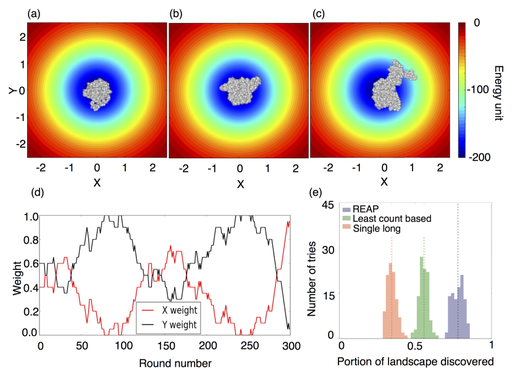
Figure 4 : The Regions sampled using (a) single long trajectory, (b) least count based adaptive sampling, and (c) REAP algorithm methods performed on circular potentials are shown with white circles on top of the potential. The white circles represents a data point generated from Eq. 3 (d) Weights for each RC signify the importance of each RC depending on the round number (or iteration of the algorithm) (e) A plot showing the distribution for portion of landscape discovered for REAP, LC, and SL simulations using 100 repeated simulations. The expectation value of each distribution is depicted with dashed lines.
원문 · CC BY 4.0 · Zahra Shamsi, Kevin J. Cheng, Diwakar Shukla · REinforcement learning based Adaptive samPling: REAPing Rewards by Exploring Protein Conformational Landscapes · 원문 그림 인용 · 원본 PDF 21쪽에서 그림 영역을 추출했습니다.알라닌 디펩타이드와 Src 키나아제 적용
알라닌 디펩타이드에서는 총 2 ns MD 시뮬레이션으로 이면각 지형을 탐색했습니다. 시작 구조는 (-π/2,π) 근처의 가장 안정한 상태였습니다. 원문은 SL이 두 준안정 상태를 포착했지만 REAP가 드러낸 (π/4,-π/2) 새 준안정 상태는 샘플링하지 못했다고 보고합니다. 가중치 변화에서는 알고리즘이 처음에는 φ 방향을 택하다가 이후 ψ 좌표를 더 중요하게 보는 것으로 나타났습니다.
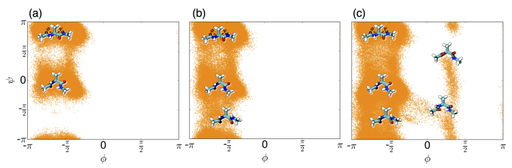
Figure 5 : Alanine dipeptide landscapes were generated using three simulation methods: (a) single long trajectory simulation, (b) least counts adaptive and (C) the REAP algorithm. Representative molecular structures are shown on top of the landscape to illustrate the new regions sampled using REAP within the same simulation time.
원문 · CC BY 4.0 · Zahra Shamsi, Kevin J. Cheng, Diwakar Shukla · REinforcement learning based Adaptive samPling: REAPing Rewards by Exploring Protein Conformational Landscapes · 원문 그림 인용 · 원본 PDF 22쪽에서 그림 영역을 추출했습니다.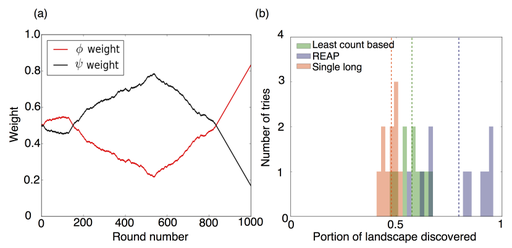
Figure 6 : (a) The weights corresponding to alanine dipeptide RCs ( φ and ψ) change over each simulation round. As a result, these change in weights demonstrate how the algorithm identifies important direction of sampling as it explores the landscape (b) A plot showing the distribution of portion of landscape discovered over 10 repeated simulation trials. Dashed lines indicate the expected value for each distribution.
원문 · CC BY 4.0 · Zahra Shamsi, Kevin J. Cheng, Diwakar Shukla · REinforcement learning based Adaptive samPling: REAPing Rewards by Exploring Protein Conformational Landscapes · 원문 그림 인용 · 원본 PDF 22쪽에서 그림 영역을 추출했습니다.Src 키나아제는 이전 연구와 같은 마르코프 상태 모델로 키네틱 몬테카를로(KMC) 궤적을 생성해 평가했습니다. 기준 조건은 15 µs의 연속 시뮬레이션이며, 모든 시뮬레이션은 비활성 상태의 같은 MSM 상태에서 시작했습니다. 원문은 REAP와 LC가 SL보다 활성 상태 도달 시간의 중앙값이 약 절반이었다고 보고하며, 이 결과는 KMC 설정에서 얻은 것입니다. 무관한 거리 좌표를 추가했을 때에도 REAP는 그 거리들에 낮은 가중치를 부여했다고 원문이 보고합니다.
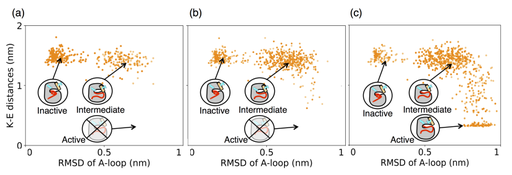
Figure 7 : (a) The simulation data of Src kinase using a single trajectory approach is plotted using two RCs: K-E distances and RMSD of the A-loop. Simulations started in the inactive conformation and ran for a total time of 15 µs. (b) Simulations data using least counts adaptive sampling. Sampling improves on (a), but fails to reach the active state (c) This plot shows how the REAP sampling algorithm outperforms that of the single trajectory approach in (a). The algorithm was able to facilitate sampling of the active kinase conformation.
원문 · CC BY 4.0 · Zahra Shamsi, Kevin J. Cheng, Diwakar Shukla · REinforcement learning based Adaptive samPling: REAPing Rewards by Exploring Protein Conformational Landscapes · 원문 그림 인용 · 원본 PDF 23쪽에서 그림 영역을 추출했습니다.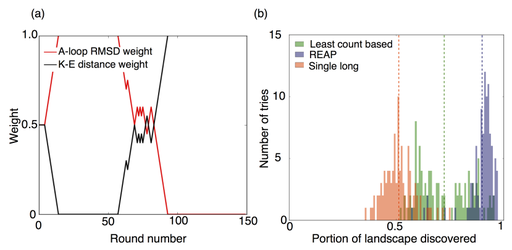
Figure 8 : (a) Weights for each RC signify the importance of each RC depending on the round number (or iteration of the algorithm) (b) A plot showing the frequency of portion of landscape discovered for REAP, LC, and SL simulations for 100 trials. Dashed lines represent the expected value of each distribution.
원문 · CC BY 4.0 · Zahra Shamsi, Kevin J. Cheng, Diwakar Shukla · REinforcement learning based Adaptive samPling: REAPing Rewards by Exploring Protein Conformational Landscapes · 원문 그림 인용 · 원본 PDF 23쪽에서 그림 영역을 추출했습니다.초기 반응 좌표 선택과 적용 범위
이 연구의 가장 중요한 제약은 초기 반응 좌표 선택입니다. 저자들은 REAP에서 초기 RC 선택이 구조적 또는 생물물리 데이터에 크게 의존할 가능성이 있다고 밝힙니다. 다만 알고리즘은 많은 수의 RC를 사용할 수 있고, 빠른 방향의 가중치를 몇 라운드 안에 0으로 줄인다고 설명됩니다. 대안으로 저자들은 결합 작업 추정이나 진화적 결합(EC) 쌍을 RC로 쓰는 방법을 언급하지만, 이는 본 논문의 검증 대상이 아니라 향후 가능성으로 제시된 것입니다.
또한 본문의 결과는 L자형과 원형 모델 포텐셜, 2 ns 알라닌 디펩타이드 MD, KMC 기반 Src 키나아제 평가에서 얻은 것입니다. 이 결과를 모든 단백질 계나 실제 MD 설정으로 확장할 근거는 원문에 제시되지 않습니다. 방법의 적용 범위는 주로 Src 키나아제와 알라닌 디펩타이드에서 확인되었습니다.
논문 정보
- 저자
- Zahra Shamsi, Kevin J. Cheng, Diwakar Shukla
- 학회·저널
- arXiv · 프리프린트
- 최초 공개일
- 2017년 10월 2일
- 등록일
- 2026년 11월 6일
- 수정일
- 2018년 7월 5일
- 버전
- v2
- arXiv
- 1710.00495
- 분류
- q-bio.BM · physics.bio-ph · physics.chem-ph
- 원문 이용 조건
- CC BY 4.0
- 제공 범위
- 논문 정보, 해설, 허용된 원문 그림
AI 해설은 논문 원문과 별개의 설명이며 오류가 있을 수 있습니다. 원문과 그림은 각 출처의 이용 조건과 따로 표시된 권리를 따릅니다.
초록
One of the key limitations of Molecular Dynamics simulations is the computational intractability of sampling protein conformational landscapes associated with either large system size or long timescales. To overcome this bottleneck, we present the REinforcement learning based Adaptive samPling (REAP) algorithm that aims to efficiently sample conformational space by learning the relative importance of each reaction coordinate as it samples the landscape. To achieve this, the algorithm uses concepts from the field of reinforcement learning, a subset of machine learning, which rewards sampling along important degrees of freedom and disregards others that do not facilitate exploration or exploitation. We demonstrate the effectiveness of REAP by comparing the sampling to long continuous MD simulations and least-counts adaptive sampling on two model landscapes (L-shaped and circular), and realistic systems such as alanine dipeptide and Src kinase. In all four systems, the REAP algorithm consistently demonstrates its ability to explore conformational space faster than the other two methods when comparing the expected values of the landscape discovered for a given amount of time. The key advantage of REAP is on-the-fly estimation of the importance of collective variables, which makes it particularly useful for systems with limited structural information.
원문 인용
Zahra Shamsi, Kevin J. Cheng, Diwakar Shukla (2017). REinforcement learning based Adaptive samPling: REAPing Rewards by Exploring Protein Conformational Landscapes. arXiv:1710.00495v2. https://arxiv.org/abs/1710.00495v2
BibTeX
@misc{shamsi2017reinforcement,
  title = {{REinforcement learning based Adaptive samPling: REAPing Rewards by Exploring Protein Conformational Landscapes}},
  author = {Zahra Shamsi and Kevin J. Cheng and Diwakar Shukla},
  year = {2017},
  eprint = {1710.00495},
  archivePrefix = {arXiv},
  url = {https://arxiv.org/abs/1710.00495v2}
}