논문 해설
Radars for Autonomous Driving: A Review of Deep Learning Methods and Challenges
자율주행을 위한 레이더: 딥러닝 방법과 과제에 대한 검토
- 연구 문제 레이더는 고해상도 속도 영상화, 가림과 장거리 객체 감지, 악천후 강건성을 갖추지만 낮은 분해능, 희소성, 클러터, 높은 불확실성 때문에 딥러닝 연구가 제약됩니다.
- 연구 방법 이 리뷰는 FMCW 신호 처리에서 데이터 형식, 검출 구조, 조기·후기 융합, 점유와 장면 흐름, 불확실성, 다중 경로 클러터를 차례로 정리합니다.
- 주요 결과 조기 융합과 점유 기반 추적은 레이더의 속도와 악천후 강건성을 활용할 수 있는 방향으로 제시되며, 4D 레이더는 3D 레이더보다 각도 분해능과 범위가 개선된 것으로 비교됩니다.
레이더 딥러닝이 제약받는 이유
자율주행 인지에서 레이더는 고해상도 속도 영상화, 가림 및 장거리 객체 감지, 악천후에서의 견고함이라는 장점을 가진 센서입니다. 그럼에도 레이더 데이터는 분해능이 낮고 희소하며 클러터가 많고 불확실성이 큽니다. 여기에 고품질 레이더 데이터셋이 부족하여 레이더 전용 모델 연구가 제한되었습니다. 그 결과 현재의 많은 레이더 모델은 라이다와 비전 모델을 기반으로 만들어지며, 레이더의 고유한 특징을 충분히 활용하지 못한다고 원문은 지적합니다. 이 리뷰는 이러한 상황에서 레이더 딥러닝 연구 주제를 정리하고 기회와 과제를 개관하는 것을 목표로 합니다.
레이더 원시 신호에서 데이터 형식까지
FMCW 레이더는 주파수가 선형으로 증가하는 chirp를 송신하고, 반사파의 지연으로 거리를 계산합니다. 여러 chirp에 걸친 FFT로 radial velocity를 얻으며, 안테나 배열의 FFT로 방위각과 고도각을 얻어 radarcube를 만듭니다. 원문에 따르면 이 다차원 행렬은 거대하여 딥러닝에 그대로 쓰기 어렵고, 그래서 RAD 텐서, range-azimuth 히트맵, 점군, micro-Doppler 스펙트로그램 같은 압축 형식이 쓰입니다. 점군은 radarcube의 피크를 CFAR로 추출한 희소한 3D 점 집합입니다. CFAR는 주변 셀의 평균 잡음 바닥보다 진폭이 임계값을 넘는 셀을 신호로 판정하므로, 약한 SNR 관측이 걸러질 수 있다는 한계가 원문에서 함께 지적됩니다.
점군 기반 검출 모델의 구성
레이더 검출 모델은 특징 인코더, 백본, 검출 헤드의 세 단계로 구성됩니다. PointPillars는 점군을 BEV 2D 격자의 수직 필러로 묶고 학습된 특징을 의사 이미지로 만들어 2D 합성곱 백본에 넣습니다. VoxelNet은 높이 구조를 보존하는 3D 복셀로 확장하지만 메모리와 연산 비용이 큽니다. 헤드 측면에서 CenterNet은 객체를 중심점으로 모델링하고 나머지 속성을 이후에 회귀합니다. 원문은 이 구조들이 레이더 입력 형식과 어떻게 맞물리는지를 설명하지만, 특정 실험 결과를 이 흐름 전체의 공통 성능으로 제시하지는 않습니다.
조기 융합과 후기 융합의 차이
후기 융합은 각 센서의 완전한 검출 결과를 associator로 합치는 방식이어서 센서 데이터의 특징을 융합 단계에서 쓰지 못합니다. 조기 융합은 여러 센서의 데이터 특징을 모델 안에서 함께 학습하며, 트랜스포머의 교차 어텐션이 이 과정을 가능하게 합니다. 카메라와 레이더 조기 융합인 CenterFusion은 perspective view에서 레이더 특징으로 깊이와 속도를 개선합니다. CramNet은 카메라 perspective view와 레이더 BEV를 광선 제약 투영 공간에서 교차 어텐션으로 융합합니다. 라이다와 레이더의 조기 융합인 MVDNet과 Bi-LRFusion은 BEV 특징을 교차 어텐션으로 결합하며, 원문은 이 연구들의 성능 향상을 각 논문의 설정에서 보고된 결과로 제시합니다.
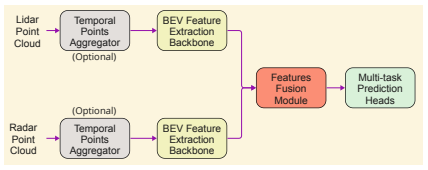
FIGURE 12 . A high-level block diagram of common lidar-radar early fusion models. These models learn BEV features from both sensors, typically using similar backbones, and follow by fusing these features for joint inference.
원문 · CC BY 4.0 · Arvind Srivastav, Soumyajit Mandal · Radars for Autonomous Driving: A Review of Deep Learning Methods and Challenges · 원문 그림 인용 · 원본 PDF 14쪽에서 그림 영역을 추출했습니다.점유 추정과 장면 흐름
점유 기반 방법은 자차 중심의 세밀한 격자에서 각 셀의 점유와 속도를 예측하므로 객체 검출에 의존하지 않고 주행 가능 영역을 추정합니다. 레이더 기반 점유 모델은 속도와 거리 정보를 활용하지만, 원문에 따르면 희소성과 낮은 분해능 때문에 예측이 coarse해지는 한계가 있습니다. 장면 흐름은 점의 움직임을 나타내는 모션 필드를 예측합니다. RaFlow는 4D 레이더 점군 두 프레임을 입력으로 자기지도 방식의 흐름과 정적·동적 분할을 추정하며, 원문은 정적 점에 무게를 둔 설계가 동적 점의 흐름 추정 신뢰도를 낮출 수 있다고 제한합니다.
불확실성 모델링과 레이블 개선
불확실성은 측정 분산이 일정한지 여부에 따라 homoscedastic과 heteroscedastic으로 나뉩니다. 자율주행 환경은 거리와 운동 상태에 따라 분산이 달라지는 heteroscedastic한 예입니다. 이 가운데 aleatoric 불확실성은 센서 잡음 같은 입력 자체의 무작위성에서 생기며, 레이더에서 특히 크다고 원문은 설명합니다. 원문은 이를 활용해 모델 출력의 불확실성을 줄이거나 레이블 불확실성을 줄이는 방법을 소개합니다. P-smoothing은 객체의 평균 수신 전력에 따라 소프트 레이블을 만들며, 원문에 따르면 저반사체와 먼 거리 객체의 aleatoric 불확실성은 평균 수신 전력에 반영됩니다.
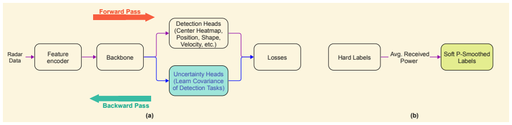
FIGURE 14 . The high uncertainty of radar data and measurements results in less reliable detections from learned radar models. (a) Some studies seek to improve task robustness by learning the uncertainty associated with each task using auxiliary heads during the forward pass, followed by weighing the loss for each task within the total loss based on its learned uncertainty. (b) Other studies focus on improving model robustness by reducing the uncertainty of the labels.
원문 · CC BY 4.0 · Arvind Srivastav, Soumyajit Mandal · Radars for Autonomous Driving: A Review of Deep Learning Methods and Challenges · 원문 그림 인용 · 원본 PDF 16쪽에서 그림 영역을 추출했습니다.다중 경로 클러터와 시뮬레이션
레이더의 긴 파장은 주변 표면을 거울처럼 작동하게 하여 다중 경로 전파를 만들고, 이로 인해 실제 객체가 없는 허위 관측인 클러터가 생깁니다. 원문은 이를 더블 바운스, 차체 하부 반사, 거울형 유령 검출의 세 유형으로 나눕니다. 초기 연구는 규칙 기반 필터를 썼지만 복잡한 주행 장면에서 견고하지 않았습니다. 이후 PointNet과 PointNet++ 기반 학습 방법이 제안되었습니다. 레이더 시뮬레이션은 물리 기반 반사도 모델링이 어려워 GAN으로 라이다 고도 맵에서 레이더 데이터를 생성하는 방법이 소개되며, 원문은 그 모델로 학습한 레이더 모델이 실제 데이터로 학습한 모델과 비슷한 성능을 보였다고 보고합니다.
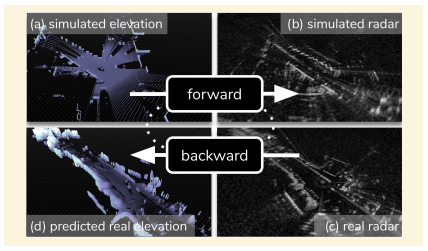
FIGURE 16 . This figure illustrates a GAN [124] that generates synthetic radar data (b) from input lidar elevation map (a). The network implements a bi-directional mapping by additionally learning to produce realistic lidar data from real radar data, which enforces cyclic consistency (depicted with dashed lines), resulting in improved quality of the generated radar data.
원문 · CC BY 4.0 · Arvind Srivastav, Soumyajit Mandal · Radars for Autonomous Driving: A Review of Deep Learning Methods and Challenges · 원문 그림 인용 · 원본 PDF 18쪽에서 그림 영역을 추출했습니다.남은 과제와 적용 범위
원문은 4D 레이더가 3D 레이더보다 각도 분해능과 최대 범위에서 개선되었다고 비교하며, 솔리드 스테이트 라이다는 각도 분해능이 더 높지만 레이더는 속도 영상화와 악천후 내성에서 강점이 있다고 설명합니다. 다만 이 비교는 제공된 사양 표와 감쇠 모델에 기반한 해석이며, 실제 주행 데이터에서의 전 범위 검증으로 읽지 않아야 합니다. 레이더 데이터셋은 NuScenes처럼 3D 레이더 중심인 자료와 K-Radar처럼 4D 레이더 자료가 혼재하고, 리뷰 전체가 모든 조건을 같은 기준으로 재측정한 것은 아닙니다. 따라서 여기서 정리된 결과는 각 선행 연구의 데이터와 설정 범위 안에서 읽어야 합니다.
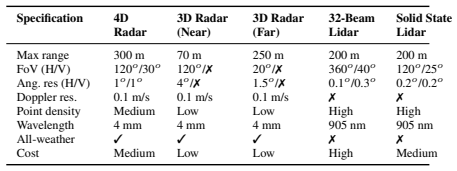
TABLE 1 . A comparison of capabilities of radars and lidars. Generally, 3D radars provide two types of low-resolution imaging – near range and far range. 4D radars have substantially better imaging resolution and more capabilities than their 3D counterparts, thus bridging the performance gap with lidars. Here FoV refers to the “Field of View” while H/V denotes Horizontal/Vertical.
원문 · CC BY 4.0 · Arvind Srivastav, Soumyajit Mandal · Radars for Autonomous Driving: A Review of Deep Learning Methods and Challenges · 원문 그림 인용 · 원본 PDF 5쪽에서 그림 영역을 추출했습니다.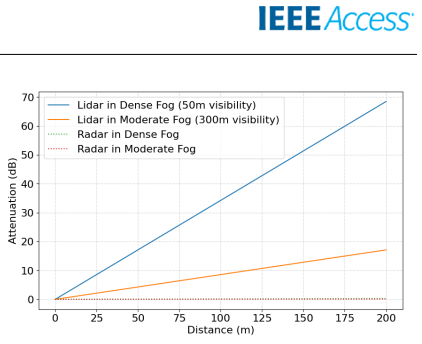
FIGURE 3 . A comparison of signal power attenuation in moderate and dense fog conditions for 77 GHz Radar (using the ITU model) and 905 nm Lidar (using the Al Naboulsi model). This chart shows that lidar undergoes significant attenuation in fog while radar is unaffected.
원문 · CC BY 4.0 · Arvind Srivastav, Soumyajit Mandal · Radars for Autonomous Driving: A Review of Deep Learning Methods and Challenges · 원문 그림 인용 · 원본 PDF 5쪽에서 그림 영역을 추출했습니다.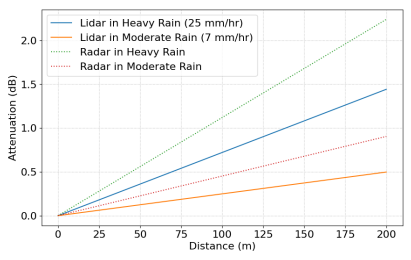
FIGURE 4 . A comparison of signal power attenuation in moderate and heavy rain conditions for 77 GHz Radar (using the ITU model) and 905 nm Lidar (using a Marshall-Palmer rain distribution). This chart shows that both lidar and radar perform well, even in heavy rain conditions.
원문 · CC BY 4.0 · Arvind Srivastav, Soumyajit Mandal · Radars for Autonomous Driving: A Review of Deep Learning Methods and Challenges · 원문 그림 인용 · 원본 PDF 5쪽에서 그림 영역을 추출했습니다.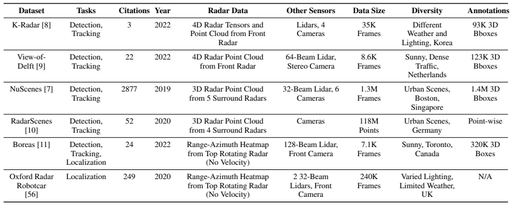
TABLE 2 . A comparison of recent high-quality radar datasets for autonomous systems
원문 · CC BY 4.0 · Arvind Srivastav, Soumyajit Mandal · Radars for Autonomous Driving: A Review of Deep Learning Methods and Challenges · 원문 그림 인용 · 원본 PDF 8쪽에서 그림 영역을 추출했습니다.논문 정보
- 저자
- Arvind Srivastav, Soumyajit Mandal
- 학회·저널
- arXiv · 프리프린트
- 최초 공개일
- 2023년 6월 15일
- 등록일
- 2026년 11월 6일
- 수정일
- 2023년 9월 27일
- 버전
- v3
- arXiv
- 2306.09304
- 분류
- cs.CV
- 원문 이용 조건
- CC BY 4.0
- 제공 범위
- 논문 정보, 해설, 허용된 원문 그림
AI 해설은 논문 원문과 별개의 설명이며 오류가 있을 수 있습니다. 원문과 그림은 각 출처의 이용 조건과 따로 표시된 권리를 따릅니다.
초록
Radar is a key component of the suite of perception sensors used for safe and reliable navigation of autonomous vehicles. Its unique capabilities include high-resolution velocity imaging, detection of agents in occlusion and over long ranges, and robust performance in adverse weather conditions. However, the usage of radar data presents some challenges: it is characterized by low resolution, sparsity, clutter, high uncertainty, and lack of good datasets. These challenges have limited radar deep learning research. As a result, current radar models are often influenced by lidar and vision models, which are focused on optical features that are relatively weak in radar data, thus resulting in under-utilization of radar's capabilities and diminishing its contribution to autonomous perception. This review seeks to encourage further deep learning research on autonomous radar data by 1) identifying key research themes, and 2) offering a comprehensive overview of current opportunities and challenges in the field. Topics covered include early and late fusion, occupancy flow estimation, uncertainty modeling, and multipath detection. The paper also discusses radar fundamentals and data representation, presents a curated list of recent radar datasets, and reviews state-of-the-art lidar and vision models relevant for radar research. For a summary of the paper and more results, visit the website: autonomous-radars.github.io.
원문 인용
Arvind Srivastav, Soumyajit Mandal (2023). Radars for Autonomous Driving: A Review of Deep Learning Methods and Challenges. arXiv:2306.09304v3. https://arxiv.org/abs/2306.09304v3
BibTeX
@misc{srivastav2023radars,
  title = {{Radars for Autonomous Driving: A Review of Deep Learning Methods and Challenges}},
  author = {Arvind Srivastav and Soumyajit Mandal},
  year = {2023},
  eprint = {2306.09304},
  archivePrefix = {arXiv},
  url = {https://arxiv.org/abs/2306.09304v3}
}