논문 해설
Reinforcement learning pulses for transmon qubit entangling gates
트랜스몬 큐빗 얽힘 게이트를 위한 강화학습 펄스
- 연구 문제 고정 주파수 transmon의 엔탱글링 게이트는 부정확한 물리 모델에 의존해 설계되는 경우가 많습니다. 이 논문은 모델 지식 없이 연속 제어 강화학습 에이전트가 cross-resonance 및 CNOT 게이트 펄스를 설계할 수 있는지 다룹니다.
- 연구 방법 두 transmon을 시뮬레이션하는 환경에서 DDPG 에이전트가 PWC 펄스의 진폭 변화량을 행동으로 선택하고, 최종 충실도 기반 희소 보상으로 학습합니다.
- 주요 결과 시뮬레이션에서 RL 펄스는 248.9 ns ZX(π/2) 및 CNOT 게이트를 F > 99.9%로 설계했고, 기존 direct 방식보다 짧은 177.8 ns 펄스도 보고되었습니다. 드리프트 학습에 맥락 정보를 더하면 최대 4% 드리프트에서 99.9% 충실도를 보였습니다.
모델 기반 게이트 설계의 한계
고정 주파수 고정 결합 transmon 큐빗에서 두 큐빗 게이트를 만드는 일은 보통 물리 모델에 의존합니다. 그러나 실제 하드웨어에는 잡음, 결맞음 손실, 기타 환경 교란이 있어 정확한 모델을 알기 어렵습니다. 또한 모델이 있어도 최적 제어 문제를 해석적으로 풀기 어려운 경우가 많습니다. 이 논문은 모델 없이 장치와 직접 상호작용하며 학습하는 강화학습 에이전트가 cross-resonance 기반 ZX(π/2) 및 CNOT 게이트 펄스를 설계할 수 있는지 묻습니다. 연구 범위는 시뮬레이션 환경에서의 두 큐빗 게이트 설계이며, 목표 충실도는 99.9%로 설정됩니다.
환경과 PWC 펄스 행동 공간
환경은 두 transmon을 Duffing 진동자로 모델링하고, 회전 좌표계에서 결합 항과 cross-resonance 구동을 포함한 해밀토니안 H2(t)로 시뮬레이션합니다. 에이전트는 각 시간 단계에서 복소 제어 펄스의 진폭 변화량을 행동으로 선택합니다. 행동은 상대 변화 a_i = A_i − A_{i−1}로 정의되며, 각 성분은 드라이브별 창 w_u 또는 w_d 안으로 제한되고 최종 진폭은 [−1, 1]로 잘립니다. 상태는 시간 진화된 기저 상태, 이전 단계 진폭 A_{i−1}, 그리고 드리프트 환경에서는 상대 파라미터 변화 Δp/p0로 구성됩니다. 이렇게 하면 PWC 펄스 설계 공간을 직접 탐색할 수 있으며, 탐색 창을 작게 두어 학습을 안정화합니다.
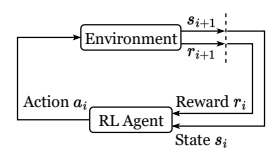
FIG. 3 . Basic reinforcement learning loop. The agent in- teracts with its environment (different from the conventional definition of environment in physics) by taking actions and in turn receiving information about the environment’s new state. In addition, the agent receives a reward indicating the usefulness of the last action for achieving the given task.
원문 · CC BY 4.0 · Ho Nam Nguyen, Felix Motzoi, Mekena Metcalf, K. Birgitta Whaley, Marin Bukov, Markus Schmitt · Reinforcement learning pulses for transmon qubit entangling gates · 원문 그림 인용 · 원본 PDF 6쪽에서 그림 영역을 추출했습니다.희소 보상과 DDPG 학습
보상은 에피소드 종료 시점의 최종 충실도에만 주어지는 희소 보상입니다. 보상은 r_N = −log10(1 − F)로 정의되어, 충실도가 0.99에서 0.999로 오를 때 보상이 2에서 3으로 한 단위 늘어납니다. 학습 알고리즘은 연속 행동을 다루는 DDPG입니다. DDPG는 Q-네트워크 Q_ϕ와 결정론적 정책 네트워크 μ_θ를 함께 학습하며, 전이 튜플을 Experience Replay Buffer에 저장한 뒤 무작위 배치로 두 네트워크를 갱신합니다. 탐색 잡음은 Ornstein-Uhlenbeck 과정으로 생성되고 시간에 따라 감쇠합니다. 학습 중에는 목표 네트워크를 천천히 갱신하여 목표값이 빠르게 흔들리는 문제를 줄입니다.
이 설명은 DDPG의 일반적 구성과 이 논문이 사용한 구성 요소를 함께 보여 줍니다.
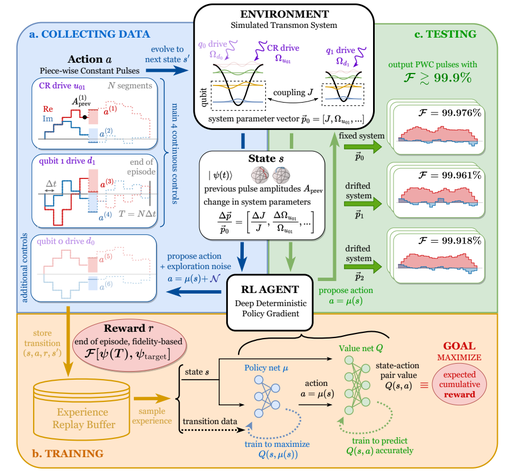
FIG. 4 . Reinforcement learning for designing high-fidelity quantum gates. RL framework involves two main entities: the environment, which is a system of two coupled transmons simulated as anharmonic oscillators truncated a three energy levels, and the RL agent, which uses the DDPG algorithm for learning continuous control drives. We focus on learning 2 control drives (cross-resonance u01 and qubit 1 rotation d1) in the main text, and report additional results for including a third control drive (qubit 0 rotation d0) in App. E 1. a) Step 1: Collecting data. At every step, the current state s of the environment is characterized by the time-evolved quantum state of the transmons{ψj(t)}, the previous control pulse amplitudes Aprev, and the relative changes in system parameters ∆ ⃗ p/⃗ p0. Based on that state s, the RL agent proposes an action a to determine control drive amplitudes that evolve the transmon environment forward in time. The environment outputs the next state s′ and a fidelity-based reward r (cf. Eq. 24), and the transition tuple ( s, a, r, s′) is stored to an Experience Replay Buffer. An episode is complete when the RL agent fully constructs an N -segment pulse, and data from many episodes are collected for training. Here we consider a sparse reward scheme, meaning a non-zero reward is given only at the end of each episode. In addition, during data collection, some noise is injected into the RL agent’s action to encourage exploration of new control solutions (cf. Alg. 1). b) Step 2: Training.Transition data from the Experience Replay Buffer are randomly sampled for batch-training two networks in DDPG algorithm: a value network Q, which learns to accurately predict the expected cumulative reward Q(s, a) of taking an action a from a state s, and a policy network µ, which learns to propose an action a = µ(s) that maximizes this Q-value. Outside of this training process, RL agent typically refers to the policy network µ because it generates all of the agent’s actions. c) Step 3: Testing. Once trained, the RL agent can deterministically construct pulses with fidelity ≳ 99.9%, not only for a fixed environment, but also for environments whose parameters have drifted.
원문 · CC BY 4.0 · Ho Nam Nguyen, Felix Motzoi, Mekena Metcalf, K. Birgitta Whaley, Marin Bukov, Markus Schmitt · Reinforcement learning pulses for transmon qubit entangling gates · 원문 그림 인용 · 원본 PDF 8쪽에서 그림 영역을 추출했습니다.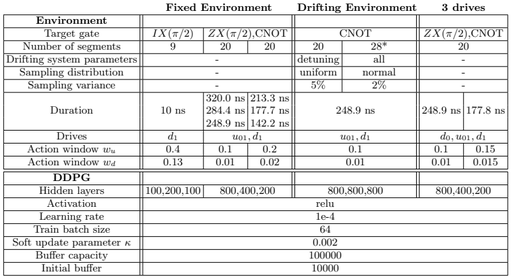
원문 그림 TABLE I. Training hyperparameters for training an RL agent to design quantum gates on simulated transmon environment. Unmentioned hyperparameters necessary for the DDPG algorithm are set to their default values in RLlib’s implementation [54], version 2.0.0. *When studying the adaptability of our RL agent to drifting system characteristics, we discover a particular region around +2% drift on all system parameters where the 20-segment ansatz yields no solution with fidelity better than 99.5%. The problem goes away when we increase the number of segments to 28, whose result was reported in the main text.
원문 · CC BY 4.0 · Ho Nam Nguyen, Felix Motzoi, Mekena Metcalf, K. Birgitta Whaley, Marin Bukov, Markus Schmitt · Reinforcement learning pulses for transmon qubit entangling gates · 원문 그림 인용 · 원본 PDF 20쪽에서 그림 영역을 추출했습니다.기존 cross-resonance 방식과의 비교
검증의 첫 단계는 단일 큐빗 X(π/2) 게이트입니다. 10 ns RL 펄스는 35.6 ns DRAG 펄스보다 빠르며, 평균 충실도는 99.9% 이상으로 보고됩니다. 이 과정에서 RL 펄스는 최대 진폭이 커지고 준위 2로의 누설이 중간 단계에서 크게 나타나지만, 최종 누설은 낮게 억제됩니다. 두 큐빗 ZX(π/2) 게이트에서는 direct 방식과 RL 방식을 248.9 ns와 177.8 ns에서 비교합니다. RL 방식은 같은 충실도 기준에서 게이트 시간을 줄이며, 원문은 최대 약 30% 감소 가능성을 보고합니다. 보고된 수치는 특정 시뮬레이션 파라미터와 최적화 설정에서 얻은 것입니다.
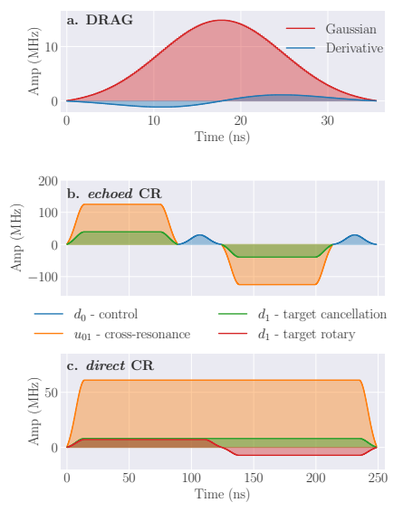
FIG. 2 . Standard error suppression techniques for im- plementing gates on transmon-qubit devices. The ana- lytical waveforms are discretized at the inverse sampling rate dt = 2/9 ns. a) RX (π/2) implemented using DRAG scheme with an in-phase Gaussian pulse d(t) and its out-of-phase derivative (blue). ZX (π/2) implemented using b) an echoed pulse and c) an echo-free/ direct pulse, consisting of a main cross-resonance pulse u01(t) (orange) along with on-resonance drives, d0(t) and d1(t), on control (blue) and target (green and red) qubits.
원문 · CC BY 4.0 · Ho Nam Nguyen, Felix Motzoi, Mekena Metcalf, K. Birgitta Whaley, Marin Bukov, Markus Schmitt · Reinforcement learning pulses for transmon qubit entangling gates · 원문 그림 인용 · 원본 PDF 5쪽에서 그림 영역을 추출했습니다.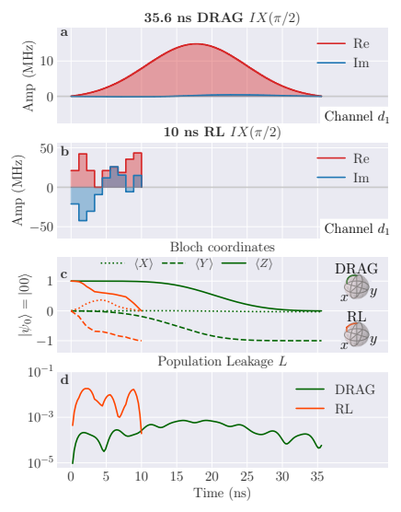
FIG. 5 . Optimization for the single-qubit gate X(π/2) in two-transmon setting. (a) IBM 35.6 ns DRAG pulse. (b) 10 ns RL-optimized pulse with training hyperparameters given in the “Fixed Environment” section of Table I. (c) Cor- responding evolution of Bloch coordinates for the controlled qubit. (d) Population leakage to |2⟩ for RL pulse is up to a few orders of magnitude higher compared to DRAG during the evolution. RL-optimized pulse is 3 × faster with similar average gate fidelity above 99.9%, and makes use of the pres- ence of level |2⟩, at the expense of accessing three times larger amplitudes.
원문 · CC BY 4.0 · Ho Nam Nguyen, Felix Motzoi, Mekena Metcalf, K. Birgitta Whaley, Marin Bukov, Markus Schmitt · Reinforcement learning pulses for transmon qubit entangling gates · 원문 그림 인용 · 원본 PDF 10쪽에서 그림 영역을 추출했습니다.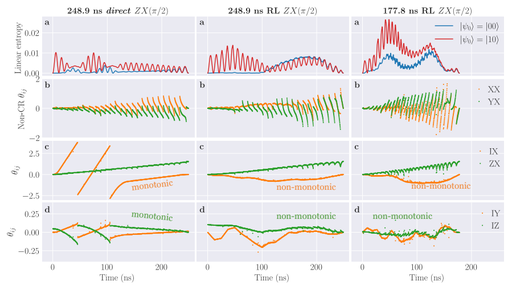
FIG. 8 . Entanglement and rotation angles of optimized ZX (π/2) pulses. We display results with fidelity over 99.9% for the direct and RL approaches at gate durations 248.9 ns and 177.8 ns. (a) Linear entropy Slin evolution for the initial states |00⟩ and |10⟩, which are expected to remain separable. (b) Rotation angles evolution, cf. Eq. 31, for two entangling interactions not present in the effective CR model given in Eq. 12. (c-d) Rotation angles evolution for several interaction types predicted by the effective CR model, including the main entangling process ZX and target qubit rotation angles IX , IY , and IZ . Deviation from zero entanglement for initial states |00⟩ and |10⟩ indicates the presence of entangling interactions beyond this model, such as the shown evolution of XX and Y Xinteractions. While the ZX angle is accumulated in a similar manner, target qubit rotations in RL-designed solutions behave fundamentally differently w.r.t the monotonicity of those rotation angles in the direct scheme.
원문 · CC BY 4.0 · Ho Nam Nguyen, Felix Motzoi, Mekena Metcalf, K. Birgitta Whaley, Marin Bukov, Markus Schmitt · Reinforcement learning pulses for transmon qubit entangling gates · 원문 그림 인용 · 원본 PDF 13쪽에서 그림 영역을 추출했습니다.드리프트와 일반화 평가
드리프트 평가에서는 고정 환경에서 학습한 펄스가 파라미터 변화에 얼마나 민감한지 살핍니다. 직접 펄스는 구동 세기 변화에 민감하고, 고정 환경 RL 펄스는 모든 파라미터 변화에 빠르게 저하됩니다. 이를 보완하기 위해 드리프트 환경에서 학습하고, 파라미터 상대 변화를 문맥 정보로 함께 제공합니다. 모든 파라미터를 2% 표준편차 가우시안 분포로 샘플링한 설정에서, 맥락 포함 에이전트는 최대 4% 드리프트까지 99.9% 충실도를 보인다고 보고됩니다. 또한 큰 드리프트에서는 fine-tuning이 필요하며, 일반화된 에이전트를 시작점으로 사용하면 처음부터 학습하는 경우보다 학습 에피소드 수가 줄어듭니다.
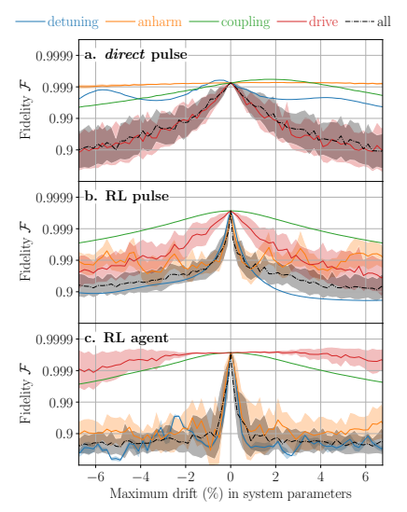
FIG. 11 . Fidelity of fixed-environment control solu- tions in the presence of system drifts. We sample drifts in system parameters (see legend) of a single type (solid curves) and of all types simultaneously (dashed black curve), and then bin the data points according to the maximum drift. The binned mean fidelities (curves) and their standard devi- ations (shaded areas) are displayed. (a-b) Fidelity of pulses from direct implementation and RL optimization are evalu- ated on new environments. The direct pulse is susceptible mostly only to drift in drive strength, whereas the RL solu- tion is susceptible to drift in all parameters. (c) Fidelity of adaptive pulse found by RL agent via interaction with each new environment; solution remains susceptible to drift in de- tuning and anharmonicity while generalizing well for drift in drive strength. Data represents optimizing a 248.9 ns CNOT pulse, with RL training hyperparameters given in the “Drift- ing Environment” section of Table I.
원문 · CC BY 4.0 · Ho Nam Nguyen, Felix Motzoi, Mekena Metcalf, K. Birgitta Whaley, Marin Bukov, Markus Schmitt · Reinforcement learning pulses for transmon qubit entangling gates · 원문 그림 인용 · 원본 PDF 16쪽에서 그림 영역을 추출했습니다.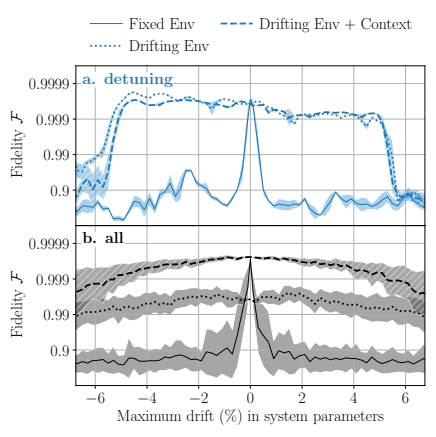
FIG. 12 . Improved generalization fidelity when using augmented RL approach. As reference, we import fidelity curves (solid) from an agent trained on a fixed environment from Fig. 11c. We display improved results for training on an environment with drifting system parameters, when the agent has no knowledge (dotted) or full knowledge (dashed) of the drifting parameters, i.e., context information. (a) Drift in de- tuning frequency only. Training on environments with drift- ing system parameters is sufficient in improving the fidelity to ≳ 99.9% within a 5% drift. Having context information provides a slight improvement in performance while cutting training time in half. (b) Drift in all parameters. Context is essential to stabilize training, and provides the best general- ization result. RL training hyperparameters are given in the “Drifting Environment” section of Table I.
원문 · CC BY 4.0 · Ho Nam Nguyen, Felix Motzoi, Mekena Metcalf, K. Birgitta Whaley, Marin Bukov, Markus Schmitt · Reinforcement learning pulses for transmon qubit entangling gates · 원문 그림 인용 · 원본 PDF 17쪽에서 그림 영역을 추출했습니다.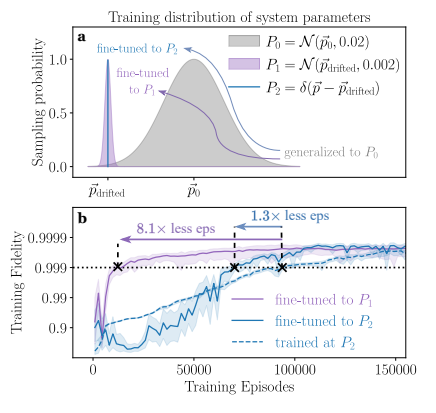
FIG. 13 . Reduction in training episodes when using a generalized agent to fine-tune. a) Training distribu- tion of system parameters for three cases: generalizing to a Gaussian distribution P0 of 2% standard deviation (gray) as a starting point (same agent for dashed black curve in Fig. 12b), then either fine-tuning to a narrower distribution P1 of 0.2% standard deviation (purple), or fine-tuning to a fixed envi- ronment, i.e., a delta distribution P2 (blue). P0 is centered at the original system parameters ⃗ p0 whereas P1 and P2 are centered at ⃗ pdrifted. b) Mean training fidelity as a function of training episodes for comparison between fine-tuning (to P1 and P2) and training from scratch (under P2). Shaded region is defined by the minimum and maximum training fidelity. For each case, we perform 3 runs with different seeds and re- port the best learning curve. RL training hyperparameters are given in the “Drifting Environment” section of Table I. Fine-tuning to P1 and P2 offers a 8 .1× and 1 .3× reduction in episodes required to reach 99.9% mean fidelity, implying great potential for transfer learning.
원문 · CC BY 4.0 · Ho Nam Nguyen, Felix Motzoi, Mekena Metcalf, K. Birgitta Whaley, Marin Bukov, Markus Schmitt · Reinforcement learning pulses for transmon qubit entangling gates · 원문 그림 인용 · 원본 PDF 18쪽에서 그림 영역을 추출했습니다.적용 범위와 한계
논문은 주로 두 제어 드라이브 u01과 d1을 사용한 결과를 본문에 제시합니다. 세 번째 드라이브를 포함한 결과와 TD3 설정은 부록의 추가 실험에 있으며, 그 결과는 모든 설정에서 일관되게 성공하지 않았다고 보고됩니다. 또한 평가는 시뮬레이션 환경과 특정 IBMQ Valencia 계열 파라미터에 기반하므로 실제 장치에서의 검증은 원문에서 수행하지 않았습니다. 평균 충실도가 주 지표이며, 최악의 경우 충실도는 보충 실험에서 뚜렷한 이점을 보이지 않았습니다. 드리프트 일반화 역시 고정된 분포와 샘플링 범위에서 평가되었으므로, 그 밖의 큰 변화에는 fine-tuning이 필요할 수 있습니다.
논문 정보
- 저자
- Ho Nam Nguyen, Felix Motzoi, Mekena Metcalf, K. Birgitta Whaley, Marin Bukov, Markus Schmitt
- 학회·저널
- arXiv · 프리프린트
- 최초 공개일
- 2023년 11월 7일
- 등록일
- 2026년 11월 6일
- 수정일
- 2024년 6월 14일
- 버전
- v2
- arXiv
- 2311.03684
- DOI
- 10.1088/2632-2153/ad4f4d
- 분류
- quant-ph
- 원문 이용 조건
- CC BY 4.0
- 제공 범위
- 논문 정보, 해설, 허용된 원문 그림
AI 해설은 논문 원문과 별개의 설명이며 오류가 있을 수 있습니다. 원문과 그림은 각 출처의 이용 조건과 따로 표시된 권리를 따릅니다.
초록
The utility of a quantum computer depends heavily on the ability to reliably perform accurate quantum logic operations. For finding optimal control solutions, it is of particular interest to explore model-free approaches, since their quality is not constrained by the limited accuracy of theoretical models for the quantum processor - in contrast to many established gate implementation strategies. In this work, we utilize a continuous-control reinforcement learning algorithm to design entangling two-qubit gates for superconducting qubits; specifically, our agent constructs cross-resonance and CNOT gates without any prior information about the physical system. Using a simulated environment of fixed-frequency, fixed-coupling transmon qubits, we demonstrate the capability to generate novel pulse sequences that outperform the standard cross-resonance gates in both fidelity and gate duration, while maintaining a comparable susceptibility to stochastic unitary noise. We further showcase an augmentation in training and input information that allows our agent to adapt its pulse design abilities to drifting hardware characteristics, importantly with little to no additional optimization. Our results exhibit clearly the advantages of unbiased adaptive-feedback learning-based optimization methods for transmon gate design.
원문 인용
Ho Nam Nguyen, Felix Motzoi, Mekena Metcalf, K. Birgitta Whaley, Marin Bukov, Markus Schmitt (2023). Reinforcement learning pulses for transmon qubit entangling gates. arXiv:2311.03684v2. https://doi.org/10.1088/2632-2153/ad4f4d
BibTeX
@article{nguyen2023reinforcement,
  title = {{Reinforcement learning pulses for transmon qubit entangling gates}},
  author = {Ho Nam Nguyen and Felix Motzoi and Mekena Metcalf and K. Birgitta Whaley and Marin Bukov and Markus Schmitt},
  year = {2023},
  eprint = {2311.03684},
  archivePrefix = {arXiv},
  doi = {10.1088/2632-2153/ad4f4d},
  url = {https://arxiv.org/abs/2311.03684v2}
}