논문 해설
An Experimental Analysis of Attack Classification Using Machine Learning in IoT Networks
- 연구 문제 IoT 네트워크 공격을 머신러닝으로 분류할 때 어떤 모델이 이진 분류와 다중 클래스 분류에서 가장 우수한지가 불분명했습니다.
- 연구 방법 Bot-IoT 데이터에서 전처리와 80대 20 분할을 거친 뒤 여러 분류기를 기본 설정으로 학습하고 같은 지표로 비교합니다.
- 주요 결과 이진 분류에서는 RF가 여러 공격 유형에서 우수했고, 다중 클래스 분류에서는 KNN이 초록 기준 정확도 99%로 가장 높았습니다.
IoT 공격 분류에서 어떤 모델을 쓸지 정하기 어려운 이유
IoT 기기는 연산 능력과 배터리가 제한되어 보안이 자주 빠지고, 공격 트래픽이 늘면서 기존 시그니처 기반 침입 탐지 시스템으로는 새로운 공격을 따라가기 어렵습니다. 이에 따라 머신러닝 기반 이상 탐지가 주목받지만, 선행 연구는 사용한 데이터셋이 오래되었거나 다중 클래스 분류를 다루지 않는 경우가 많았습니다. 이 논문은 최신 Bot-IoT 데이터셋에서 KNN, SVM, DT, NB, RF, ANN, LR을 이진 분류와 다중 클래스 분류 모두에서 같은 평가 지표로 비교합니다. 여기서 다루는 질문은 어떤 모델이 이 데이터셋의 공격 분류에서 가장 우수한지입니다.
데이터 준비와 모델 학습 절차
실험은 Bot-IoT 데이터셋의 CSV 파일에서 시작합니다. 값이 없거나 분류와 무관한 특징을 제거하고, 특징 값을 -1과 1 사이로 재조정하는 정규화를 적용합니다. 다중 클래스 데이터셋은 이진 분류용 데이터의 모든 행을 모은 뒤 무작위로 섞어 만들며, 약 25%인 1,500,000행만 사용합니다. 데이터는 80대 20 비율로 학습과 테스트에 나누고, 분할의 난수 시드는 121로 설정합니다. 모델은 scikit-learn과 Keras로 구현하며, ANN만 Keras를 사용하고 나머지는 scikit-learn을 사용합니다. 비교를 위해 각 분류기는 기본 하이퍼파라미터로 학습합니다. 클래스 불균형을 보정하기 위한 균형 가중 클래스 설정은 SVM, DT, RF, ANN, LR에만 적용할 수 있으며, KNN과 NB는 이 설정을 쓸 수 없습니다.
성능은 혼동 행렬에서 계산한 정확도, 정밀도, 재현율, F1 점수, 로그 손실, ROC AUC 등으로 평가합니다.
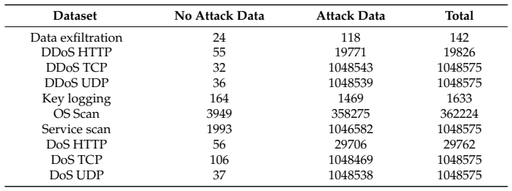
Table 5 . Dataset label distribution.
원문 · CC BY 4.0 · Andrew Churcher, Rehmat Ullah, Jawad Ahmad, Sadaqat ur Rehman, Fawad Masood, Mandar Gogate, Fehaid Alqahtani, Boubakr Nour, William J. Buchanan · An Experimental Analysis of Attack Classification Using Machine Learning in IoT Networks · 원문 그림 인용 · 원본 PDF 14쪽에서 그림 영역을 추출했습니다.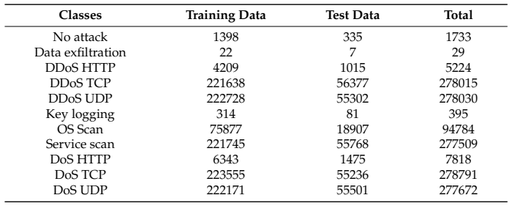
Table 6 . Multi-class data representation.
원문 · CC BY 4.0 · Andrew Churcher, Rehmat Ullah, Jawad Ahmad, Sadaqat ur Rehman, Fawad Masood, Mandar Gogate, Fehaid Alqahtani, Boubakr Nour, William J. Buchanan · An Experimental Analysis of Attack Classification Using Machine Learning in IoT Networks · 원문 그림 인용 · 원본 PDF 14쪽에서 그림 영역을 추출했습니다.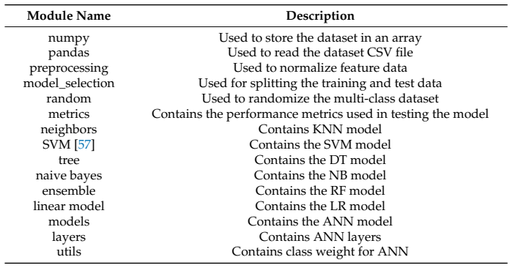
Table 7 . Modules used and description.
원문 · CC BY 4.0 · Andrew Churcher, Rehmat Ullah, Jawad Ahmad, Sadaqat ur Rehman, Fawad Masood, Mandar Gogate, Fehaid Alqahtani, Boubakr Nour, William J. Buchanan · An Experimental Analysis of Attack Classification Using Machine Learning in IoT Networks · 원문 그림 인용 · 원본 PDF 15쪽에서 그림 영역을 추출했습니다.이진 분류 결과와 RF의 우위
이진 분류에서는 데이터셋별로 모델 순위가 달라지지만, 초록은 RF가 여러 공격 유형에서 정밀도, 재현율, F1 점수, 로그 손실 측면에서 우수하다고 보고합니다. 예를 들어 데이터 유출 데이터에서 RF는 표의 모든 지표에서 최고 점수를 기록하지만, DT도 완벽한 점수를 보이면서 로그 손실이 9.99로 높습니다. 이처럼 정확도가 같아도 로그 손실을 함께 봐야 확신도가 다른 예측을 구별할 수 있습니다. 가중 클래스를 적용한 설정에서도 RF는 완벽한 점수를 유지하면서 로그 손실이 조금 증가합니다. 이 결과는 Bot-IoT의 기본 하이퍼파라미터 설정과 해당 데이터 분할에서 얻은 것입니다.
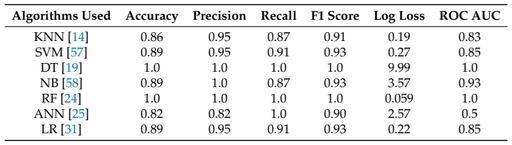
Table 8 . Data exfiltration results.
원문 · CC BY 4.0 · Andrew Churcher, Rehmat Ullah, Jawad Ahmad, Sadaqat ur Rehman, Fawad Masood, Mandar Gogate, Fehaid Alqahtani, Boubakr Nour, William J. Buchanan · An Experimental Analysis of Attack Classification Using Machine Learning in IoT Networks · 원문 그림 인용 · 원본 PDF 16쪽에서 그림 영역을 추출했습니다.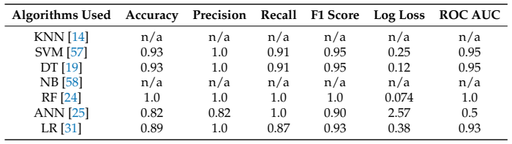
Table 11 . Data exfiltration weighted classes results.
원문 · CC BY 4.0 · Andrew Churcher, Rehmat Ullah, Jawad Ahmad, Sadaqat ur Rehman, Fawad Masood, Mandar Gogate, Fehaid Alqahtani, Boubakr Nour, William J. Buchanan · An Experimental Analysis of Attack Classification Using Machine Learning in IoT Networks · 원문 그림 인용 · 원본 PDF 17쪽에서 그림 영역을 추출했습니다.다중 클래스 분류와 KNN의 결과
다중 클래스 분류에서 초록은 KNN이 정확도 99%로 다른 알고리즘보다 우수하며 RF보다 4% 높다고 보고합니다. 본문 표 41에서도 KNN은 정확도, 정밀도, 재현율, F1 점수 0.99와 가장 낮은 로그 손실 0.042를 기록합니다. 반면 SVM과 LR은 여러 지표에서 가장 낮은 값을 보입니다. 혼동 행렬을 보면 KNN은 데이터 양이 많은 클래스뿐 아니라 적은 클래스에서도 잘못 분류되는 비율이 낮게 나타납니다. 다만 이 결과는 무작위로 섞어 만든 하나의 다중 클래스 데이터셋과 기본 하이퍼파라미터에서 얻은 것입니다.
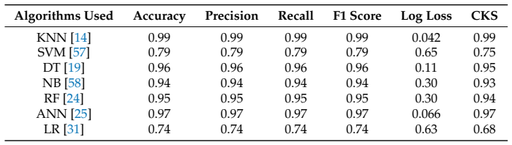
Table 41 . Multi-class results.
원문 · CC BY 4.0 · Andrew Churcher, Rehmat Ullah, Jawad Ahmad, Sadaqat ur Rehman, Fawad Masood, Mandar Gogate, Fehaid Alqahtani, Boubakr Nour, William J. Buchanan · An Experimental Analysis of Attack Classification Using Machine Learning in IoT Networks · 원문 그림 인용 · 원본 PDF 27쪽에서 그림 영역을 추출했습니다.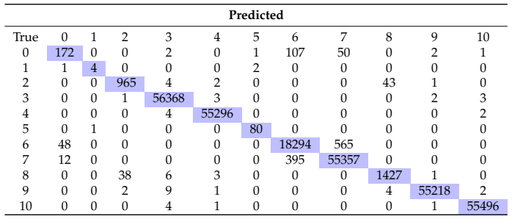
Table 43 . KNN confusion matrix.
원문 · CC BY 4.0 · Andrew Churcher, Rehmat Ullah, Jawad Ahmad, Sadaqat ur Rehman, Fawad Masood, Mandar Gogate, Fehaid Alqahtani, Boubakr Nour, William J. Buchanan · An Experimental Analysis of Attack Classification Using Machine Learning in IoT Networks · 원문 그림 인용 · 원본 PDF 27쪽에서 그림 영역을 추출했습니다.균형 가중 클래스의 효과
균형 가중 클래스 설정은 클래스 불균형을 보정하려는 목적으로 도입되었습니다. 다중 클래스 결과에서 이 설정을 적용하면 KNN과 NB는 실행할 수 없고 SVM은 실행 시간 문제로 평가하지 않으며, 나머지 모델 대부분은 지표가 낮아집니다. 예외는 ANN으로, 다중 클래스 가중 설정에서 로그 손실이 조금 낮아져 이 설정에서 가장 좋은 모델로 제시됩니다. 따라서 가중 클래스는 클래스별 재현율을 높이는 데 도움이 될 수 있지만, 이 실험에서는 전반적인 성능을 낮추는 결과가 더 많았습니다.
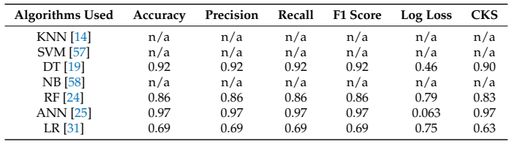
Table 42 . Multi-class weighted classes results.
원문 · CC BY 4.0 · Andrew Churcher, Rehmat Ullah, Jawad Ahmad, Sadaqat ur Rehman, Fawad Masood, Mandar Gogate, Fehaid Alqahtani, Boubakr Nour, William J. Buchanan · An Experimental Analysis of Attack Classification Using Machine Learning in IoT Networks · 원문 그림 인용 · 원본 PDF 27쪽에서 그림 영역을 추출했습니다.결과 해석의 범위와 한계
이 논문의 결과는 Bot-IoT 데이터셋, 기본 하이퍼파라미터, 하나의 80대 20 분할과 고정된 시드에서 얻은 것입니다. 데이터 유출, 키로깅 같은 일부 클래스는 테스트 샘플이 매우 적어 점수가 크게 흔들릴 수 있습니다. 저자들은 데이터 양을 늘리면 결과가 달라진다는 점을 확인했지만, 이 해석은 해당 데이터 일부에 한정된 관찰로 읽어야 합니다. 저자들은 향후 실제 IDS 프로토타입에서 다양한 혼합 공격 데이터로 다중 클래스 기능을 검증하겠다고 밝힙니다.
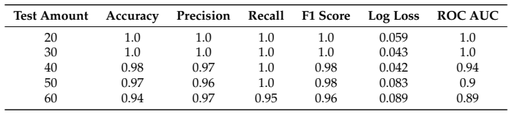
Table 10 . Data exfiltration RF test data amounts.
원문 · CC BY 4.0 · Andrew Churcher, Rehmat Ullah, Jawad Ahmad, Sadaqat ur Rehman, Fawad Masood, Mandar Gogate, Fehaid Alqahtani, Boubakr Nour, William J. Buchanan · An Experimental Analysis of Attack Classification Using Machine Learning in IoT Networks · 원문 그림 인용 · 원본 PDF 17쪽에서 그림 영역을 추출했습니다.
Table 23 . Key logging DT test data amounts.
원문 · CC BY 4.0 · Andrew Churcher, Rehmat Ullah, Jawad Ahmad, Sadaqat ur Rehman, Fawad Masood, Mandar Gogate, Fehaid Alqahtani, Boubakr Nour, William J. Buchanan · An Experimental Analysis of Attack Classification Using Machine Learning in IoT Networks · 원문 그림 인용 · 원본 PDF 21쪽에서 그림 영역을 추출했습니다.논문 정보
- 저자
- Andrew Churcher, Rehmat Ullah, Jawad Ahmad, Sadaqat ur Rehman, Fawad Masood, Mandar Gogate, Fehaid Alqahtani, Boubakr Nour, William J. Buchanan
- 학회·저널
- arXiv · 프리프린트
- 최초 공개일
- 2021년 1월 10일
- 등록일
- 2026년 11월 6일
- 수정일
- 2021년 1월 10일
- 버전
- v1
- arXiv
- 2101.12270
- DOI
- 10.3390/s21020446
- 분류
- cs.CR · cs.LG
- 원문 이용 조건
- CC BY 4.0
- 제공 범위
- 논문 정보, 해설, 허용된 원문 그림
AI 해설은 논문 원문과 별개의 설명이며 오류가 있을 수 있습니다. 원문과 그림은 각 출처의 이용 조건과 따로 표시된 권리를 따릅니다.
초록
In recent years, there has been a massive increase in the amount of Internet of Things (IoT) devices as well as the data generated by such devices. The participating devices in IoT networks can be problematic due to their resource-constrained nature, and integrating security on these devices is often overlooked. This has resulted in attackers having an increased incentive to target IoT devices. As the number of attacks possible on a network increases, it becomes more difficult for traditional intrusion detection systems (IDS) to cope with these attacks efficiently. In this paper, we highlight several machine learning (ML) methods such as k-nearest neighbour (KNN), support vector machine (SVM), decision tree (DT), naive Bayes (NB), random forest (RF), artificial neural network (ANN), and logistic regression (LR) that can be used in IDS. In this work, ML algorithms are compared for both binary and multi-class classification on Bot-IoT dataset. Based on several parameters such as accuracy, precision, recall, F1 score, and log loss, we experimentally compared the aforementioned ML algorithms. In the case of HTTP distributed denial-of-service (DDoS) attack, the accuracy of RF is 99%. Furthermore, other simulation results-based precision, recall, F1 score, and log loss metric reveal that RF outperforms on all types of attacks in binary classification. However, in multi-class classification, KNN outperforms other ML algorithms with an accuracy of 99%, which is 4% higher than RF.
원문 인용
Andrew Churcher, Rehmat Ullah, Jawad Ahmad, Sadaqat ur Rehman, Fawad Masood, Mandar Gogate, Fehaid Alqahtani, Boubakr Nour, William J. Buchanan (2021). An Experimental Analysis of Attack Classification Using Machine Learning in IoT Networks. arXiv:2101.12270v1. https://doi.org/10.3390/s21020446
BibTeX
@article{churcher2021experimental,
  title = {{An Experimental Analysis of Attack Classification Using Machine Learning in IoT Networks}},
  author = {Andrew Churcher and Rehmat Ullah and Jawad Ahmad and Sadaqat ur Rehman and Fawad Masood and Mandar Gogate and Fehaid Alqahtani and Boubakr Nour and William J. Buchanan},
  year = {2021},
  eprint = {2101.12270},
  archivePrefix = {arXiv},
  doi = {10.3390/s21020446},
  url = {https://arxiv.org/abs/2101.12270v1}
}